Cats in art
Cats in art: the artists and artworks behind a royal cat portrait
Cats in art from Egyptian bronzes and medieval bestiaries to Kuniyoshi, Steinlen, Louis Wain and Foujita: who made them, what they mean and where to see them.
By Purrealism
Cats have been made into art for thousands of years, and each age made them for its own reasons. Egyptians cast bronze cats for a goddess. Medieval monks described cats in books about animals and drew them chasing mice in the margins of prayer books. Japanese printmakers dressed cats as actors, and painters in Paris drew their own cats at home. This guide follows that long history in order, explains what a cat in an old artwork can mean, and shows how the same ideas help you choose a royal portrait of your own cat. Each of the ten pages linked below goes deeper into one artist or tradition, using the records of the museums and libraries that hold the works. Ten individual paintings, from Leonardo to Manet's Olympia, are picked out with the museum that holds each one in our article on famous paintings of cats; this hub covers the artists and traditions behind them.
Why cats in art matter for a portrait of your cat
A royal portrait of a cat joins a long line of pictures in which a person decided a cat was worth recording. Some of those pictures show one real animal with its own coat and its own name. Others use a cat to say something about a god, a household or a human feeling. Knowing the difference helps you decide what you want a portrait of your cat to say.
It also helps with practical choices. Old artists had to decide how to pose a cat, where to put it against a background, and how to show its fur. Henriette Ronner-Knip, for example, posed her cats in a glass cage with cushions to hold them still, according to the Rijksmuseum. A modern portrait starts from a photo and raises the same questions: which pose, which colours and which setting suit this cat.
Cats in art through history
Ancient Egypt: cats for a goddess
The oldest cat artworks in this guide come from Egypt. From October 2017 to January 2018 the Smithsonian's National Museum of Asian Art showed Divine Felines, 80 objects from the Middle Kingdom (2008 to 1630 BC) to the Byzantine period. The museum listed statues, coffins, amulets, textiles and a mummified cat among them. It explained that Egyptians kept cats to keep away mice and snakes, and that cats also came to stand for powerful kings and gods.
Harvard Art Museums calls the seated cat the most popular animal made in bronze during the first millennium BC. Its own bronze cat was cast by the lost-wax method, in which a wax model is covered in clay and the wax is melted out and replaced with metal. Many of these objects had a religious job. The Art Institute of Chicago says wooden cat coffins held mummified cats and were given in temples, and that the cat shape suggests they were presented to the goddess Bastet. Egyptian artists also drew cats for fun. The Royal Museums of Art and History in Brussels holds a limestone flake from the New Kingdom, 1550 to 1069 BC, on which a cat serves a lady mouse. Our page on Egyptian cat art covers the bronzes, amulets, coffins and these joke drawings.
Medieval manuscripts: cats and mice
In the Middle Ages cats appear in handwritten books. The University of Aberdeen describes a bestiary as a collection of short descriptions of animals, real and imaginary, each with a moral lesson. Its own Aberdeen Bestiary, from the 12th century, calls the cat musio because it is the enemy of mice. Cats also appear in the margins of prayer books. A book of hours made in England around 1300, now at the Walters Art Museum, shows Tibert the Cat carrying the front of the bier, the frame that holds a coffin, at the funeral of Renard the Fox. Both are characters from animal stories. Real cats left marks too. The British Library shows a 12th-century copy of the letters of Pope Gregory the Great with four muddy paw prints on one page. Our page on cats in medieval manuscripts looks at bestiaries, margins and the cats that walked on the books.
Europe before 1800: the cat as a sign
The National Gallery in London says cats were kept to control mice and rats and often appear in paintings, but that before the 18th century European artists rarely painted them as lap pets. In many older paintings the cat stands for an idea. The same gallery calls the cat licking an oyster shell in Jan Steen's painting of a man offering an oyster to a woman "a traditional symbol of lust". Our page on cat symbolism in art compares those meanings across China, Korea, Japan and the Netherlands. The cats that Renaissance painters placed beside saints and at the Last Supper are covered in cats in Renaissance paintings.
Japan in the 1800s: Kuniyoshi and the woodblock print
Japanese printmakers made cats into popular characters. The Smithsonian's National Museum of Asian Art says Utagawa Kuniyoshi was fond of cats, and that they often appear in his prints, sometimes dressed as courtesans or actors. The Ota Memorial Museum of Art in Tokyo says he concentrated on these pictures of cats acting like people in 1841 and 1842. In 1841 he made a round fan picture that showed cats with the faces of kabuki actors. When it became popular, a kabuki play used these fan pictures. Our page on Japanese cat prints covers Kuniyoshi's series and the other printmakers who drew cats.
Paris in the 1800s: Manet, Champfleury and Steinlen
In 1869 the French writer Champfleury published a book about cats, Les Chats. The British Library says it was advertised with a poster using a lithograph by Édouard Manet of two cats on a rooftop, The Cats' Rendezvous, which the Art Institute of Chicago dates to 1868. In the 1885 English translation, Champfleury wrote that "Next to the Egyptians the Japanese are, par excellence, painters of the cat." Manet also painted his own cat. The National Gallery in London says his Woman with a Cat shows his wife, Suzanne Leenhoff, with their cat Zizi asleep on her lap. Our page on Manet's cats follows his cat prints and drawings beyond Olympia.
The journal Le Chat Noir, "The Black Cat", was founded in 1882 to promote a cabaret of the same name in Montmartre, according to the Bibliothèque nationale de France. The library says Théophile-Alexandre Steinlen was one of the first artists to draw wordless picture stories for it, and one of the most prolific. Many of his stories star cats. The Museum of Fine Arts, Boston, holds his book of them, Des chats: images sans paroles, which it dates to 1898 with a question mark. Our page on Steinlen's cats covers the journal, the book and his house full of cats.
The painters who made cats their subject
Two artists of the later 1800s built their careers on cats. Henriette Ronner-Knip was born in Amsterdam in 1821 and died near Brussels in 1909. The Digitaal Vrouwenlexicon, a Dutch dictionary of women's lives, says she first became known for paintings of dogs and began painting the cats that made her famous from 1870. The Rijksmuseum holds her Cat at Play, a young cat among dominoes. Our page on Henriette Ronner-Knip covers her training, her methods and her buyers.
In London, Louis Wain began drawing his cat Peter to cheer his wife, Emily, during her illness, according to The National Archives. His first cat piece for the Illustrated London News appeared in 1884. Frances Simpson's Book of the Cat, published in 1903, records that he followed Harrison Weir as president of the National Cat Club. Our page on Louis Wain follows his magazines, his annuals, his hospital years and the argument over his late patterned cats.
The 1900s: Gwen John and Foujita
Two painters of the early 1900s drew their own cats again and again. Museum Wales says the Welsh painter Gwen John got her first cat, a tortoiseshell, in Paris in 1904 and named it Edgar Quinet after the street where she lived. The cat disappeared in 1908. In 1976 the National Museum of Wales bought nearly 1,000 works from her studio, and the museum says her drawings include sketches of cats. Our page on Gwen John's cats covers these drawings and her paintings of girls holding cats.
The Japanese painter Léonard Tsuguharu Foujita (1886 to 1968) lived and worked in Paris for many years. The Musées de Reims say he adopted his cat Mikè after it followed him home one evening near the Parc Montsouris, and that he painted himself beside it several times. The Centre Pompidou holds one of these self-portraits, painted in 1928. The Tokyo Fuji Art Museum holds a copy of A Book of Cats, published in 1930 with texts by Michael Joseph and 20 of Foujita's cat drawings. Our page on Foujita's cats covers his paintings, prints and books.
How to read a cat in an old artwork
A few ideas make most cat artworks easier to understand.
Subject or sign. Ask whether the cat is the subject or a sign. Ronner-Knip and Wain made cats the whole subject. In a Dutch genre painting, a painting of everyday life, the cat may stand for a human feeling.
The same cat, different meanings. The meaning depends on where the work was made. The Cleveland Museum of Art says the Chinese words for cat and butterfly sound like mao die, a word for a person in their eighties. Its painting Cat and Butterfly by Min Zhen therefore wishes a friend a long life. In Japan, the SFO Museum says a beckoning cat figure with its left paw raised brings luck to a business, and with its right paw raised brings good fortune to the home.
Painting or print. Many famous cat pictures are prints, made in many copies. Kuniyoshi's cats are woodblock prints, cut into wood and printed in colour. Manet's Cats' Rendezvous is a lithograph, a print made from a drawing on stone.
The real cat behind the picture. Several artists drew their own cats: Manet's Zizi, Gwen John's Edgar Quinet, Foujita's Mikè and Louis Wain's Peter. Those works are the closest the past comes to a modern pet portrait.
Common mistakes when looking at cats in art
Reading every cat as a symbol. The National Gallery says cats were kept to control vermin and often appear in paintings. Some painted cats are there because a household had a cat.
Taking an Egyptian bronze cat for a pet portrait. Many of these bronzes and coffins were religious gifts. The Art Institute of Chicago says cat coffins held mummified cats given in temples, most likely to Bastet. The lives of real Egyptian cats are a separate subject, covered in cats in ancient Egypt.
Treating a story as a fact. Some famous details about cat artists are told as stories and cannot be checked. Where a museum reports a rumour, the pages in this guide say so.
Reading Louis Wain's patterned cats as a record of illness. In 1939 the psychiatrist Walter Maclay arranged eight of Wain's patterned cats in an order meant to show mental decline. The Wellcome Collection says there was no evidence for that order.
Cat artists and traditions compared
| Tradition or artist | When | Main material | How the cat appears | Example and where it is | Guide page |
|---|---|---|---|---|---|
| Ancient Egypt | Middle Kingdom to Byzantine times | Bronze, wood, limestone | Sacred animal of Bastet; servant to mice in joke drawings | Seated bronze cat, Harvard Art Museums | Egyptian cat art |
| Medieval manuscripts | 1100s to 1300s | Ink and paint on parchment | Mouse-catcher in bestiaries; characters in margins | Aberdeen Bestiary, University of Aberdeen | Medieval manuscript cats |
| Utagawa Kuniyoshi | 1840s | Woodblock print | Cats as actors and courtesans | Prints in the Ota Memorial Museum of Art and the Smithsonian | Japanese cat prints |
| Édouard Manet | 1868 to 1883 | Lithograph and oil | Rooftop cats; his own cat Zizi | Woman with a Cat, owned by Tate and shown at the National Gallery, London | Manet's cats |
| Théophile-Alexandre Steinlen | 1880s and 1890s | Drawings printed in a journal and a book | Heroes of wordless picture stories | Des chats, Museum of Fine Arts, Boston | Steinlen's cats |
| Henriette Ronner-Knip | 1870 to 1909 | Oil and watercolour | Kittens at play indoors | Cat at Play, Rijksmuseum | Henriette Ronner-Knip |
| Louis Wain | From 1884 | Drawings for magazines and books | His own cat Peter, then cats of every kind | Illustrated London News, from 1884 | Louis Wain |
| Gwen John | From 1904 | Pencil and watercolour on paper | Her own cats, drawn from life | Cat studies, Museum Wales | Gwen John's cats |
| Léonard Tsuguharu Foujita | 1920s and 1930 | Oil and gouache, drawings, a book | His cat Mikè beside him | Self-portrait of 1928, Centre Pompidou | Foujita's cats |
| Symbols across cultures | Many periods | Paintings and figures | Long life, luck, desire | Cat and Butterfly, Cleveland Museum of Art | Cat symbolism |
Ten famous single works with cats, from Leonardo to Gwen John, are listed with their museums in famous paintings of cats. Cats at the royal courts of Japan, Korea and Siam, as animals in real palaces, are covered in royal cats of Asia. For the same history told through dogs, see dogs in art.
Coat colour: what old artists had to solve
A painter of cats has to show fur against a background. A black cat against a dark wall is hard to see, and so is a white cat on a pale cushion. The Rijksmuseum's watercolour The Musicians by Ronner-Knip shows a mother cat and her kittens in a domestic interior.
The coat colour preview further down this page helps with the same problem for your own cat. You choose a photo, and the tool reads it in your browser, so the photo never leaves your device. It finds the main colours in the middle 60 percent of the photo and lists each colour with its share. It then shows the main colour against four backdrops, near black, deep red, forest green and royal blue, with a contrast ratio for each. The ratio uses the formula in the Web Content Accessibility Guidelines, published by the W3C, where contrast runs from 1:1 to 21:1. A higher number means the coat stands out more from that backdrop.
From cat art to a royal portrait of your cat
The artists in this guide show a cat in three main ways: as a symbol, as a character in a story, or as one real animal with its own face. A royal portrait belongs to the third kind. It puts your cat at the centre and dresses it as a ruler.
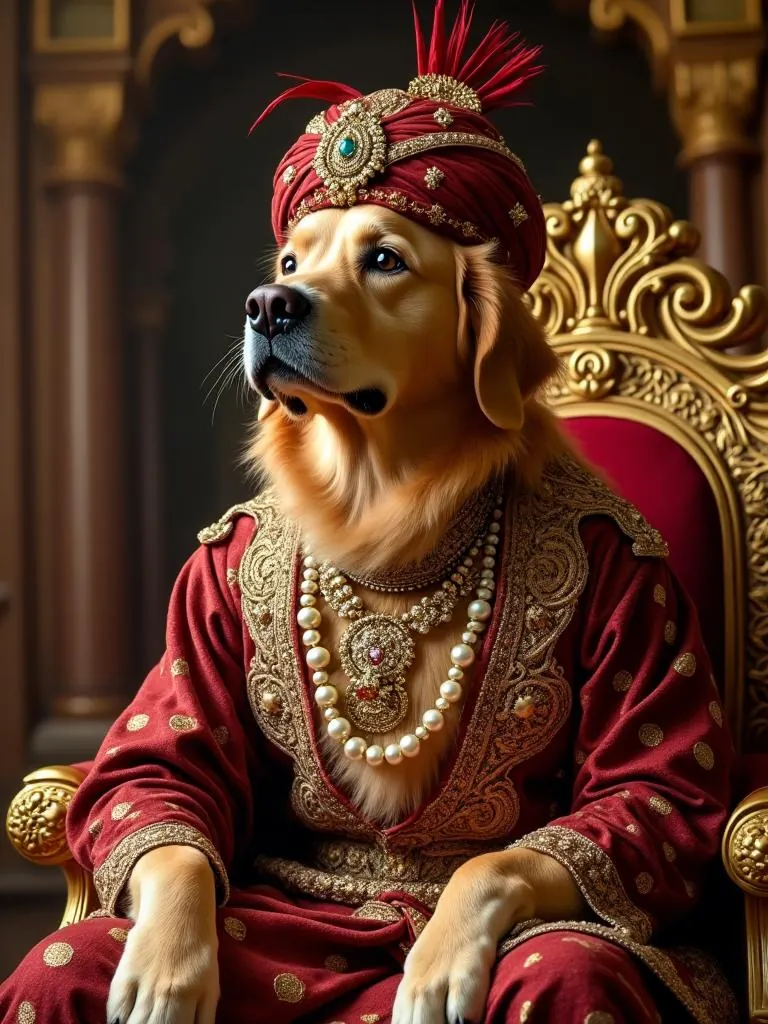
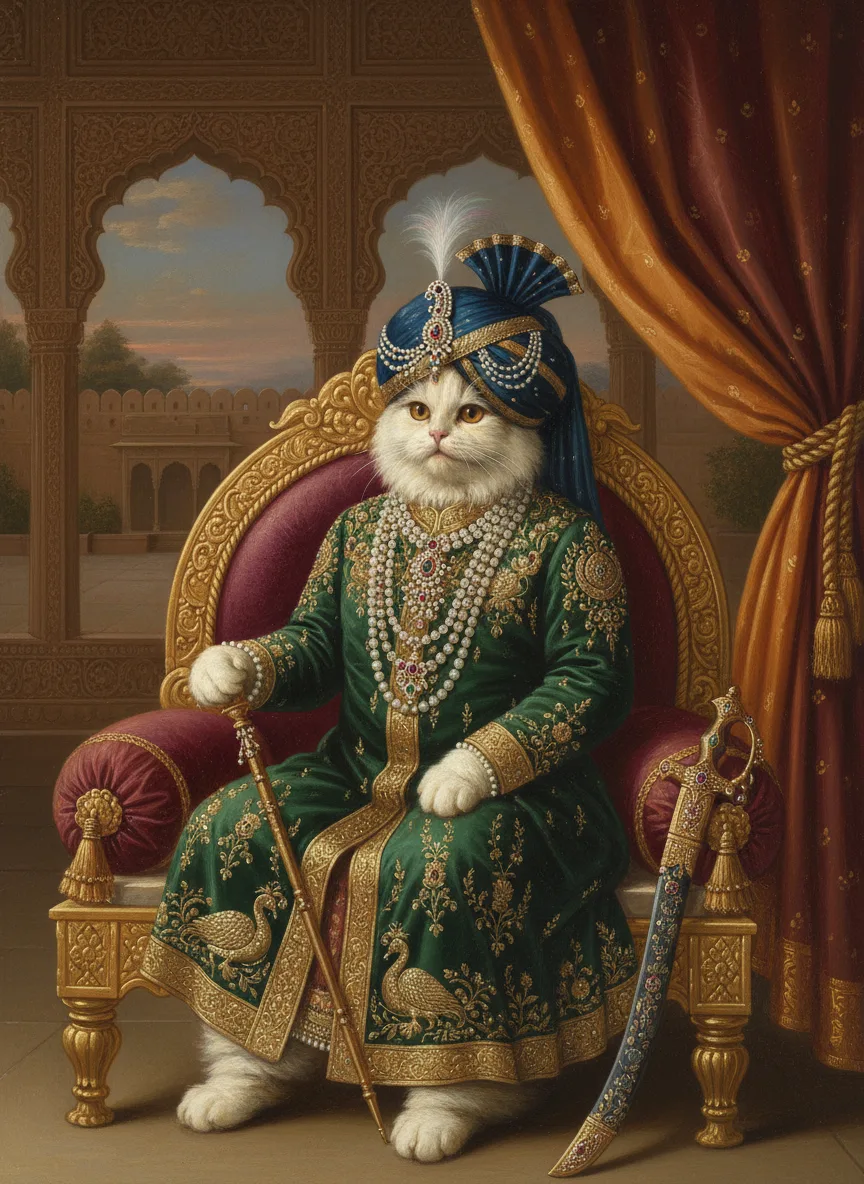
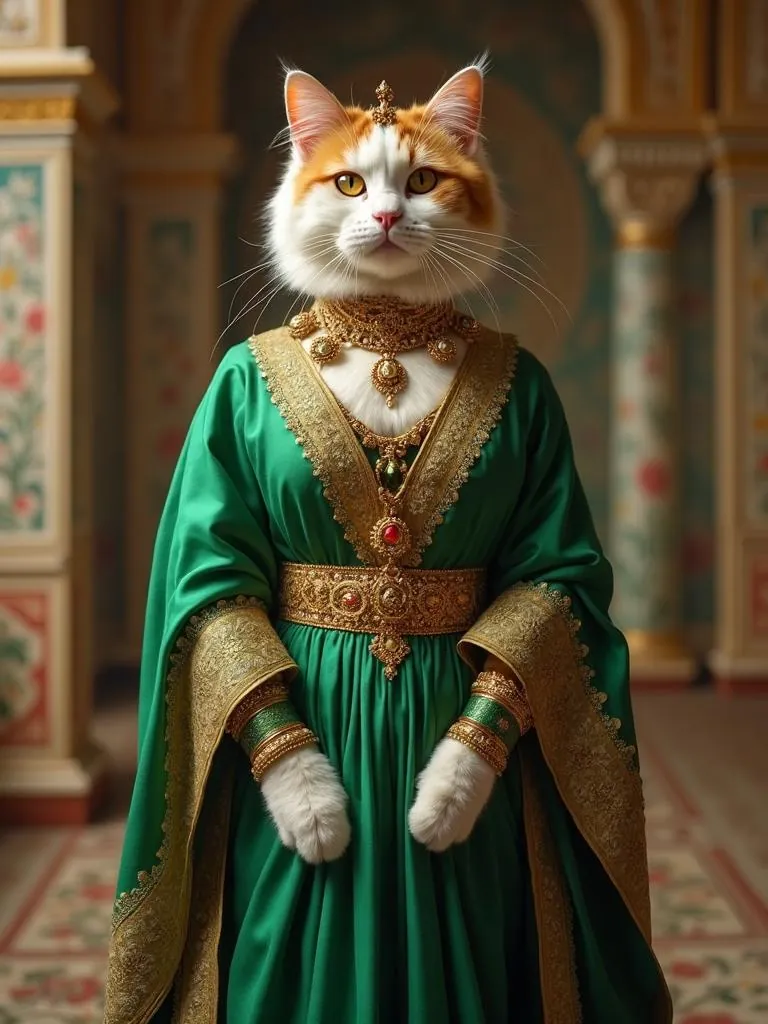
Purrealism offers 15 royal portrait styles. Nine come from Indian courts: Indian Royalty, Maharaja, Maharani, Patiala Royalty, Chola Warrior, Mysore Royal, Mughal Emperor, Rajput Warrior and Maratha King. Six come from European history: Renaissance Royal, Victorian Noble, Military General, Medieval Knight, Baroque Aristocrat and Regency Era. The cover of this page shows a white and ginger cat as a Maharani in a green and gold gown, and the gallery shows it with other finished portraits. The guide on how to choose a royal portrait style compares the styles.
When you are ready, the portrait studio takes one clear photo of your cat, up to 5 MB. You can choose a digital download, or an art print in 8 × 10, 12 × 16, 18 × 24 or 24 × 36 inches on matte or glossy paper. Run the photo through the coat colour preview first if you want to see which backdrop colour gives your cat's coat the most contrast.
Try it
Coat colour preview
Choose a photo of your pet. The tool reads its main colours in your browser and shows how the main one stands out against four backdrop colours. The photo never leaves your device.
Every page in this guide, by topic
Start here
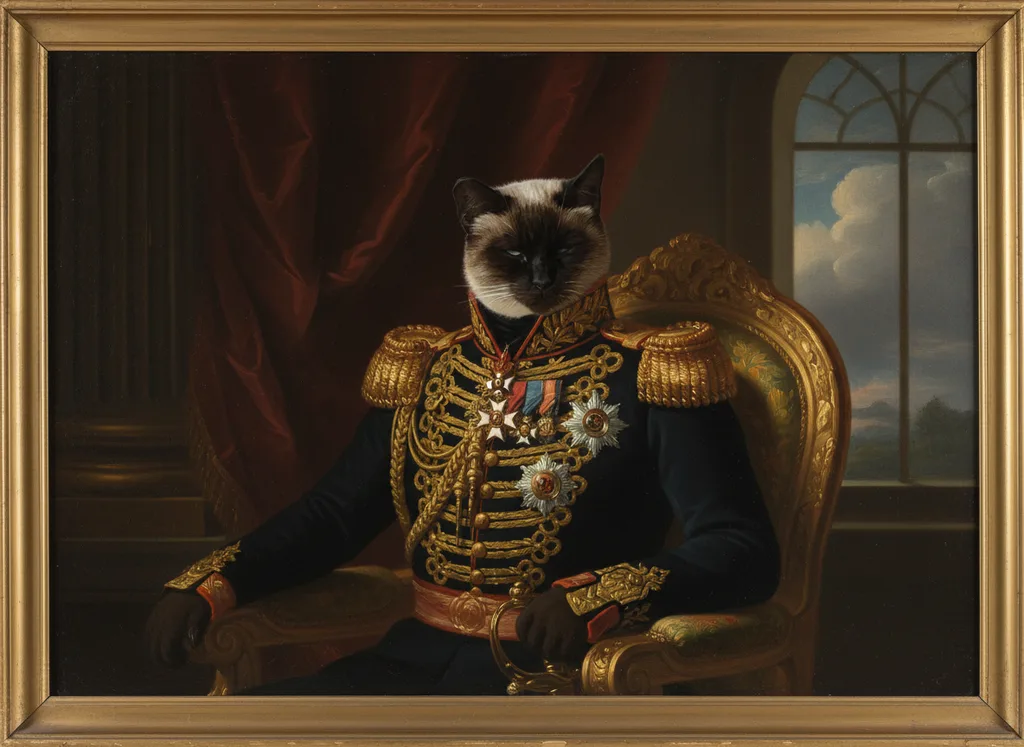
Cat symbolism in art: long life in China, luck in Japan, desire in Dutch paintings
What a cat means in a painting depends on where it was made: a wish for long life in China and Korea, luck in Japan, lust or trouble in Dutch art.
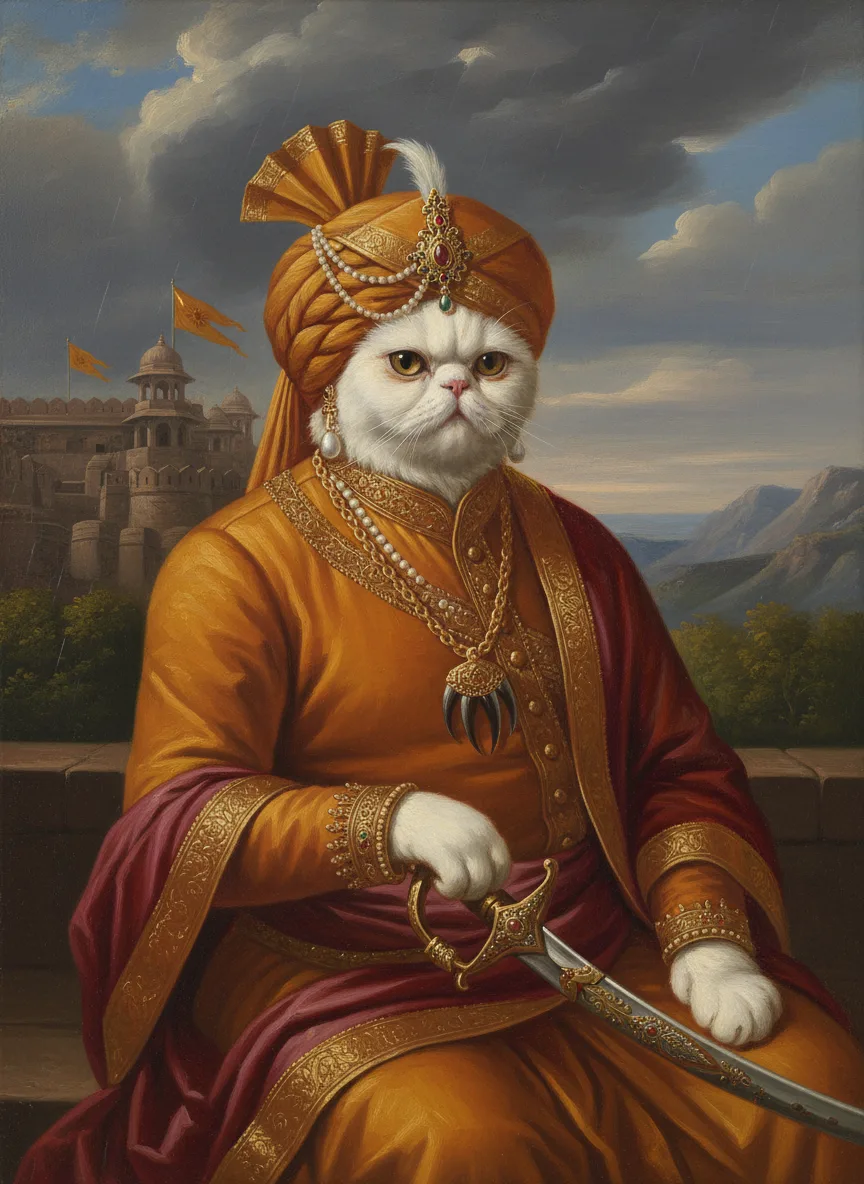
Egyptian cat art: bronze cats, Bastet figures, amulets and cat coffins
How Egyptian bronze cats were cast, what Bastet figures and cat amulets were for, and where to see cat coffins and cats serving mice in museums today.
Manuscripts and woodblock prints
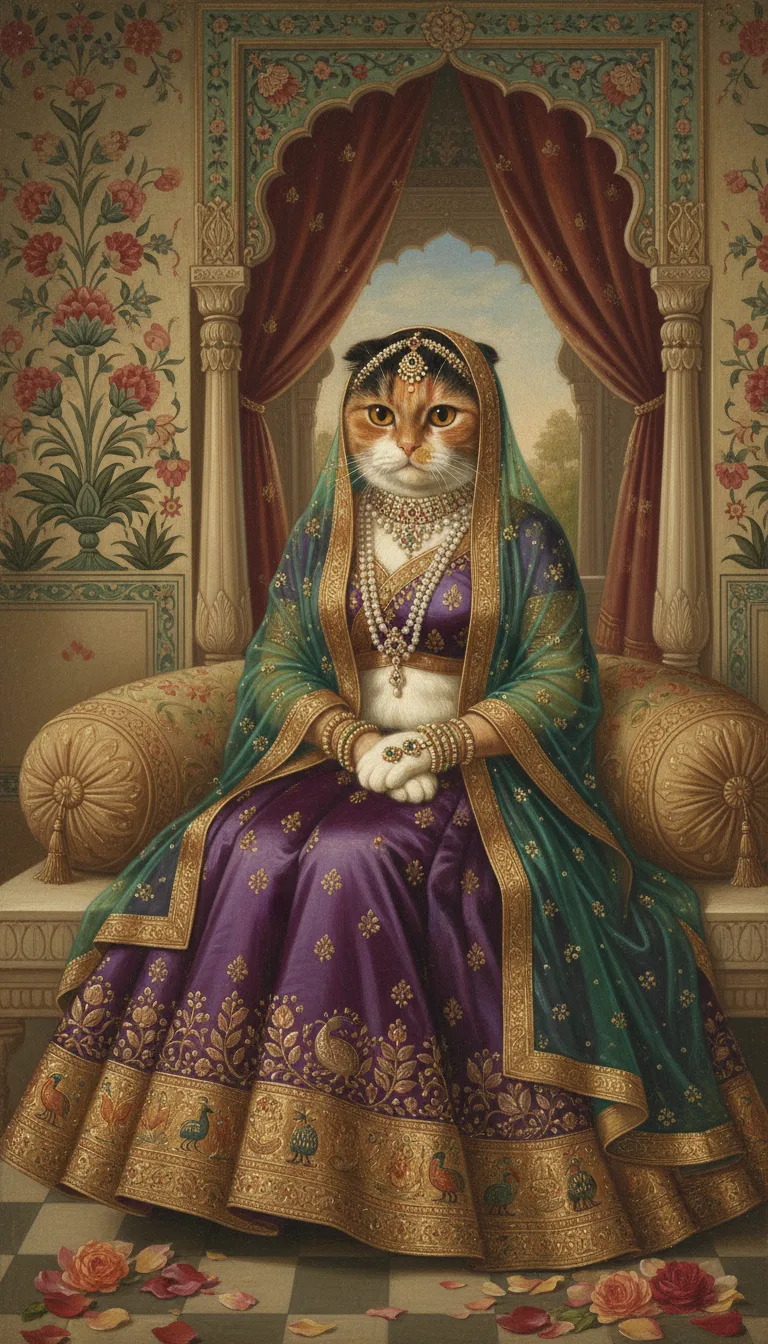
Cats in medieval manuscripts: bestiaries, margins, books of hours and paw prints
What medieval bestiaries said about cats, why cats and mice fill the margins of prayer books, and the paw prints and curses that real cats left on the page.
Japanese cat prints: Kuniyoshi's cats and the woodblock artists who drew them
How Utagawa Kuniyoshi turned cats into actors, words and ghosts in his woodblock prints, and which other Japanese printmakers drew cats, with museum records.
Paris in the 1800s
Manet's cats: the Champfleury prints, his cat Zizi and Woman with a Cat
Édouard Manet's cats beyond Olympia: his 1868 poster for Champfleury's book Les Chats, the etching Cat and Flowers, sketches of Zizi and Woman with a Cat.
Steinlen's cats: the Chat Noir artist and his wordless cat stories
How Théophile-Alexandre Steinlen drew cats for the Chat Noir journal, gathered them in the book Des chats, and kept a Montmartre house called the Cat's Cottage.
Painters who specialised in cats
Henriette Ronner-Knip: the Dutch painter of cats and kittens
Henriette Ronner-Knip (1821 to 1909) trained in her blind father's studio, painted dogs in Brussels, then kittens for royal buyers. Her life, methods and works.
Louis Wain: his life, his cat Peter and his patterned cats
How Louis Wain began drawing his cat Peter, drew cats for magazines and annuals, led the National Cat Club, and why experts still argue about his late cats.
The 1900s
Gwen John's cats: Edgar Quinet, the cat drawings and the girls holding cats
Gwen John named her first cat Edgar Quinet after her Paris street and drew her cats again and again. Where her cat drawings and paintings are today.
Foujita's cats: the Paris painter who drew himself with his cat
Léonard Tsuguharu Foujita painted himself with his cat Mikè, drew the 20 cats of A Book of Cats in 1930 and painted cats on a milky white ground.
Questions and answers
Who is the famous cat artist?
Several artists are famous for cats. The National Archives says Louis Wain published his first cat piece in the Illustrated London News in 1884. A Dutch biographical dictionary says Henriette Ronner-Knip painted cats from 1870. The Smithsonian says the Japanese printmaker Utagawa Kuniyoshi was fond of cats, and the Bibliothèque nationale de France says Théophile-Alexandre Steinlen drew many wordless picture stories for the Paris journal Le Chat Noir.
How old are the cat artworks in museums?
Some cat artworks in museums are more than 3,000 years old. The Smithsonian's exhibition Divine Felines showed 80 Egyptian objects from the Middle Kingdom (2008 to 1630 BC) to the Byzantine period, including statues, coffins and amulets. The Royal Museums of Art and History in Brussels holds a New Kingdom limestone flake, dated 1550 to 1069 BC, with a cat and a mouse drawn on it.
Why did European artists rarely paint cats as pets before the 1700s?
European artists rarely painted cats as pets before the 1700s because cats were kept above all to catch mice and rats. The National Gallery in London says cats were essential for the control of vermin and often appear in paintings, but that before the 18th century they were rarely treated as lap pets in European art. In older works a cat often stands for an idea.
Which artists drew their own cats?
Many artists drew their own cats. The National Gallery in London says Manet's Woman with a Cat shows his wife Suzanne with their cat Zizi. Museum Wales says Gwen John named her tortoiseshell cat Edgar Quinet. The Musées de Reims say Foujita adopted his cat Mikè after it followed him home. The National Archives says Louis Wain drew his cat Peter to cheer his sick wife, Emily.
Are old pictures of cats paintings or prints?
Many old pictures of cats are prints, made in many copies from a carved or drawn surface. Kuniyoshi's cats are woodblock prints. The Art Institute of Chicago lists Manet's The Cats' Rendezvous of 1868 as a lithograph, a print made from a drawing on stone. Paintings in oil or watercolour, such as Henriette Ronner-Knip's Cat at Play at the Rijksmuseum, are single works.
What did Champfleury say about Japanese pictures of cats?
The French writer Champfleury praised Japanese artists as painters of cats. In the 1885 English translation of his book, The Cat Past and Present, he wrote that next to the Egyptians, the Japanese are, par excellence, painters of the cat. The British Library says the book first appeared in French in 1869 and was advertised with a poster using a lithograph of cats by Manet.
Were Egyptian bronze cats portraits of pets?
Most Egyptian bronze cats were religious objects made for a goddess. Harvard Art Museums links the popularity of the seated bronze cat to the spread of sacred animal cults from the Late Period to the Ptolemaic period. The Art Institute of Chicago says cat-shaped coffins held mummified cats and were given in temples, and that their form suggests they were presented to the goddess Bastet.
What do experts say about Louis Wain's patterned cats?
Experts disagree about Louis Wain's patterned cats. The psychiatrist Walter Maclay collected eight of them in 1939 and arranged them in an order meant to show mental decline. The Wellcome Collection says there was no evidence to support that order. Its 2020 article, by the artist and curator Bryony Benge-Abbott, calls for a more positive and nuanced view of Wain's later life and work.
How does the coat colour preview on Purrealism work?
The coat colour preview reads a photo of your pet inside your browser, and the photo never leaves your device. It finds the main colours in the middle 60 percent of the photo and lists each with its share. It then shows the main colour against four backdrops: near black, deep red, forest green and royal blue, with a contrast ratio for each.
What does the contrast ratio in the coat colour preview mean?
The contrast ratio in the coat colour preview measures the difference in brightness between your cat's main coat colour and a backdrop. It uses the formula in the Web Content Accessibility Guidelines, published by the W3C, where ratios run from 1:1 for two identical colours to 21:1 for black on white. A higher number means the coat stands out more from that backdrop.
Why does a black cat get a low contrast ratio in the coat colour preview?
A black cat gets a low contrast ratio in the coat colour preview because all four backdrops, near black, deep red, forest green and royal blue, are dark colours. The contrast ratio in the Web Content Accessibility Guidelines is close to 1:1 when two colours have almost the same brightness. A white, cream or ginger coat is brighter, so it scores higher against the same dark backdrops.
Sources
- Cat (1962.69), Harvard Art Museums. Accessed September 28, 2026.
- 'Divine Felines' Highlights the Importance of Cats in Ancient Egypt, Smithsonian's National Museum of Asian Art. Accessed September 28, 2026.
- Cat Coffin, The Art Institute of Chicago. Accessed September 28, 2026.
- The mouse and the cat (ostracon), Royal Museums of Art and History, Brussels. Accessed September 28, 2026.
- Folio 23v: De musione; the cat. De muribus; mice, University of Aberdeen. Accessed September 28, 2026.
- What is a Bestiary?, University of Aberdeen. Accessed September 28, 2026.
- Gwen John, Cat studies (NMW A 5451), Amgueddfa Cymru, Museum Wales. Accessed September 28, 2026.
- Cats get off the page, British Library, Medieval manuscripts blog. Accessed September 28, 2026.
- Book of hours, Walters Ms. W.102, The Walters Art Museum. Accessed September 28, 2026.
- Cats (glossary), The National Gallery, London. Accessed September 28, 2026.
- Cats in Ukiyo-e, Ota Memorial Museum of Art. Accessed September 28, 2026.
- Utagawa Kuniyoshi, Kamada Matahachi Kills a Big Cat from the Mountains of Suzaka (S2004.3.167), Smithsonian's National Museum of Asian Art. Accessed September 28, 2026.
- The Cat, Past and Present, from the French of M. Champfleury (1885), Wellcome Library, via the Internet Archive. Accessed September 28, 2026.
- Champfleury and his cats, British Library, European studies blog. Accessed September 28, 2026.
- Édouard Manet, The Cats' Rendezvous, The Art Institute of Chicago. Accessed September 28, 2026.
- Edouard Manet, Woman with a Cat, The National Gallery, London. Accessed September 28, 2026.
- Bandes dessinées de Théophile Alexandre Steinlen, Bibliothèque nationale de France, Gallica. Accessed September 28, 2026.
- Des Chats: Images Sans Paroles (Some Cats: Pictures Without Words), Museum of Fine Arts, Boston. Accessed September 28, 2026.
- Knip, Henriette (1821-1909), Digitaal Vrouwenlexicon van Nederland, Huygens Institute. Accessed September 28, 2026.
- The Musicians, Henriëtte Ronner (RP-T-1892-A-2661), Rijksmuseum. Accessed September 28, 2026.
- Cat at Play, Henriëtte Ronner (SK-A-3089), Rijksmuseum. Accessed September 28, 2026.
- Louis Wain, The National Archives (UK). Accessed September 28, 2026.
- The Book of the Cat, by Frances Simpson (1903), Project Gutenberg. Accessed September 28, 2026.
- Louis Wain's cryptic cats, Wellcome Collection. Accessed September 28, 2026.
- Gwen John, Cat studies, Amgueddfa Cymru, Museum Wales. Accessed September 28, 2026.
- The Gwen John Studio Collection at Amgueddfa Cymru, Amgueddfa Cymru, Museum Wales. Accessed September 28, 2026.
- Foujita, Chats, Musées de Reims. Accessed September 28, 2026.
- Léonard Foujita, Portrait de l'artiste (1928), Centre Pompidou. Accessed September 28, 2026.
- Cat (from A Book of Cats), Tokyo Fuji Art Museum. Accessed September 28, 2026.
- Min Zhen, Cat and Butterfly, Cleveland Museum of Art. Accessed September 28, 2026.
- Maneki Neko: Japan's Beckoning Cat, SFO Museum. Accessed September 28, 2026.
- Jan Steen, An Interior with a Man offering an Oyster to a Woman (NG2559), The National Gallery, London. Accessed September 28, 2026.
- Understanding Success Criterion 1.4.3: Contrast (Minimum), W3C Web Accessibility Initiative. Accessed September 28, 2026.
Short reads on this topic
Articles from Purrspectives that answer one question each.
Dog years to human years: the chart by size, and the DNA formula
A 1-year-old dog is closer to 15 or 30 in human years than to 7. The AKC chart by size, the 2020 DNA formula, and a dog's life stages, explained simply.
Pug history: from Chinese emperors to the House of Orange
Pugs began as companions of Chinese emperors, reached Holland on Dutch trading ships and became the dog of the House of Orange. Their history, art and health.
Persian cat history: where the breed came from, its first cat show, coat and care
Persian cat history from a cat brought to Italy in 1626 to the 1871 Crystal Palace show, plus face types, coat colours, grooming and how to photograph one.