Henriette Ronner-Knip: the Dutch painter of cats and kittens
Henriette Ronner-Knip (1821 to 1909) trained in her blind father's studio, painted dogs in Brussels, then kittens for royal buyers. Her life, methods and works.
By Purrealism. Part of Cats in art: the artists and artworks behind a royal cat portrait.
Henriette Ronner-Knip (1821 to 1909) was a Dutch painter who spent most of her working life in Belgium and sold her pictures of cats and kittens to buyers in several countries. This page covers her life, from her training in her father's studio to her years in Brussels, the dogs she painted first, the way she worked with live cats, and where her paintings are today. The main sources are the Digitaal Vrouwenlexicon van Nederland, a biographical dictionary of Dutch women published by the Huygens Institute of the Royal Netherlands Academy of Arts and Sciences, the Rijksmuseum, and two books from her own lifetime: a chapter by the Dutch writer Emile Wesly from 1898, and Frances Simpson's Book of the Cat from 1903. For other artists who painted cats, see the cats in art guide.
A family of painters
Henriette Knip was born in Amsterdam on 31 May 1821. Her father, Josephus Augustus Knip (1777 to 1847), painted animals and landscapes. Her mother was Cornelia van Leeuwen (1790 to 1848). The Vrouwenlexicon says Henriette was the third generation of artists in the family. Her grandfather Nicolaas Frederik Knip painted wallpaper and still lifes, and he trained her father, an uncle and an aunt as artists. The family moved often: to Paris, Vught, The Hague, Beek and Den Bosch, and in 1840 to Berlicum, in the Dutch province of North Brabant.
She started young. According to the Vrouwenlexicon, she had her own place in her father's studio from the age of four, and on her 11th birthday he gave her an easel.
Training in a blind father's studio
Emile Wesly wrote about her childhood in Het schildersboek, a book of chapters on 19th-century Dutch painters by people who knew them, published in 1898. His account is the family story as it was told in her lifetime.
Wesly says her father went blind at the age of 50 and could no longer paint. He did not want strangers to teach her, because he feared a school would spoil her own way of seeing, so he told her to use nature as her only model. After the gift of the easel, she had to work in his studio from first light until dark. Her only breaks were meals and two hours a day in a completely dark room, which her father hoped would protect her eyes from the illness that had ended his own career.
Her work soon earned money. Wesly says that at 15 she sent a small painting to an exhibition in Düsseldorf and it sold at once. The Vrouwenlexicon adds that from 1838 she sold work at the Dutch exhibitions of Living Masters, held each year in different cities, and that her sales helped to support the family after her father stopped painting.
In 1848, after both parents had died, she moved to Amsterdam. That year she became the first woman admitted as a "working member", the membership for practising artists, of Arti et Amicitiae, the city's society of artists.
Marriage and the move to Brussels
On 14 March 1850 she married Feico Ronner (1819 to 1883) in Amsterdam. The couple settled at once in Elsene, a district of Brussels. Wesly tells how it happened: she had been ill, and a doctor advised a change of air, so they set out for Switzerland. They stopped in Brussels to rest, liked it, and stayed. When Wesly wrote, she had lived there for 47 years and had still never seen Switzerland.
The first years were hard. Wesly says she started work in her studio at five each morning, and sometimes finished a small panel before her family woke up. She sold these for low prices because nobody in Brussels knew her yet. Her husband was often ill and did not work, so she earned the family's income. The Vrouwenlexicon says he handled the business side: letters, and sending paintings to exhibitions. After his death in 1883, their son Edouard took this over.
Dogs before cats
Her first success in Brussels came from dogs. The Vrouwenlexicon says she was influenced by the dog painter Joseph Stevens (1816 to 1892), who painted thin street dogs, and that she became fascinated by the dogs that pulled carts in the city. Wesly says she painted the milkmen's cart dogs for more than 15 years, and that art dealers then refused any other subject from her.
The best known of these is The Death of a Friend, shown in Brussels in 1860. A working man kneels to mourn his dog, which has died in the harness of his cart. Wesly writes that she painted four life-size dog heads, as studies for this picture, in a single morning. For the wider story of dogs in paintings, see our dogs in art guide.
The turn to cats
The Vrouwenlexicon says she began painting the cats that made her famous from 1870. Wesly, writing in 1898, says cats had been her main subject for more than 30 years. She set them in the rich rooms of well-off families, among fine furniture, fabrics and precious objects, and gave the paintings story titles such as The Music Lesson, with kittens playing on instruments, and Journey Around the World, with cats and a globe.
Writers of her time praised the same things. Wesly says each of her kittens had its own face and character, so that each one was a portrait of a particular animal. He also points to the mother cat, who watches her kittens at play, and says no other cat painter showed a mother's care as well. He compares her with the French cat painter Eugène Lambert, and so does Frances Simpson, who in 1903 described kittens pulling at old lace, scattering an artist's materials and dragging jewels from a casket. Simpson also noticed that almost all the fluffy kittens in her pictures have coats patched in several colours.
How she worked with live cats
Live cats move while an artist draws them. The Rijksmuseum explains that to draw the cats she used a special glass cage, and posed the animals inside it with cushions. Its example is The Musicians, a watercolour of around 1876 to 1877 in which a mother cat sits on a footstool with a kitten, while another kitten sits inside a guitar and two others play with its loose strings.
The Vrouwenlexicon says she practised drawing live cats in her studio for a long time, and that her special skill was the softness of their fur. Simpson's book prints a photograph titled "Madame Ronner at Work", taken by the photographer Alexandre of Brussels. Late in life her pictures changed. The Vrouwenlexicon says her compositions became simpler, with more attention on the cats and less on the room, and her colours became lighter under the influence of Impressionism. At 80 she still worked four to five hours a day in her Brussels studio.
Buyers, honours and a book
Her prices show her success. The Vrouwenlexicon says they rose from 200 guilders in the 1840s to more than 2,000 guilders in the 1880s, a sum that only the best-known painters could ask. She showed more than 168 paintings at the Living Masters exhibitions between 1838 and 1898, and also exhibited in Germany, England, France and America.
Royal buyers came too. Wesly lists them: Emperor Wilhelm I of Germany owned a painting of a cat defending itself against dogs, the Belgian royal family had several of her pictures, and five hung in the royal palace in Lisbon. The Duchess of Edinburgh bought a group of kittens sent to an exhibition in London, and the Princess of Wales bought another painting. Wesly says she painted lapdogs for the Queen of the Belgians and for the Countess of Flanders.
The two sources give different years for her Belgian knighthood in the Order of Leopold: Wesly says February 1877, and the Vrouwenlexicon says 1887. The Vrouwenlexicon adds that the Netherlands made her a knight of the Order of Orange-Nassau in 1901. Wesly says the museums in Amsterdam, The Hague and Dordrecht bought her paintings, and the French government bought one of her studies in 1892.
In 1891 an album of her paintings appeared in three languages. Wesly says the Dutch text was by Johan Gram, the French by Henry Havard, and the English by M. H. Spielmann, editor of The Magazine of Art. It reproduced twelve of her newest paintings as photogravures, prints made from photographs etched into metal plates, by the firm Goupil. Simpson praised the English volume, with its "interesting account of her life and work" by Spielmann.
Her name also appears in the London cat show world. Simpson's list of officers of the National Cat Club names "Madame Ronner" as a vice-president, in the same list as Louis Wain, whose life is on our page about Louis Wain. The Book of the Cat opens with a picture of a black Persian cat "painted specially" by her for it.
Where to see her work
| Work | Date | Medium and size | Held by | What it shows |
|---|---|---|---|---|
| Studies of a barn owl and four golden orioles | 1843 | Watercolour, pen and pencil, 25.7 by 36.7 cm | Rijksmuseum, bought 1938 | Early bird studies |
| Cat with Kittens | 1844 | Oil on panel, 52.5 by 39 cm | Rijksmuseum, on loan from the City of Amsterdam | A cat and four kittens on an old blanket in the window of a wooden shed, with ivy around it |
| Cat at Play | around 1860 to 1878 | Oil on panel, 32.8 by 45.2 cm | Rijksmuseum, bequest 1907 | A young cat plays with dominoes beside an ashtray holding a burning cigar |
| The Musicians | around 1876 to 1877 | Watercolour over pencil, 34.3 by 45.4 cm | Rijksmuseum, bequest 1892 | A mother cat watches kittens play with a guitar |
| Cat watching birds beside a sleeping dog | between 1831 and 1892 | Watercolour, 30.9 by 52 cm | Rijksmuseum, bequest 1892 | The title describes the scene |
| New Lodgers and Hide and Seek | 1884 | Mezzotints by Frederick Hunter after her paintings | Victoria and Albert Museum, London | Cats at play |
| Five cat studies | 1895 to 1902 | Oil | Hartlepool Museums, England | Cats sitting, looking around, and sleeping against each other |
Cat with Kittens is signed "Henriette Knip 1844", her name before marriage. The Rijksmuseum describes Cat at Play as one of the scenes that made her one of the most successful Dutch artists of her time, and in 2026 its page listed it on display in room 1.14. A mezzotint is a print made from a metal plate roughened all over, so that it can print soft shades of dark and light; the two V&A prints were published in London in 1884. Tees Valley Museums say the five Hartlepool paintings are all titled Cat Study.
Her family and her last years
She trained all her children to paint, the Vrouwenlexicon says. Her son Alfred (1852 to 1901) became an illustrator, and her daughters Alice (1857 to 1957) and Emma (1860 to 1936) painted still lifes, pictures of flowers and objects. Wesly's chapter includes a charcoal portrait of her drawn by Alfred.
Henriette Ronner-Knip died in Elsene on 28 February 1909 and was buried in the family grave beside her husband. Sales of the contents of her studio followed in The Hague in March 1911 and in Amsterdam in October 1919. The Vrouwenlexicon says that art historians later found her kittens too sweet to take seriously, and her work spent years in museum storerooms. Interest returned with a large exhibition at the Kunsthal in Rotterdam in 1998, and in 2019 the Stedelijk Museum Vianen showed her cat portraits under the title Miauw.
Her cats and a portrait of your own
Wesly praised her because each of her kittens looks like one particular cat. A portrait of your own cat starts from the same point. The cat's own markings, face and coat colours matter most, and a clear photo taken in daylight shows them best. For what cats have meant in paintings over the centuries, read our page on cat symbolism in art.
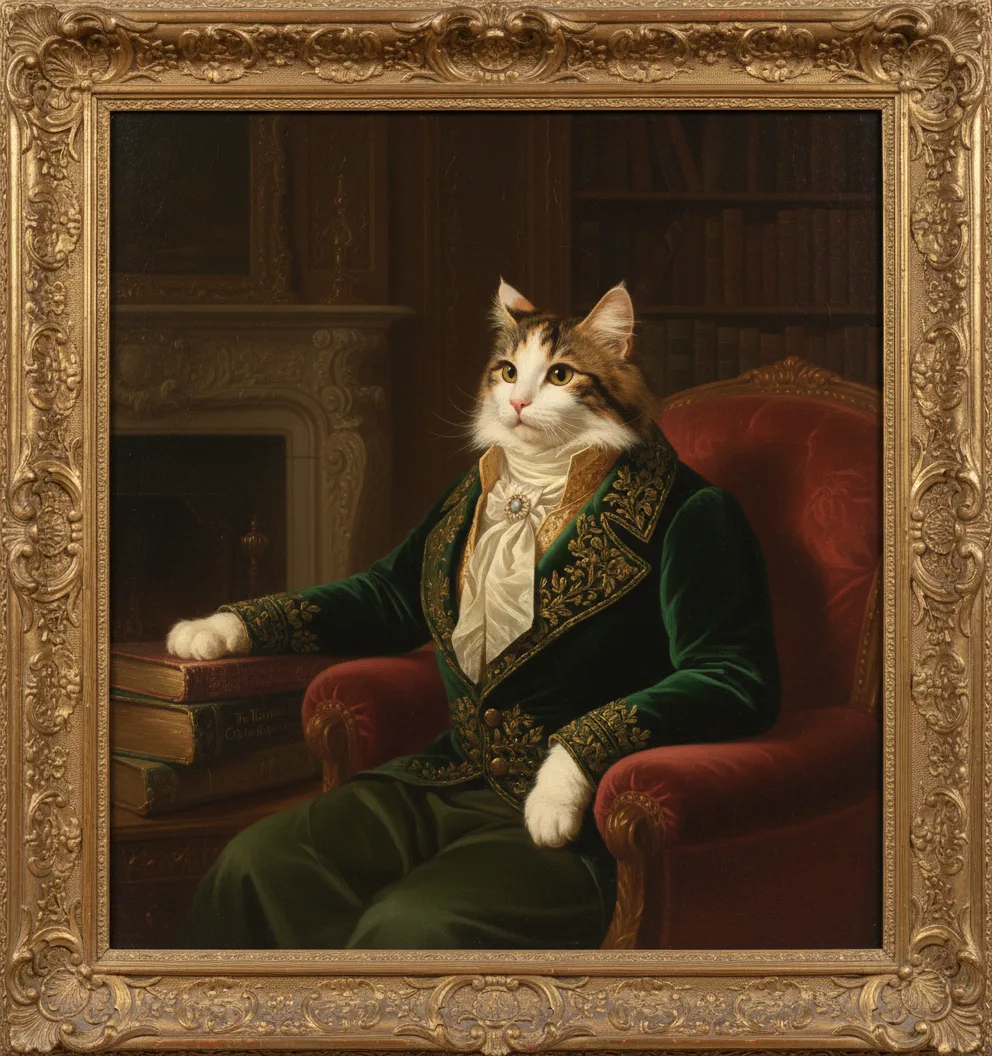
Purrealism's Victorian Noble style dresses a cat as a well-born person of Ronner-Knip's own century. The cover of this page shows a Norwegian Forest Cat from the studio examples in that style. You can see more finished portraits in the gallery, or upload one photo of your own cat, up to 5 MB, in the portrait studio.
Questions and answers
Who was Henriette Ronner-Knip?
Henriette Ronner-Knip was a Dutch painter of animals, born in Amsterdam on 31 May 1821, who became famous for her pictures of cats and kittens. According to the Digitaal Vrouwenlexicon van Nederland, a biographical dictionary of Dutch women, she lived and worked in Elsene, near Brussels, from 1850. She died there on 28 February 1909 and was buried beside her husband, Feico Ronner.
Who taught Henriette Ronner-Knip to paint?
Henriette Ronner-Knip was taught by her father, the animal and landscape painter Josephus Augustus Knip. The Digitaal Vrouwenlexicon van Nederland says she had a place in his studio from the age of four and received an easel on her 11th birthday. Emile Wesly, writing in 1898, says her father had gone blind and made her work in his studio from dawn until dark.
When did Henriette Ronner-Knip start painting cats?
Henriette Ronner-Knip began painting cats as her main subject in 1870, according to the Digitaal Vrouwenlexicon van Nederland. Before that she was known for dogs, especially the working dogs that pulled carts in Brussels. She had painted cats earlier too: the Rijksmuseum holds her Cat with Kittens, an oil on panel signed and dated 1844, with her name before marriage.
How did Henriette Ronner-Knip keep cats still while she painted?
Henriette Ronner-Knip used a special glass cage to pose the cats she drew. The Rijksmuseum in Amsterdam explains this on its page for her watercolour The Musicians, made around 1876 to 1877. Inside the cage the animals were posed with the help of cushions. In that picture a mother cat watches her kittens play with a guitar and its loose strings.
Why did Henriette Ronner-Knip move to Brussels?
Henriette Ronner-Knip settled near Brussels straight after her marriage to Feico Ronner in 1850. The Dutch writer Emile Wesly, in a book published in 1898, says the couple meant to travel to Switzerland for her health. They stopped in Brussels to rest, liked the city and stayed. Wesly says that 47 years later she had still never seen Switzerland.
What was Henriette Ronner-Knip's painting The Death of a Friend?
The Death of a Friend is a painting of 1860 by Henriette Ronner-Knip that shows a working man mourning his dog, which died pulling his cart. According to the Digitaal Vrouwenlexicon van Nederland, it belongs to her years of painting the cart dogs of Brussels. Emile Wesly wrote in 1898 that it made her well known in Brussels when it was shown there.
Where can I see Henriette Ronner-Knip's paintings?
The Rijksmuseum in Amsterdam holds several works by Henriette Ronner-Knip, and its page for Cat at Play listed the painting on display in room 1.14 in 2026. The museum also holds Cat with Kittens (1844) and the watercolour The Musicians. Hartlepool Museums in England hold five of her cat studies, and the Victoria and Albert Museum holds prints made after her paintings.
Which royals owned Henriette Ronner-Knip paintings?
Several royal families owned paintings by Henriette Ronner-Knip. Emile Wesly, writing in 1898, says Emperor Wilhelm I of Germany had one of a cat defending itself against dogs, and that five hung in the royal palace in Lisbon. He adds that the Duchess of Edinburgh and the Princess of Wales bought her work, and that she painted the Belgian queen's lapdogs.
What is the Henriette Ronner book by M. H. Spielmann?
The Henriette Ronner book by M. H. Spielmann is the English edition of an album of her paintings published in 1891. Emile Wesly says the album appeared in Dutch, French and English, with texts by Johan Gram, Henry Havard and Spielmann, editor of The Magazine of Art. It had twelve of her newest paintings reproduced as photogravures by the firm Goupil.
Did Henriette Ronner-Knip's children become painters?
Three of Henriette Ronner-Knip's children became artists. The Digitaal Vrouwenlexicon van Nederland says she trained all her children to paint. Her son Alfred Ronner (1852 to 1901) became an illustrator, and her daughters Alice (1857 to 1957) and Emma (1860 to 1936) painted still lifes, pictures of flowers and objects. The same source says Alice in particular became a successful painter.
Was Henriette Ronner-Knip a member of a cat club?
Henriette Ronner-Knip was a vice-president of the National Cat Club in London. Frances Simpson's Book of the Cat, published in 1903, lists 'Madame Ronner' among the club's vice-presidents, in the same list that names Louis Wain as president of the committee. The book opens with a picture of a black Persian cat 'painted specially' by her for it.
How much did Henriette Ronner-Knip charge for a painting?
Henriette Ronner-Knip's prices rose from 200 guilders in the 1840s to more than 2,000 guilders in the 1880s. According to the Digitaal Vrouwenlexicon van Nederland, only the best-known painters of that time could ask such a sum. The same source says she showed more than 168 paintings at the Dutch Living Masters exhibitions between 1838 and 1898.
Sources
- Knip, Henriette (1821-1909), by Hanna Klarenbeek, Digitaal Vrouwenlexicon van Nederland, Huygens Institute (Royal Netherlands Academy of Arts and Sciences). Accessed September 28, 2026.
- Het schildersboek: Nederlandsche schilders der negentiende eeuw in monographieën door tijdgenooten, volume 1 (1898), chapter 'Henriëtte Ronner' by Emile Wesly, Internet Archive (digitized with funding from the Getty Research Institute). Accessed September 28, 2026.
- The Book of the Cat, by Frances Simpson (Cassell, 1903), Project Gutenberg. Accessed September 28, 2026.
- Cat at Play, Henriëtte Ronner (SK-A-3089), Rijksmuseum. Accessed September 28, 2026.
- The Musicians, Henriëtte Ronner (RP-T-1892-A-2661), Rijksmuseum. Accessed September 28, 2026.
- Cat with Kittens, Henriëtte Ronner (SK-C-163), Rijksmuseum. Accessed September 28, 2026.
- Kat bespiedt vogels bij een slapende hond, Henriëtte Ronner (RP-T-1892-A-2662), Rijksmuseum. Accessed September 28, 2026.
- Studies van een kerkuil en vier wielewalen, Henriëtte Ronner (RP-T-1938-17), Rijksmuseum. Accessed September 28, 2026.
- New Lodgers, Frederick Hunter after Henriette Ronner, Victoria and Albert Museum. Accessed September 28, 2026.
- Hide and Seek, Frederick Hunter after Henriette Ronner, Victoria and Albert Museum. Accessed September 28, 2026.
- Henriette Ronner-Knip's Cat Paintings, Tees Valley Museums. Accessed September 28, 2026.
Short reads on this topic
Articles from Purrspectives that answer one question each.
Dog years to human years: the chart by size, and the DNA formula
A 1-year-old dog is closer to 15 or 30 in human years than to 7. The AKC chart by size, the 2020 DNA formula, and a dog's life stages, explained simply.

Pug history: from Chinese emperors to the House of Orange
Pugs began as companions of Chinese emperors, reached Holland on Dutch trading ships and became the dog of the House of Orange. Their history, art and health.
Persian cat history: where the breed came from, its first cat show, coat and care
Persian cat history from a cat brought to Italy in 1626 to the 1871 Crystal Palace show, plus face types, coat colours, grooming and how to photograph one.