Gwen John's cats: Edgar Quinet, the cat drawings and the girls holding cats
Gwen John named her first cat Edgar Quinet after her Paris street and drew her cats again and again. Where her cat drawings and paintings are today.
By Purrealism. Part of Cats in art: the artists and artworks behind a royal cat portrait.
Gwen John (1876 to 1939) was a Welsh painter who spent most of her working life in and near Paris, and who kept cats from her first year in Paris, 1904, onward. This page covers her first cat, Edgar Quinet, and what museum records and her own words say about it; the small cat studies in the Gwen John studio collection at Amgueddfa Cymru, Museum Wales; the cat drawings at Tate; her paintings of girls and young women holding cats; and the 2026 exhibition, which included paintings of her cats. It draws on Museum Wales, Tate and other museums, and on a history sheet published by the town of Meudon. For the wider story of cats in art, start with the cats in art guide.
From Wales to Paris
Museum Wales says John was born in Haverfordwest, Pembrokeshire, in 1876. She attended the Slade School of Fine Art in London from 1895 to 1898, one of the first generation of women to receive a formal art education. The National Museum of Women in the Arts in Washington says she left for Paris in 1898 to study at the new art school of the painter James McNeill Whistler.
In 1903 she set off on a walking tour through France with her friend Dorelia McNeill. By the beginning of 1904, according to Museum Wales, she had settled in Paris.
That same year she began to model for the sculptor Auguste Rodin. The National Museum of Women in the Arts says she was his model and lover from 1904 until his death in 1917. The Musée Rodin in Paris says Rodin borrowed her features for the muse in his monument to Whistler, a memorial ordered from him in 1905 and never finished. The town of Meudon says the Musée Rodin keeps close to 1,000 letters she wrote to him.
Edgar Quinet, the first cat
John's first cat arrived in the same year, 1904. Museum Wales explains it in its record of a sheet of Cat studies (NMW A 5451): "Gwen John acquired her first cat in 1904. It was a tortoiseshell cat that she named Edgar Quinet after the street in which she was living." Pallant House Gallery adds that the cat was female, in spite of the man's name.
What John wrote about the cat
The same Museum Wales record quotes John's own words about one of her cats: "she is very important, perhaps the most important thing but that ought not to be, n'est pas?" The last words are her French for "isn't it?" She admits that the cat matters more to her than she thinks it should.
The loss in 1908
Edgar Quinet disappeared in 1908. Museum Wales says John "was devastated and even wrote a poem about her loss". Pallant House Gallery also records the poem. A 2004 article in Tate Etc., the magazine published by Tate, adds a detail: when the cat vanished, John spent days camping out in the woods in the hope of finding it. The same article says she never killed the insects she found in her house, and carried them out to the street in a box instead.
Pallant House Gallery says John had many cats over her life.
The cat drawings at Museum Wales
In 1976, a hundred years after John's birth, the National Museum of Wales bought nearly 1,000 works from her nephew, Edwin John. The museum's blog explains that a studio collection is everything left in an artist's studio at their death. John died suddenly in September 1939. Edwin brought what he could to Britain as the Second World War began, and returned after the war for the rest.
The museum says the collection has over 900 drawings, six oil paintings and several sketchbooks. Among the landscapes, street views and flowers are "sketches of cats and horses". The museum adds that John often worked in series, drawing the same subject again and again, sometimes almost the same each time and sometimes in new colours. Before this purchase, the museum owned only three drawings and four oil paintings by her. It now holds the largest public collection of her work anywhere.
The cat sheets are small: seven of the eight in the table below are between 15.6 and 16.9 cm tall. The records describe pencil drawings with watercolour or a wash, a thin layer of watered paint. Museum Wales says she "frequently captured her adored cats in spontaneous drawings", meaning quick sketches.
| Drawing | Museum number | Materials | Size (cm) |
|---|---|---|---|
| Seated tortoiseshell cat | NMW A 5444 | Watercolour and pencil on paper | 16.9 × 13 |
| Two cats sleeping | NMW A 5447 | Watercolour and pencil on paper | 15.6 × 17.8 |
| Cat washing itself | NMW A 5450 | Wash and pencil on paper | 16.6 × 11.4 |
| Cat studies | NMW A 5451 | Watercolour and pencil on paper | 15.8 × 12.8 |
| Cat studies | NMW A 5452 | Watercolour and pencil on paper | 15.9 × 12.5 |
| Tortoiseshell cat | NMW A 15591 | Pencil and watercolour on paper | 16.2 × 12.5 |
| Tortoiseshell cat | NMW A 15592 | Pencil and watercolour on paper | 16.8 × 12.9 |
| Girl with a cat | NMW A 3598 | Pencil on paper | 22.5 × 15.6 |
All of these came to the museum in the 1976 purchase. The online records give no year for them. When we checked the records in September 2026, Seated tortoiseshell cat, Cat washing itself, two of the Cat studies sheets and Girl with a cat were marked "Currently on loan", and the others "In store". The records show the images online, so you can study them before you plan a visit.
The cat drawings at Tate
Tate in London holds three more drawings called Cat, each dated about 1904 to 1908, the years of Edgar Quinet. Tate lists each as graphite and watercolour on paper; graphite is the grey material inside a pencil. Tate's published collection data gives their sizes as 11.1 × 13.7 cm and 16.5 × 11.7 cm for the two bought in 1940, and 12.3 × 16 cm for the one given by Mary Constance Lloyd in 1957.
Tate's page on a past Gwen John display at Tate Britain says she moved to Meudon, a suburb of Paris, in 1911. It describes a simple life focused on her art, "her cats and her garden".
Life with cats in Meudon
The town of Meudon gives her addresses. She lived there from 1911 to 1939: on rue Terre Neuve until 1926, and then on rue Babie until 1 September 1939. She died in Dieppe on 18 September 1939.
Wales.com, the Welsh Government's site for the country, says she lived in Meudon alone with her cats. The Pallant House Gallery article sums up what the drawings show: with an eye for detail and flowing lines, she brought out the personality of each cat.
Girls and young women holding cats
John also painted people with cats. Tate owns Young Woman Holding a Black Cat, an oil on canvas that it dates about 1918 to 1922. Tate's collection data gives its size as 46 × 29.8 cm and records that the gallery bought it in 1946. The Tate Britain display text says she was known for painting in series, and her girls with cats exist in more than one version. Museum Wales holds a pencil drawing on the same subject, Girl with a cat (NMW A 3598), 22.5 × 15.6 cm.
Another version, Girl with a Cat, is at The Met in New York, an oil painting of 1918 to 1922, 33.7 × 26.7 cm, which is in our list of famous paintings of cats.
How she painted them
Museum Wales has studied how John built her paintings of seated women and girls. Its blog says she often painted "from the edges", starting at a corner of the canvas and working inwards, with the face painted last or not at all. She laid a ground, the first coat on the canvas, of chalk and animal glue, which leaves small bubbles and a rough surface. The paint on top went on dry and thin, so the sitter and the background blend into one surface. The blog on the studio collection adds that she mixed this chalky ground herself, and nobody knows her exact recipe.
Strange Beauties: the 2026 exhibition
Museum Wales opened Gwen John: Strange Beauties at National Museum Cardiff on 7 February 2026, for the 150th year since her birth. The museum called it the first major retrospective of her work in over forty years, meaning a show of her whole career. It ran in Cardiff until 28 June 2026 and then began a tour:
| Venue | Dates |
|---|---|
| National Museum Cardiff, Wales | 7 February to 28 June 2026 |
| National Galleries Scotland: Modern Two, Edinburgh | 1 August 2026 to 4 January 2027 |
| Yale Center for British Art, Connecticut | 18 February to 20 June 2027 |
| National Museum of Women in the Arts, Washington | 30 July to 28 November 2027 |
The Cardiffian, the news site of Cardiff University's journalism school, reported that the show brought together more than 200 paintings, drawings, watercolours and personal items. Its title comes from John's own description of herself, quoted by the museum's senior curator of art: "a seer of strange beauties, a teller of harmonies, a diligent worker."
The cats had their own part. A photo caption in The Cardiffian identifies paintings of cats by John in the show, including Edgar. A free family trail, Through Edgar's Eyes, let children aged seven to 11 follow paw prints through the rooms. Museum Wales also ran a family painting event called Cats on 28 May 2026, "inspired by Gwen John's own love for cats".
Other artists and their cats
John drew her cats for herself. When the 2026 exhibition was announced, Museum Wales said many of her drawings and studio works had never been exhibited before. Other artists of her lifetime made cats a public part of their work: see our pages on Louis Wain's cat pictures, Steinlen's cats and Foujita's cats. For what cats have meant in paintings across cultures, read what cats mean in art.
A portrait of your own cat
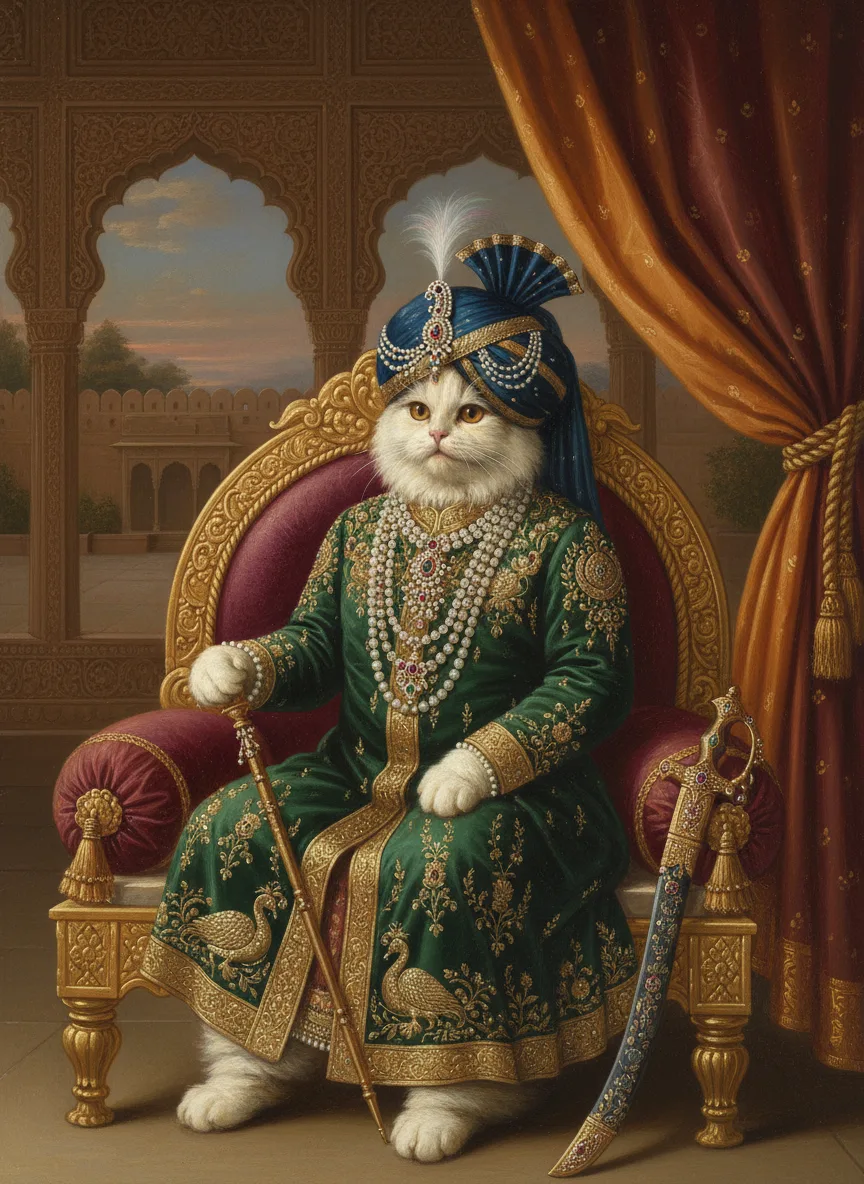
Many of John's cat drawings show a tortoiseshell cat asleep, washing or sitting up, each one a study of an animal she lived with. A royal portrait of your own cat starts from the same place, a photo that shows its real markings. On Purrealism you choose one of 15 styles, from Maharaja and Mughal Emperor to Renaissance Royal and Victorian Noble, and upload one photo of up to 5 MB in the portrait studio. The cover of this page shows a Persian cat from the studio examples in the Maharaja style, and the gallery has more finished portraits.
Questions and answers
Did Gwen John have a cat?
Gwen John had several cats, and the first was a tortoiseshell called Edgar Quinet. According to Amgueddfa Cymru, Museum Wales, she got the cat in Paris in 1904 and named it after the street where she was living. Pallant House Gallery says she had many cats during her life. Museum Wales holds a set of her quick pencil and watercolour drawings of them, bought from her studio in 1976.
Why was Gwen John's cat called Edgar Quinet?
Gwen John's cat was called Edgar Quinet because she lived on a street of that name in Paris when she got the cat in 1904. Amgueddfa Cymru, Museum Wales, gives this explanation in its record of one of her Cat studies drawings. Pallant House Gallery says the cat was female, in spite of the man's name. The cat disappeared four years later, in 1908.
What happened to Gwen John's cat Edgar Quinet?
Gwen John's cat Edgar Quinet disappeared in 1908. Amgueddfa Cymru, Museum Wales, says John was devastated and even wrote a poem about her loss. A 2004 article in Tate Etc., the magazine published by Tate, says she spent days camping out in the woods in the hope of finding the cat. Pallant House Gallery also records the poem.
What materials did Gwen John use for her cat drawings?
Gwen John drew her cats in pencil and added watercolour or a wash of thin paint, on small sheets of paper. Amgueddfa Cymru, Museum Wales, lists Seated tortoiseshell cat as watercolour and pencil on paper, 16.9 by 13 cm. Tate describes its three Cat drawings, dated about 1904 to 1908, as graphite and watercolour on paper. Graphite is the grey material inside a pencil.
What is the Gwen John studio collection?
The Gwen John studio collection is the group of works left in her studio when she died in 1939. Amgueddfa Cymru, Museum Wales, bought nearly 1,000 of them from her nephew Edwin in 1976. The museum says it holds over 900 drawings, six oil paintings and several sketchbooks, including sketches of cats and horses. It is the largest public collection of her work.
Where can I see Gwen John's cat drawings?
Gwen John's cat drawings are held mainly by Amgueddfa Cymru, Museum Wales, in Cardiff, and by Tate in London. Museum Wales shows its drawings online in Collections Online, and in September 2026 several were marked as on loan and others as in store. Tate holds three drawings called Cat. Check each online record before a visit, because the locations change.
When does the Gwen John exhibition finish in Cardiff?
The Gwen John exhibition in Cardiff, Gwen John: Strange Beauties, finished on 28 June 2026 at National Museum Cardiff. According to Amgueddfa Cymru, Museum Wales, it then moved to National Galleries Scotland: Modern Two in Edinburgh from 1 August 2026 to 4 January 2027. It goes on to the Yale Center for British Art in 2027 and the National Museum of Women in the Arts in Washington.
What was the Through Edgar's Eyes trail?
Through Edgar's Eyes was a family trail at National Museum Cardiff, named after Gwen John's cat Edgar Quinet. The Cardiffian, the news site of Cardiff University's journalism school, reported in February 2026 that it let children aged seven to 11 follow paw prints through the exhibition Gwen John: Strange Beauties. The show brought together more than 200 paintings, drawings, watercolours and personal items.
When did Gwen John move to Paris?
Gwen John had settled in Paris by the beginning of 1904, according to Amgueddfa Cymru, Museum Wales. She had first studied there in 1898, at the art school of the painter James McNeill Whistler, and in 1903 she walked through France with her friend Dorelia McNeill. Her first cat, Edgar Quinet, came into her life in her first year in Paris.
Where did Gwen John live in Meudon?
Gwen John lived in Meudon, a town just outside Paris, from 1911 to 1939. The town of Meudon says she lived on rue Terre Neuve until 1926 and then on rue Babie until 1 September 1939. The Welsh Government's Wales.com site says she lived there alone with her cats. She died in Dieppe on 18 September 1939.
What does Gwen John's Young Woman Holding a Black Cat show?
Gwen John's Young Woman Holding a Black Cat shows a young woman holding a black cat, as its title says. Tate in London owns the oil painting and dates it about 1918 to 1922. Tate's collection data gives its size as 46 by 29.8 cm and records that the gallery bought it in 1946. It belongs to a group of her paintings of girls and women holding cats.
Sources
- Cat studies (NMW A 5451), Gwen John, Amgueddfa Cymru, Museum Wales. Accessed September 28, 2026.
- Cat studies (NMW A 5452), Gwen John, Amgueddfa Cymru, Museum Wales. Accessed September 28, 2026.
- Cat studies (NMW A 5449), Gwen John, Amgueddfa Cymru, Museum Wales. Accessed September 28, 2026.
- Seated tortoiseshell cat (NMW A 5444), Gwen John, Amgueddfa Cymru, Museum Wales. Accessed September 28, 2026.
- Tortoiseshell cat (NMW A 15591), Gwen John, Amgueddfa Cymru, Museum Wales. Accessed September 28, 2026.
- Tortoiseshell cat (NMW A 15592), Gwen John, Amgueddfa Cymru, Museum Wales. Accessed September 28, 2026.
- Two cats sleeping (NMW A 5447), Gwen John, Amgueddfa Cymru, Museum Wales. Accessed September 28, 2026.
- Cat washing itself (NMW A 5450), Gwen John, Amgueddfa Cymru, Museum Wales. Accessed September 28, 2026.
- Girl with a cat (NMW A 3598), Gwen John, Amgueddfa Cymru, Museum Wales. Accessed September 28, 2026.
- The Gwen John Studio Collection at Amgueddfa Cymru, Amgueddfa Cymru, Museum Wales. Accessed September 28, 2026.
- Gwen John: 'It's tone that matters' Part 2, Amgueddfa Cymru, Museum Wales. Accessed September 28, 2026.
- Major new exhibition of Gwen John's work to open at National Museum Cardiff, Amgueddfa Cymru, Museum Wales. Accessed September 28, 2026.
- Gwen John: Strange Beauties, Amgueddfa Cymru, Museum Wales. Accessed September 28, 2026.
- Paint Along: Gwen John, Amgueddfa Cymru, Museum Wales. Accessed September 28, 2026.
- Who is Gwen John and why should young people visit an exhibition of her work?, The Cardiffian, Cardiff University School of Journalism. Accessed September 28, 2026.
- 'Cat', Gwen John, c.1904 to 1908 (N05154), Tate. Accessed September 28, 2026.
- 'Cat', Gwen John, c.1904 to 1908 (N05155), Tate. Accessed September 28, 2026.
- 'Cat', Gwen John, c.1904 to 1908 (T00156), Tate. Accessed September 28, 2026.
- 'Young Woman Holding a Black Cat', Gwen John, c.1918 to 1922 (N05744), Tate. Accessed September 28, 2026.
- Tate collection metadata: artwork_data.csv, Tate. Accessed September 28, 2026.
- Gwen John (Tate Britain display), Tate. Accessed September 28, 2026.
- I think if we are to do beautiful pictures, we ought to be free from family conventions and ties, Tate Etc., Tate. Accessed September 28, 2026.
- 10 Things you need to know about Gwen John, Pallant House Gallery. Accessed September 28, 2026.
- Gwen John, Ville de Meudon. Accessed September 28, 2026.
- Gwen John, Artist Profile, National Museum of Women in the Arts. Accessed September 28, 2026.
- Draped Muse from the Monument to Whistler, large model, Musée Rodin. Accessed September 28, 2026.
- New exhibition about pioneering artist Gwen John comes to Cardiff in 2026, Wales.com, Welsh Government. Accessed September 28, 2026.
- Gwen John, Girl with a Cat (object 481489), The Metropolitan Museum of Art. Accessed September 28, 2026.
Short reads on this topic
Articles from Purrspectives that answer one question each.
Dog years to human years: the chart by size, and the DNA formula
A 1-year-old dog is closer to 15 or 30 in human years than to 7. The AKC chart by size, the 2020 DNA formula, and a dog's life stages, explained simply.

Pug history: from Chinese emperors to the House of Orange
Pugs began as companions of Chinese emperors, reached Holland on Dutch trading ships and became the dog of the House of Orange. Their history, art and health.
Persian cat history: where the breed came from, its first cat show, coat and care
Persian cat history from a cat brought to Italy in 1626 to the 1871 Crystal Palace show, plus face types, coat colours, grooming and how to photograph one.