Japanese cat prints: Kuniyoshi's cats and the woodblock artists who drew them
How Utagawa Kuniyoshi turned cats into actors, words and ghosts in his woodblock prints, and which other Japanese printmakers drew cats, with museum records.
By Purrealism. Part of Cats in art: the artists and artworks behind a royal cat portrait.
Cats were the most popular animal in Japanese woodblock prints, according to the Ota Memorial Museum of Art in Tokyo, and in 2012 that museum counted 2,321 cats in works by the printmaker Utagawa Kuniyoshi and his pupils. This page follows his cats through museum records. It covers the cats he dressed as actors when actor prints were banned, the cats that bend into the letters of a word, the fifty-three cats for the stations of a famous road, and the ghost cats of the kabuki stage. It then looks at Hiroshige's school and at other printmakers, from the early 1700s to the 1960s. For cats across all of art history, start at the cats in art guide.
Why Japanese printmakers drew cats
The prints on this page are ukiyo-e, pictures of everyday life, theatre and stories printed from carved wooden blocks. The Victoria and Albert Museum describes the kind called nishiki-e as full-colour prints. The Rijksmuseum's records explain how they were printed: one block carried the black outlines, and separate blocks added each colour.
The Ota museum says cats were the most popular animal in ukiyo-e. Artists drew them as pets, as monsters, and as people who dance and go to school. Printers also sold sheets that showed the life story of a female cat, and cat pictures meant to keep mice away. The Smithsonian's National Museum of Asian Art adds that stories of cat sorcery were in fashion around 1840. One example it gives is Takizawa Bakin's novel The Story of the Eight Dogs of the Satomi Clan, published in parts between 1814 and 1847, which has an episode in which a hero kills a huge cat witch.
Utagawa Kuniyoshi and his cats
The Museum of Fine Arts, Boston gives Kuniyoshi's dates as 1797 to 1861. The Ota museum says he made his debut in his late teens. After a period without success, he became famous in his early thirties with a series of warrior prints, One Hundred and Eight Heroes from Tales of the Water Margin. He went on to make warriors, landscapes, beautiful women, actors, pictures for children and comic pictures.
Cats appear across this work. The Smithsonian says Kuniyoshi was fond of cats, and that they often appear in his prints, which it calls observant, sympathetic and humorous. Sometimes the cats take the place of courtesans or actors. In 2012 the Ota museum held a show of 243 cat works by Kuniyoshi and his pupils and counted 2,321 cats in them. Its exhibition text, published by the listings site Tokyo Art Beat, says Kuniyoshi was rumoured to have kept more than 10 cats in his house.
Cats in place of actors
In the Tenpō Reforms, the Tokugawa shogunate, the military government of Japan, put strict controls on popular entertainment. The Ota museum says printmakers were forbidden to show famous actors and courtesans, two popular subjects. Kuniyoshi turned to comic pictures of animals behaving like people, and they became popular. Some were taken off sale because officials thought they mocked the government, and he was sometimes called in by the magistrate. He kept making new ones.
The Ota museum says Kuniyoshi concentrated on pictures of cats acting like people in 1841 and 1842. In 1841 he made a round fan print, One Hundred Faces of Cats, that gave cats the faces of real kabuki actors. It was so popular that a kabuki play used the fan pictures. In the same years he drew acrobats as cats and illustrated a novel called Story of the Hazy Moon Cat.
A print from 1847 in the Rijksmuseum shows a wall covered in graffiti: six actor portraits, a hand drum and a cat.
Popular Cat Games
In the late 1840s Kuniyoshi made a series the Museum of Fine Arts, Boston calls Popular Cat Games and the Victoria and Albert Museum calls Frolics of Fashionable Cats. The prints these museums describe act out kabuki scenes with cats. Both hold the same design, dated 1847 to 1852 by the MFA. The MFA calls it a cat version of the famous scene Akoya's Torture by Koto from the play Futaba gunki, and the V&A describes two cats with a koto, a Japanese stringed instrument. In another V&A print from the series a cat strikes an octopus in a parody of a kabuki scene. The V&A bought an album with both prints in 1879.
Cats that spell words
In one series, cats twist their bodies into the letters of a word. The Ota museum showed all five prints of this series in 2023 and says it is one of the most popular groups of Kuniyoshi's works. One is Cats Forming the Hiragana Characters for Bonito. Hiragana is one of the Japanese alphabets of syllables, and a bonito is a fish, so the cats spell out the name of a fish.
The same show included another cat series by Kuniyoshi that acts out common sayings, and a printed cat to keep mice away.
Fifty-three cats for fifty-three stations
The Tōkaidō was the road between Edo, now Tokyo, and Kyoto, with 53 post towns, stations where travellers could rest, along the way. Printmakers sold series with one picture for each station. Kuniyoshi made a version with cats. The Ota museum, which showed it in 2023, describes it as fifty-three cats personified as the post towns.
The Rijksmuseum in Amsterdam holds a sheet of it, dated 1847 to 1850 and 35.4 by 23.9 cm. The museum describes cats in different poses, each beside a red frame that holds the name of one station.
Ghost cats and monster cats
Kuniyoshi's cats could also be frightening. The Philadelphia Museum of Art holds a print from around 1839 to 1842 titled A Cat Threatening Goldfish, or Ghost Stories. The Smithsonian holds a print from around 1840 in which the warrior Kamada Matahachi kills a monstrous cat in the mountains of Ise. The museum explains that cats with supernatural powers are common in Japanese folktales, as are foxes and badgers.
Some of Kuniyoshi's ghost cats came from the kabuki stage. The MFA holds Kuniyoshi's triptych, a picture printed on three sheets that sit side by side, The Origin Story of the Cat Stone at Okabe. Okabe was a station on the Tōkaidō. The print is dated to the 7th month of 1847 and is 36.6 by 73.8 cm. It shows the actor Onoe Kikugorō III as the spirit of the cat stone, in a play staged at the Ichimura theatre. A second MFA triptych from the same month, The Story of Nippondaemon and the Cat, shows Kikugorō III as the cat stone's spirit again.
The MFA also explains the nekomata, a cat monster with a forked tail, from a kabuki play about strange events on the Tōkaidō. The role was written for Kikugorō III, who specialized in ghost plays. Kuniyoshi's print of 1847 marks the actor's retirement performance that year, and his rival Utagawa Kunisada drew the same role three years after the actor died. Another ghost cat print by Kuniyoshi, the Okazaki Cat Demon, is covered in our list of famous paintings of cats.
Hiroshige and his school
The Tokyo National Museum's 2006 display of cats included Utagawa Hiroshige's print of the Asakusa rice fields from One Hundred Famous Views of Edo, with its cat on a windowsill, which the famous paintings article covers. Hiroshige also worked with Kuniyoshi and Kunisada on a Tōkaidō series. The MFA records that Fifty-three Pairings for the Tōkaidō Road was designed by all three, and Kuniyoshi drew the Okabe station, around 1845 to 1846, as the story of the cat stone.
Hiroshige's pupil Hiroshige II made a fan print in 1863, A White Cat Playing with a String. The Minneapolis Institute of Art says it shows his close study of a house cat, drawn in a bold and simple way, with its back legs braced as if it is about to jump.
Other printmakers who drew cats
Cats were in Japanese pictures long before Kuniyoshi, and printmakers kept drawing them after him. The Tokyo National Museum's 2006 display included an ukiyo-e painting with a cat that suggests a scene from the Tale of Genji about the imperial princess Onna Sannomiya. It also showed A Girl and Her Cat at the Kotatsu Warmer by Utagawa Kunimasa, which the museum lists as an Important Art Object. Our page on royal cats of Japan, Korea and Siam covers the real cats of the Japanese court.
Toy prints, called omocha-e, were ukiyo-e for children. The Ota museum says most were made between the end of the Edo period, which the Smithsonian dates to 1868, and the Meiji era that followed. Most of the cat toy prints it showed in 2023 picture a world where only cats live. Among them was Hotspring Spa for Cats by Utagawa Yoshifuji, and the same show included his Small Kittens Join to Form a Big Cat.
The 20th-century printmaker Inagaki Tomoo (1902 to 1980) made several cat prints that are now in American museums. The Art Institute of Chicago explains how he made Cat Making Up in 1962. He drew in pencil, drew over it in ink, laid the drawing face down on a wet block and rubbed the back so the ink moved onto the wood. He then carved the block using those lines as a guide. The collector Oliver Statler, who knew him, wrote that the print shows one cat: the two heads show the movement of a cat washing itself.
| Work | Artist | Date | Museum | What the cat does |
|---|---|---|---|---|
| Standing Courtesan Playing with Cat and Kitten (hanging scroll) | Okumura Masanobu | around 1715 | Minneapolis Institute of Art | Plays with a courtesan |
| Woman Holding a Cat and a Girl Trying to Reach the Cat (book page) | Nishikawa Sukenobu | 1739 | Minneapolis Institute of Art | Held out of a girl's reach |
| Cat and Mouse (tall, narrow pillar print) | Isoda Koryūsai | around 1780 | Minneapolis Institute of Art | Shown with a mouse |
| Popular Cat Games | Utagawa Kuniyoshi | 1847 to 1852 | MFA Boston; V&A, London | Acts out kabuki scenes |
| Cats for the 53 stations of the Tōkaidō | Utagawa Kuniyoshi | 1847 to 1850 | Rijksmuseum, Amsterdam | Stands for a station on the road |
| The Origin Story of the Cat Stone at Okabe | Utagawa Kuniyoshi | 1847 | MFA Boston | Appears as the spirit of a cat stone |
| A White Cat Playing with a String (fan print) | Utagawa Hiroshige II | 1863 | Minneapolis Institute of Art | Gets ready to pounce |
| Sleeping Cat | Kawanabe Kyōsai | 19th century | Minneapolis Institute of Art | Sleeps |
| Cat Catching a Rat | Kobayashi Kiyochika | first edition 1877 | Minneapolis Institute of Art | Catches a rat |
| Cat and Goldfish | Ohara Shōson | around 1928 to 1930 | Minneapolis Institute of Art | Shown with goldfish |
| Cat on Cushion | Inagaki Tomoo | 1957 | Minneapolis Institute of Art | Shown on a cushion |
| Cat Making Up | Inagaki Tomoo | 1962 | Art Institute of Chicago | Washes itself |
The museum records list most of these works as not on view, so check the online record before you travel.
From a woodblock cat to your own cat's portrait
Kuniyoshi dressed his cats as actors and courtesans, and cast them as monsters in ghost stories. A royal pet portrait uses the same idea: a real animal, dressed for a role. A Japanese painter who drew cats with fine ink outlines in Paris in the 1920s is the subject of our page on Foujita's cats, and the meanings cats carried in Japanese and other art are covered in what cats mean in art.
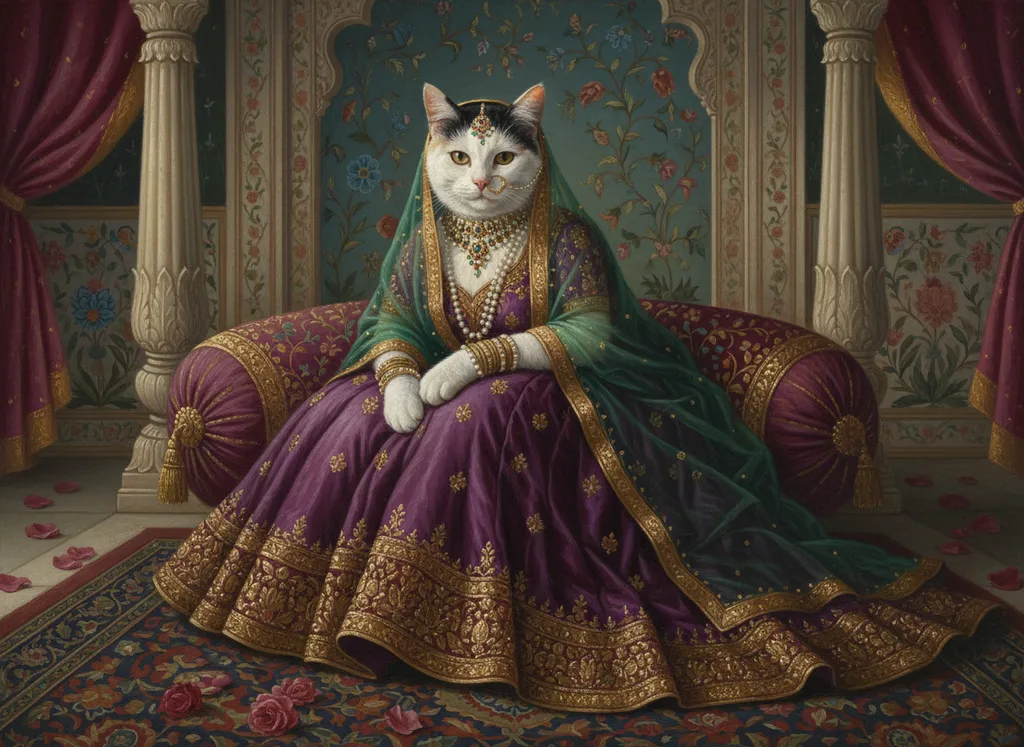
Purrealism's portrait studio has 15 royal styles, from the Maharani to the Regency Era. The cover of this page shows a calico cat in the Maharani style. You can see finished portraits in the gallery, or upload one clear photo of your cat, up to 5 MB, in the portrait studio.
Questions and answers
Who is Utagawa Kuniyoshi?
Utagawa Kuniyoshi was a Japanese woodblock print artist who lived from 1797 to 1861, according to the Museum of Fine Arts, Boston. The Ota Memorial Museum of Art in Tokyo says he made his debut in his late teens and became famous in his early thirties with a series of warrior prints, One Hundred and Eight Heroes from Tales of the Water Margin. Today he is also known for his prints of cats.
Did Utagawa Kuniyoshi love cats?
Utagawa Kuniyoshi was fond of cats, according to the Smithsonian's National Museum of Asian Art, which says cats often appear in his prints and sometimes take the form of courtesans or actors. The exhibition text for a 2012 show at the Ota Memorial Museum of Art in Tokyo says he was rumoured to have kept more than 10 cats. The same show counted 2,321 cats in 243 works by Kuniyoshi and his pupils.
Why did Kuniyoshi draw cats as kabuki actors?
Kuniyoshi drew cats as kabuki actors in a period when the Tenpō Reforms banned prints of actors and courtesans, according to the Ota Memorial Museum of Art in Tokyo. The museum says he turned to comic pictures of animals acting like people, and they became popular. In 1841 he made a fan print, One Hundred Faces of Cats, that gave cats the faces of real kabuki actors.
What are Kuniyoshi's cats forming characters?
Kuniyoshi's cats forming characters are a series of five prints in which cats twist and bend their bodies into the letters of a word. The Ota Memorial Museum of Art in Tokyo showed all five in 2023, including Cats Forming the Hiragana Characters for Bonito. Hiragana is one of the Japanese alphabets of syllables, and a bonito is a fish, so the cats spell out the name of a fish.
What is Kuniyoshi's print of cats for the fifty-three stations of the Tōkaidō?
Kuniyoshi's print of cats for the fifty-three stations of the Tōkaidō shows cats in many poses, each next to the name of a stop on the road between Edo, now Tokyo, and Kyoto. The Rijksmuseum in Amsterdam dates its sheet to 1847 to 1850 and says each station name sits in a red frame beside a cat. The Ota Memorial Museum of Art in Tokyo showed it in its 2023 exhibition Cats in Ukiyo-e.
What is the cat stone of Okabe?
The cat stone of Okabe is a kabuki story about the spirit of a cat stone at Okabe, a station on the Tōkaidō road. The Museum of Fine Arts, Boston holds Kuniyoshi's triptych from 1847, The Origin Story of the Cat Stone at Okabe. It shows the actor Onoe Kikugorō III as the spirit of the cat stone, in a play staged at the Ichimura theatre in Edo.
What is a nekomata in Japanese prints?
A nekomata is a cat monster with a forked tail, and it appears in kabuki plays and the prints made from them. The Museum of Fine Arts, Boston says the nekomata came from a kabuki play about strange events on the Tōkaidō road, written for the actor Onoe Kikugorō III. Kuniyoshi made an 1847 print of the role, and his rival Kunisada drew it again after the actor died.
What are Japanese toy prints of cats?
Japanese toy prints of cats are woodblock prints made for children, called omocha-e, which means toy pictures. The Ota Memorial Museum of Art in Tokyo says most were made from the end of the Edo period into the Meiji era, and most show a world where only cats live. Its 2023 show had 40 of them, with cats at the public bath, eating soba noodles and riding in a rickshaw.
Did Hiroshige draw cats?
Utagawa Hiroshige drew a cat on a windowsill in his print of the Asakusa rice fields from One Hundred Famous Views of Edo, which the Tokyo National Museum showed in a display of cats in 2006. His pupil Hiroshige II made a fan print in 1863, A White Cat Playing with a String. The Minneapolis Institute of Art says it shows close study of a house cat, braced on its back legs and ready to jump.
How was a Japanese woodblock print of a cat made?
A Japanese woodblock print of a cat was made by carving a drawing into a wooden block, inking the block and pressing paper onto it. The Art Institute of Chicago explains how Inagaki Tomoo made Cat Making Up in 1962. He drew the cat in pencil and ink, laid the drawing face down on a wet block, and rubbed the back so the ink moved onto the wood as a guide for carving.
Where can I see Kuniyoshi's cat prints?
Kuniyoshi's cat prints are in several museums outside Japan. The Museum of Fine Arts, Boston holds his Okabe cat stone triptych and prints from his series Popular Cat Games. The Victoria and Albert Museum in London holds prints from the same series in an album it bought in 1879. The Rijksmuseum in Amsterdam holds a sheet of his cats for the Tōkaidō stations. Most are listed as not on view, so check before a visit.
Sources
- Cats in Ukiyo-e (exhibition, 2023), Ota Memorial Museum of Art. Accessed September 28, 2026.
- Utagawa Kuniyoshi (exhibition, 2021), Ota Memorial Museum of Art. Accessed September 28, 2026.
- "One Hundred Images of Cats: Many Varieties of Cats by Kuniyoshi" Exhibition (Ota Memorial Museum of Art, 2012), Tokyo Art Beat. Accessed September 28, 2026.
- Utagawa Kuniyoshi, Kamada Matahachi, a Man of Unmatched Power from Matsuzaka, Ise, Kills a Big Cat from the Mountains of Suzaka (S2004.3.167), Smithsonian's National Museum of Asian Art. Accessed September 28, 2026.
- Utagawa Kuniyoshi, The Scene of Torture by Scolding from The Stinky Sleeve, from the series Popular Cat Games (17.3216.26), Museum of Fine Arts, Boston. Accessed September 28, 2026.
- Utagawa Kuniyoshi, The Origin Story of the Cat Stone at Okabe, Representing One of the Fifty-three Stations of the Tōkaidō Road (11.28742-4), Museum of Fine Arts, Boston. Accessed September 28, 2026.
- Utagawa Kuniyoshi, The Story of Nippondaemon and the Cat (11.27023-5), Museum of Fine Arts, Boston. Accessed September 28, 2026.
- Utagawa Kuniyoshi, Okabe: The Story of the Cat Stone, from the series Fifty-three Pairings for the Tōkaidō Road (11.28626), Museum of Fine Arts, Boston. Accessed September 28, 2026.
- Two Japanese Master Printmakers Go Head to Head in "Showdown! Kuniyoshi vs. Kunisada", Museum of Fine Arts, Boston. Accessed September 28, 2026.
- Utagawa Kuniyoshi, Scene of Tortuous Rebuke of Grubby Sleeves, from the series Frolics of Fashionable Cats (O391531), Victoria and Albert Museum. Accessed September 28, 2026.
- Utagawa Kuniyoshi, Imitation of Umegae Striking the Limitless Bell, from the series Frolics of Fashionable Cats (O1801165), Victoria and Albert Museum. Accessed September 28, 2026.
- Utagawa Kuniyoshi, Katten voor de 53 stations van de Tokaido (AK-MAK-909), Rijksmuseum. Accessed September 28, 2026.
- Utagawa Kuniyoshi, Zes acteursportretten (RP-P-1968-162), Rijksmuseum. Accessed September 28, 2026.
- Utagawa Kuniyoshi, A Cat Threatening Goldfish, or Ghost Stories (Hyaku monogatari), c. 1839-1842, Philadelphia Museum of Art. Accessed September 28, 2026.
- Cats Depicted in Japanese Art (display, 2006), Tokyo National Museum. Accessed September 28, 2026.
- Utagawa Hiroshige II, A White Cat Playing with a String, Minneapolis Institute of Art. Accessed September 28, 2026.
- Okumura Masanobu, Standing Courtesan Playing with Cat and Kitten, Minneapolis Institute of Art. Accessed September 28, 2026.
- Nishikawa Sukenobu, Woman Holding a Cat and a Girl Trying to reach the Cat, Minneapolis Institute of Art. Accessed September 28, 2026.
- Isoda Koryūsai, Cat and Mouse, Minneapolis Institute of Art. Accessed September 28, 2026.
- Kawanabe Kyōsai, Sleeping Cat, Minneapolis Institute of Art. Accessed September 28, 2026.
- Kobayashi Kiyochika, Cat Catching a Rat, Minneapolis Institute of Art. Accessed September 28, 2026.
- Ohara Shōson, Cat and Goldfish, Minneapolis Institute of Art. Accessed September 28, 2026.
- Inagaki Tomo'o, Cat on Cushion, Minneapolis Institute of Art. Accessed September 28, 2026.
- Inagaki Tomoo, Cat Making Up, The Art Institute of Chicago. Accessed September 28, 2026.
Short reads on this topic
Articles from Purrspectives that answer one question each.
Dog years to human years: the chart by size, and the DNA formula
A 1-year-old dog is closer to 15 or 30 in human years than to 7. The AKC chart by size, the 2020 DNA formula, and a dog's life stages, explained simply.
Pug history: from Chinese emperors to the House of Orange
Pugs began as companions of Chinese emperors, reached Holland on Dutch trading ships and became the dog of the House of Orange. Their history, art and health.
Persian cat history: where the breed came from, its first cat show, coat and care
Persian cat history from a cat brought to Italy in 1626 to the 1871 Crystal Palace show, plus face types, coat colours, grooming and how to photograph one.