Cats in medieval manuscripts: bestiaries, margins, books of hours and paw prints
What medieval bestiaries said about cats, why cats and mice fill the margins of prayer books, and the paw prints and curses that real cats left on the page.
By Purrealism. Part of Cats in art: the artists and artworks behind a royal cat portrait.
Cats in medieval manuscripts turn up in four places: in the bestiary, the medieval book of animals; in the margins around the text, where they chase mice or play music; in books of hours, decorated prayer books for private use; and on the pages themselves, where real cats left paw prints. This page looks at each, using the libraries and museums that hold the books. It is part of our guide to cats in art. The temple cats of Egypt come before it in Egyptian cat art, and the cat as a sign of the devil in later church paintings is covered in cats in Renaissance paintings.
The cat in the bestiary
A bestiary is a collection of short descriptions of animals, real and imaginary, each followed by a moral lesson. The University of Aberdeen says the bestiary took its form in England in the 12th century. Its main source was Physiologus, a Greek text probably written in Alexandria in the 4th century, with around 50 chapters on beasts, birds and stones. The Getty Museum adds that a bestiary could hold from a few dozen to more than a hundred animals, each with a picture, and that these books were most popular from around 1100 to 1300.
Much of what bestiaries say about cats comes from Isidore of Seville, a writer in 7th-century Spain. Isidore explained animals through their names. The Aberdeen site gives his example: a cat is called catus because it catches mice.
The Aberdeen Bestiary, held by the University of Aberdeen as MS 24, is a 12th-century English copy. Its recorded history begins in 1542, when it was listed in Henry VIII's Old Royal Library at Westminster Palace. In 1624 or 1625 Thomas Reid gave it to Marischal College in Aberdeen, together with around 1,350 other books and manuscripts.
Its cat entry is short. In the university's translation:
The cat is called musio, mouse-catcher, because it is the enemy of mice. It is commonly called catus, cat, from captura, the act of catching. Others say it gets the name from capto, because it catches mice with its sharp eyes. For it has such piercing sight that it overcomes the dark of night with the gleam of light from its eyes.
The picture on the same page shows cats leaping about and hunting, while a mouse carries grain. The university's commentary compares it with a sister manuscript, the Ashmole Bestiary in Oxford. There, the cats catch mice as the text describes, and one cat twists round to lick its own back end. The Aberdeen painter left out the caught mice, which, the commentary says, changes the emphasis to the text's praise of the cat's sharp sight.
Cambridge University Library says bestiaries place the cat and dog beside griffins and dragons for a reason: every animal was there to teach a moral or spiritual lesson. A British Library bestiary made in England in the second quarter of the 13th century, Harley MS 4751, shows cats catching mice beside mice stealing the bread used in Holy Communion. Someone later drew a cat playing a stringed instrument in its margin.
Cats and mice in the margins
The margins of a medieval book are the borders around the text, and some painters filled them with small scenes.
The Luttrell Psalter, a book of psalms made in England between 1325 and 1340, has a cat playing with a mouse in the margin of folio 190. The British Library, which holds it, also has a 12th-century copy of Gregory the Great's Moralia in Job from Arnstein in Germany. In one of its decorated capital letters, a dog catches a cat that is catching mice.
Sometimes the mice win. The British Library's post "Lolcats of the Middle Ages" shows a book of hours made in London around 1320 to 1330, in which mice lay siege to a castle defended by a cat. The library says artists used the war between cats and mice as a picture of human society. The 14th-century poet William Langland used the old fable of the mice who want to hang a bell on the cat. In his version it comments on the powerful regent John of Gaunt and the Commons, just before the English uprising of 1381.
Cats also appear in medical and proverb books. The British Library has an Italian herbal, a medical book about plants, made around 1440, with a painting of a cat chasing a mouse. At the Walters Art Museum, a book of rhymed proverbs made in Savoy between 1475 and 1500 has six drawings on sayings about cats. The museum explains that each drawing and its verse work together as a riddle that brings a known saying to mind.
Cats in books of hours
A book of hours is a decorated prayer book. The Getty Museum says these were among the most widely made and used books of the Middle Ages, and that they reflect a growing wish for private prayer.
The Walters Art Museum holds a book of hours made in England around 1300, Ms. W.102. The museum says its patron is unknown: a woman prays in many of its painted initials, but its instructions in the Office of the Dead mention "freres", or brothers. Along the margins of one section, the Hours of Jesus Crucified, the painter drew the funeral of Renard the Fox. A sheep rings bells, a wolf called Ysengrin dresses as a bishop, and a rabbit tolls church bells. On folio 77, Tibert the Cat carries the front of the fox's bier, the frame that holds the body. On folio 78, another cat beats a cymbal in the procession.
The British Library shows cats at home in these books too:
- The Maastricht Hours, made in Liège in the first quarter of the 14th century. A nun spins thread while her pet cat plays with the spindle.
- A Flemish book of hours from around 1500. Saint Mark writes at home with his books piled beside him, while a cat prowls in the background. In the same book's calendar page for January, a cat eyes its owners' roast dinner.
- The London book of hours of around 1320 to 1330, where the cat defends its castle against the mice.
Real cats on the page
Other cats in manuscripts are real ones that walked across the pages.
In a 2018 post called "Cats, get off the page!", British Library curators Eleanor Jackson and Kate Thomas show three examples. A 12th-century copy of Pope Gregory the Great's letters, from the cathedral priory of St Andrew in Rochester, has four muddy paw prints on one corner. A 12th-century English copy of Isidore's Etymologies has one clear print at the top of the page and perhaps ten or more smudged prints across half of the text. A collection of Middle English poems has two prints in the middle of a page, in a part made between around 1516 and 1527 for Henry Algernon Percy, Earl of Northumberland. The curators add that books were used for centuries, so nobody can say when the cats made their marks.
A 15th-century paw print trail became famous in 2013. The University of Chicago Divinity School describes a manuscript photographed in Dubrovnik by the medievalist Emir Filipović, where a cat stepped in ink and walked across the page. The writer was an official working on a collection of government letters.
A scribe in Deventer, in what is now the Netherlands, had a worse night around 1420. Thijs Porck, a lecturer at Leiden University, tells the story. A cat urinated on the manuscript overnight, so the scribe left the rest of the page blank, drew a picture of a cat, and wrote in Latin:
Here is nothing missing, but a cat urinated on this during a certain night. Cursed be the pesty cat that urinated over this book during the night in Deventer and because of it many others too. And beware well not to leave open books at night where cats can come.
The manuscript is in the Historical Archive in Cologne. Porck also explains why the cats were there at all: mice ate books. An 11th-century copy of Boethius at Corpus Christi College, Cambridge, has rat and mouse teeth marks on every page.
Pangur Bán and the scholar's cat
Monks and nuns wrote about their cats as well as drawing them. The British Library's Gillian Kenny opens her 2019 post with a riddle by Aldhelm, abbot of Malmesbury in England in the 7th century, spoken by a cat: "in the dark nights I make my rounds of the shadowy corners". She adds that the Ancrene Riwle, an early 13th-century guide for anchoresses, religious women who shut themselves away from the world, allowed them only one animal, a cat.
The best-known cat poem of the period is Pangur Bán. An Irish monk living in exile in continental Europe wrote it in Old Irish in the 9th century. The cat's name points to his soft, white coat. The monk compares their two jobs, the cat hunting mice and the monk hunting for meaning in his books. In Robin Flower's English translation, it begins:
I and Pangur Bán my cat, 'Tis a like task we are at: Hunting mice is his delight, Hunting words I sit all night.
The University of Chicago Divinity School places the poem in a 9th-century manuscript from the monastery of Reichenau, now kept in the abbey library of St Paul im Lavanttal in Austria as Cod. 86b/1. Kenny adds that early Irish law had a whole section on cats, called Catslechta, the "cat-sections". It listed herding cats, mousers, guard cats, kittens kept as playmates for children, and simple pet cats. A cat that hurt someone while chasing a mouse was not held responsible if that person had no business being there.
Where to find these cats
| Manuscript | Date | Where made | Held by | What the cat does |
|---|---|---|---|---|
| Aberdeen Bestiary, MS 24 | 12th century | England | University of Aberdeen | Leaps and hunts |
| Moralia in Job, Harley MS 3053 | second half of the 12th century | Arnstein, Germany | British Library | Catches mice while a dog catches it |
| Gregory the Great's letters, Royal MS 6 C X | 12th century | Rochester, England | British Library | Left four muddy paw prints |
| Bestiary, Harley MS 4751 | second quarter of the 13th century | England | British Library | Catches mice |
| Book of hours, Ms. W.102 | around 1300 | England | Walters Art Museum | Carries the fox's bier |
| Maastricht Hours, Stowe MS 17 | first quarter of the 14th century | Liège | British Library | Plays with a nun's spindle |
| Book of hours, Harley MS 6563 | around 1320 to 1330 | London | British Library | Defends a castle against mice |
| Luttrell Psalter, Add MS 42130 | 1325 to 1340 | England | British Library | Plays with a mouse |
| Deventer manuscript, G.B. quarto 249 | around 1420 | Deventer | Historical Archive, Cologne | Urinated on the page |
| Flemish book of hours, Add MS 35313 | around 1500 | Flanders | British Library | Prowls behind Saint Mark |
A medieval cat and a portrait of your own cat
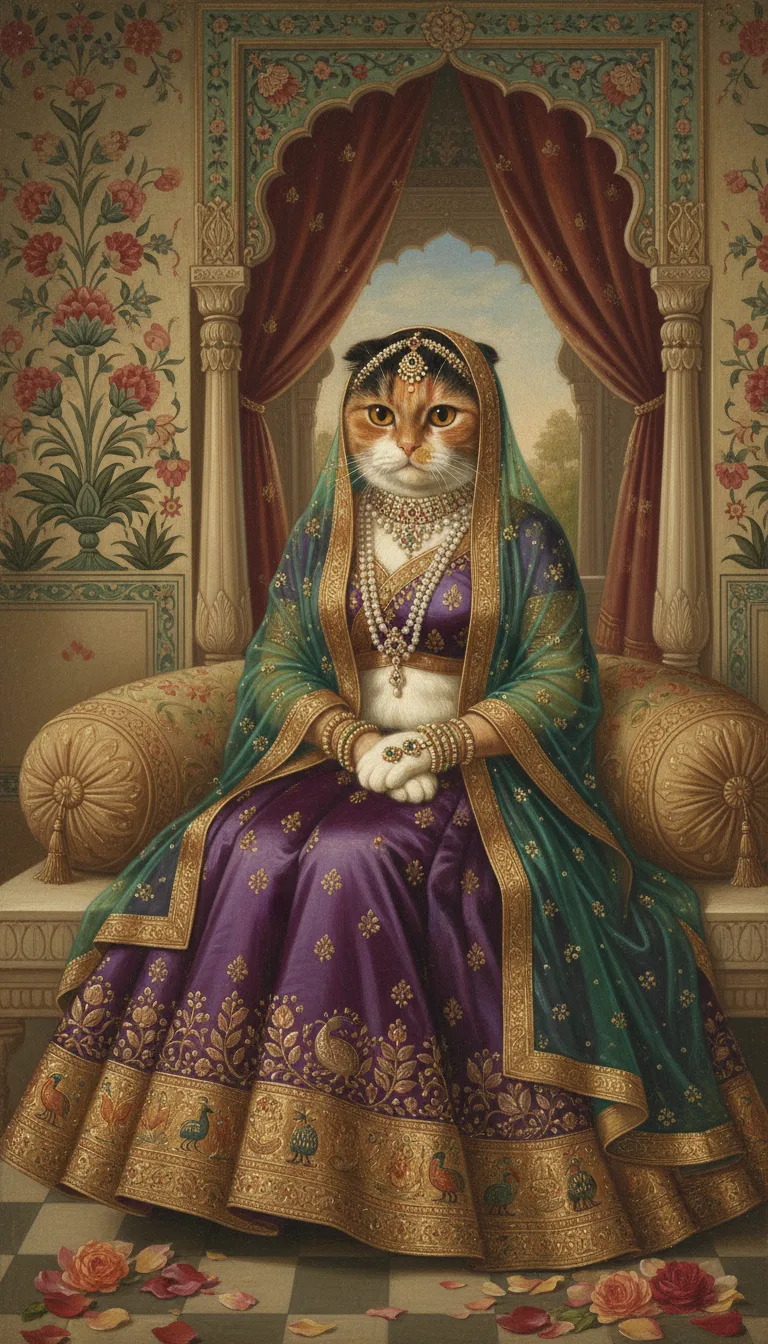
The cats in these books are ordinary house cats doing ordinary things: hunting, washing, playing and walking across the work on the desk. That is also where a pet portrait begins, with one real cat and its own habits and coat. Medieval Knight is one of the 15 royal portrait styles on this site, next to the Indian court styles such as Maharani. The cover of this page shows a Calico cat in the Maharani style. For what cats came to mean in paintings, from home life to bad luck, read what cats mean in art. You can compare finished portraits in the gallery, or upload one photo of up to 5 MB in the portrait studio.
Questions and answers
What did medieval cats look like?
Medieval cats in manuscripts look like house cats caught in the middle of hunting, washing or playing. The Aberdeen Bestiary, a book of animals made in England in the 12th century and held by the University of Aberdeen, shows its cats leaping and hunting. The Luttrell Psalter at the British Library, made in England between 1325 and 1340, has a cat playing with a mouse in the margin.
What is a medieval bestiary?
A medieval bestiary is a book of short descriptions of real and imaginary animals, each with a moral lesson. The University of Aberdeen says the bestiary took its form in England in the 12th century, built mainly on an older Greek text called Physiologus. The Getty Museum says a bestiary could describe from a few dozen to more than a hundred animals, each with a picture.
What does the Aberdeen Bestiary say about cats?
The Aberdeen Bestiary says the cat is called musio, mouse-catcher, because it is the enemy of mice, and catus from the Latin word for catching. In the University of Aberdeen's translation, the cat's sight is so sharp that the gleam of its eyes overcomes the dark of night. The picture on the same page shows cats leaping and hunting, and a mouse carrying grain.
Who wrote Pangur Bán?
Pangur Bán was written by an Irish monk whose name is not recorded. The British Library says he wrote the poem in Old Irish in the 9th century, while living in exile in continental Europe. He compares his own work with the work of his cat: the cat hunts mice, and the monk hunts for words and meanings in his books.
When was Pangur Bán written?
Pangur Bán was written in the 9th century. The University of Chicago Divinity School's Sightings series places it in a 9th-century manuscript from the monastery of Reichenau, in what is now Germany. That manuscript is now kept in the abbey library of St Paul im Lavanttal in Austria, as Cod. 86b/1. The poem is in Old Irish, the monk's own language.
What does the name Pangur Bán mean?
The name Pangur Bán points to the cat's soft, white coat, according to the British Library. The poem is best known in English in Robin Flower's translation, which opens with the lines 'I and Pangur Bán my cat, / 'Tis a like task we are at: / Hunting mice is his delight, / Hunting words I sit all night.'
Why are there cat paw prints on medieval manuscripts?
Cat paw prints appear on medieval manuscripts because cats lived where books were kept and walked across open pages. The British Library has a 12th-century copy of Pope Gregory the Great's letters, from the cathedral priory of St Andrew in Rochester, with four muddy paw prints on one corner. The library adds that nobody can say when the cats made their marks.
What did the Deventer scribe write about the cat?
The Deventer scribe cursed a cat that had urinated on his manuscript during the night, around 1420. According to Thijs Porck of Leiden University, the scribe left the rest of the page empty, drew a cat and wrote a warning: do not leave books open at night where cats can come. The manuscript is in the Historical Archive in Cologne.
Why did medieval monasteries keep cats?
Medieval monasteries kept cats mainly to catch mice, which could damage books and food. The British Library says that in the Middle Ages cats were kept mostly for their skill at catching rodents. Thijs Porck of Leiden University points to an 11th-century copy of Boethius at Corpus Christi College, Cambridge, whose pages all show the teeth marks of rats and mice.
Were medieval nuns allowed to have cats?
Some medieval religious women were allowed a cat. The British Library says the Ancrene Riwle, an early 13th-century guide for anchoresses, women who shut themselves away from the world for prayer, allowed them only one animal companion, and that animal was a cat. The Maastricht Hours, made in Liège in the early 14th century, shows a nun spinning thread while her cat plays with the spindle.
Why do mice fight cats in medieval manuscripts?
Mice fight cats in medieval manuscripts because artists used the pair as a picture of human society. The British Library shows a book of hours made in London around 1320 to 1330 in which mice lay siege to a castle defended by a cat. The library says the 14th-century poet William Langland used a story of mice and a cat to comment on English politics.
Are there cats in medieval books of hours?
Cats do appear in medieval books of hours. The Walters Art Museum holds a book of hours made in England around 1300, whose margins show the funeral of Renard the Fox. On one page Tibert the Cat carries the front of the fox's bier, and on another page a cat beats a cymbal in the procession.
Sources
- Folio 23v: the horse continued. De musione; the cat. De muribus; mice. De mustela; the weasel, University of Aberdeen, The Aberdeen Bestiary. Accessed September 28, 2026.
- What is a Bestiary?, University of Aberdeen, The Aberdeen Bestiary. Accessed September 28, 2026.
- History of the Manuscript, University of Aberdeen, The Aberdeen Bestiary. Accessed September 28, 2026.
- An Introduction to the Bestiary, Book of Beasts in the Medieval World, J. Paul Getty Trust. Accessed September 28, 2026.
- Books of Beasts: From Cambridge to California, Cambridge University Library Special Collections. Accessed September 28, 2026.
- Transcending Time: The Medieval Book of Hours, J. Paul Getty Museum. Accessed September 28, 2026.
- Lolcats of the Middle Ages, by Nicole Eddy (21 January 2013), British Library, Medieval manuscripts blog. Accessed September 28, 2026.
- Cats, get off the page!, by Eleanor Jackson and Kate Thomas (27 December 2018), British Library, Medieval manuscripts blog. Accessed September 28, 2026.
- A useful companion for a scholar: cats in the Middle Ages, by Gillian Kenny (12 March 2019), British Library, Medieval manuscripts blog. Accessed September 28, 2026.
- Cat and Mouse, and Hairy Elephants (28 January 2012), British Library, Medieval manuscripts blog. Accessed September 28, 2026.
- Paws, Pee and Mice: Cats among Medieval Manuscripts, by Thijs Porck (22 February 2013), Turning Over a New Leaf project, Leiden University. Accessed September 28, 2026.
- Cats and Clerics: A Medieval History, by Julian Hendrix (28 March 2013), The University of Chicago Divinity School. Accessed September 28, 2026.
- W.102, Book of hours, The Walters Art Museum (The Digital Walters). Accessed September 28, 2026.
- W.102, Book of hours: manuscript description, The Walters Art Museum (The Digital Walters). Accessed September 28, 2026.
- W.313, Compilation of Rhymed Proverbs: manuscript description, The Walters Art Museum (The Digital Walters). Accessed September 28, 2026.
Short reads on this topic
Articles from Purrspectives that answer one question each.
Dog years to human years: the chart by size, and the DNA formula
A 1-year-old dog is closer to 15 or 30 in human years than to 7. The AKC chart by size, the 2020 DNA formula, and a dog's life stages, explained simply.

Pug history: from Chinese emperors to the House of Orange
Pugs began as companions of Chinese emperors, reached Holland on Dutch trading ships and became the dog of the House of Orange. Their history, art and health.
Persian cat history: where the breed came from, its first cat show, coat and care
Persian cat history from a cat brought to Italy in 1626 to the 1871 Crystal Palace show, plus face types, coat colours, grooming and how to photograph one.