Persian cat history: where the breed came from, its first cat show, coat and care
Persian cat history from a cat brought to Italy in 1626 to the 1871 Crystal Palace show, plus face types, coat colours, grooming and how to photograph one.
By Purrealism
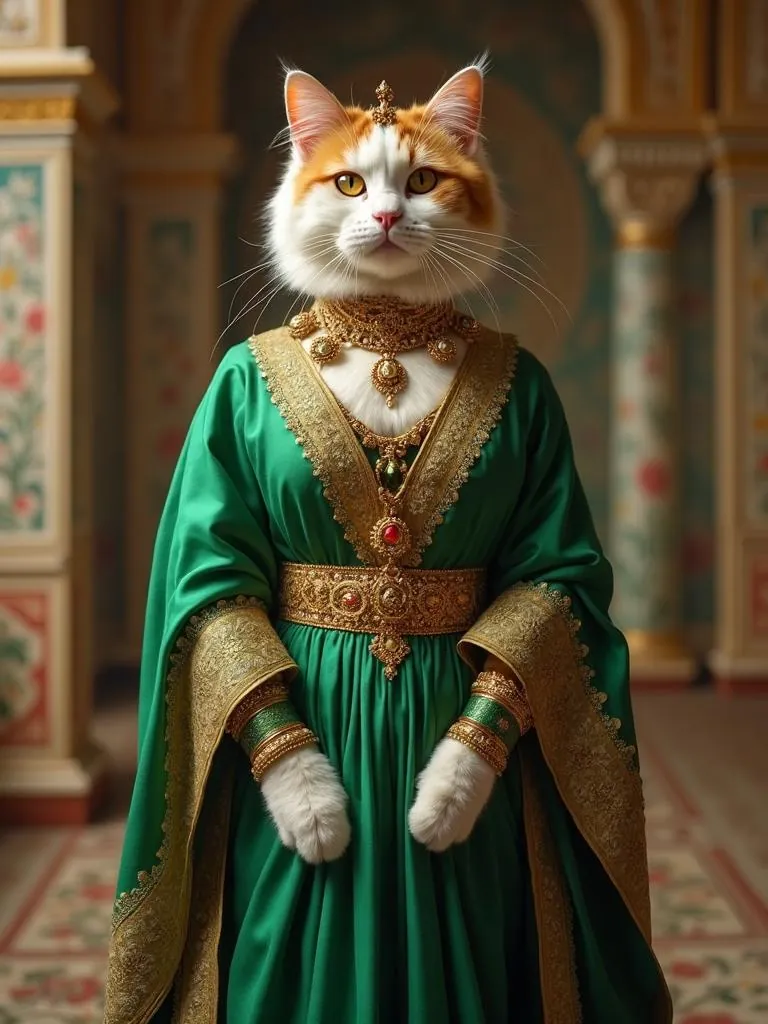
The Persian is a long-haired cat with a round head, large round eyes and a short nose. It is one of the oldest cat breeds. This guide follows its history from a cat carried to Italy in 1626 to the first cat show in London in 1871, then explains the face types, the coat colours, the daily grooming the coat needs, and how to photograph and portray a Persian.
Where the Persian cat came from
Nobody knows exactly where or when the first long-haired cats appeared. The Cat Fanciers' Association (CFA), a North American register of pedigree cats, says the breed's name comes from its presumed country of origin, Persia, the old name for Iran.
The earliest record the CFA gives is from 1626. In that year Pietro della Valle, an Italian trader, came back from a trip to Persia with a long-haired cat with a heavy coat. The CFA says this cat looked different from the Turkish Angora, another long-haired cat that reached Europe at about the same time. Breeders combined the two to produce a sturdy cat with a short nose and a coat that was silky, dense and full.
Victorian cat shows and the Persian
England's first cat show was held in Victorian London, and Persians were in it. The artist Harrison Weir planned the first one, at the Crystal Palace in London, in July 1871. In his book Our Cats and All About Them, published in 1889, Weir says he took the idea to the manager of the Crystal Palace, drew up the prize list and the points for judging, and drew a cat's head for the posters. He, his brother John Jenner Weir and the Rev. J. Macdona were the judges.
Weir describes walking along the pens with a friend who disliked cats. The cats lay on crimson cushions and drank fresh milk, and among them were "beautiful pure white Persian cats". By the end of the visit, his friend had begun to admire them. The CFA adds that Best in Show went to Weir's own cat, a 14-year-old female blue tabby of the type now called the British Shorthair.
A 2019 study led by the Royal Veterinary College (RVC) in England calls the Persian one of the oldest cat breeds, and also dates its first show to 1871 at the Crystal Palace.
Weir's book includes a chapter on the Persian as the Victorians judged it. He asked for:
- Eyes that were large, full and round, with a soft expression.
- A head larger than the Angora's, with smaller, less pointed ears that still had tufts of hair at the tips.
- A coat of long, silky hair, longest around the neck, where it looked like a lion's mane, with long tufts between the toes.
- A tail longer than the Angora's, shaped like a brush.
He wrote that black Persians were the most sought after and the hardest to find, with blue, which he also called light slate, next in value. White Persians were also in demand.
The breed then crossed the Atlantic. The CFA says the first Persians reached the United States in the late 1880s, and that the Persian was one of the six breeds the CFA recognized when it started in 1906. It has been among the CFA's ten most registered breeds for as long as that ranking has existed.
Face types and coat colours
Breed standards today describe the face in more detail than Weir did. The RVC study says current breed standards describe a massive round head, a broad skull and a short, broad nose, with a clear dip, called the break or stop, between the eyes. Every Persian has a short face. Veterinarians call this shape brachycephalic, which means short-headed. The study names two groups of breeding lines by how short the face is:
| Type | Other names in the RVC study | Face |
|---|---|---|
| Extreme | Peke-faced, Ultra-type | The flattest face |
| Less extreme | Doll-faced, Open-type, Classic | A face with more nose |
The shape matters for health. The RVC study says the Persian skull shape has been linked with problems of the eyes, face, teeth, breathing, nerves and giving birth, and that these may be worse in cats with the flattest faces. The authors recommend a move toward the less extreme types.
The CFA's show description asks for a heavily boned, well-balanced cat with a sweet expression and soft, round lines. The eyes should be large, round and full, level and set far apart. The coat should be long and thick, standing out from the body, with a huge ruff around the neck that continues in a deep frill between the front legs.
Persians come in many colours. The CFA shows them in seven colour groups:
- Solid
- Silver and golden
- Shaded and smoke
- Tabby
- Parti-colour
- Calico and bicolour
- Himalayan, the colour-point Persian with a pale body and darker face, ears, legs and tail
The CFA calls the breed playful yet placid, easygoing and mellow. It says a Persian can be persuaded to chase a toy, but is happier receiving attention and affection.
Grooming a Persian
The Persian's coat needs daily care. The CFA says owning one calls for a serious commitment to grooming, and to vacuuming. It recommends a steel or Teflon-coated comb with long coarse and fine teeth to keep the coat free of mats (tight clumps of tangled hair). Comb the coat thoroughly and trim the nails before an occasional bath. Many owners use a professional groomer.
The RVC study shows why this matters. It followed 3,235 Persians seen at 304 veterinary clinics in the UK during 2013. At least one health problem was recorded for 64.9% of them. The most common problems were:
- Coat problems: 12.7%
- Gum disease: 11.3%
- Overgrown nails: 7.2%
- Eye discharge: 5.8%
The authors cite a study of how cats groom themselves, which found that the long, dense coat of a Persian stops the cat from reaching the deeper layers of its own fur.
The Cornell Feline Health Center gives three pieces of advice:
- Brush and comb every day. Start while the cat is young, so it gets used to it.
- Expect more hairballs in long-haired breeds such as Persians and Maine Coons, above all in the seasons when cats shed.
- Ask for help if the cat refuses. A veterinarian or a reputable groomer can give a haircut once or twice a year, which Cornell says works well for long-haired breeds.
Cornell also says grooming is important for older long-haired cats, which can become matted when they stop cleaning themselves as well. A sudden change in grooming can be a sign of illness, so mention it to your vet.
How to photograph a Persian for a portrait
A long coat and a short face each need care in a photo. These steps build on the general guide on how to photograph your pet for a portrait:
- Comb first. A combed coat shows its real length and shape. Photograph after a calm grooming session, once the cat has relaxed again.
- Check the eyes. Eye discharge was one of the four most common problems in the RVC study. If the fur under the eyes is stained or damp, ask your vet how to clean it safely before the photo day.
- Use soft side light. Window light from one side shows the texture of long fur. Light from behind the camera flattens a pale coat into one white shape.
- Keep the fur detailed. A white, cream or silver coat can turn plain white in a bright photo. The guide to photographing black and white coats explains how to set the brightness.
- Get level with the face. Hold the camera at the cat's eye level. A short nose can disappear in a photo taken from above, and a turn of the head to one side shows its shape.
- Show the whole cat if you can. A royal portrait dresses the body, so a photo that shows the ruff, the chest and the front paws gives the portrait your cat's real markings to follow.
Persians in royal portraits
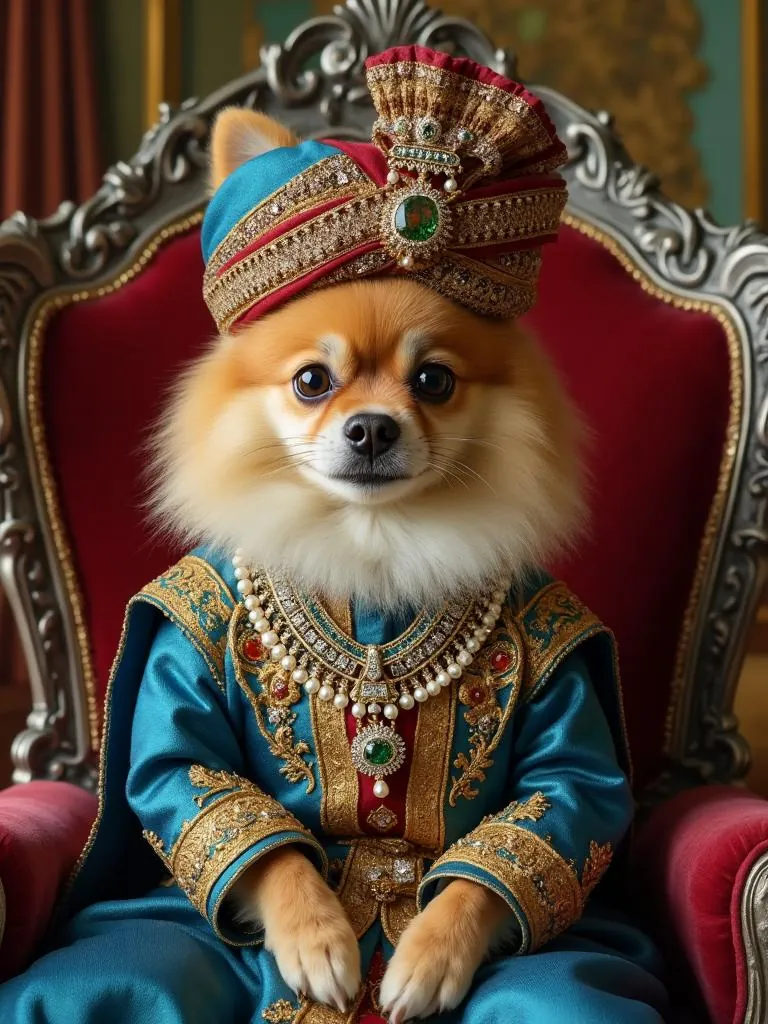
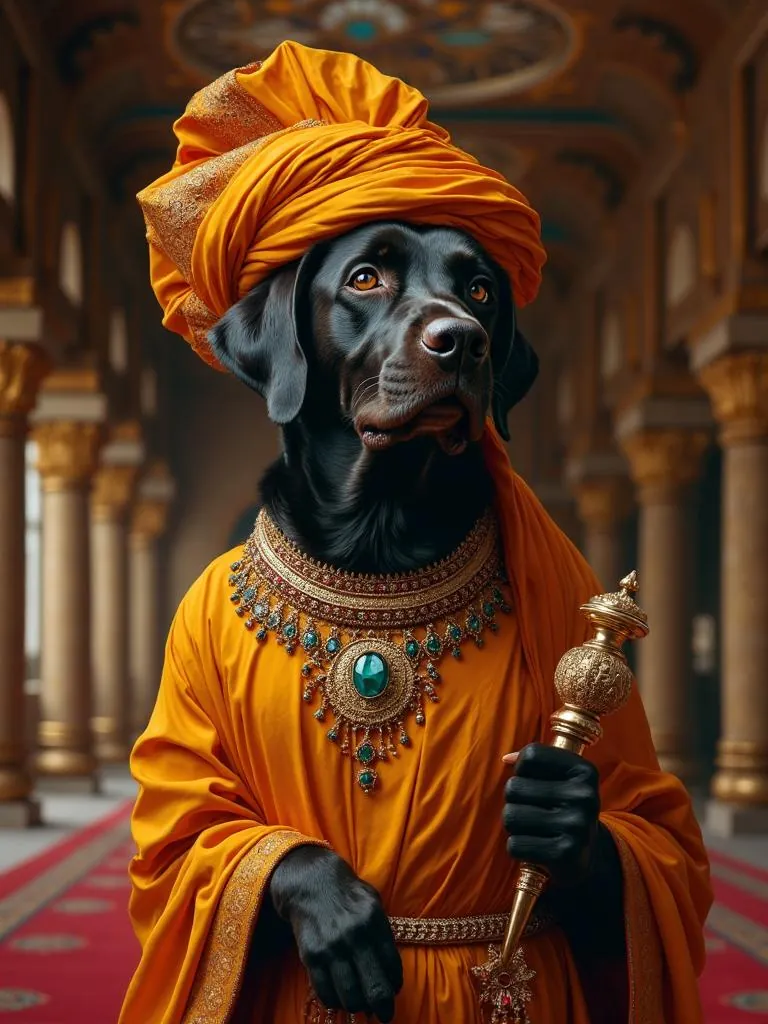
The gallery has two studio examples of Persian cats, each shown next to the original photo. In the Maratha King style, a white Persian with a flat face wears a saffron turban with pearls and a saffron robe, and holds a curved sword, with a fort flying saffron flags behind. In the Maharaja style, a long-haired Persian wears a blue turban with a white feather and strings of pearls, and a green coat embroidered in gold, seated on a gold throne.
Royal cats have a long history of their own, told in the guide to royal cats in history. To start a portrait of your own Persian, choose a style in the portrait studio and upload one photo of up to 5 MB.
Questions and answers
Why is it called Persian cat?
The Persian cat is called Persian after Persia, the old name for Iran, which the Cat Fanciers' Association calls the breed's presumed country of origin. The CFA says that in 1626 an Italian trader, Pietro della Valle, came back from a trip to Persia with a long-haired cat that had a heavy coat. How the first long-haired cats reached Europe is not known for certain.
When did Persian cats originate?
The exact date when Persian cats originated is not known. The earliest record the Cat Fanciers' Association gives is from 1626, when the Italian trader Pietro della Valle brought a long-haired cat back to Italy from Persia. A 2019 study by the Royal Veterinary College calls the Persian one of the oldest cat breeds, and says it was first shown at a cat show in 1871, at the Crystal Palace in London.
Are Persian cats affectionate?
Persian cats are described as calm and affectionate by the Cat Fanciers' Association. The CFA calls the breed playful yet placid, easygoing and mellow, and says a Persian can be persuaded to chase a toy but is happier receiving attention and affection. Each cat still has its own character, so meet the cat or its parents before you decide.
Do Persian cats shed?
Persian cats shed hair, and their long coat makes the loose hair a larger problem. The Cornell Feline Health Center says hairballs are more common in the seasons when cats shed their coats, and that long-haired breeds such as Persians and Maine Coons are at greater risk of hairballs than short-haired breeds. Cornell recommends brushing and combing the coat every day to remove loose hair.
Should Persian cats be groomed?
Persian cats should be groomed every day, because their long, dense coat tangles and mats. The Cat Fanciers' Association says owning a Persian calls for a serious commitment to regular grooming, and recommends a steel or Teflon-coated comb with long coarse and fine teeth. A 2019 Royal Veterinary College study found coat problems in 12.7% of the Persians it followed, the most common problem recorded.
Do Persian cats need baths?
Persian cats need a bath from time to time. The Cat Fanciers' Association says a Persian should be combed thoroughly and have its nails trimmed before an occasional bath, so that no tangles are left to tighten in the water. The CFA also says many pet owners take their Persians to a professional groomer, because the coat needs so much care.
Can you shave a Persian cat?
A Persian cat can be given a haircut when daily brushing is not possible. The Cornell Feline Health Center says that if a cat will not allow brushing, you can take it to a veterinarian or a reputable groomer for a haircut once or twice a year, and that this works well for long-haired breeds. A haircut shortens the coat so that daily combing becomes easier to keep up.
Do Persian cats have breathing problems?
Persian cats can have breathing problems linked to their flat faces. A 2019 study by the Royal Veterinary College says the Persian skull shape has been associated with eye, face, tooth, breathing, nerve and birth problems, and that these may be worse in cats with the flattest faces. The study found eye discharge in 5.8% of Persians and gum disease in 11.3%.
When was the first cat show?
The first cat show in England was held at the Crystal Palace in London in July 1871. It was planned by the artist Harrison Weir, who wrote in his 1889 book Our Cats and All About Them that he, his brother John Jenner Weir and the Rev. J. Macdona judged it. Weir wrote that the show included beautiful pure white Persian cats, resting on crimson cushions.
How do I photograph a long-haired cat for a portrait?
A long-haired cat photographs best after a comb-through, in soft daylight from a window to one side. Side light shows the texture of the coat, while light from straight ahead flattens it into one pale shape. Hold the camera at the cat's eye level and focus on the eyes. For a white or silver coat, lower the brightness a step so the fur keeps its detail.
Sources
- Persian, The Cat Fanciers' Association
- British Shorthair article, 1995, The Cat Fanciers' Association
- Persian cats under first opinion veterinary care in the UK: demography, mortality and disorders (O'Neill and others, Scientific Reports, 2019), Royal Veterinary College and University of Edinburgh, in Scientific Reports
- A Hairy Dilemma, Cornell Feline Health Center, Cornell University College of Veterinary Medicine
- The Danger of Hairballs, Cornell Feline Health Center, Cornell University College of Veterinary Medicine
- Loving Care for Older Cats, Cornell Feline Health Center, Cornell University College of Veterinary Medicine
- Our Cats and All About Them, by Harrison Weir (1889), Project Gutenberg
Share this guide
The button copies a ready-written post, then opens LinkedIn. Paste the text into the post box.
Go deeper
The full guides on this topic, each a set of pages with sources: