Steinlen's cats: the Chat Noir artist and his wordless cat stories
How Théophile-Alexandre Steinlen drew cats for the Chat Noir journal, gathered them in the book Des chats, and kept a Montmartre house called the Cat's Cottage.
By Purrealism. Part of Cats in art: the artists and artworks behind a royal cat portrait.
Théophile-Alexandre Steinlen (1859 to 1923) drew, printed and sculpted cats for most of his working life in Paris. This page follows his cats from the wordless picture stories he drew for the journal of the Chat Noir cabaret in the 1880s, to his book Des chats, his cat posters and prints, and the Montmartre house that people called the Cat's Cottage. It draws on the records of the libraries and museums that hold his work, among them the Bibliothèque nationale de France (BnF), the Art Institute of Chicago and the Musée d'Orsay. For cats by other artists, start with the cats in art guide.
From Lausanne to Montmartre
Steinlen was born in Lausanne, Switzerland, in 1859. La Tribune de l'Art, a French art journal, says he moved to Paris in 1881 and lived there for the rest of his life. The Association des amis de Théophile Alexandre Steinlen, a society devoted to his work, says he first trained as a designer of printed fabrics. It dates his arrival in Paris to October 1881, with his partner and later wife, Émilie Mey.
He settled in Montmartre, the hill district in the north of Paris. In 1881 Rodolphe Salis opened a cabaret there, a club with songs, poems and shows, called Le Chat Noir, "The Black Cat". The Musée d'Orsay says the black cat gave the cabaret its name and its outline. The museum suggests two reasons for the name: a tribute to Edgar Allan Poe's story The Black Cat and to Charles Baudelaire, who translated Poe and wrote poems about cats, and the stray cats that filled Paris at night at the time.
The friends' association says the painter Adolphe Willette, Steinlen's neighbour, introduced him to Salis. In June 1885 Salis moved the cabaret to a larger building at 12 rue de Laval. The Musée d'Orsay records that Steinlen decorated the new Chat Noir and made the cat its main character.
Le Chat Noir, the journal
Salis also started a journal with the same name. The BnF says Le Chat Noir was created in 1882 to promote the cabaret. It was an illustrated weekly with literary texts, poems, announcements and stories told in pictures without captions. The friends' association gives the dates of the first and last issues: 14 January 1882 and 30 March 1895, with 690 issues in all.
Stories without words
The BnF says Steinlen was one of the first artists to draw wordless comic strips for the journal, and one of its most prolific contributors. Each story filled one page and had a title, and the pictures told the rest. The French department of Rutgers University, whose Zimmerli Art Museum holds many of his works, says Steinlen made the cabaret's own cat the hero of a number of these "histoires sans paroles", or stories without words.
The BnF's list of his strips shows how often a cat led the story in 1884 alone:
- 23 February: Le corbeau et le chat (The crow and the cat)
- 1 March: Le chat, l'enfant et la tartine (The cat, the child and the slice of bread)
- 29 March: Comment l'amour vient aux chats (How love comes to cats)
- 3 May: Horrible fin d'un poisson rouge (Horrible end of a goldfish)
- 20 September: Le chat et la grenouille (The cat and the frog)
- 13 December: Chat blanc, chat noir (White cat, black cat)
Horrible End of a Goldfish appeared in issue 121, on 3 May 1884. The Musée de Montmartre owns a print of the page, and La Tribune de l'Art shows it as the first image in its review of the museum's Steinlen centenary exhibition. The BnF puts the journal's first nine years online in its Gallica digital library, with nearly 400 wordless stories by all of its artists. The last Steinlen strip on the BnF's list is dated 30 May 1891.
Des chats: the book of cat stories
Steinlen's strips were later gathered into albums. The Museum of Fine Arts, Boston, holds a copy of Des chats: images sans paroles (Some cats: pictures without words), published in Paris by Ernest Flammarion. The museum dates it 1898 with a question mark, and the BnF gives 1897. It is a large book, 44.7 cm tall and 31 cm wide, with 28 leaves. The museum lists the pictures as gillotypes, prints reproduced from his drawings, and the cover as a colour lithograph, a print made from a drawing on stone.
Princeton University Library holds another copy. In January 2026 its staff chose a page from the book for one of the library's monthly stickers, and described the book as comic-like scenes of cats getting into mischief. The page they chose shows a cat fascinated by a fishbowl: the goldfish story from Le Chat Noir, printed again in the book.
The Virginia Museum of Fine Arts owns an ink drawing for the book called Le méchant dada (Bad horsey), which it dates to around 1898. A strip with the same title appeared in Le Chat Noir on 19 September 1885, according to the BnF's list.
Posters, prints and magazine pages
His best-known cat is the black cat on the 1896 poster Tournée du Chat Noir, which our list of famous paintings of cats describes.
Many other works with cats survive in museums. In 1894 Steinlen made the poster À la Bodinière, a lithograph in black, olive, orange and blue, 58.5 by 79.4 cm, now in the Art Institute of Chicago. The Virginia Museum of Fine Arts included its own copy in its exhibition Steinlen: Cats. The friends' association says La Bodinière was also the gallery where he held his first solo exhibition in 1894, with 300 works.
For the magazine L'Illustration, Steinlen surrounded a short article by Jacques Dalbray in praise of cats with colour drawings of cats. The Cleveland Museum of Art holds the page from the issue of 30 March 1901. The cats sit, sleep and prowl around the columns of text, as if the text were furniture. The museum explains that colour printing was costly at the time, because each colour had to be printed separately. Steinlen overlapped as few colours as possible, such as yellow, grey and black, to make many different fur patterns.
The Art Institute of Chicago holds a group of his cat prints from the Charles Deering Collection:
- Cat Arching Its Back, 1898. A drypoint, a print from lines scratched straight into a metal plate with a needle. The image is 7.6 by 14.1 cm.
- Reclining Cat Stretched Out from Left to Right, February 1903. An aquatint and soft-ground etching, two ways of printing tone and soft lines from a metal plate, in dark brown ink.
- Winter: Cat on a Cushion, 1909. A lithograph in six colours printed from two stones, 49.4 by 58.9 cm.
- Summer: Cat on a Balustrade, 1909. The companion print. The museum holds two copies in different colours, one in pink, violet, black and brown, the other in green, yellow-orange, brown and black.
- Two Cats on a Cushion, 1914. A drypoint, 15.2 by 25.4 cm.
The Virginia Museum of Fine Arts built its exhibition Steinlen: Cats from the Frank Raysor Collection, a gift to the museum, with 32 works. It opened in October 2018 and later travelled to the Museum of the Shenandoah Valley in 2019. The museum says the show traced how Steinlen tried several styles over his career, among them Japonisme, the French taste for Japanese art. Our page on cats in Japanese woodblock prints covers that art.
Steinlen's own cats and the Cat's Cottage
The Musée d'Orsay says Steinlen was a member of the Société protectrice des animaux, the French society for the protection of animals. He housed and fed all the cats of his neighbourhood in his house on rue Caulaincourt, which was renamed the Cat's Cottage. La Tribune de l'Art says he lived surrounded by stray cats, so the house was nicknamed the Cat's Cottage or the Cat's Villa. It adds that he also took in peacocks, monkeys and a crocodile named Gustave.
The friends' association dates the move to 58 rue Caulaincourt to 1894. The studio filled the ground floor, and the family lived on the floor above, which had a balcony. The association records cats, a monkey and a crocodile at the house, and says the crocodile died in 1902. It cites witnesses of the time who described the house as a meeting place for all the cats of the district.
The association also tells two stories about his early love of cats. As a schoolboy he drew cats in the margins of his notebooks. In his first years as an artist in Paris, it says, he sold cat drawings in exchange for food.
The Musée d'Orsay explains what the cat meant to him. He made it his emblem: independent and rebellious, like the artist himself, and, in the museum's words, "the eye of the street". The museum holds his drawing Chat noir couché en boule sur un divan (Black cat curled up in a ball on a sofa), dated 1920, given by Colette Desormière in 1962. It showed the drawing in 2023 in a small display of cat drawings by Steinlen and Édouard Manet. Manet had drawn his own cat poster in 1868, for a book about cats, and his cats have a page of their own.
Steinlen also sculpted cats. La Tribune de l'Art reports three bronze cats in the first room of the centenary exhibition at the Musée de Montmartre, which ran from 13 October 2023 to 11 February 2024. The museum says cats were one of the main subjects of his work, beside the people of Paris.
Where to see Steinlen's cats
| Work | Date | Type | Where it is held |
|---|---|---|---|
| Horrible fin d'un poisson rouge | 3 May 1884 | Page of the journal Le Chat Noir | Musée de Montmartre, Paris; online at the BnF's Gallica |
| À la Bodinière | 1894 | Colour lithograph poster | Art Institute of Chicago |
| Des chats: images sans paroles | 1897 or 1898 | Book of cat stories | Museum of Fine Arts, Boston; Princeton University Library |
| Cat Arching Its Back | 1898 | Drypoint | Art Institute of Chicago |
| On Cats, for L'Illustration | 30 March 1901 | Colour magazine page | Cleveland Museum of Art |
| Reclining Cat Stretched Out from Left to Right | 1903 | Aquatint and soft-ground etching | Art Institute of Chicago |
| Winter: Cat on a Cushion | 1909 | Colour lithograph | Art Institute of Chicago |
| Summer: Cat on a Balustrade | 1909 | Colour lithograph | Art Institute of Chicago |
| Two Cats on a Cushion | 1914 | Drypoint | Art Institute of Chicago |
| Chat noir couché en boule sur un divan | 1920 | Drawing | Musée d'Orsay, Paris |
In September 2026 the Art Institute of Chicago listed all of its Steinlen cat prints in this table as not on view, and the Museum of Fine Arts, Boston, listed its copy of Des chats the same way. Check each museum's page before a visit. The journal pages are the easiest to see, because the BnF shows them free online.
Steinlen's cats and a portrait of your own cat
Steinlen drew cats he knew, in the poses they take at home: a back arched, a body stretched out on the floor, a cat curled on a cushion. A portrait of your own cat starts in the same way, with one clear photo in which your cat looks like itself. Our page on Louis Wain follows another artist who filled magazines with cats.
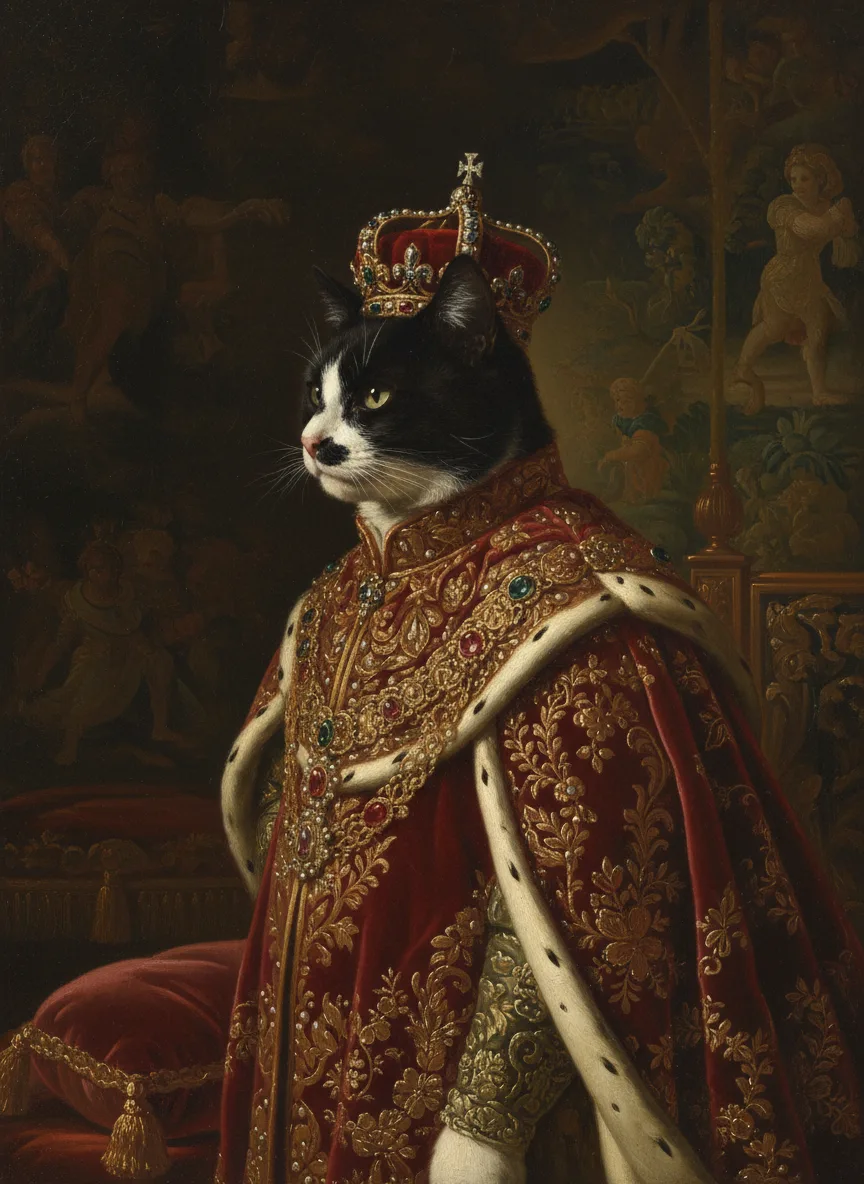
The cover of this page shows a tuxedo cat from the studio examples, painted in the Renaissance Royal style. Purrealism offers 15 royal styles, from Indian Royalty to Regency Era. You can see finished portraits in the gallery, or upload one photo of up to 5 MB in the portrait studio.
Questions and answers
What is Le Chat Noir?
Le Chat Noir, French for The Black Cat, was a cabaret opened by Rodolphe Salis in Montmartre, Paris, in 1881, and also the name of its weekly journal. According to the Bibliothèque nationale de France, the journal was created in 1882 to promote the cabaret. It printed literary texts, poems, announcements and stories told in pictures without captions, and Théophile-Alexandre Steinlen drew many of those picture stories with cats.
Was Steinlen French or Swiss?
Théophile-Alexandre Steinlen was born in Switzerland and worked in France. The Art Institute of Chicago describes him as a French artist born in Switzerland, who lived from 1859 to 1923. La Tribune de l'Art, a French art journal, says he was born in Lausanne in 1859, moved to Paris in 1881 and lived there for the rest of his life, in the Montmartre district.
What is Steinlen's Horrible End of a Goldfish?
Horrible End of a Goldfish is a wordless cat story by Théophile-Alexandre Steinlen, printed in issue 121 of the journal Le Chat Noir on 3 May 1884. In the pictures, a cat is fascinated by a fishbowl. The Musée de Montmartre in Paris owns a print of the journal page, and Princeton University Library holds a copy of his later book Des chats, which includes the same goldfish story.
What is Steinlen's book Des chats?
Des chats: images sans paroles, meaning Some cats: pictures without words, is a book of Théophile-Alexandre Steinlen's cat drawings published in Paris by Ernest Flammarion. The Museum of Fine Arts, Boston, dates it 1898 with a question mark and describes a large volume of 28 leaves with a colour lithograph cover. The Bibliothèque nationale de France says it gathered his wordless strips from the journal Le Chat Noir.
Where can I see Steinlen's Des chats book?
Copies of Théophile-Alexandre Steinlen's Des chats are held by the Museum of Fine Arts, Boston, and by Princeton University Library. The Boston copy is 44.7 cm tall and is listed as not on view. Many of the same stories first appeared in the journal Le Chat Noir, and the Bibliothèque nationale de France offers the journal's first nine years free on its Gallica website.
Why was Steinlen's house called the Cat's Cottage?
Théophile-Alexandre Steinlen's house on rue Caulaincourt in Montmartre was called the Cat's Cottage because of the cats he looked after there. According to the Musée d'Orsay, he belonged to the French animal protection society and housed and fed all the cats of his neighbourhood. La Tribune de l'Art says the house was also nicknamed the Cat's Villa.
Did Steinlen have other pets besides cats?
Théophile-Alexandre Steinlen kept other animals besides cats. La Tribune de l'Art says he lived surrounded by stray cats at his house in Montmartre and also took in peacocks, monkeys and a crocodile named Gustave. The Association des amis de Théophile Alexandre Steinlen, a society devoted to his work, records a monkey and a crocodile at the house on rue Caulaincourt and says the crocodile died in 1902.
Why did Steinlen draw so many cats?
Théophile-Alexandre Steinlen drew cats because he lived with them and saw them as a sign of himself. The Musée d'Orsay says he made the cat his emblem, independent and rebellious like the artist, and calls him the artist who drew cats more than any other. The Association des amis de Théophile Alexandre Steinlen says he already drew cats in the margins of his school notebooks.
Where can I see Steinlen's cat prints?
The Art Institute of Chicago holds a group of Théophile-Alexandre Steinlen's cat prints from the Charles Deering Collection. They include Cat Arching Its Back of 1898, Winter: Cat on a Cushion and Summer: Cat on a Balustrade of 1909, and Two Cats on a Cushion of 1914. In September 2026 the museum listed all of them as not on view, so check its website before a visit.
What did Steinlen draw for L'Illustration?
Théophile-Alexandre Steinlen drew colour cats around an article about cats by Jacques Dalbray in the French magazine L'Illustration of 30 March 1901. The Cleveland Museum of Art, which holds the page, says the cats sit, sleep and prowl around the columns of text. It explains that each colour had to be printed separately, so Steinlen overlapped as few colours as possible, such as yellow, grey and black, to make many fur patterns.
Did Steinlen make sculptures of cats?
Théophile-Alexandre Steinlen made sculptures of cats as well as drawings and prints. La Tribune de l'Art reports that three bronze cats by Steinlen were shown in the first room of the centenary exhibition at the Musée de Montmartre in Paris, which ran from 13 October 2023 to 11 February 2024. The review says the exhibition gave no information about his sculpture.
Sources
- Bandes dessinées de Théophile Alexandre Steinlen, Bibliothèque nationale de France, Gallica. Accessed September 28, 2026.
- Le Chat noir, Bibliothèque nationale de France, Gallica. Accessed September 28, 2026.
- Théophile-Alexandre Steinlen. The centenary exhibition, La Tribune de l'Art. Accessed September 28, 2026.
- Théophile-Alexandre Steinlen (1859-1923) The Centenary Exhibition, Musée de Montmartre. Accessed September 28, 2026.
- Exposition Accro-chat-ge (archived copy of the museum page), Musée d'Orsay. Accessed September 28, 2026.
- Biographie, Association des amis de Théophile Alexandre Steinlen. Accessed September 28, 2026.
- About That Cat, Department of French, Rutgers University. Accessed September 28, 2026.
- Des Chats: Images Sans Paroles (Some Cats: Pictures Without Words), Museum of Fine Arts, Boston. Accessed September 28, 2026.
- January 2026 Decalcomania, Princeton University Library, Special Collections. Accessed September 28, 2026.
- Steinlen: Cats, Virginia Museum of Fine Arts. Accessed September 28, 2026.
- Steinlen Cats, Museum of the Shenandoah Valley. Accessed September 28, 2026.
- On Cats by Jacques Dalbray, Cleveland Museum of Art. Accessed September 28, 2026.
- À la Bodiniére, The Art Institute of Chicago. Accessed September 28, 2026.
- Cat Arching Its Back, The Art Institute of Chicago. Accessed September 28, 2026.
- Reclining Cat Stretched Out from Left to Right, The Art Institute of Chicago. Accessed September 28, 2026.
- Winter: Cat on a Cushion, The Art Institute of Chicago. Accessed September 28, 2026.
- Summer: Cat on a Balustrade, The Art Institute of Chicago. Accessed September 28, 2026.
- Summer: Cat on a Balustrade (second colour version), The Art Institute of Chicago. Accessed September 28, 2026.
- Two Cats on a Cushion, The Art Institute of Chicago. Accessed September 28, 2026.
Short reads on this topic
Articles from Purrspectives that answer one question each.
Dog years to human years: the chart by size, and the DNA formula
A 1-year-old dog is closer to 15 or 30 in human years than to 7. The AKC chart by size, the 2020 DNA formula, and a dog's life stages, explained simply.

Pug history: from Chinese emperors to the House of Orange
Pugs began as companions of Chinese emperors, reached Holland on Dutch trading ships and became the dog of the House of Orange. Their history, art and health.
Persian cat history: where the breed came from, its first cat show, coat and care
Persian cat history from a cat brought to Italy in 1626 to the 1871 Crystal Palace show, plus face types, coat colours, grooming and how to photograph one.