Cats in ancient Egypt: how they were tamed and how they lived
How cats were tamed in Egypt, what they ate, the prince who gave his cat a stone coffin, and what Herodotus, Diodorus and the cat cemeteries record.
By Purrealism. Part of Royal pets in history: the real dogs and cats of kings, queens and emperors.
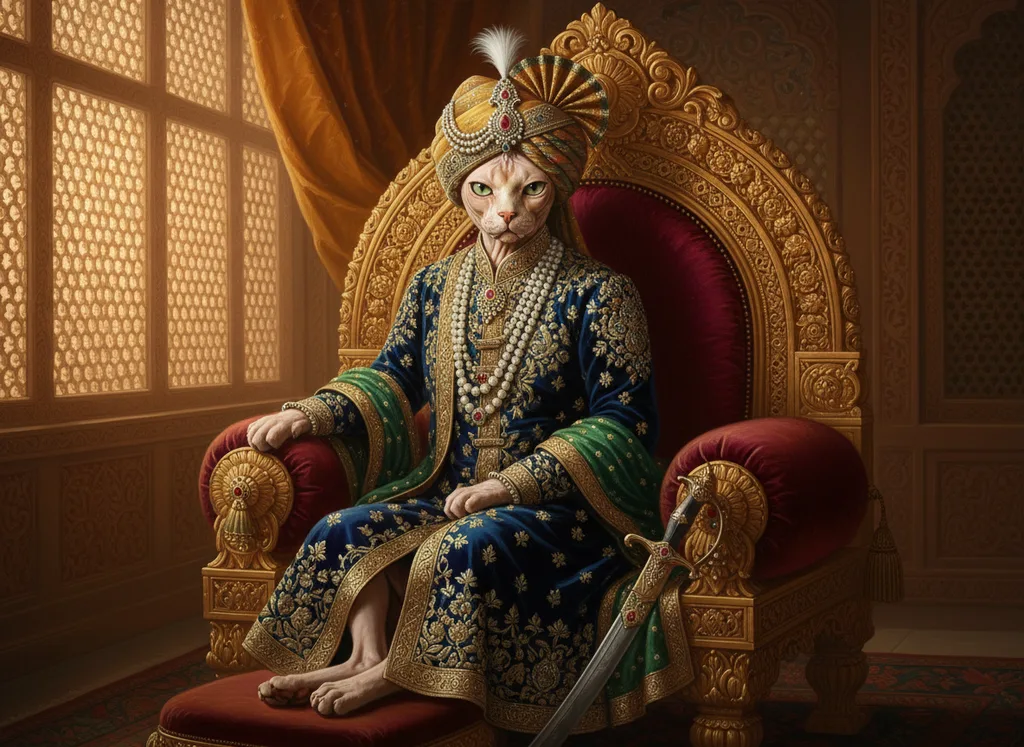
This page follows the real cats of ancient Egypt: when people first began to live with them, how they were fed and kept, the few cats whose names or coffins survive, and what two Greek writers recorded about them. It ends with the two great cat cemeteries at Bubastis and Beni Hasan, and what archaeologists found there. For other royal animals from Egypt to Europe and India, start at the royal pets in history guide. The goddess Bastet, cat mummies as gifts to the gods and the famous bronze cat statues have their own article, royal cats in history, so this page covers them only in passing.
When people in Egypt began to live with cats
For a long time, historians dated the domestic cat in Egypt to the Middle Kingdom, around 1950 BC, or, on less direct evidence, 300 years earlier, in the late Old Kingdom. A team led by Wim Van Neer of the Royal Belgian Institute of Natural Sciences sums up that older view in a 2014 paper in the Journal of Archaeological Science. The same paper mentions an earlier find from Cyprus: a cat buried close to a human around 9,500 years ago.
The Egyptian evidence comes from Hierakonpolis, on the west bank of the Nile, 17 km north of the modern town of Edfu. Its cemetery HK6 held the tombs of the town's leading families, and many animals were buried around them in graves of their own. An earlier find there was a jungle cat, a separate wild species, dated to 3700 BC. A thigh bone and a front leg bone had healed after breaking, so someone had cared for it for several weeks before it was killed and buried.
Then the team found a small pit with six cats buried at the same time: a male, a female and four kittens from two different litters. The grave dates from between 3800 and 3600 BC. The kittens were 4 to 5 months old, and the female was under a year old, too young to be their mother. The shape of the jaw and the size of the leg bones point to the domestic form of the cat, although the authors ask readers to treat that result with caution. The ages give a second clue. Wild cats in Egypt have one birth season, in spring, and the ages of these cats show births outside that season. The authors write that wild cats raised by people in Africa can have two or three litters a year. Their conclusion is that people and cats were living closely at Hierakonpolis almost 2,000 years before the older accepted date.
Ancient DNA shows how cats spread beyond Egypt. A 2017 study in Nature Ecology and Evolution, which tested cat remains from many sites and periods, found that both the Near Eastern and the Egyptian wildcat populations passed their genes to the domestic cat, at different times. Cats first spread from the Near East in the Neolithic period. In the Classical period, the Egyptian cat spread across the Old World along the sea and land routes of trade. The same study found that the tabby coat pattern became common only after the Middle Ages.
Cats at home and on the hunt
The Egyptian word for cat was miu, or miut, which Jennifer Houser Wegner, a curator in the Egyptian Section of the Penn Museum, says probably sounded like the cry of a cat. Writing for Glencairn Museum in 2015, she explains that people in the Nile valley first valued cats near their homes because the cats kept pests down. Over time, cats became household pets. Tomb walls and funerary stelae, the carved stone slabs set up for the dead, show cats sitting under or beside their owners' chairs. Henry G. Fischer, curator in Egyptology at The Metropolitan Museum of Art, dates the first of these pet cats in art to the 12th Dynasty.
Some cats hunted. Wegner's article illustrates a hunting cat from the tomb of Nebamun, from the 18th Dynasty, around 1350 BC. The Greek historian Diodorus Siculus gave another practical reason to keep one: in book I of his Library of History, he wrote that the cat was useful against asps, which are venomous snakes, and against other reptiles that sting.
Diodorus also recorded what the cats of the sacred places ate. Their keepers broke bread into milk and called the cats with a clucking sound, or cut up fish from the Nile and fed it to them raw. He wrote that land was set aside for each sacred species, and that its income paid for their food and care.
Cats even appear in advice for daily life. Wegner quotes a wisdom text from the Ptolemaic period, the Instruction of Onchsheshonqy, which has over 500 lines of advice. One line reads "Do not laugh at a cat". She reads it as a warning against mocking the gods who could appear in the form of a cat.
Named cats and a prince's stone coffin
Fischer, writing in the Metropolitan Museum Journal in 1977, kept a numbered list of Egyptian dog names that runs to 77 entries. For cats he could point to only one personal name in a tomb painting: a cat facing its master in the 18th Dynasty tomb of Puyemre at Thebes. Its name is Nedjem, "The Pleasant One", a name people also used.
One Egyptian pet cat belonged to a prince. Fischer writes that Thutmose, High Priest of Memphis and a son of King Amenhotep III, valued his cat so much that he had a limestone coffin made for her. Even so, the inscription calls her only "The Cat". The coffin is in the Cairo Museum, listed as CG 5003. Wegner, in her Glencairn article, says some pet cats were buried in carved coffins that carried the animal's own name, and that the best known of these belonged to a royal pet, the cat Ta-miu, a name that means "The female cat". The name has the same meaning as the words Fischer reads on Thutmose's coffin, though Wegner names no owner. The same Glencairn article dates the reign of Amenhotep III to 1391 to 1353 BC.
| Cat | Date | What the record says | Source |
|---|---|---|---|
| Six cats at Hierakonpolis | 3800 to 3600 BC | A male, a female and four kittens buried together in an elite cemetery | Van Neer and others, 2014 |
| The cat of Prince Thutmose | Reign of Amenhotep III, 1391 to 1353 BC | A limestone coffin; the inscription calls her "The Cat" | Fischer, 1977 |
| Nedjem | 18th Dynasty | Named in the tomb of Puyemre at Thebes: "The Pleasant One" | Fischer, 1977 |
| The cats Diodorus saw | 59 BC | A Roman who killed one by accident was punished by a crowd | Diodorus, book I |
| Beni Hasan cats | Buried in ancient times; shipped in 1890 | 19.5 tons of mummies sent to Liverpool | University of Liverpool |
What Herodotus reported
The Greek historian Herodotus, who lived from around 484 to 425 BC, wrote about Egypt's customs in book 2 of his Histories. On cats, he describes a house fire. He writes that the Egyptians stood around in a broken line, watching the cats more than fighting the fire, while the cats slipped past the men and leapt into the flames. When a cat died, he says, there was great mourning. In a house where a cat died a natural death, the family shaved only their eyebrows. When a dog died, they shaved the head and the whole body.
He also offers his own explanation for why Egypt did not have even more cats: male cats, he says, killed kittens so that the mothers would breed again. The next section of the book, chapter 67, gives a practical fact: dead cats were carried to sacred buildings in the town of Bubastis, where they were embalmed and buried.
What Diodorus saw with his own eyes
Diodorus Siculus, a Greek historian, visited Egypt in 59 BC, according to C. H. Oldfather's introduction to his translation. Diodorus wrote that anyone who killed a cat or an ibis, even by accident, was put to death, because crowds attacked the killer, sometimes with no trial. People who came across a dead cat shouted that they had found it already dead.
He says he saw the next story himself. A group of Romans was visiting Egypt at a time when Rome had not yet named the Egyptian king, Ptolemy, a friend, and the people were anxious to give the visitors no reason for complaint or war. One of the Romans killed a cat by accident. A crowd rushed to his house. The officials the king sent to plead for him could not save him, and neither could the people's fear of Rome. Diodorus adds that Egyptian soldiers on campaign abroad bought back captured cats and hawks and brought them home, even when they were short of money for the journey.
Bubastis: the cemetery of the cat goddess's city
Bubastis is Tell Basta today, in Al-Sharkia in the eastern Nile Delta. Egypt's Ministry of Tourism and Antiquities describes it as the house of the goddess Bastet, and as the capital of the country during the 22nd Dynasty, around 945 to 715 BC.
The archaeologist Édouard Naville dug at Bubastis from 1887 to 1889 and published his results in 1891. He believed the kings of the 22nd Dynasty set up the cemetery of cats. Local farmers had already dug out several acres in search of the bronze cats sold in the dealers' shops of Cairo, leaving heaps of white cat bones. In the winter of 1889, Naville's team dug deeper, into older pits. The bones lay in large underground pits with walls of brick or hardened clay. Beside each pit stood a furnace with red or blackened bricks, and the bones were mixed with ashes and charcoal. Naville concluded that the bodies had been burnt. One pit held more than 720 cubic feet of bones.
Naville sent skulls to the naturalist Professor Virchow in Berlin. Some turned out to belong to ichneumons, a species of mongoose, which were also sacred animals. He wrote that mummified cats were rare at Bubastis, while at Beni Hasan mummification was the rule. In 1891 Naville also believed the Egyptians had tamed the cat without truly domesticating it. The Hierakonpolis evidence above, published more than a century later, points to a close bond much earlier than he thought.
Beni Hasan: cats that became fertiliser
The University of Liverpool's Department of Archaeology, Classics and Egyptology says 19.5 tons of cat mummies from the cemetery at Beni Hasan were shipped to Liverpool in 1890 and crushed for use as fertiliser. The archaeologist John Garstang later dug more than 888 tombs at Beni Hasan, from 1902 to 1904. In 2016, a display at World Museum in Liverpool showed some Beni Hasan cats that escaped that fate, including the Garstang Museum's own cat mummy, known as Felix.
From Egyptian cats to your own cat
Some modern breeds carry Egyptian names. The Cat Fanciers' Association links the spotted Egyptian Mau to cats shown in papyri and wall paintings from as early as 1550 BC, and says the breed reached the United States in 1956 with a Russian princess, Nathalie Troubetskoy. The Sphynx, the hairless cat on this page's cover, has a Canadian story. The association says it began in Toronto in 1966, when a domestic cat gave birth to a hairless kitten, and calls it the first Canadian cat breed.
The cover shows a Sphynx cat in the Maharaja style, one of the 15 royal portrait styles on this site. Cats at other courts, in Japan, Korea and Siam, are the subject of royal cats of Asia, and the dogs that lived beside the Egyptian kings are covered in pharaohs and their dogs. You can see finished cat portraits in the gallery. The portrait studio takes one clear photo of up to 5 MB, and you can choose a digital download or an art print.
Questions and answers
When were cats domesticated in Egypt?
Cats were living closely with people in Egypt by 3800 to 3600 BC, according to a 2014 study in the Journal of Archaeological Science. At Hierakonpolis, archaeologists found six cats buried together in an elite cemetery, and the bones point to the domestic form. The authors say this is almost 2,000 years before the older accepted date for the domestic cat in Egypt, which was the Middle Kingdom, around 1950 BC.
Are cats originally from Egypt?
Domestic cats come from two wildcat populations, one in the Near East and one in Egypt, according to a 2017 ancient DNA study in Nature Ecology and Evolution. The study found that cats first spread from the Near East in the Neolithic period. Later, in the Classical period, the Egyptian cat spread across the Old World, carried along the sea and land routes that people used for trade.
What did cats in ancient Egypt eat?
Cats cared for in Egyptian sacred places ate bread soaked in milk or raw fish from the Nile, according to the Greek historian Diodorus Siculus. In his Library of History, he wrote that their keepers broke the bread into the milk and called the cats with a clucking sound before setting the food down. He also wrote that land was set aside so its income could pay for the animals' food and care.
Did ancient Egyptians shave their eyebrows when a cat died?
Egyptians shaved their eyebrows when a house cat died a natural death, according to the Greek historian Herodotus in book 2 of his Histories. He wrote that the family shaved only the eyebrows for a cat, while a family whose dog had died shaved the head and the whole body. Herodotus described this as part of the great mourning that followed a cat's death in Egypt.
What happened if you killed a cat in ancient Egypt?
Killing a cat in ancient Egypt could cost a person their life, even by accident, according to Diodorus Siculus. He wrote that crowds punished the killer, sometimes without a trial. During his visit to Egypt in 59 BC, he saw a crowd go to the house of a Roman who had killed a cat by accident, and the king's officials could not save the man from punishment.
Did ancient Egyptians name their cats?
Ancient Egyptians rarely recorded names for their cats, according to Henry G. Fischer of The Metropolitan Museum of Art. Writing in 1977, he listed one clear case: a cat in an 18th Dynasty tomb painting at Thebes named Nedjem, "The Pleasant One", a name people also used. Even Prince Thutmose's own cat is called only "The Cat" on her limestone coffin.
Which Egyptian prince made a coffin for his cat?
Prince Thutmose, a son of King Amenhotep III and High Priest at Memphis, had a limestone coffin made for his cat. Henry G. Fischer of The Metropolitan Museum of Art wrote in 1977 that she is named only as "The Cat" on it, and that the coffin is in the Cairo Museum. The coffin is listed there as CG 5003, and Fischer calls it a special honour for a pet.
Why did Egyptians take dead cats to Bubastis?
Egyptians took dead cats to sacred buildings in Bubastis, where the cats were embalmed and buried, according to Herodotus in book 2 of his Histories. Bubastis, today Tell Basta in the eastern Nile Delta, was the home of the goddess Bastet. When Édouard Naville dug there in 1889, he emptied one pit that held more than 720 cubic feet of cat bones.
What was found in the cat cemetery at Bubastis?
The cat cemetery at Bubastis held large brick-lined pits full of cat bones, with a furnace beside each pit, according to the archaeologist Édouard Naville. In his 1891 report he wrote that the bones were mixed with ashes and charcoal, so he believed the cats had been burnt. Bronze cats had been thrown in among the bones, and some skulls turned out to be mongooses.
What happened to the cat mummies of Beni Hasan?
Many cat mummies from the cemetery at Beni Hasan were shipped to Liverpool in 1890 and crushed for fertiliser. The University of Liverpool says the cargo weighed 19.5 tons. In 2016, a display at World Museum in Liverpool showed some Beni Hasan cats that escaped that fate, including the Garstang Museum's cat mummy Felix. The archaeologist John Garstang dug at Beni Hasan from 1902 to 1904.
Are sphynx cats from ancient Egypt?
The Sphynx cat comes from Toronto, Canada, where a domestic cat gave birth to a hairless kitten in 1966, according to the Cat Fanciers' Association. The association calls the Sphynx the first Canadian cat breed. Breeders crossed hairless cats with coated cats for 30 years to build the breed, and the association accepted it for registration in 1998.
What was the ancient Egyptian word for cat?
The ancient Egyptian word for cat was miu or miut, according to Jennifer Houser Wegner of the Penn Museum. She says the word probably sounded like the noise a cat makes. The same pattern appears in the Egyptian word iwiw for dog, which may have sounded like barking. Wegner adds that a royal pet cat was called Ta-miu, which means "The female cat".
Sources
- More evidence for cat taming at the Predynastic elite cemetery of Hierakonpolis (Upper Egypt), Journal of Archaeological Science 45 (2014), by Wim Van Neer, Veerle Linseele, Renée Friedman and Bea De Cupere, KU Leuven (Lirias repository). Accessed September 28, 2026.
- The palaeogenetics of cat dispersal in the ancient world, by Claudio Ottoni and others (2017), Nature Ecology and Evolution. Accessed September 28, 2026.
- Cats, Lions, and the Fabulous Felines of Ancient Egypt, by Jennifer Houser Wegner (Glencairn Museum News, number 7, 2015), Glencairn Museum. Accessed September 28, 2026.
- More Ancient Egyptian Names of Dogs and Other Animals, by Henry G. Fischer (Metropolitan Museum Journal 12, 1977), The Metropolitan Museum of Art. Accessed September 28, 2026.
- Herodotus, The Histories, book 2, chapter 66 (translated by A. D. Godley), Perseus Digital Library, Tufts University. Accessed September 28, 2026.
- Herodotus, The Histories, book 2, chapter 67 (translated by A. D. Godley), Perseus Digital Library, Tufts University. Accessed September 28, 2026.
- Diodorus Siculus, Library of History, book I, chapters 69 to 98 (Loeb translation by C. H. Oldfather), LacusCurtius, University of Chicago. Accessed September 28, 2026.
- Diodorus Siculus, Library of History, Introduction by C. H. Oldfather, LacusCurtius, University of Chicago. Accessed September 28, 2026.
- Bubastis (1887 to 1889), by Édouard Naville, Eighth Memoir of the Egypt Exploration Fund (1891), Internet Archive. Accessed September 28, 2026.
- Tell Basta, Egyptian Ministry of Tourism and Antiquities. Accessed September 28, 2026.
- Animal mummies revealed (13 October 2016), Department of Archaeology, Classics and Egyptology, University of Liverpool. Accessed September 28, 2026.
- Sphynx, The Cat Fanciers' Association. Accessed September 28, 2026.
- Egyptian Mau, The Cat Fanciers' Association. Accessed September 28, 2026.
Short reads on this topic
Articles from Purrspectives that answer one question each.
Dog years to human years: the chart by size, and the DNA formula
A 1-year-old dog is closer to 15 or 30 in human years than to 7. The AKC chart by size, the 2020 DNA formula, and a dog's life stages, explained simply.

Pug history: from Chinese emperors to the House of Orange
Pugs began as companions of Chinese emperors, reached Holland on Dutch trading ships and became the dog of the House of Orange. Their history, art and health.
Persian cat history: where the breed came from, its first cat show, coat and care
Persian cat history from a cat brought to Italy in 1626 to the 1871 Crystal Palace show, plus face types, coat colours, grooming and how to photograph one.