Louis Wain: his life, his cat Peter and his patterned cats
How Louis Wain began drawing his cat Peter, drew cats for magazines and annuals, led the National Cat Club, and why experts still argue about his late cats.
By Purrealism. Part of Cats in art: the artists and artworks behind a royal cat portrait.
Louis Wain (1860 to 1939) was an English artist whose cats walked, talked, played sport and wore clothes. This page follows his life in order: the cat Peter who led him to draw cats, his years drawing for magazines, annuals and postcards, his work for the National Cat Club, his years in hospital, and the argument over his late, patterned cats. The facts come from Bethlem Museum of the Mind, The National Archives in Britain, the Wellcome Collection, the Victoria and Albert Museum (V&A), and books from his own lifetime that are now free to read online. For the wider story of cats in pictures, start with the cats in art guide.
Family and training
Louis William Wain was born in London on 5 August 1860. Bethlem Museum of the Mind says his father travelled for a textile firm and his mother, who came from a French family, designed church embroideries and carpets. He studied at the West London School of Art. The National Archives says he began by drawing animals and country scenes for papers such as The Illustrated Sporting and Dramatic News.
Money was a problem from the start. An article by the artist and curator Bryony Benge-Abbott, published by the Wellcome Collection, says his father died suddenly when Louis was 20. From then on he had to support his mother and five unmarried sisters.
Emily, Peter and the first cat pictures
The National Archives dates Wain's marriage to Emily Richardson to 1883. Emily fell ill soon afterwards. Wain began drawing their cat, Peter, to cheer her up. The Wellcome article says he made hundreds of drawings of Peter in funny poses during her illness. Emily liked them and encouraged him to publish them. She died in January 1887.
Wain later gave the cat the credit for his career. Peter had been a stray, and The National Archives quotes Wain's own words: "to him, properly, belongs the foundation of my career, the developments of my initial efforts, and the establishing of my work."
His first cat piece for The Illustrated London News, Our Cats: A Domestic History, was published in 1884. In 1886 Macmillan published Madame Tabby's Establishment, a children's story by "Kari". Its title page reads "Illustrated by L. Wain", and its list of illustrations has seven pictures. The National Archives gives the author's real name as Caroline Hughes. The same year brought his large Christmas sheet of kittens for The Illustrated London News, which our article on famous paintings of cats describes.
Peter in print
Cats named Peter appear in his work after Emily's death. The English Illustrated Magazine for 1889 to 1890 printed an article by J. E. Panton called Cats and Kittens; or, "In Defence of the Cat", with pictures by Wain. One of them is captioned as the short-haired black and white kitten "Peter". Panton writes that this kitten is square and sturdy, with more character than the two fluffy long-haired kittens in the first picture.
In 1892 G. P. Putnam's Sons published Peter, a Cat o' One Tail: His Life and Adventures in New York and London. The title page says it was "illustrated by Louis Wain (Peter's proprietor)" and "written by Charles Morley (a pal of Peter's)". It is a told story: the chapter list has Peter learning manners, getting lost, and being found with a showman called the Professor, who runs a cat and dog show.
Magazines, annuals and postcards
From the 1880s until the First World War, Bethlem says, the "Louis Wain cat" appeared in large numbers of prints, books, magazines, postcards and annuals, the gift books that come out once a year. Bethlem says his cats did every human activity, down to showing off the latest fashions at the Ascot horse races. The National Archives adds that Wain drew for newspapers, children's books and advertisers, and that his own Louis Wain Annual ran from 1901 to 1915.
The V&A in London holds a group of his original drawings and designs. The drawing for Kitten Life at the Cat Show was presented by Sir William Ingram, 1st Baronet.
| Work | Date | Held by | What the cats do |
|---|---|---|---|
| Kitten Life at the Cat Show, pen and ink, for The Illustrated London News | 1892 | V&A, London | A drawing of cats, titled for a cat show |
| Catland, cover design for Raphael Tuck & Sons, 43.8 by 34.9 cm | around 1900 to 1910 | V&A, London | A cat teaches kittens to swim from a bathing machine, a hut on wheels used at the seaside |
| My Friend the Prince, ink, watercolour and gouache, 35.2 by 53.3 cm | around 1900 to 1910 | V&A, London | A cat in men's clothes introduces two cat couples on a country road, and one male cat raises his hat |
| The ninth design in a series on the nine lives of a cat, for Lloyd's Weekly News | 27 August 1905 | V&A, London | The cat reaches "the Cats paradise" |
| Jacksons Ltd, colour lithograph poster, 150 by 188 cm | around 1925 | V&A, London | Cats at a garden party listen to an early radio |
A lithograph is a print made from a drawing on stone, and gouache is a thick, opaque watercolour paint. The V&A records that the 1905 nine lives series was inspired by Wain's pet cat, Peter the Great.
Wain protected some of his pictures by copyright. The National Archives holds forms he sent to the Stationers' Company in London for copyright protection, among them Cats Playing Cricket (1906) and advertising pictures for Jackson's Boots and Hats (1909) and Globe Polish (1910). Even so, he often sold drawings outright, so other people reprinted them and he earned nothing more. Bethlem says he was bad at business and never made much money.
The cat show world
Wain was also a leader among people who bred and showed cats. Frances Simpson's Book of the Cat, published in London in 1903, is a guide to the cat shows of that time, and it names him often.
Simpson says the National Cat Club was founded in 1887 with the artist Harrison Weir as president. When Weir retired, Wain was appointed, and in 1903 he "still holds the office". Her printed list of officers calls the Duchess of Bedford the club's president and Wain the president of its committee. The same list names the painter Madame Ronner as a vice-president, and our page on Henriette Ronner-Knip tells her story.
Wain judged cats too. Simpson lists him among the judges at the club's championship show at the Crystal Palace in 1902. She quotes his report on the 1900 show, where he judged the class for neutered cats. He wrote that neutered cats should be encouraged as "home" cats, and he complained that judges and exhibitors cared too much about "correct coloured eyes".
Owners valued his pictures. Simpson writes that the cat rooms of Lady Decies, a well-known breeder, had pictures by Louis Wain on the walls. She also records a supper for London's cats' meat men, the street sellers of horse meat for cats, organised by the editor of the weekly paper Our Cats with Wain's help. There were 250 guests, and 400 more applicants had to be turned away.
War, poverty and hospital
Bethlem says his cats stayed popular until the First World War began, and that during the war he became poor. The Wellcome article says demand for his work fell in those years. He tried new things, including "futurist" ceramic cats in a style close to Cubism, the art style built from flat, angular shapes, and he later wrote: "I never knew from one moment to another exactly what I was going to do."
Then his mental health broke down. Bethlem says he became suspicious, abusive and sometimes violent towards his sisters. The 1921 census, held by The National Archives, shows him living with three of his sisters in Willesden, with his job given as "artist". In June 1924 a doctor certified him insane, and he was sent to the ward for patients who could not pay at Springfield Hospital in Tooting.
In 1925 admirers found him there and raised money to move him. The sources name different famous supporters: Bethlem names the Prime Minister Ramsay MacDonald, while The National Archives names the writer H. G. Wells and the Prime Minister Stanley Baldwin. One list of gifts to the Louis Wain Fund in The National Archives adds up to £231 11s. Wain moved to Bethlem Hospital in 1925 and to Napsbury Hospital, near St Albans, in May 1930. He kept drawing. Exhibitions of his work were held in London in 1931 and 1937, and he died at Napsbury on 4 July 1939, aged 78.
The argument over the patterned cats
Some of Wain's late cats are covered in bright, repeating patterns. Two small gouaches in the Wellcome Collection, both dated 1925 to 1939, show the style:
- Norman, 18.5 by 12.2 cm: a turquoise cat on a blue ground, its fur drawn as white lines that look like Gothic tracery, the carved stone patterns in the windows of medieval churches.
- Early Greek, 18.8 by 12.6 cm: a cat standing on its back legs, its body in yellow, purple and blue on a green ground with red patterns.
The words "Norman" and "Early Greek" are written in pencil on the backs of the sheets.
Two readings of pictures like these exist, and the experts do not agree.
The illness reading. In 1939 the psychiatrist Walter Maclay (1902 to 1964) found eight patterned Wain cats in a junk shop in Notting Hill, according to Bethlem and the Wellcome Collection. Maclay thought they fitted the medical ideas of his day: as Wain's mind declined, he could draw a cat less and less clearly. He arranged the eight pictures in an order to show that decline. They became known as the "Kaleidoscope Cats". The Wellcome article says a major V&A exhibition in 1972 still used the words "psychotic" and "disturbed" for his art. Some doctors still hold this view. A short summary of a conference talk, published in the journal European Psychiatry in 2014 by the psychiatrists M. Brenha and P. Teixeira, concludes that the changes in his drawing follow the course of his schizophrenia.
The experiment reading. The Wellcome article says there was no evidence for Maclay's order. Bethlem reports a talk by the psychiatrist David O'Flynn, who argues against many of the claims about the Kaleidoscope Cats. Bethlem's summary of the talk says that Wain's work did change and became more experimental, but that the pictures are hard to call "deteriorated". The Wellcome article goes further and suggests the patterns may show growing confidence and pleasure in new techniques. The National Archives puts both sides: some say the patterns show his illness, and others say they may be the result of experiment. Bethlem adds that experts also disagree on his diagnosis. The Wellcome article reports a popular modern theory that he would today be seen as autistic.
Bethlem and The National Archives agree on one point: Wain kept drawing in hospital until near the end of his life.
Louis Wain and a portrait of your own cat
Wain started with one real cat, Peter. In 1892 a book's title page called him "Peter's proprietor", the owner of the cat in the story. Other artists who made cats their main subject are covered on our pages about Steinlen's cats and Japanese cat prints.
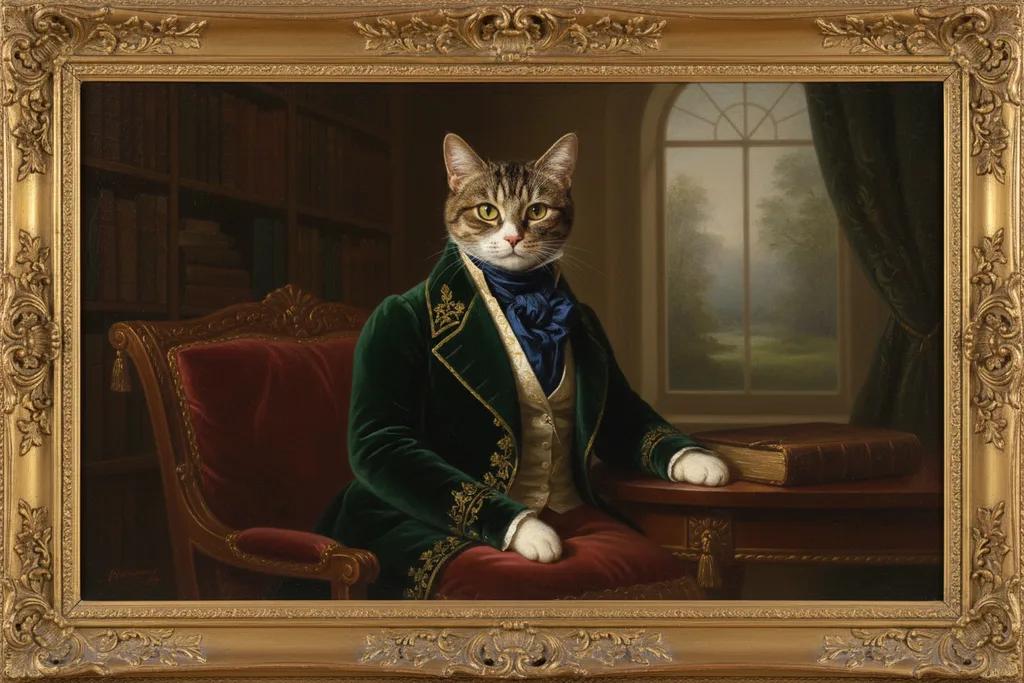
Purrealism's Victorian Noble style dresses a cat as a well-born person of Wain's own century. The cover of this page shows a Calico Cat from the studio examples in that style. You can see more finished portraits in the gallery, or upload one photo of your own cat, up to 5 MB, in the portrait studio.
Questions and answers
Who was Louis Wain's wife?
Louis Wain's wife was Emily Richardson. According to The National Archives in Britain, she became ill soon after their marriage, and Wain began drawing their cat, Peter, to cheer her up. The drawings made her happy, and she encouraged him to publish them. Emily died in January 1887, before the great successes of his career. The Wellcome Collection says she died of cancer.
Why did Louis Wain draw cats?
Louis Wain first drew cats to comfort his sick wife, Emily, with pictures of their cat Peter. The National Archives quotes Wain's own words about Peter, who had been a stray: 'to him, properly, belongs the foundation of my career, the developments of my initial efforts, and the establishing of my work.' The Wellcome Collection says he made hundreds of drawings of Peter during her illness.
When did Louis Wain start painting?
Louis Wain started his career drawing animals and country scenes, after studying at the West London School of Art. The National Archives says he drew for papers such as The Illustrated Sporting and Dramatic News. His first cat piece for The Illustrated London News, called Our Cats: A Domestic History, was published in 1884. In 1886 he illustrated Madame Tabby's Establishment, a children's book about cats.
What is the book Peter, a Cat o' One Tail?
Peter, a Cat o' One Tail is an illustrated story about Louis Wain's cat Peter, published by G. P. Putnam's Sons in New York and London in 1892. The title page names Wain as the illustrator and 'Peter's proprietor', meaning the cat's owner. The text was written by Charles Morley, who calls himself 'a pal of Peter's'. A copy from the University of Florida is online at the Internet Archive.
Was Louis Wain president of the National Cat Club?
Louis Wain was president of the National Cat Club in the early 1900s. Frances Simpson's Book of the Cat, published in London in 1903, says the club was founded in 1887 with Harrison Weir as president, and that Wain was appointed when Weir retired. Her list of the club's officers names the Duchess of Bedford as president and Wain as president of the committee.
Did Louis Wain judge cat shows?
Louis Wain judged cat shows around 1900. Frances Simpson's Book of the Cat, from 1903, lists him among the judges at the National Cat Club's show at the Crystal Palace in 1902. The same book quotes his report on the 1900 Crystal Palace show, where he judged the class for neutered cats and argued that neutered house cats should be encouraged.
What was the Louis Wain Annual?
The Louis Wain Annual was a book of his cat pictures that came out once a year. According to The National Archives in Britain, it ran from 1901 to 1915. Wain also drew for magazines, newspapers, children's books, postcards and advertisements. The Victoria and Albert Museum holds two of his book cover designs for the publisher Raphael Tuck & Sons, Catland and By Road & Rail in Catland.
Why was Louis Wain institutionalized?
Louis Wain was sent to hospital because his mental health had broken down. Bethlem Museum of the Mind says that during the First World War he grew poor and became suspicious, abusive and sometimes violent towards the sisters he lived with. In June 1924 he was certified insane and sent to Springfield Hospital in Tooting, south London. According to The National Archives, it was his sisters who had him committed.
What was Louis Wain diagnosed with?
Louis Wain was diagnosed with schizophrenia when he was admitted to an asylum in 1924, according to an article published by the Wellcome Collection. The National Archives says he may also have had anxiety and depression. Bethlem Museum of the Mind says the diagnosis is still debated, and the Wellcome article reports a newer theory that he would today be seen as autistic.
What are Louis Wain's kaleidoscope cats?
The kaleidoscope cats are eight patterned cat paintings by Louis Wain. Bethlem Museum of the Mind says the psychiatrist Walter Maclay found them in a junk shop in Notting Hill and wrote about them in 1939. Maclay put them in an order meant to show Wain's mind falling apart. The Wellcome Collection says there is no evidence for that order.
How old was Louis Wain when he died?
Louis Wain was 78 when he died in July 1939. Bethlem Museum of the Mind gives the date as 4 July 1939 and the place as Napsbury Hospital, near St Albans, where he had lived since 1930. The museum says he kept drawing until near the end of his life, and exhibitions of his work were held in London in 1931 and 1937.
Sources
- Louis Wain, The National Archives (UK). Accessed September 28, 2026.
- Louis Wain (artist page), Bethlem Museum of the Mind. Accessed September 28, 2026.
- Louis Wain and the Summer Cat Show, Bethlem Museum of the Mind. Accessed September 28, 2026.
- Kaleidoscope Cats: A Clinical Perspective on Louis Wain, Bethlem Museum of the Mind. Accessed September 28, 2026.
- Two Men and Eight Cats: Louis Wain, Walter Maclay and the Kaleidoscope Cats, Bethlem Museum of the Mind. Accessed September 28, 2026.
- Louis Wain's cryptic cats, by Bryony Benge-Abbott, Wellcome Collection. Accessed September 28, 2026.
- Norman. Gouache by Louis Wain, 1925 to 1939, Wellcome Collection. Accessed September 28, 2026.
- A cat standing on its hind legs, formed by patterns supposed to be in the 'Early Greek' style. Gouache by Louis Wain, 1925/1939, Wellcome Collection. Accessed September 28, 2026.
- EPA-0896: The Schizophrenic Process and Louis Wain's Cats (M. Brenha and P. Teixeira, European Psychiatry, 2014), Cambridge University Press. Accessed September 28, 2026.
- The Book of the Cat, by Frances Simpson (Cassell, 1903), Project Gutenberg. Accessed September 28, 2026.
- Madame Tabby's Establishment, by Kari, illustrated by L. Wain (Macmillan, 1886), Internet Archive (copy from the University of Florida). Accessed September 28, 2026.
- Peter, a Cat o' One Tail: His Life and Adventures (G. P. Putnam's Sons, 1892), Internet Archive (copy from the University of Florida). Accessed September 28, 2026.
- English Illustrated Magazine 1889 to 1890 (J. E. Panton, Cats and Kittens; or, In Defence of the Cat, illustrated by Louis Wain), Internet Archive. Accessed September 28, 2026.
- Kitten Life at the Cat Show, Louis Wain, Victoria and Albert Museum. Accessed September 28, 2026.
- 9. The end of the ninth life. The Cats paradise, Louis Wain, Victoria and Albert Museum. Accessed September 28, 2026.
- Catland, Louis Wain, Victoria and Albert Museum. Accessed September 28, 2026.
- By Road & Rail in Catland with Louis Wain, Victoria and Albert Museum. Accessed September 28, 2026.
- My Friend the Prince, Louis Wain, Victoria and Albert Museum. Accessed September 28, 2026.
- Jacksons Ltd (poster), Louis Wain, Victoria and Albert Museum. Accessed September 28, 2026.
Short reads on this topic
Articles from Purrspectives that answer one question each.
Dog years to human years: the chart by size, and the DNA formula
A 1-year-old dog is closer to 15 or 30 in human years than to 7. The AKC chart by size, the 2020 DNA formula, and a dog's life stages, explained simply.
Pug history: from Chinese emperors to the House of Orange
Pugs began as companions of Chinese emperors, reached Holland on Dutch trading ships and became the dog of the House of Orange. Their history, art and health.
Persian cat history: where the breed came from, its first cat show, coat and care
Persian cat history from a cat brought to Italy in 1626 to the 1871 Crystal Palace show, plus face types, coat colours, grooming and how to photograph one.