Pug history: from Chinese emperors to the House of Orange
Pugs began as companions of Chinese emperors, reached Holland on Dutch trading ships and became the dog of the House of Orange. Their history, art and health.
By Purrealism
The pug has lived with royal families for most of its history. It began at the court of the Chinese emperors, reached Europe on Dutch trading ships and became the dog of the Dutch royal House of Orange. In the 1700s it appeared in paintings and in porcelain across Europe. This guide follows that history, then covers what a pug is like today, its breathing problems, and how to show a pug in a royal portrait.
Where pugs come from
The pug comes from China. The American Kennel Club (AKC) says most historians agree the breed began there, where pugs were bred as companion animals for wealthy families. It dates the breed's roots to 400 B.C. and says pugs lived as companions to Chinese emperors and their families.
The Royal Kennel Club in the United Kingdom offers a reason for the breed's shape. It says the Chinese liking for small dogs with short faces may well have led to the pug. The AKC says Chinese breeders also bred for the folds on the forehead. They wanted wrinkles in a pattern that looked like the Chinese character for "prince".
Pugs shared the palace with other short-faced dogs. Our page on the Pekingese and the Chinese emperors follows the Pekingese and the Shih Tzu, which lived beside the pug at court.
How the pug got its name
Nobody knows for certain where the English name comes from. The AKC says the most popular theory links it to the marmoset, a small monkey that was also called a pug monkey. In German the breed has a different name, Mops, and the Victoria and Albert Museum (V&A) in London uses that word when it writes about the pug societies of the 1740s.
From China to the Netherlands
The pug reached Europe by sea. According to the Royal Kennel Club, traders of the Dutch East India Company are thought to have carried dogs of this type from China to the Netherlands in the 16th century. There the dogs became popular at court. The AKC describes a longer route, with the breed spreading from China to Japan and Russia and then to Europe.
The House of Orange story
The House of Orange is the family of the Dutch princes, and today the Dutch royal family. The AKC calls the pug the mascot of Holland's royal House of Orange, and it tells the story behind the title.
In 1572, the AKC says, Spanish soldiers tried to kill William the Silent, Prince of Orange. His pug, Pompey, stopped the attempt. Because of Pompey's courage, the pug became the official breed of the House of Orange. This is the story as the AKC tells it. We could not find a museum record that confirms the event, so treat it as the kennel club's account.
The pug then travelled with the family to England. The Royal Kennel Club says that when William of Orange took the English throne, his pugs came with him and caught the attention of the English nobility. This William was a later prince of the same family.
Pugs in 18th century art
By the 1700s the pug was a fashionable dog in Europe, and artists put it into their work. The AKC names Goya, William Hogarth and Reinagle among the painters who included pugs in their pictures. Two pieces in London museums show how the breed looked and what it meant.
Hogarth and his pug, Trump
In 1745 the London painter William Hogarth painted himself with his pug, Trump, in a picture called The Painter and his Pug. The National Gallery in London says the dog alludes to the artist's "pugnacious" character, meaning his readiness to fight. The V&A holds a small porcelain figure of Trump, made at the Chelsea factory in London between 1747 and 1750. The museum points out that Trump has a much longer muzzle than the pugs of today. Our page on Hogarth and Trump tells the full story of the painting and the figures.
The Order of the Pug
The pug also became the sign of a private society. The V&A explains that in 1738 the Pope forbade Catholics from becoming Freemasons, members of a society with its own rituals and ranks. In 1740 Klemens August of Bavaria founded the Order of the Pug for Catholics instead. Its symbol was the pug, which stood for loyalty, fidelity and steadfastness. The order also let women join, provided they were Catholic.
The porcelain factory at Meissen, in Germany, made pugs in large numbers at this time. The V&A says its modeller, Johann Joachim Kändler, made many different models of pugs and of people holding pugs, which presumably reflects the order's popularity in the 1740s. One of them, modelled in 1744 and 29 cm tall, is in the V&A. A young woman in a salmon pink overdress holds one pug, and a second pug sits at her feet.
Royal owners after 1750
Pugs stayed close to power. The AKC says Josephine, the wife of Napoleon, had a pug named Fortune, and that Fortune bit Napoleon on the couple's wedding night. The AKC also names Queen Victoria as a pug lover. Her dogs have their own guide: Queen Victoria and her dogs. For the wider story of dogs at court, read royal dogs in history.
What a pug is like today
The breed's motto is the Latin phrase multum in parvo, which the AKC translates as "a lot in a little". The Royal Kennel Club calls the pug the most solid of the toy breeds, the group of small companion dogs. The AKC lists a height of 10 to 13 inches and a weight of 14 to 18 pounds.
Pugs come in three colours, according to the AKC: silver or apricot fawn with a black face mask, or all black. The large round head, the big eyes and the wrinkled brow give pugs expressions that owners read as surprise, happiness or curiosity. The AKC says pugs love food and gain weight easily, so owners must watch how much they eat. The Royal Kennel Club puts their exercise needs at up to one hour a day.
Breathing and other health points
The pug's short face affects its health. Cornell University's College of Veterinary Medicine uses the word brachycephalic for a dog with a short muzzle caused by its breed's genes. Many of these dogs have a group of problems called brachycephalic obstructive airway syndrome, or BOAS. Cornell says it is seen most often in English bulldogs, pugs, French bulldogs and Boston terriers.
Cornell lists the parts of the airway involved:
- Small nostrils that can close in as the dog breathes in.
- A long soft palate, the soft back part of the roof of the mouth, which can block air on its way to the voice box.
- Tissue near the vocal cords that is pulled inward and blocks air.
- A narrow windpipe in some dogs.
The signs Cornell names are noisy breathing (snoring, wheezing and snorting), trouble with exercise, gagging, hard or open-mouth breathing, bluish gums and collapse. The University of Cambridge vet school adds that some dogs make these noises only when they are excited, playing, eating or stressed. It says affected dogs can have trouble breathing in their sleep, and that they lose body heat less easily than other dogs, so they can suffer heat stroke.
Cornell says mild cases are managed with weight control and limits on activity, and that surgery can widen the nostrils and shorten the soft palate. It advises owners to keep these dogs out of high heat and humidity. The AKC adds that the pug's large eyes need care, since corneal ulcers and dry eye occur in the breed. A pug that snores loudly while awake, or tires after a short walk, should see a vet.
Painting a pug in a royal style
A pug has sat for royal portraits since the 1700s, and its round face and dark mask make a clear subject. Three points help.
Take the photo at the pug's eye level. A photo from above makes the head look larger and hides the eyes under the brow folds. Use daylight from a window so the folds and the black mask show detail. A black pug needs even light, because shadows on a black coat hide the shape of the face. The guide on how to photograph your pet for a portrait goes through the steps.
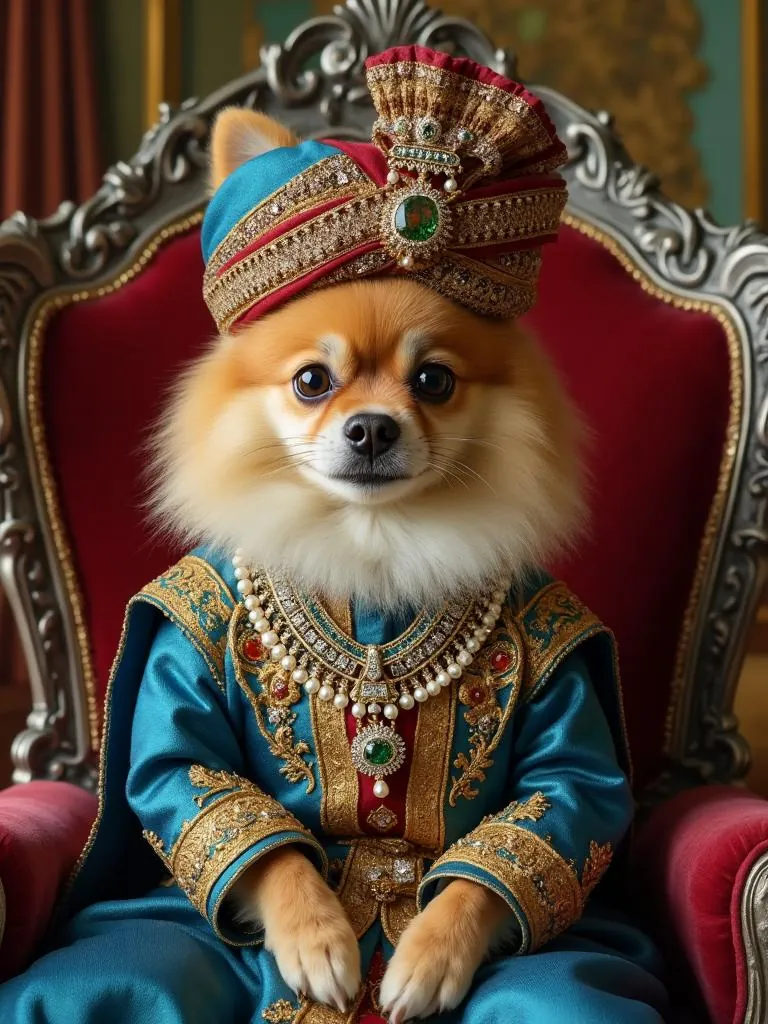
Choose a style from the pug's history or from its character. The pug's story runs through European courts, so the six European styles (Renaissance Royal, Victorian Noble, Military General, Medieval Knight, Baroque Aristocrat and Regency Era) follow its path from Holland to England. The gallery shows a pug in the Regency Era style. The nine Indian court styles work for a pug too. The portrait at the top of this page shows a Pomeranian, another small palace dog, as Patiala royalty in a blue coat and a jewelled turban on a red throne.
Start with one clear photo. The portrait studio takes one photo of up to 5 MB and lets you try any of the 15 styles.
Questions and answers
What is the origin of a pug?
The pug comes from China. The American Kennel Club says most historians agree the breed began there, where pugs were bred as companions for wealthy families, and that its roots go back to 400 B.C. The Royal Kennel Club says traders of the Dutch East India Company are thought to have carried dogs of this type from China to the Netherlands in the 16th century.
What were pugs originally bred for?
Pugs were bred to be companions. The American Kennel Club says they were bred in China as companion animals for the wealthy, and that they lived with Chinese emperors and their families. Unlike hounds or herding dogs, the pug had no working task. Its job was to live beside its owners, and it kept that role when it reached the royal courts of Europe.
How did pugs get their name?
Nobody knows for certain how pugs got their English name. The American Kennel Club says the most popular theory is that the name came from the marmoset, a small monkey that was also called a pug monkey. In German the breed is called Mops, and the Victoria and Albert Museum uses that name when it describes the 18th century Order of the Pug.
Are pugs royalty?
Pugs have a long royal history. The American Kennel Club calls the pug the companion of Chinese emperors and later the mascot of Holland's royal House of Orange. The Royal Kennel Club says that when William of Orange took the English throne, his pugs came with him. The American Kennel Club also names Queen Victoria and Napoleon's wife Josephine as pug owners.
What did pugs originally look like?
Pugs of the 1700s had a longer nose than pugs today. The Victoria and Albert Museum holds a Chelsea porcelain figure of Trump, the pug of the painter William Hogarth, made between 1747 and 1750. The museum says Trump has a much longer muzzle than the pugs of today. Hogarth also painted Trump in his 1745 self-portrait, now shown by the National Gallery in London.
Why were pugs bred with flat faces?
Pugs have flat faces because breeders in China liked small dogs with short faces. The Royal Kennel Club says this Chinese preference may well have led to the pug. The American Kennel Club adds that Chinese breeders also aimed for wrinkles on the forehead in a pattern that looked like the Chinese character for prince. Cornell's vet school says a short muzzle comes from a dog's genes.
Do pugs have breathing problems?
Many pugs have breathing problems caused by their short skull. Cornell University's College of Veterinary Medicine says brachycephalic obstructive airway syndrome is seen most often in English bulldogs, pugs, French bulldogs and Boston terriers. Signs include snoring, snorting, wheezing, open-mouth breathing and trouble with exercise. The University of Cambridge vet school says affected dogs lose heat less easily and can suffer heat stroke.
Why is the pug the dog of the House of Orange?
The pug became the dog of the Dutch House of Orange because of a story from 1572. The American Kennel Club says Spanish soldiers tried to kill William the Silent, Prince of Orange, and his pug, Pompey, stopped the attempt. Because of Pompey, the kennel club says, the pug became the official breed of the House of Orange. We found no museum record that confirms the event.
What was the Order of the Pug?
The Order of the Pug was a society for Catholics founded in 1740 by Klemens August of Bavaria. The Victoria and Albert Museum says he founded it after the Pope forbade Catholics from becoming Freemasons in 1738. Its symbol was the pug, which stood for loyalty, fidelity and steadfastness. Women could join if they were Catholic, which Masonic lodges of the time did not allow.
Sources
- Pug Dog Breed Information, American Kennel Club
- Pug History: From Emperors' Companions to Family Pets, American Kennel Club
- Facts About the Pug That You May Not Know, American Kennel Club
- Pug, The Royal Kennel Club
- Figure, modelled by Johann Joachim Kändler, Meissen, 1744 (C.4-1956 family), Victoria and Albert Museum
- Hogarth's Dog, Trump, Victoria and Albert Museum
- The Painter and his Pug, William Hogarth, The National Gallery, London
- Brachycephalic Obstructive Airway Syndrome (BOAS), Cornell University College of Veterinary Medicine
- BOAS: Recognition and diagnosis, Department of Veterinary Medicine, University of Cambridge
Go deeper
The full guides on this topic, each a set of pages with sources: