Egyptian cat art: bronze cats, Bastet figures, amulets and cat coffins
How Egyptian bronze cats were cast, what Bastet figures and cat amulets were for, and where to see cat coffins and cats serving mice in museums today.
By Purrealism. Part of Cats in art: the artists and artworks behind a royal cat portrait.
Ancient Egyptian cat art survives in museums as bronze cats, figures of the goddess Bastet with a cat's head, small charms, coffins shaped like cats, a painted papyrus and drawings on stone. This page looks at those objects, how they were made and what each was for, using the records of the museums that hold them. It belongs to our guide to cats in art. The lives of the real cats, from the first tame cats to the cat cemeteries, are told in cats in ancient Egypt, and three famous museum bronzes have their own section in royal cats in history.
Why Egypt made so many bronze cats
Harvard Art Museums calls the seated cat the most popular animal made in bronze in Egypt during the first millennium BC. Its catalogue links this to the spread of sacred animal cults from the Late Period to the Ptolemaic Period, 664 to 30 BC. Most of these bronzes were given at shrines as gifts to the gods. The larger hollow ones could also hold a cat mummy.
The same catalogue links these gifts to an organised cult of the king, which may explain why so many were made and why they look alike. The cat sits upright, head held high, with its tail curled along its right side, the same way the cat is drawn in hieroglyphic writing. One or both ears are pierced, and some cats still wear gold hoop earrings. Many have a scarab beetle on the forehead and a pendant on the chest, signs of protection and of the sun.
How a bronze cat was cast
Egyptian metalworkers cast their cats by the lost-wax method. The Musée Rodin in Paris explains the steps for bronze in general. The maker shapes a model in wax around a core of clay. The model is wrapped in heat-proof clay and baked, so the wax melts and runs out. Molten bronze is poured into the empty space the wax has left, and metal rods hold the core in place while it flows. When the metal cools, the mould is broken, the core is crumbled out, and the surface is cleaned and polished.
Harvard's own bronze cat shows these steps. The cat is 28.9 cm high, made of leaded bronze (copper, tin and lead), and dated from the mid 7th to the late 1st century BC. The museum's conservators found that the inside of the cat follows every curve of the outside. They read this as a sign of the indirect lost-wax method, where the wax model is formed inside a mould, as in the Rodin description above. Black remains of the clay core are still in the tail, at the base and at the back of the head. Iron pins, of the kind that held a core in place during casting, are visible inside at the shoulders, the back and the head. The small holes in the ears were drilled after casting.
The same cat was once colourful. Fine wire of a green and red copper alloy is set into the ears, the head and the shoulders, and the whiskers were set with a black metal that may be silver. Four hollows along the tail once held inlays of glass or faience, and a worn patch on the forehead marks where a scarab has been lost. It is on view at Harvard in Room 3740.
Smaller casts were made to be fixed into a base. The Cleveland Museum of Art has a bronze cat only 9.2 cm tall, made between 664 and 30 BC, with a tang, a metal peg under its body. It still wears a gold earring and an embossed pendant, and the museum calls it a votive offering, a gift made to a god. The Royal Ontario Museum in Toronto has a small cat that leans forward on top of a papyrus column, and the museum says cat and column appear to have been cast together, hollow. The museum thinks it topped a staff carried in ceremonies and processions.
Bastet with a cat's head
The Royal Ontario Museum explains how the goddess changed over time. In the Old Kingdom, Bastet was a fierce lioness, a war goddess who nursed the king. The house cat later became her sacred animal, and in the Middle Kingdom she was shown as a woman with a cat's head. She became gentler as her image changed. She helped women in pregnancy and guarded newborn babies, and she can appear with kittens at her feet.
The museum's own figure of Bastet, 7.2 cm tall and made between 664 and 332 BC, shows her as a cat-headed woman in a patterned dress. In her right hand she holds a sistrum, a metal rattle used in temple music. In her left she holds an aegis, which the museum calls a magically protective shield, and a small basket hangs over her arm.
The sistrum appears on its own as well. The Cleveland Museum of Art has one from 380 to 343 BC, 21.4 cm long, decorated with the head of the goddess Hathor and a cat, the image of Bastet. The museum says the rustling sound of its metal discs was meant to calm goddesses such as Hathor and Bastet, and that women played these rattles in temple choirs.
Some cat figures carry the names of real people. The Louvre's seated Bastet cat, 27.6 cm tall and made of copper alloy with gold, has a hieroglyphic dedication that names King Psamtek I, who ruled from 664 to 610 BC. The Louvre's record also lists a man named Djedbastetiouefankh, called a dancer of Bastet.
Mothers, kittens and charms
Egyptian artists often showed Bastet's cats as mothers. The Royal Ontario Museum has a faience cat with her kittens, 17.8 cm tall, from the years 525 to 404 BC, when Persia ruled Egypt. Faience is a ceramic made from ground quartz or sand with small amounts of other minerals, including copper. The Australian Museum explains that it glazes itself in the kiln, as salt in the wet paste rises to the surface, and that the Egyptians called its blue and green shine tjehent, meaning brilliant or dazzling. The Royal Ontario Museum suggests its mother cat was either a family's own object of worship or a gift left at a shrine.
Small charms, called amulets, show the same cat at a much smaller size. The Cleveland Museum of Art has a carved stone cat only 4.4 cm tall, made between 1069 and 715 BC, with a loop on its back for a cord. Its base combines two hieroglyphs: the sign for an ointment jar, also used to write Bastet's name, and the sign for "protection". The museum records that it once belonged to Howard Carter, who found the tomb of Tutankhamun. The Art Institute of Chicago holds a faience ring with a seated cat, around 1390 BC, and a faience cat on a papyrus column. The Royal Ontario Museum has a carved stone kitten from the Roman period that measures 1.8 by 1.7 cm.
Cats also decorated useful objects. The exhibition Divine Felines, organised by the Brooklyn Museum and shown at the Smithsonian's Freer and Sackler galleries from October 2017 to January 2018, included a weight in the form of a cat, made of bronze, silver and lead between 305 and 30 BC.
Coffins and cases for cat mummies
Harvard's catalogue says that small cat figures were sometimes wrapped into the bandages of a cat mummy, and that the mummy was placed in a bronze or wooden case shaped like a seated cat. The Art Institute of Chicago explains what such a gift meant. People placed animal coffins in temples, with a mummified animal linked to the god whose help they wanted. The animal's soul was thought to carry messages between people and the gods, about problems such as illness or a crime against the giver. Chicago's wooden coffin, made of wood and plaster and 63.5 cm high, has the shape of a cat, so the museum thinks it was given to Bastet.
Several museums hold cases like it:
- The Cleveland Museum of Art has a hollow bronze coffin 51 cm high, from 305 to 30 BC, open at the bottom. A necklace was scratched into the finished bronze, and traces show on the chest. Cleveland also has a small coffin carved from sycamore fig wood, 20 cm high.
- The Louvre's bronze cat coffin, 33.6 cm high, from the Late Period, has pierced ears, a collar with a pendant and eyes inlaid with dark blue glass.
- The Vatican Museums hold a bronze case 45.2 cm high from the 22nd Dynasty, 945 to 712 BC. The museum says its lost eyes were glass paste or stone, and that the linen strips that once bound the case are still stuck to its surface with resin.
- The Museo Egizio in Turin has a wooden coffin from Thebes, dated 770 to 430 BC, with the cat mummy still inside.
A tomcat in the Book of the Dead
Cats also appear in painted scenes for the dead. The Book of the Dead is a collection of spells meant to help a dead person pass the dangers of the underworld. The Royal Ontario Museum says the first copies date from 1550 BC and that the book grew longer over time. Its own copy, made for a man named Amenemhet around 320 BC, measures around 6 metres and is one of the few surviving copies that keep much of their gold leaf.
One fragment, 73.2 by 24 cm, shows chapter 17. Near its upper right, the sun god Re appears as a tomcat, cutting up the evil serpent Apop in front of the sacred Ished tree. Only the back half of the cat is still clear. Harvard's catalogue explains the idea behind it: the tomcat was linked with the sun god, and in the Book of the Dead he kills the serpent Apophis, the sun god's enemy.
Tomb reliefs also show wild animals that museums call cats. The Cleveland Museum of Art has a limestone relief from the tomb of Mentuemhat at Thebes, made around 667 to 647 BC. The museum describes a civet cat attacking a bird's nest in a papyrus marsh, in a scene copied from Old Kingdom work.
Cats that serve mice
Some Egyptian cats were drawn as jokes on ostraca, flakes of limestone with drawings or writing in ink. The Louvre's and Turin's examples come from Deir el-Medina, the village of the workmen who built and decorated the royal tombs of the New Kingdom. The Deir el-Medina Database at Leiden says the site has produced a huge number of texts written on ostraca and papyri.
The Royal Museums of Art and History in Brussels explain the joke. Satirical drawings like these show animals, most often cats and mice, and reverse their usual roles. The cats act as servants to lady mice, in scenes that borrow their layout from funeral scenes and temple reliefs. On the Brussels stone, 9 by 12.5 cm and made between 1550 and 1069 BC, a mouse sits at a table of offerings and smells a lotus flower. On the other side of the table, a cat stands on its back legs and waves a fan.
The Louvre shows a similar fragment from Deir el-Medina, 12.2 by 13.1 cm, drawn in black and red between 1295 and 1069 BC. The museum lists a standing cat who offers a vase and a seated cat who smells a lotus flower. In Turin, the Museo Egizio has a limestone ostracon from the same village, dated 1292 to 1077 BC, where a group of dogs carries a mouse in a sedan chair.
Where to see these objects
| Object | Date | Material and size | Museum | What the cat does |
|---|---|---|---|---|
| Statuette of a cat | mid 7th to late 1st century BC | Leaded bronze, 28.9 cm | Harvard Art Museums | Sits upright, once inlaid |
| Cat with gold earring | 664 to 30 BC | Bronze and gold, 9.2 cm | Cleveland Museum of Art | Votive gift fixed on a peg |
| Bastet as a cat-headed woman | 664 to 332 BC | Bronze, 7.2 cm | Royal Ontario Museum | Holds a sistrum and an aegis |
| Seated Bastet cat | 664 to 610 BC | Copper alloy and gold, 27.6 cm | Louvre | Carries a dedication |
| Mother cat with kittens | 525 to 404 BC | Faience, 17.8 cm | Royal Ontario Museum | Sits with her kittens |
| Amulet of Bastet | 1069 to 715 BC | Carved stone, 4.4 cm | Cleveland Museum of Art | Sits on the sign for protection |
| Cat coffin | 664 to 32 BC | Wood and plaster, 63.5 cm | Art Institute of Chicago | Held a cat mummy |
| Cat coffin | 305 to 30 BC | Bronze, 51 cm | Cleveland Museum of Art | Held a cat mummy |
| Book of the Dead of Amenemhet | around 320 BC | Papyrus, ink and gold | Royal Ontario Museum | Re as a tomcat cuts up Apop |
| Cat and mouse ostracon | 1550 to 1069 BC | Limestone, 9 by 12.5 cm | Royal Museums of Art and History, Brussels | Fans a seated mouse |
Always check a museum's online record before a visit, because objects move between display and storage. In Toronto, the Royal Ontario Museum lists the mother cat, the Bastet figure, a seated bronze cat and a mummified cat from the Roman period as on view in its Galleries of Africa: Egypt.
From Egyptian cats to your own cat's portrait
The Egyptian cat makers worked to a fixed pose: upright, head held high, often with gold earrings. A royal pet portrait follows a different idea, one real cat with its own face and coat, and it starts with a clear photo taken at your cat's eye level. For how later artists painted cats as signs of home, luck or trouble, read what cats mean in art. The next step in time, from temple cats to the cats in monks' books, is cats in medieval manuscripts.
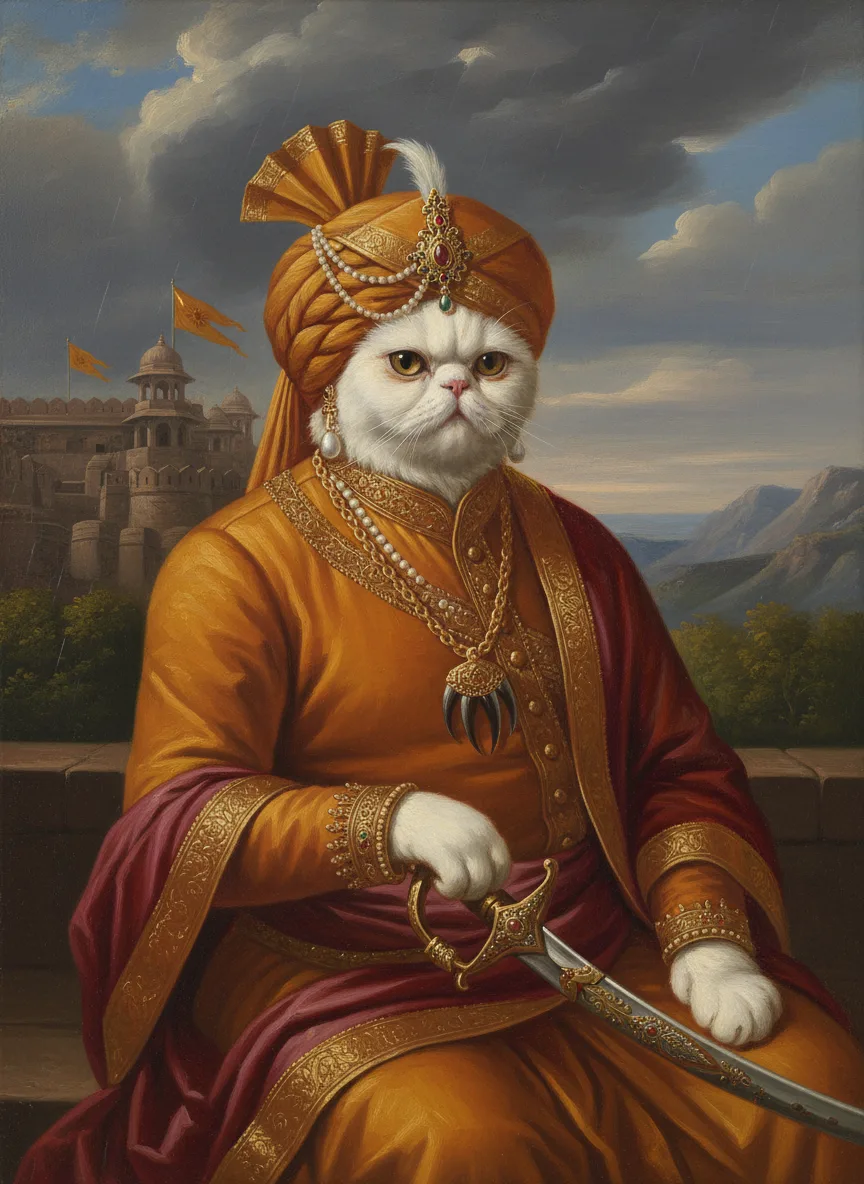
The cover of this page shows a Persian cat in the Maratha King style, one of the 15 royal portrait styles on this site. You can see more finished portraits in the gallery, or start your own in the portrait studio with one photo of up to 5 MB.
Questions and answers
How were Egyptian bronze cats made?
Egyptian bronze cats were made by lost-wax casting. A wax model was built over a clay core, covered in clay, and heated so the wax ran out, and molten metal filled the space. Harvard Art Museums found black core remains inside its bronze cat, and iron pins of the kind used to hold a core in place. The holes in the cat's ears were drilled after casting.
What did Egyptian cat statues look like?
Egyptian cat statues usually show a cat sitting upright with its head held high and its tail curled along its right side. Harvard Art Museums says this pose follows the hieroglyphic sign for a cat. Many have pierced ears, and some still wear gold hoop earrings. A scarab beetle on the forehead and a pendant on the chest point to protection and to the sun.
What does the Egyptian cat symbolize?
The Egyptian cat stood for the goddess Bastet, and through her for motherhood and protection. The Royal Ontario Museum in Toronto says ancient texts and images praise the cat's beauty, its devotion to its kittens and its skill at hunting birds. Its faience figure of a mother cat with kittens, made around 525 to 404 BC, may have been a family's own devotional object.
What is Bastet known for?
Bastet is known as the Egyptian cat goddess who protected mothers and babies. According to the Royal Ontario Museum, she began as a fierce lioness in the Old Kingdom, and by the Middle Kingdom she was shown as a woman with a cat's head. She helped women in pregnancy and guarded the newborn, and she can appear with kittens at her feet.
Is Bastet evil?
Bastet was a kind goddess in Egyptian belief, though she had a fierce side. The Vatican Museums say she began as a terrifying lioness and was later worshipped as a gentle cat who had to be calmed by ritual. Harvard Art Museums describes Bastet and her cats as peaceful and protective, in contrast with the lioness goddess Sekhmet.
What is the symbol of Bastet?
The sistrum, a metal rattle used in temple music, is one of the symbols of Bastet. A bronze Bastet figure at the Royal Ontario Museum holds a sistrum in her right hand and an aegis, which the museum calls a magically protective shield, in her left. The Cleveland Museum of Art has a sistrum from 380 to 343 BC decorated with a cat.
What is an Egyptian cat coffin?
An Egyptian cat coffin is a case in the shape of a seated cat that held a mummified cat given to a god. The Art Institute of Chicago says the animal's soul was thought to carry messages between people and the gods, about problems such as illness. Its wooden cat coffin, 63.5 cm high, was probably offered to Bastet.
Did Egyptian cat statues wear earrings?
Many Egyptian cat statues had pierced ears and wore gold earrings. Harvard Art Museums says one or both ears of these bronzes tend to be pierced, and gold hoops survive on some. The Cleveland Museum of Art has a bronze cat 9.2 cm tall that still wears a gold earring, and the Vatican Museums have a bronze cat case whose earrings are lost.
Why did ancient Egyptians draw cats serving mice?
Ancient Egyptians drew cats serving mice as a joke that reversed the usual roles of the two animals. The Royal Museums of Art and History in Brussels says these satirical drawings use parody and borrow their layout from funeral scenes and temple reliefs. On its limestone flake from the New Kingdom, a mouse sits at an offering table smelling a lotus flower while a cat stands and fans her.
What is the cat in the Book of the Dead?
The cat in the Book of the Dead is the sun god Re in the form of a tomcat, fighting the serpent Apop. The Royal Ontario Museum holds a papyrus from around 320 BC, from the Book of the Dead of a man named Amenemhet, where the cat cuts up the serpent in front of a sacred tree in chapter 17.
Where can I see ancient Egyptian cat art in Canada?
The Royal Ontario Museum in Toronto shows ancient Egyptian cat art in its Galleries of Africa: Egypt. Its online records list a faience mother cat with kittens, a bronze figure of Bastet with a cat's head, a seated bronze cat and a mummified cat as on view. Its gilded Book of the Dead papyrus with a tomcat is listed as not on view.
Sources
- Cat, 1962.69, Harvard Art Museums. Accessed September 28, 2026.
- Lost-wax bronze casting, Musée Rodin, Paris. Accessed September 28, 2026.
- Cat, 1942.776, Cleveland Museum of Art. Accessed September 28, 2026.
- Cat Coffin, 1917.998, Cleveland Museum of Art. Accessed September 28, 2026.
- Cat Coffin, 1914.806, Cleveland Museum of Art. Accessed September 28, 2026.
- Amulet of Bastet, 1973.29, Cleveland Museum of Art. Accessed September 28, 2026.
- Arched Sistrum, 1920.1990, Cleveland Museum of Art. Accessed September 28, 2026.
- Marsh Scene with Cat and Birds, 1949.498, Cleveland Museum of Art. Accessed September 28, 2026.
- Cat Coffin, The Art Institute of Chicago. Accessed September 28, 2026.
- Ring: Figure of Seated Cat, The Art Institute of Chicago. Accessed September 28, 2026.
- Amulet of a Cat Sitting on a Papyrus Column, The Art Institute of Chicago. Accessed September 28, 2026.
- Statuette of standing cat, Bastet (933.4.5), Royal Ontario Museum. Accessed September 28, 2026.
- Figure of a seated cat with kittens (977.247.1), Royal Ontario Museum. Accessed September 28, 2026.
- Figure of a seated cat (910.17.51), Royal Ontario Museum. Accessed September 28, 2026.
- Finial, decorated with a cat (910.92.99), Royal Ontario Museum. Accessed September 28, 2026.
- Hathor-headed sistrum decorated with cats (971.165.35), Royal Ontario Museum. Accessed September 28, 2026.
- Amulet, kitten, Bastet (995X2.207), Royal Ontario Museum. Accessed September 28, 2026.
- Mummified cat (910.169.1), Royal Ontario Museum. Accessed September 28, 2026.
- Book of the Dead fragment, Chapter 17 (910.85.236.7), Royal Ontario Museum. Accessed September 28, 2026.
- Statuette de Bastet (E 2533), Musée du Louvre. Accessed September 28, 2026.
- Cercueil de chat (N 4538), Musée du Louvre. Accessed September 28, 2026.
- Ostracon figuré (E 32954), Musée du Louvre. Accessed September 28, 2026.
- Urn for the mummy of a cat (Cat. 18311), Vatican Museums. Accessed September 28, 2026.
- Coffin for a cat containing a mummy (Cat. 2371/02), Museo Egizio, Turin. Accessed September 28, 2026.
- Ostracon with satirical scene: a group of dogs carry a mouse on a sedan chair (Suppl. 6333), Museo Egizio, Turin. Accessed September 28, 2026.
- The mouse and the cat (E.06727), Royal Museums of Art and History, Brussels. Accessed September 28, 2026.
- The Deir el-Medina Database: Introduction, The Deir el-Medina Database, Leiden. Accessed September 28, 2026.
- Egyptian Faience, The Australian Museum. Accessed September 28, 2026.
- Divine Felines: Cats of Ancient Egypt, media images, Smithsonian, Freer|Sackler. Accessed September 28, 2026.
Short reads on this topic
Articles from Purrspectives that answer one question each.
Dog years to human years: the chart by size, and the DNA formula
A 1-year-old dog is closer to 15 or 30 in human years than to 7. The AKC chart by size, the 2020 DNA formula, and a dog's life stages, explained simply.
Pug history: from Chinese emperors to the House of Orange
Pugs began as companions of Chinese emperors, reached Holland on Dutch trading ships and became the dog of the House of Orange. Their history, art and health.
Persian cat history: where the breed came from, its first cat show, coat and care
Persian cat history from a cat brought to Italy in 1626 to the 1871 Crystal Palace show, plus face types, coat colours, grooming and how to photograph one.