Cat symbolism in art: long life in China, luck in Japan, desire in Dutch paintings
What a cat means in a painting depends on where it was made: a wish for long life in China and Korea, luck in Japan, lust or trouble in Dutch art.
By Purrealism. Part of Cats in art: the artists and artworks behind a royal cat portrait.
A cat in a work of art can carry a message, and the message depends on where and when the work was made. In China and Korea a painted cat could wish someone a long life. In Japan a small clay cat with a raised paw is kept to bring luck to a shop. In Dutch paintings of the 1600s a cat under the table could point to lust or to trouble, and in English witch trials a cat could be a demon. This page follows those meanings through works in museums in Cleveland, Washington, Taipei, London, Amsterdam and Philadelphia, and on the National Museum of Korea, using the explanations their curators give. For the artists who painted cats, start with the cats in art guide.
A wish for long life: cats and butterflies in China
Chinese painters paired a cat with a butterfly for a reason: a pun, a play on words that sound alike.
The Cleveland Museum of Art explains it on the label of an album leaf by Min Zhen: "cat and butterfly" sound like the characters mao die, meaning "octogenarian", a person in their eighties. The National Palace Museum in Taipei splits the pun in two: the cat stands for an octogenarian and the butterfly for a septuagenarian, a person in their seventies. The Smithsonian's National Museum of Asian Art in Washington puts it as "seventy or eighty years of life". A picture of a cat and a butterfly therefore says: may you live to a great age.
Three works that use the pun
Min Zhen, Cat and Butterfly, 1788. Min Zhen lived from 1730 to after 1788. The Cleveland Museum of Art says he painted this leaf, 29 × 18.4 cm, in ink on paper, as part of an album for his friend Dailili Shanren, who gave him a scholar's stone in exchange. The cat is seen from above, an unusual view that the museum says gives the leaf a humorous touch. The painting expresses the hope that the friend will live a long life.
Shen Zhenlin, Cats and Butterflies of Longevity, Qing dynasty. Shen Zhenlin worked in the Qing court painting academy between 1851 and 1874. The National Palace Museum says the Empress Dowager Cixi gave him a plaque she inscribed herself. His work fills two albums, painted in gold and mineral colours on black paper, with cats and butterflies playing among the flowers of the seasons. The museum says people used the pun to send birthday wishes to an honoured elder.
Qi Baishi, Cat and Butterflies, before 1937. Qi Baishi (1864 to 1957) painted this hanging scroll, 131 × 28.1 cm, in ink and colour on paper. The Freer Gallery of Art, part of the Smithsonian, says he painted it for Xu Beihong (1895 to 1954), another famous artist of the time. The museum says a sense of humour must have led Qi to send a wish for old age to a man almost three decades younger, and that he still kept the custom of respect for elders.
Japanese artists drew the same pair of animals. The Smithsonian holds Cat and butterfly, a Japanese woodblock print by Ohara Koson from about 1910, 36.1 × 23 cm.
Cats and sparrows in Korea
Korean painters used the same sound play. In an online exhibition, the National Museum of Korea says cats and sparrows were popular subjects in traditional Korean painting and stood for the joy of a long life. It explains that the Chinese character for "cat" sounds like the character for "an elderly person".
The museum's example is Cat and Sparrows by Byeon Sang-byeok (1730 to 1775), a painter of the late Joseon dynasty, held in its collection. Byeon was known for his careful paintings of animals, and people called him "Byeon Cat" and "Byeon Chicken". For the real cats kept at the Korean and Japanese courts, read our page on royal cats of Japan, Korea and Siam.
The beckoning cat of Japan
Japan's lucky cat figure is the maneki neko, which means "beckoning cat", a cat with one paw raised. The Mingei International Museum in San Diego says a figure of a cat with a paw raised in the Japanese gesture of beckoning has been a good luck charm since the Edo period, the time before 1868, drawing good fortune to people and to businesses.
SFO Museum, which showed beckoning cats lent by the Mingei at San Francisco International Airport in 2018, gives their history. They are a type of engimono, an object believed to bring good fortune. The Imado kilns of Edo, the old name for Tokyo, made the first ones in the mid-1800s as simple clay figures fired at a low heat. By the end of the Meiji period in 1912, potteries across Japan made them, including the Seto and Kutani kilns.
The museum explains what each detail means:
| Detail | Meaning, according to SFO Museum |
|---|---|
| Left paw raised | Luck and good fortune for a business |
| Right paw raised | Good fortune, health and happiness for the home |
| White cat | Happiness and satisfaction |
| Black cat | Safety, and driving away evil |
| Gold cat | Money and fortune |
| Bib | Often painted with signs of good luck, such as coins |
Japanese makers began to export beckoning cats in the Meiji period, 1868 to 1912. The museum says they are so common in Chinese restaurants and shops that many people are surprised to learn they are Japanese. Japanese printmakers also drew cats as ghosts and demons, which are covered on our page about cats in Japanese woodblock prints.
Liberty in ancient Rome
In Europe the cat carried other meanings. The National Gallery in London says in its glossary that cats were symbols of liberty in ancient Rome. The same entry says cats have long been kept to control vermin, such as mice and rats, and that before the 18th century European artists rarely painted them as lap pets. The older Egyptian tradition, with its cat goddess and bronze cats, is on our page about ancient Egyptian cat art.
Desire and trouble in Dutch paintings of the 1600s
In the four Dutch paintings of daily life below, all from the 1600s, the museums that own them read the cat as a sign.
The cat as a sign of lust
Jan Steen, An Interior with a Man offering an Oyster to a Woman, probably 1660 to 1665. This small oil painting on wood, 38.1 × 31.5 cm, belongs to the National Gallery in London. A young woman in a red jacket leans back with a glass of wine while a man offers her an oyster. The gallery explains that oysters were seen in 17th-century Holland as an aphrodisiac, a food that raises sexual desire. Under the table, a cat licks out an empty oyster shell, and the gallery calls the cat "a traditional symbol of lust". It reads the whole room as a brothel and the picture as one of Steen's comic jokes.
Nicolaes Maes, Woman Plucking a Duck, about 1655 to 1656. The Philadelphia Museum of Art says this quiet home scene hides a message of desire. It points to "the lurking cat (a symbol of lust)" and to a rifle, a gamebag and a glass of wine in the next room, which hint that a man is nearby.
The cat as a warning
Judith Leyster, A Boy and a Girl with a Cat and an Eel, about 1635. In this oil on wood, 59.4 × 48.8 cm, at the National Gallery in London, a boy holds a cat tight and teases it with an eel held out of reach, while his sister pulls its tail. The gallery links it to an old Dutch saying, "He who plays with cats gets scratched", meaning that a person who looks for trouble finds it. It says children's games were often used in Dutch painting of the time to point out the bad behaviour of adults, so the picture is both a joke and a warning.
Jan Steen, Children Teaching a Cat to Dance, 1660 to 1679. The Rijksmuseum in Amsterdam holds this oil on panel, 68.5 × 59 cm, known as The Dancing Lesson. Children make a cat dance while a girl plays a shawm, the wind instrument that came before the oboe. A dog barks, and a man watches through a small window above. The Rijksmuseum says Steen's paintings are entertaining but often contain a wise lesson about human folly and its results.
The cat at home
A cat can also simply mean home. In 1654 Rembrandt made the etching The Virgin and Child with the Cat and Snake. An etching is a print made from lines scratched through a coating on a metal plate and then cut into the metal by acid. The Victoria and Albert Museum in London owns a copy, 9.5 × 14.5 cm at the plate edge.
The V&A calls it "a homely scene of maternal affection" that is also a piece of Christian symbolism. Mary holds the baby Jesus in a room with a fireplace, a trunk and a chair. On the left a cat plays with the hem of her dress. A snake slips out from under her skirt and she treads on it, which the museum says shows her role as the new Eve who will defeat original sin. Joseph looks in through the window, and the pattern of the glass makes a halo around Mary's head. In the V&A's reading, the cat belongs to the homely scene and the snake to the Christian message.
Renaissance artists gave cats darker roles, such as the devil beside Judas at the Last Supper, and a cat stands for one of the four human temperaments in Albrecht Dürer's Adam and Eve. Those works are covered in our guide to cats in Renaissance paintings.
Witches' cats in English pamphlets
The National Gallery glossary traces the link between black cats and witches to a Roman myth, in which a priestess of Hecate, goddess of the underworld, was turned into a cat. In England, cats appear in printed pamphlets about witch trials.
The University of Glasgow holds one of them, The Wonderful Discoverie of the Witchcrafts of Margaret and Phillip Flower, printed in London in 1619. The two sisters were servants of the Earl of Rutland. In the university's summary of the pamphlet's story, after Margaret was dismissed she stole a glove belonging to Lord Rosse, the earl's heir, and gave it to her mother, Joan Flower. Joan stroked her cat, called Rutterkin, with the glove, dipped it in boiling water, pricked it and buried it. Lord Rosse later fell ill and died. The university explains that the pamphlet's woodcut, a print cut in a block of wood, shows three witches with their familiars, "demons in the shape of small animals whose function was to advise and assist witches".
Wellcome Collection in London holds an engraving of about 1800 copied from that woodcut, 8.8 × 10.7 cm. It shows three witches with a cat, a dog and a bird. Wellcome's record says the copyist named the women as Joan Flower and her daughters, but that the 1619 publisher lettered the same picture with the names of three other Leicestershire women, Anne Baker, Joanne Willimot and Ellen Greene. According to the scholar Marion Gibson, cited by Wellcome, Margaret and Philippa Flower were executed in 1618 or 1619.
Cat meanings at a glance
| Meaning | Where | Example | Source |
|---|---|---|---|
| A long life | China | Min Zhen, Cat and Butterfly, 1788 | Cleveland Museum of Art |
| The joy of a long life | Korea | Byeon Sang-byeok, Cat and Sparrows | National Museum of Korea |
| Luck and good fortune | Japan | Maneki neko figures, from the mid-1800s | SFO Museum, Mingei International Museum |
| Liberty | Ancient Rome | Glossary entry | National Gallery, London |
| Lust | The Dutch Republic | Jan Steen, oyster scene, probably 1660 to 1665 | National Gallery, London |
| Trouble for those who look for it | The Dutch Republic | Judith Leyster, about 1635 | National Gallery, London |
| An ordinary home | The Dutch Republic | Rembrandt, etching, 1654 | Victoria and Albert Museum |
| A witch's demon helper | England | Pamphlet on the Flower family, 1619 | University of Glasgow |
Dogs in paintings carry their own set of meanings, covered in the dogs in art guide.
Choosing a meaning for your own cat's portrait
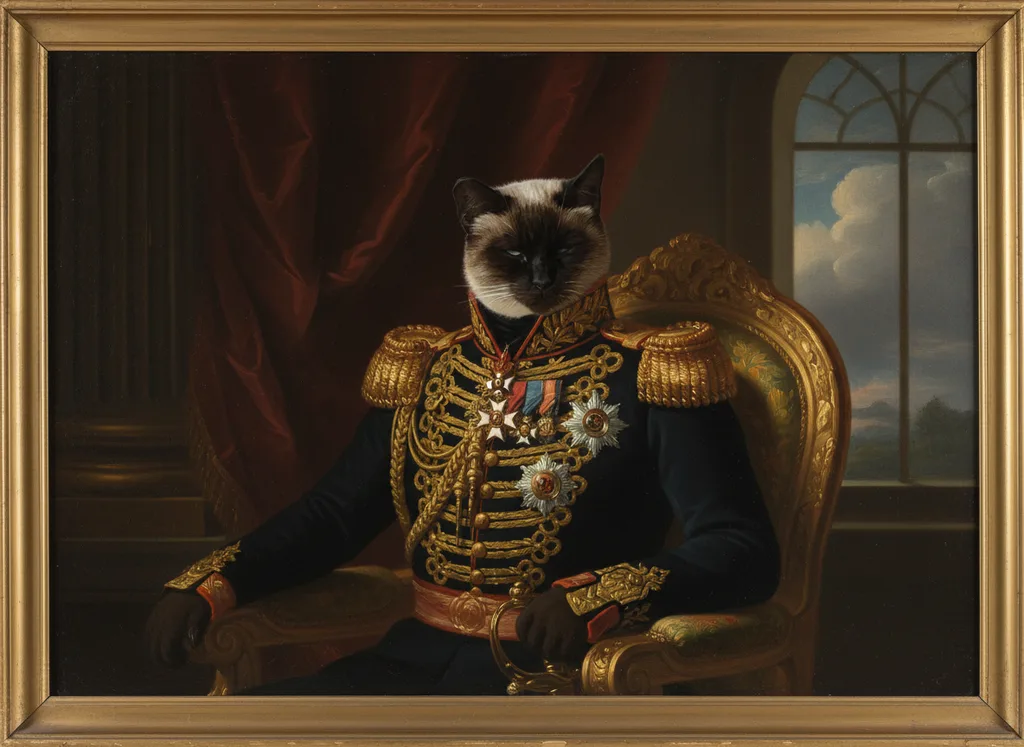
The same animal can be a birthday wish in a Chinese album and a household cat in a Dutch etching. When you pick a style for a portrait of your own cat, you choose the clothes and setting your cat will be painted in. Purrealism has 15 royal styles, from Mughal Emperor and Maharani to Baroque Aristocrat and Military General. The cover of this page shows a Siamese cat from the studio examples in the Military General style. You can see more finished portraits in the gallery, and start your own with one photo of up to 5 MB in the portrait studio.
Questions and answers
What does the cat symbolize in Chinese culture?
In Chinese painting the cat can stand for a long life, because of a pun. The Cleveland Museum of Art says the words for cat and butterfly sound like mao die, a word meaning an octogenarian, a person in their eighties. A painting of a cat with a butterfly therefore wishes the person who receives it a long life, often for a birthday.
Why did Qi Baishi paint a cat and butterflies?
Qi Baishi painted Cat and Butterflies as a playful wish for long life. The Smithsonian's National Museum of Asian Art, which holds the hanging scroll, says the pair form the word play mao die, meaning seventy or eighty years of life. The museum adds that Qi painted it for the artist Xu Beihong, almost three decades younger than him, and that a sense of humour must have led him to do so.
What do cats and sparrows mean in Korean painting?
Cats and sparrows in Korean painting stand for the joy of a long life, according to the National Museum of Korea. The museum explains that the Chinese character for cat sounds like the character for an elderly person. The late Joseon painter Byeon Sang-byeok, who lived from 1730 to 1775, painted cats so well that people called him Byeon Cat.
Do cats symbolize luck?
Cats symbolize luck in Japan through the maneki neko, the beckoning cat. The Mingei International Museum in San Diego says a figure of a cat with one paw raised in the Japanese gesture of beckoning has been a good luck charm since the Edo period, bringing good fortune to people and to businesses. SFO Museum says they often sit in the windows of Japanese and Chinese restaurants.
What do maneki neko symbolize?
Maneki neko symbolize good fortune, and their colour adds a meaning. According to SFO Museum, a white beckoning cat stands for happiness and satisfaction, a black one for safety and driving away evil, and a gold one for money and fortune. Many wear a bib painted with signs of good luck, such as coins.
Which paw does a maneki neko raise?
A maneki neko can raise either paw, and the paw changes the wish. SFO Museum, the museum at San Francisco International Airport, says a beckoning cat with the left paw up tries to bring luck and good fortune to a business. With the right paw up, it invites good fortune, health and happiness into the home.
Is maneki neko Chinese or Japanese?
The maneki neko is Japanese. SFO Museum says the first beckoning cats were made at the Imado kilns of Edo, now Tokyo, in the mid-1800s, as simple clay figures. Japanese makers began to export them during the Meiji period, 1868 to 1912. The museum says they are so common in Chinese restaurants and shops that many people are surprised to learn they come from Japan.
Why is there a cat in Jan Steen's oyster painting?
The cat in Jan Steen's An Interior with a Man offering an Oyster to a Woman stands for lust. The National Gallery in London, which owns the painting, calls the cat a traditional symbol of lust. It licks out an oyster shell under the table, and the gallery explains that oysters were seen as an aphrodisiac in 17th-century Holland.
What does 'He who plays with cats gets scratched' mean?
'He who plays with cats gets scratched' is an old Dutch saying that means a person who looks for trouble will find it. The National Gallery in London suggests it as a source for Judith Leyster's painting A Boy and a Girl with a Cat and an Eel, of about 1635. The boy teases a cat with an eel while his sister pulls its tail.
Why is there a cat in Rembrandt's Virgin and Child etching?
The cat in Rembrandt's etching The Virgin and Child with the Cat and Snake, from 1654, belongs to a home scene. The Victoria and Albert Museum calls the print a homely scene of maternal affection that is also Christian symbolism. The cat plays with Mary's hem, while a snake slips out under her skirt and she treads on it, a sign of her victory over sin.
What is a witch's familiar?
A witch's familiar was believed to be a demon in the shape of a small animal that advised and helped a witch. The University of Glasgow gives this definition for an English pamphlet of 1619 about Joan Flower and her daughters. According to the pamphlet, Joan Flower stroked her cat, Rutterkin, with a stolen glove as part of a spell against Lord Rosse.
What did cats symbolize in ancient Rome?
Cats were symbols of liberty, or freedom, in ancient Rome, according to the National Gallery in London. The same glossary entry says that black cats became linked with witches through a Roman myth, in which a priestess of Hecate, goddess of the underworld, was turned into a cat. Before the 18th century, European artists rarely painted cats as lap pets.
Sources
- Min Zhen, Cat and Butterfly (1985.71.5), Cleveland Museum of Art. Accessed September 28, 2026.
- Qi Baishi, Cat and Butterflies (F1998.74), Smithsonian's National Museum of Asian Art. Accessed September 28, 2026.
- Ohara Koson, Cat and butterfly (S2003.8.1842), Smithsonian's National Museum of Asian Art. Accessed September 28, 2026.
- Cats and Butterflies of Longevity, Shen Zhenlin, National Palace Museum, Taipei. Accessed September 28, 2026.
- Animals and Plants in Korean Traditional Paintings II: Cats and Sparrows, National Museum of Korea (on Google Arts & Culture). Accessed September 28, 2026.
- Maneki Neko: Japan's Beckoning Cat, SFO Museum. Accessed September 28, 2026.
- Maneki Neko: Japan's Beckoning Cats, From Talisman to Pop Icon, Mingei International Museum. Accessed September 28, 2026.
- Cats (glossary), The National Gallery, London. Accessed September 28, 2026.
- Jan Steen, An Interior with a Man offering an Oyster to a Woman (NG2559), The National Gallery, London. Accessed September 28, 2026.
- Nicolaes Maes, Woman Plucking a Duck, Philadelphia Museum of Art. Accessed September 28, 2026.
- Judith Leyster, A Boy and a Girl with a Cat and an Eel (NG5417), The National Gallery, London. Accessed September 28, 2026.
- Children Teaching a Cat to Dance, Known as The Dancing Lesson (SK-A-718), Rijksmuseum. Accessed September 28, 2026.
- Jan Steen, Rijksmuseum. Accessed September 28, 2026.
- The Virgin and Child with the cat and snake, Rembrandt van Rijn, Victoria and Albert Museum. Accessed September 28, 2026.
- Damned Art: England, University of Glasgow Archives and Special Collections. Accessed September 28, 2026.
- Three witches with a cat, a dog and a bird. Engraving, ca. 1800, after a woodcut, 1619, Wellcome Collection. Accessed September 28, 2026.
Short reads on this topic
Articles from Purrspectives that answer one question each.
Dog years to human years: the chart by size, and the DNA formula
A 1-year-old dog is closer to 15 or 30 in human years than to 7. The AKC chart by size, the 2020 DNA formula, and a dog's life stages, explained simply.
Pug history: from Chinese emperors to the House of Orange
Pugs began as companions of Chinese emperors, reached Holland on Dutch trading ships and became the dog of the House of Orange. Their history, art and health.
Persian cat history: where the breed came from, its first cat show, coat and care
Persian cat history from a cat brought to Italy in 1626 to the 1871 Crystal Palace show, plus face types, coat colours, grooming and how to photograph one.