Famous paintings of cats: 10 works to know and where to see them
Ten famous works of art with cats, from Leonardo da Vinci to Manet's Olympia and Louis Wain, with the date, the artist and the museum that holds each one.
By Purrealism
Cats have been in European and Japanese art for at least 500 years. This guide lists 10 works with cats, and each one was checked on the page of the museum that holds it. For every work you get the artist, the date the museum gives, where to find it, and what the cat is doing. Four are paintings. The other six are drawings and prints.
| # | Work | Artist | Date | Museum |
|---|---|---|---|---|
| 1 | Cats, lions, and a dragon | Leonardo da Vinci | 1517 to 1518 | Royal Collection, Britain |
| 2 | The Large Cat | Cornelis Visscher | 1657 | Art Institute of Chicago |
| 3 | The Graham Children | William Hogarth | 1742 | National Gallery, London |
| 4 | The Okazaki Cat Demon | Utagawa Kuniyoshi | mid-1800s | The Met, New York |
| 5 | Asakusa Ricefields and Torinomachi Festival | Utagawa Hiroshige | 1857 | Brooklyn Museum and Art Institute of Chicago |
| 6 | Olympia | Édouard Manet | 1863 | Musée d'Orsay, Paris |
| 7 | Woman with a Cat | Auguste Renoir | 1870s | National Gallery of Art, Washington |
| 8 | A Kitten's Christmas Party | Louis Wain | 1886 | Victoria and Albert Museum, London |
| 9 | Tournée du Chat Noir | Théophile Alexandre Steinlen | 1896 | Los Angeles County Museum of Art |
| 10 | Girl with a Cat | Gwen John | 1918 to 1922 | The Met, New York |
Some of these works are not always on display. In 2026 the museum pages listed the Visscher, Kuniyoshi, Renoir and Steinlen works as not on view, so check before you travel.
Two older cat works are covered in the guide to royal cats in history: the bronze cats of ancient Egypt, and Goya's portrait of a boy in red watched by three cats.
Cats drawn from life: Leonardo and Visscher
1. Leonardo da Vinci, Cats, lions, and a dragon (1517 to 1518)
Leonardo da Vinci filled one sheet with more than 20 small drawings of cats and lions, in black chalk, pen and ink, and wash (ink thinned with water). The Royal Collection Trust, which cares for the British royal art collection, dates it to 1517 to 1518. The cats sleep, sit, prowl, play and fight, and one frightened cat stands with a humped back and its fur on end. A lioness and a dragon share the sheet. The Trust says Leonardo's main interest was how the cat family bends and moves.
2. Cornelis Visscher, The Large Cat (1657)
This Dutch engraving, a print made from lines cut into a metal plate, shows one large cat. The Art Institute of Chicago calls it one of the softest pictures of a cat ever printed. A mouse creeps past a grate in the corner, and its fur is so light that it looks like a ghost. The museum says that in Visscher's culture cats were kept to kill pests, and it calls his cat a memorable portrait.
A cat in an English family portrait
3. William Hogarth, The Graham Children (1742)
The National Gallery in London holds this oil painting and shows it in Room 34. It shows the four children of Daniel Graham, apothecary (maker of medicines) to King George I and King George II, at life size.
The cat scrambles up the back of a chair with its claws out and startles a goldfinch in a gilded cage. The gallery explains why: the youngest child, Thomas, died while Hogarth was working on the painting, and the cat's sudden attack stands for the way death took him.
Cats in Japanese prints: Kuniyoshi and Hiroshige
Woodblock prints are pictures printed in ink and colour from carved wooden blocks.
4. Utagawa Kuniyoshi, The Okazaki Cat Demon (mid-1800s)
The Metropolitan Museum of Art in New York holds Kuniyoshi's Scene from a Ghost Story: The Okazaki Cat Demon, a diptych (two prints made to sit side by side). As the title says, the cat is a demon from a ghost story. Another Met page says Kuniyoshi was best known for prints of warriors, and was also a cat lover who made a number of works with cats. One is a set of three prints, Cats as Fifty-Three Stations of the Tōkaidō Road, published in 1849.
5. Utagawa Hiroshige, Asakusa Ricefields and Torinomachi Festival (1857)
This print comes from Hiroshige's series One Hundred Famous Views of Edo, the old name for Tokyo, and the Brooklyn Museum dates it to the 11th month of 1857. A cat sits on the windowsill of a second-floor room and looks out. Far away, a procession crosses the Asakusa rice fields for the Torinomachi Festival. The Art Institute of Chicago, which holds another copy, says hairpins, tissue paper and a towel show that the room belongs to a courtesan, and that the cat may represent her.
Cats in French paintings: Manet and Renoir
6. Édouard Manet, Olympia (1863)
The Musée d'Orsay in Paris holds Olympia, which Manet signed and dated 1863. The oil painting is 130.5 cm tall and 191 cm wide. It shows a nude woman, a Black servant who offers her a bouquet of flowers, and a black cat.
Encyclopaedia Britannica says Manet based the picture on Titian's Venus of Urbino (1538), a famous Renaissance nude. When Olympia was shown at the Salon of 1865, it caused a scandal. The Musée d'Orsay explains that Manet turned the goddess Venus into a modern prostitute who looks straight at the viewer. On 19 June 1865 the artist Honoré Daumier published a cartoon, now held by The Met, in which one visitor asks why the woman is called Olympia. The other answers that perhaps it is the name of the black cat.
7. Auguste Renoir, Woman with a Cat (1870s)
The National Gallery of Art in Washington dates this oil painting to the 1870s. It is 56 by 46.4 cm. A young woman in a white and blue dress sits in a burgundy armchair and hugs a brown and black striped cat. She holds it upright against her body, so its head rests on her cheek, and she looks at it with dark eyes.
Artists who made cats their main subject
8. Louis Wain, A Kitten's Christmas Party (1886)
Louis Wain was born on 5 August 1860 and died on 4 July 1939. Bethlem Museum of the Mind says he became famous for his pictures of cats, which were popular from the 1880s until the First World War. His cats did what people do: they played cricket, dug up roads, rode bicycles and made after-dinner speeches.
The Victoria and Albert Museum holds A Kitten's Christmas Party, eleven drawings of kittens on one sheet, in wash and pencil. Wain made them for the Christmas Number of the Illustrated London News in 1886.
Wain later became mentally ill. He spent 1925 to 1930 at Bethlem Hospital and kept drawing until near the end of his life. Bethlem Museum of the Mind now holds 56 of his works.
9. Théophile Alexandre Steinlen, Tournée du Chat Noir (1896)
The Los Angeles County Museum of Art says Steinlen was born in Lausanne, Switzerland, worked in France, and lived from 1859 to 1923. Encyclopaedia Britannica explains the name linked to him: Le Chat Noir, "The Black Cat", was the house magazine of the world's first cabaret, and Steinlen drew cats for its wordless comic strips from 1884 to 1886.
His printed poster Tournée du Chat Noir, from 1896, is 134.3 cm tall. In the museum's photograph, a black cat with yellow eyes sits upright on a red panel, with a red circle behind its head.
10. Gwen John, Girl with a Cat (1918 to 1922)
The Met holds Girl with a Cat, a small oil painting by Gwen John, 33.7 by 26.7 cm, dated 1918 to 1922. The Met says John was born in Haverfordwest, Wales, in 1876 and died in Dieppe, France, in 1939. Tate in London holds more of her cats, including Young Woman Holding a Black Cat, dated between 1918 and 1922.
How a modern cat portrait follows these works
A pet portrait is a picture of one particular animal, and the guide to what pet portraits are traces how painters made them for patrons. Hogarth, Manet, Renoir and Gwen John painted a cat next to a person. Leonardo, Visscher, Wain and Steinlen made cats the whole subject. Our guide to cats in art goes deeper into each of these artists and traditions, from Egyptian bronzes to Foujita's Paris studio.
A royal portrait from Purrealism puts your own cat at the centre and dresses it as a ruler. The gallery shows three cats:
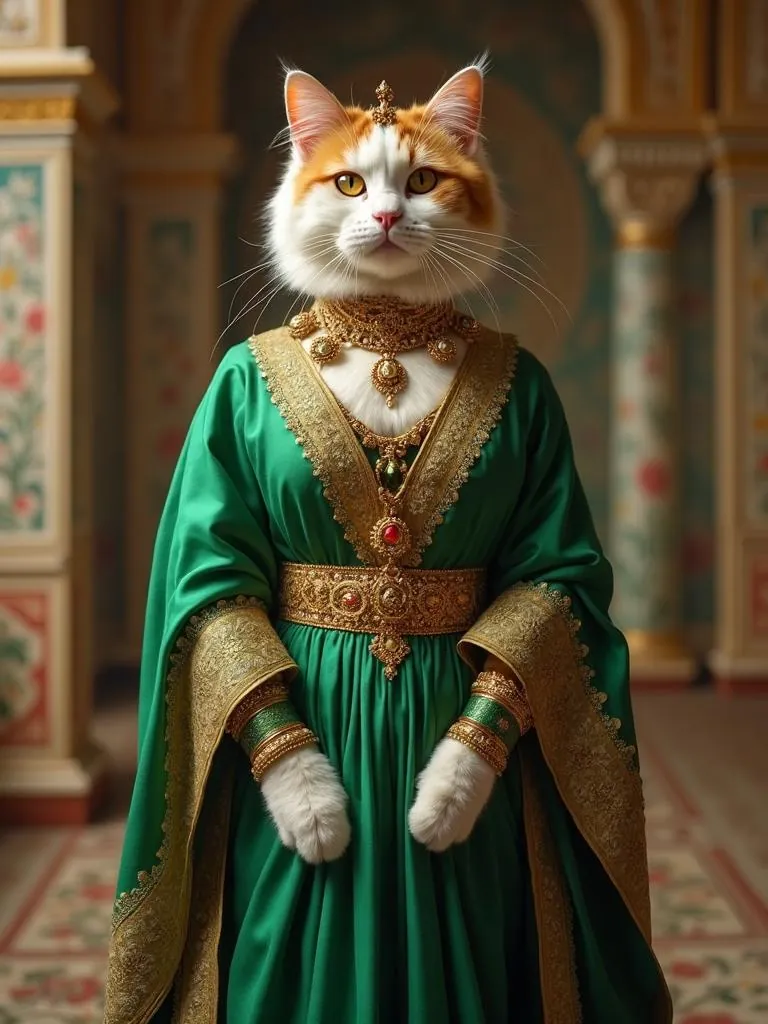
- a white and ginger cat as a Maharani, in a green and gold gown
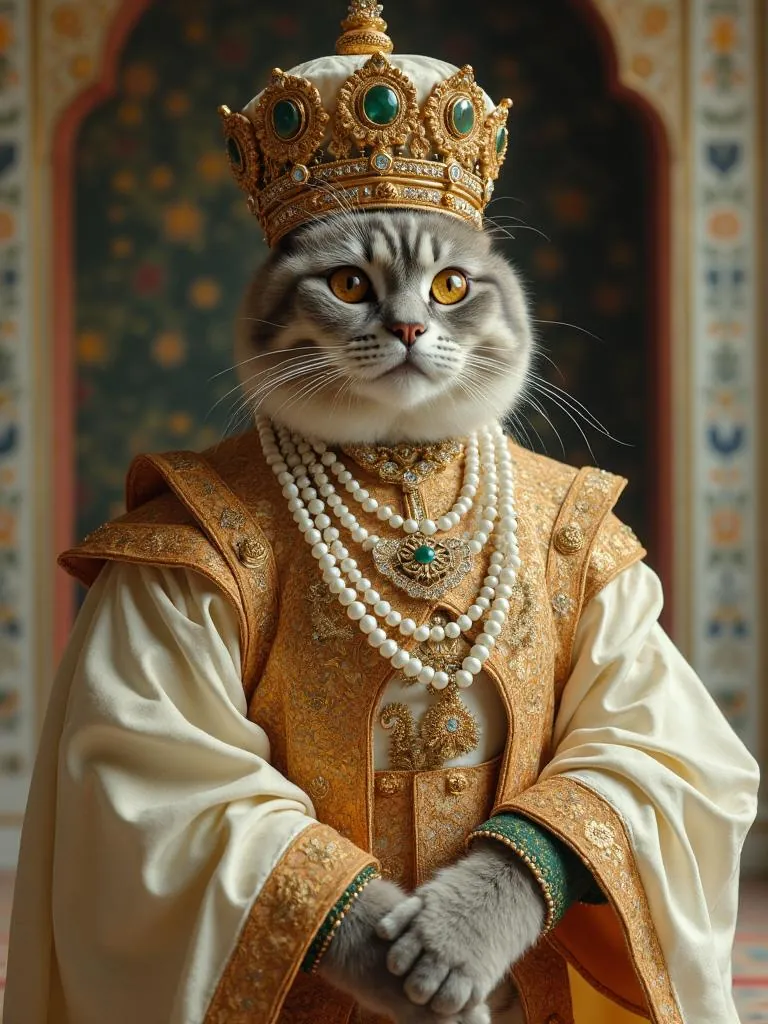
- a grey cat as a Mughal emperor, wearing a jewelled crown and pearls
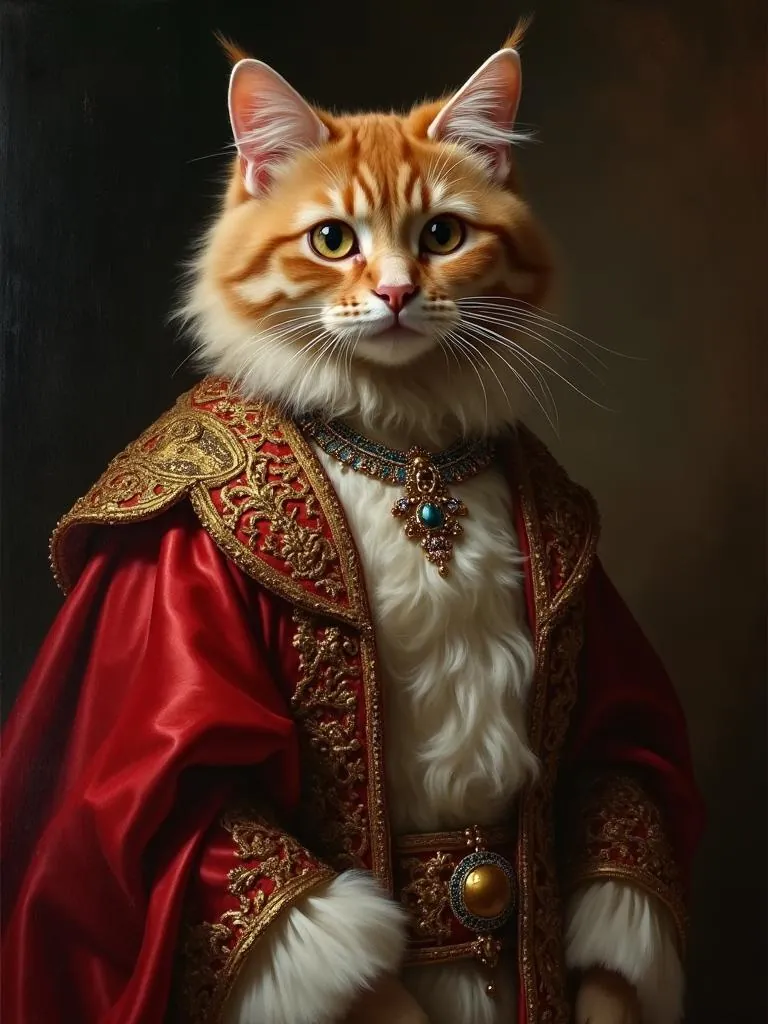
- a ginger cat in a red and gold royal robe, in the Indian Royalty style
Like Renoir's striped cat or Manet's black cat, each one is a single animal with its own coat and face. In the portrait studio you choose one of 15 royal styles and add one clear photo of your cat, saved as an image file of up to 5 MB.
Questions and answers
What is cat painting?
Cat painting is art in which a cat is the subject or takes part in the scene. Some artists made cats the whole subject: Bethlem Museum of the Mind says Louis Wain drew cats playing cricket and riding bicycles. In other works the cat sits beside people. The National Gallery in London says the cat in William Hogarth's The Graham Children, painted in 1742, climbs a chair and startles a caged goldfinch.
What do cats symbolize in art?
Cats symbolize different things in different works of art. The National Gallery in London says the cat attacking a goldfinch in Hogarth's The Graham Children stands for the way death suddenly took the youngest child. The Art Institute of Chicago says the cat on a windowsill in a Hiroshige print from 1857 may represent the courtesan who lives in the room. The same museum says that in Cornelis Visscher's Dutch culture of the 1650s, cats were kept to kill pests.
Why paint cats?
Artists painted and drew cats for different reasons. The Royal Collection Trust says Leonardo da Vinci drew more than 20 cats and lions to study how the cat family bends and moves. The Metropolitan Museum of Art says the Japanese printmaker Utagawa Kuniyoshi was a cat lover who made a number of works with cats. Bethlem Museum of the Mind says Louis Wain's cats appeared in prints, books, magazines and postcards from the 1880s until the First World War.
When was Manet's Olympia painted?
Édouard Manet painted Olympia in 1863, and he signed and dated it that year, according to the Musée d'Orsay in Paris. The painting was shown at the Salon of 1865, an art exhibition in Paris, where it caused a scandal. The oil painting is 130.5 cm tall and 191 cm wide. It shows a nude woman, a servant who offers her flowers, and a black cat.
What museum is Manet's Olympia in?
Manet's Olympia is in the Musée d'Orsay in Paris. According to the museum, the painting was given to the French state in 1890 through a public collection of money started by the painter Claude Monet. It hung in the Musée du Luxembourg and then at the Louvre, and it moved to the Musée d'Orsay in 1986. A cartoon by Honoré Daumier from 1865, held by The Met, jokes that Olympia may be the name of the painting's black cat.
Why was Manet's Olympia controversial?
Manet's Olympia was controversial because its nude woman was a modern woman who looks straight at the viewer. Encyclopaedia Britannica says 19th-century viewers accepted nudes shown as goddesses or nymphs, and that many critics read Olympia as a prostitute. The Musée d'Orsay says both the subject and the way Manet painted it caused a scandal at the Salon of 1865. A cartoon by Honoré Daumier, published in June 1865 and held by The Met, joked about the black cat too.
Who was Louis Wain?
Louis Wain was an artist famous for his pictures of cats, born on 5 August 1860 and died on 4 July 1939. According to Bethlem Museum of the Mind, his cats played cricket, rode bicycles and made after-dinner speeches, and they were popular from the 1880s until the First World War. He was treated at Bethlem Hospital from 1925 to 1930. The museum holds 56 of his works.
What did Louis Wain use to draw?
Louis Wain drew with pencil, ink and watercolour. The Victoria and Albert Museum holds A Kitten's Christmas Party, eleven drawings of kittens on one sheet in wash and pencil, made for the Christmas Number of the Illustrated London News in 1886. The V&A also holds a book cover design from the 1900s in Indian ink, watercolour and gouache, a thick watercolour paint.
Did Leonardo da Vinci draw cats?
Leonardo da Vinci drew cats, and one sheet of his cat studies belongs to the British Royal Collection. The Royal Collection Trust dates the sheet, called Cats, lions, and a dragon, to 1517 to 1518. It holds more than 20 drawings of cats and lions asleep, sitting, prowling, playing and fighting, plus a dragon. The Trust says Leonardo wanted to study the positions and movements of the cat family.
Which Japanese artists made famous cat prints?
Utagawa Kuniyoshi and Utagawa Hiroshige both made woodblock prints with cats in the 1800s. The Metropolitan Museum of Art says Kuniyoshi was a cat lover, and holds his Okazaki Cat Demon print. The Art Institute of Chicago and the Brooklyn Museum hold Hiroshige's Asakusa Ricefields and Torinomachi Festival, dated 1857, in which a cat sits on a windowsill and looks out towards a festival procession.
Sources
- Leonardo da Vinci, Cats, lions, and a dragon (RCIN 912363), Royal Collection Trust
- Cornelis Visscher, The Large Cat, The Art Institute of Chicago
- William Hogarth, The Graham Children (NG4756), National Gallery, London
- Utagawa Kuniyoshi, Scene from a Ghost Story: The Okazaki Cat Demon, The Metropolitan Museum of Art
- Paul Binnie, Kuniyoshi's Cats, from the series A Hundred Shades of Ink of Edo, The Metropolitan Museum of Art
- Utagawa Hiroshige, Asakusa Ricefields and Torinomachi Festival, No. 101 from One Hundred Famous Views of Edo, Brooklyn Museum
- Utagawa Hiroshige, Asakusa Rice Fields and Torinomachi Festival, The Art Institute of Chicago
- Utagawa Hiroshige, Revelers Returned from the Tori no Machi Festival at Asakusa, The Metropolitan Museum of Art
- Edouard Manet, Olympia, Musée d'Orsay
- Olympia, painting by Édouard Manet, Encyclopaedia Britannica
- Honoré Daumier, Looking at a Manet painting, from Sketches from the Salon, The Metropolitan Museum of Art
- Auguste Renoir, Woman with a Cat, National Gallery of Art, Washington
- Louis Wain, A Kitten's Christmas Party (E.4184-1914), Victoria and Albert Museum
- Louis Wain, By Road & Rail in Catland with Louis Wain (E.33-1962), Victoria and Albert Museum
- Louis Wain, Bethlem Museum of the Mind
- Théophile Alexandre Steinlen, Tournée du Chat Noir, Los Angeles County Museum of Art
- Théophile-Alexandre Steinlen, Encyclopaedia Britannica
- Gwen John, Girl with a Cat, The Metropolitan Museum of Art
- Gwen John, Young Woman Holding a Black Cat, Tate
Go deeper
The full guides on this topic, each a set of pages with sources: