Foujita's cats: the Paris painter who drew himself with his cat
Léonard Tsuguharu Foujita painted himself with his cat Mikè, drew the 20 cats of A Book of Cats in 1930 and painted cats on a milky white ground.
By Purrealism. Part of Cats in art: the artists and artworks behind a royal cat portrait.
Léonard Tsuguharu Foujita (1886 to 1968) was a Japanese-born painter who became famous in Paris in the 1920s for two subjects: nudes and cats. His cats look over his shoulder in self-portraits, lie beside his models, fight in mid-air and have a book of their own. This page follows Foujita's cats through the records of the museums that own them, in France, Japan and the United States. It covers his cat Mikè, the self-portraits, the white ground and fine ink line he painted them with, A Book of Cats from 1930, and the cat paintings of his last years. For other artists who drew cats, start at the cats in art guide.
Who Foujita was
The Musée des Beaux-Arts de Reims records that Foujita was born in Tokyo on 27 November 1886 and died in Zurich on 29 January 1968. The Musée des Beaux-Arts de Lyon says he entered the Western painting section of the Tokyo School of Fine Arts in 1905. According to the Pola Museum of Art in Hakone, he was not satisfied with the main trend of bright outdoor painting, and he left for France in 1913, at 26.
In Paris he lived among the artists of Montparnasse. The Lyon museum names Picasso, Chagall, Soutine, Modigliani and Pascin among his friends. From 1925 he received many commissions for nudes and portraits, and the museum calls him the recognized painter of Paris in the 1920s.
In his later life he moved between countries. The Pola Museum says he returned to Japan in 1929 for the first time in 16 years, and worked there after 1933. When the war with China began he turned to large war paintings, and after the Second World War art circles in Japan attacked him for them. The National Museum of Modern Art, Kyoto says he showed many war paintings in Japan during that war, left Japan in 1949 and returned to Paris the next year. He became a French citizen in 1955, and in 1959 he was baptized at Reims Cathedral with the name Léonard.
Mikè, the cat who followed him home
The cat in several of Foujita's self-portraits was called Mikè. The Musée des Beaux-Arts de Reims tells how they met: the cat followed Foujita one evening to his lodging near the Parc Montsouris in Paris, and he adopted it. From the 1920s he painted himself several times with Mikè beside him.
The Reims museum says that in many ways Foujita identified with the animal, which it describes as delicate and precise, with a sharp eye, fond of being indoors, sensitive to the mood of a place and always ready for a joke. The Centre Pompidou in Paris adds that his cat was the only living being allowed to move around the studio while he worked, and that it came to stand for his spirit and his inspiration. The Pompidou also says the cat was seen in Japan as an animal that brings harm, and that in Foujita's pictures it stands for his rebellion.
Self-portraits with a cat
Foujita built a look that people recognized at once. The Lyon museum lists it: a fringe cut straight across the forehead, a small moustache and round glasses with black rims. Both Lyon and the Pompidou compare his white face in these pictures to the painted face of a kabuki actor.
Self-Portrait with a Cat, 1926 (Lyon). Foujita sits at a low table, about to draw. The oil painting is 95.5 by 68.5 cm, and he gave it to the Lyon museum himself in 1927. The museum says the picture sums up everything he did well: portrait, self-portrait, still life and the image of a woman. It adds that the painting looks closer to a drawing than to a painting.
Portrait of the Artist, 1928 (Centre Pompidou). This smaller canvas, 35 by 27 cm, is painted in oil and gouache, a thick watercolour paint. In front, the painter's clasped hands stroke the cat. The French state bought it in 1937.
Self-Portrait, 1929 (Tokyo). The National Museum of Modern Art, Tokyo describes Foujita with his bowl haircut among his inkstone, his brushes, a framed picture of a woman and a cat. The oil painting is 61 by 50.2 cm. The museum says it is a rare example that keeps its original surface as it was painted.
He made the same subject as prints. The Minneapolis Institute of Art holds an etching, a print made from lines cut into a metal plate, titled Self-portrait with cat and dated 1927. The Art Institute of Chicago holds a colour woodblock print of the 1920s with the same title. A staff article on the Art Institute's website describes the cat looking over Foujita's shoulder, as if it had come to check on his work.
The white ground and the fine line
Foujita painted his cats and nudes on a white ground, a first coat on the canvas, and he became known for it. The National Museum of Modern Art, Kyoto calls it his "milk-white" background. The Centre Pompidou says he worked out the method in 1921. He used oil paint on a base of animal glues and gesso, a mixture of chalk and glue, which gave the surface the matte shine of ivory. The Pompidou says he combined fine brush lines in Chinese ink with broader areas of paint mixed with lead white.
The Tokyo museum explains how the 1929 self-portrait works. Foujita laid thin paint over a smooth, milky white ground so that light would reflect off the base layer. The result is even and matte but still seems to glow. The Lyon museum says the figures in his 1926 self-portrait stand out from an opalescent white ground, outlined in black, and that this method made his success.
Writers of his own time and ours point to the line. The Musée d'Art Moderne de Paris quotes a description of the black ink outline on his 1922 nude as finely drawn and steady. Greg Robinson, a history professor at the Université du Québec à Montréal, and Seth Jacobowitz, in a two-part history for the website Discover Nikkei, say his style joined Western oil painting with the fine lines of Japanese woodblock prints and ink painting.
Cats beside his models
The Reims museum says Foujita often joined his two passions, nudes and cats, by posing his models with cats. Its example is Reclining Nude with Cat, 1931, in the Museum of Modern Art, Saitama, Japan. The Minneapolis Institute of Art holds a later version of the idea, the oil painting Little Girl with Cat, dated 1954 and 42.5 by 34.9 cm.
A Book of Cats, 1930
In 1930 Foujita's cat drawings appeared in a book of their own, A Book of Cats, with texts by the writer Michael Joseph. The Tokyo Fuji Art Museum holds a copy. It records the publisher as Covici, Friede and describes the illustrations as collotype prints, a photographic printing method, of 20 drawings by Foujita. Its sheets measure 34 by 26 cm. The book was shown in two exhibitions of Foujita's work in Japan in 2018.
Foujita made other cat pictures in the same years. The Art Institute of Chicago holds his colour woodblock print White Persian Cat from around 1929. The Minneapolis Institute of Art holds a lithograph, a print drawn on stone, titled Cat and dated 1929. The Friends of the Institute gave it to the museum in 1931. Discover Nikkei records that Foujita arrived in New York in November 1930 for a show at the Reinhardt Galleries and stayed 10 weeks.
Cats in the air, 1940
In 1940 Foujita painted Cats, now owned by the National Museum of Modern Art, Tokyo. Art Platform Japan, a database of Japanese museum collections, gives it as oil on canvas, 81 by 100 cm, bought by the museum in 1956. The Kyoto museum showed it as one of the main works in its 2018 retrospective.
The Reims museum, which calls the painting the battle of cats, says Foujita painted it in France in 1940, just before he had to go back to Japan. The cats spin in the air, strike each other with their claws and bite. The museum suggests it may be a comic picture of the world conflict to come.
Cats of the last years
After the war Foujita kept drawing cats. The Reims museum holds an ink drawing of a cat on vellum paper, from around 1949 to 1950, made for a print and for the cover of Elizabeth Coatsworth's book Night and the Cat. It also holds an ink study of a lying cat turning its head, from around 1949.
In 1963 he returned to the fighting cats of 1940 in a calmer form. The Reims painting Cats shows nine cats lying in different poses on a floor of white eight-sided tiles. It is oil on canvas, 62.7 by 76.5 cm, and Foujita made the frame himself. The museum says group pictures of cats are rarer in his work than single cats. Many sketches in Reims show how patiently he watched cats sleeping, playing, looking about and even scratching an itch. Members of the Horiuchi family gave the painting and the drawings to the Reims museum in 2013.
Where to see Foujita's cats
| Work | Date | Medium and size | Museum |
|---|---|---|---|
| Self-Portrait with a Cat | 1926 | Oil on canvas, 95.5 × 68.5 cm | Musée des Beaux-Arts de Lyon |
| Self-portrait with cat | 1927 | Etching, 43.2 × 34.3 cm (plate) | Minneapolis Institute of Art |
| Portrait of the Artist | 1928 | Oil and gouache on canvas, 35 × 27 cm | Centre Pompidou, Paris |
| Self-Portrait | 1929 | Oil on canvas, 61 × 50.2 cm | National Museum of Modern Art, Tokyo |
| White Persian Cat | around 1929 | Colour woodblock print, 33 × 45 cm | Art Institute of Chicago |
| A Book of Cats | 1930 | Book, collotype prints of 20 drawings | Tokyo Fuji Art Museum |
| Cats | 1940 | Oil on canvas, 81 × 100 cm | National Museum of Modern Art, Tokyo |
| Little Girl with Cat | 1954 | Oil on canvas, 42.5 × 34.9 cm | Minneapolis Institute of Art |
| Cats | 1963 | Oil on canvas, 62.7 × 76.5 cm | Musée des Beaux-Arts de Reims |
Several of these records list the work as not on display, so check the museum's website before you visit.
What critics wrote about his cats
By the early 1930s, Foujita's cats were part of his fame. The Discover Nikkei history reports that a Los Angeles gallery showed 87 of his works in July 1933, and that they included pictures of cats. In October 1933 the Los Angeles newspaper editor Larry Tajiri wrote that the press in Paris, Buenos Aires and Rio de Janeiro had written at length about Foujita, his wife and his cats. The same history quotes an Oakland Tribune review of a 1932 show of modern Japanese prints at the de Young Museum in San Francisco, which said that Foujita and his cats were modern revolutionaries to Japan.
Foujita's cats and a portrait of your own cat
Foujita painted himself with his own cat, Mikè, several times. A portrait of your own cat starts from the same place: one animal, with its own markings. A painting like his depends on the details he drew with care, such as the shape of the ears, the stripes and the whiskers, and a clear photo of your cat shows them.
For a different line, the carved outlines of the Edo printmakers, read our page on Japanese cat prints. The cats of the Paris cabaret Le Chat Noir are the subject of our page on Steinlen's cats.
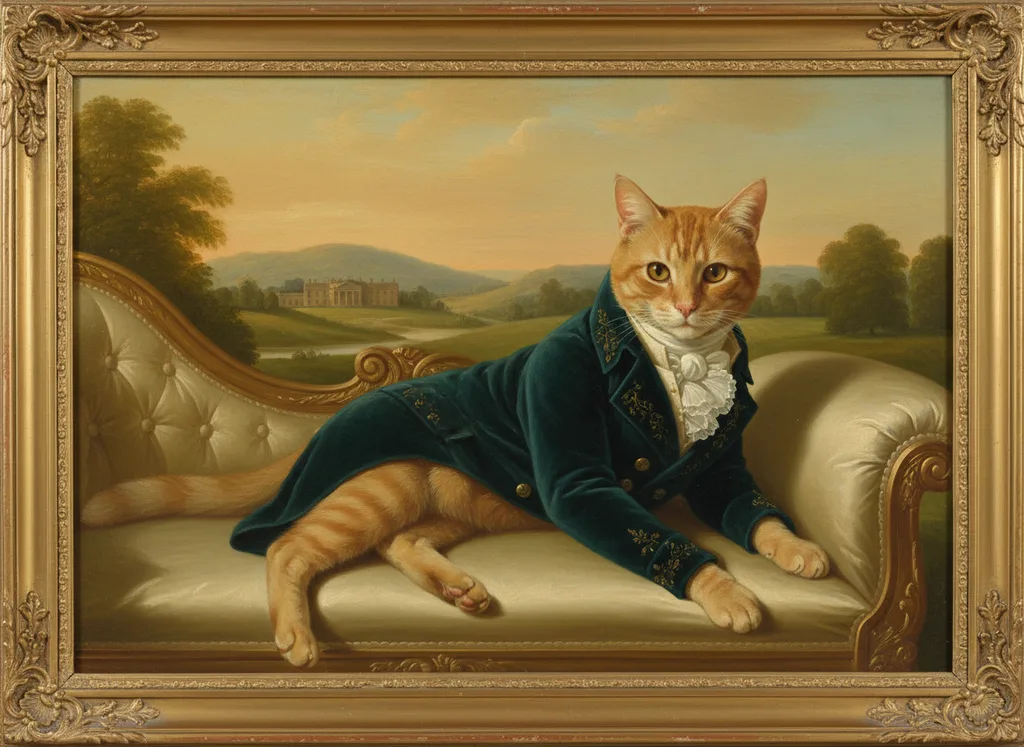
The cover of this page shows a tabby cat in Purrealism's Regency Era style, one of 15 royal styles. You can see finished portraits in the gallery, or start your own in the portrait studio with one clear photo of up to 5 MB.
Questions and answers
Who was Tsuguharu Foujita?
Tsuguharu Foujita was a painter born in Tokyo in 1886 who became famous in Paris and died in Zurich in 1968. The Pola Museum of Art says he moved to France in 1913, at 26. The Musée des Beaux-Arts de Lyon says he received many commissions for nudes and portraits in Paris from 1925. He took French nationality in 1955 and the name Léonard at his baptism in 1959.
Why did Foujita paint cats?
Foujita painted cats because the animal was like a second self to him, according to the Musée des Beaux-Arts de Lyon, which says this is why he painted many self-portraits with a cat. The Centre Pompidou in Paris adds that his cat was the only living being allowed in his studio while he worked, and that it stood for his spirit and his inspiration.
What was the name of Foujita's cat?
Foujita's cat was called Mikè, according to the Musée des Beaux-Arts de Reims in France. The museum says Mikè followed Foujita home one evening near the Parc Montsouris in Paris, and the painter adopted it. From the 1920s Foujita painted himself several times with Mikè beside him, as in his Self-Portrait with a Cat of 1926 in the Musée des Beaux-Arts de Lyon.
How did Foujita make his milky white background?
Foujita made his milky white background with a method he worked out in 1921, according to the Centre Pompidou in Paris. He used oil paint on a base of animal glues and gesso, a chalk and glue mixture, which gave the surface the matte shine of ivory. The National Museum of Modern Art, Tokyo says he laid thin paint over this smooth white ground so that light reflected off it.
What is A Book of Cats by Foujita?
A Book of Cats is a book of 20 cat drawings by Foujita with texts by the writer Michael Joseph, published in 1930 by Covici, Friede. The Tokyo Fuji Art Museum holds a copy and describes its pictures as collotype prints, a photographic printing method, of the 20 drawings. The museum measures its sheets at 34 by 26 cm, and the book was shown in two Foujita exhibitions in Japan in 2018.
Where is Foujita's Self-Portrait with a Cat?
Foujita's Self-Portrait with a Cat of 1926 is in the Musée des Beaux-Arts de Lyon, France, which he gave the painting in 1927. He painted other versions. The Centre Pompidou in Paris owns one from 1928, which the French state bought in 1937. The National Museum of Modern Art, Tokyo owns a self-portrait of 1929 in which a cat sits among his inkstone, brushes and a framed picture of a woman.
What does Foujita's 1940 painting of cats show?
Foujita's 1940 painting Cats shows a group of cats spinning in the air, clawing and biting each other. The Musée des Beaux-Arts de Reims says he painted it in France in 1940, just before he had to return to Japan, and that it may be a comic picture of the world conflict to come. The National Museum of Modern Art, Tokyo owns the canvas, which is 81 by 100 cm.
Did Foujita make prints of cats?
Foujita made prints of cats in several methods. The Art Institute of Chicago holds two colour woodblock prints, Self-portrait with Cat from the 1920s and White Persian Cat from around 1929. The Minneapolis Institute of Art holds his etching Self-portrait with cat of 1927, a print made from lines cut into a metal plate, and a lithograph of a cat from 1929.
Did Foujita paint women with cats?
Foujita often painted women with cats. The Musée des Beaux-Arts de Reims says he liked to pose his models with a cat, and gives as an example his Reclining Nude with Cat of 1931 in the Museum of Modern Art, Saitama, Japan. The Minneapolis Institute of Art holds his oil painting Little Girl with Cat, dated 1954 and 42.5 by 34.9 cm.
Where can I see Foujita's cats in France?
Foujita's cats can be seen in three French public collections. The Musée des Beaux-Arts de Lyon holds his Self-Portrait with a Cat of 1926, and the Centre Pompidou in Paris holds the version of 1928. The Musée des Beaux-Arts de Reims holds Cats, a painting of nine cats from 1963, and many cat drawings given by members of the Horiuchi family in 2013.
What did critics say about Foujita's cats in America?
American newspapers of the 1930s often mentioned Foujita's cats. Greg Robinson, a history professor at the Université du Québec à Montréal, and Seth Jacobowitz, writing for the website Discover Nikkei, report that a 1933 Los Angeles show of his work included pictures of cats. They quote an Oakland Tribune review of a 1932 show at the de Young Museum in San Francisco that called Foujita and his cats modern revolutionaries to Japan.
Sources
- Self-Portrait (O00826), FUJITA Tsuguharu, 1929, The National Museum of Modern Art, Tokyo. Accessed September 28, 2026.
- Cats (O00147), FUJITA Tsuguharu, 1940, The National Museum of Modern Art, Tokyo. Accessed September 28, 2026.
- FUJITA, Tsuguharu, Cats, Art Platform Japan. Accessed September 28, 2026.
- Chats, FOUJITA (inv. 2013.3.10), Musées de Reims. Accessed September 28, 2026.
- Chat, dessin d'une estampe et de la couverture de Night and the Cat d'Elisabeth Coatsworth, FOUJITA (inv. 2013.3.534), Musées de Reims. Accessed September 28, 2026.
- Chat couché la tête tournée, étude, FOUJITA, Musées de Reims. Accessed September 28, 2026.
- Autoportrait au chat, Leonard Tsuguharu Foujita, 1926, Musée des Beaux-Arts de Lyon. Accessed September 28, 2026.
- Léonard Foujita, Portrait de l'artiste (Autoportrait au chat), 1928, Centre Pompidou, Musée national d'art moderne. Accessed September 28, 2026.
- Self-portrait with Cat, Fujita Tsuguharu (Léonard Tsugouharu Foujita), The Art Institute of Chicago. Accessed September 28, 2026.
- White Persian Cat, Fujita Tsuguharu (Léonard Tsugouharu Foujita), The Art Institute of Chicago. Accessed September 28, 2026.
- Unfazed: Cats in Art, The Art Institute of Chicago. Accessed September 28, 2026.
- Self-portrait with cat, Léonard Tsuguharu Foujita, 1927, Minneapolis Institute of Art. Accessed September 28, 2026.
- Cat, Léonard Tsuguharu Foujita, 1929, Minneapolis Institute of Art. Accessed September 28, 2026.
- Little Girl with Cat, Léonard Tsuguharu Foujita, 1954, Minneapolis Institute of Art. Accessed September 28, 2026.
- Cat (from "A Book of Cats"), Michael Joseph and Léonard Foujita, Tokyo Fuji Art Museum. Accessed September 28, 2026.
- Léonard Foujita (Fujita Tsuguharu), Pola Museum of Art. Accessed September 28, 2026.
- Foujita: A Retrospective Commemorating the 50th Anniversary of his Death, The National Museum of Modern Art, Kyoto. Accessed September 28, 2026.
- Foujita: A Retrospective, Commemorating the 50th Anniversary of his Death, Tokyo Metropolitan Art Museum. Accessed September 28, 2026.
- Nu couché à la toile de Jouy, Foujita, 1922, Musée d'Art Moderne de Paris. Accessed September 28, 2026.
- Foujita Discovers the Americas: An Artist's Tour, Part 1, Discover Nikkei. Accessed September 28, 2026.
- Foujita Discovers the Americas: An Artist's Tour, Part 2, Discover Nikkei. Accessed September 28, 2026.
Short reads on this topic
Articles from Purrspectives that answer one question each.
Dog years to human years: the chart by size, and the DNA formula
A 1-year-old dog is closer to 15 or 30 in human years than to 7. The AKC chart by size, the 2020 DNA formula, and a dog's life stages, explained simply.
Pug history: from Chinese emperors to the House of Orange
Pugs began as companions of Chinese emperors, reached Holland on Dutch trading ships and became the dog of the House of Orange. Their history, art and health.
Persian cat history: where the breed came from, its first cat show, coat and care
Persian cat history from a cat brought to Italy in 1626 to the 1871 Crystal Palace show, plus face types, coat colours, grooming and how to photograph one.