Royal cats of Japan, Korea and Siam: court cats in diaries, poems and palace records
Cats at the royal courts of Japan, Korea and Siam: an emperor's diary, a cat with a court rank, a Joseon king's golden cat and the Thai Cat-Book Poems.
By Purrealism. Part of Royal pets in history: the real dogs and cats of kings, queens and emperors.
This page looks at cats kept at three Asian royal courts: the emperors of Heian Japan, King Sukjong of Joseon Korea, and the kings of Siam, now Thailand. It draws on the records those courts left: an emperor's diary, a court lady's book, Korean writings about the king and Thai manuscripts about cats. It then follows the Siamese cat from Bangkok to Britain and America. Cats in ancient Egypt, at the Indian courts and in European royal portraits are covered in our article on royal cats in history. This page is part of our guide to royal pets in history.
Cats at the Heian court of Japan
Cats reached Japan long before its emperors wrote about them. Iwazaki Eiji, a veterinary scientist and cat folklore researcher interviewed by Nippon.com, says Japanese house cats were once thought to have arrived by the Silk Road in the Nara period (710 to 794) or the early Heian period. In 2011, bones from the Karakami ruins on Iki island, in Nagasaki Prefecture, were identified as a domestic cat, Japan's oldest. The ruins date from the Yayoi period, 300 BCE to 300 CE.
Emperor Uda's black cat
Emperor Uda kept a diary in variant Chinese, a mixed Sino-Japanese form of writing. Most of it is lost. In 1992, Judith Rabinovitch of the University of Montana and Akira Minegishi of Yokohama National University translated an entry from the first year of the Kanpyō era, which Uda headed "For the Love of a Cat".
Uda begins by saying where the cat came from. Minamoto no Suguru, the Junior Assistant Governor-General of Dazaifu, gave it to Uda's father, the former emperor Kōkō, when Suguru came back to the capital at the end of his term. Kōkō enjoyed the cat for several days and then gave it to his son. Iwazaki Eiji says Uda was seventeen at the time.
Uda then describes the cat with care:
- Colour. Other cats are a light black, he writes, but this one is dark black, like a crow.
- Size. It is a foot and a half long and six inches high. Curled up, it looks as small as a black millet berry; stretched out, it is long, like a drawn bow.
- Movement. It walks without a sound, and Uda compares it to a black dragon above the clouds.
- Work. It catches mice at night better than other cats.
Uda had cared for the cat for five years when he wrote the entry, and gave it milk gruel every morning. He says he took such care of it because his father had given it to him. He once told the cat that it held the forces of yin and yang, the two balancing forces of Chinese thought. The cat, he wrote, sighed, raised its head and stared at his face, as if too full of feeling to answer.
A cat with a court rank
Later, Sei Shōnagon, a lady-in-waiting to the Empress, recorded a palace cat in her Pillow Book. Iwazaki Eiji says this was the cat of Emperor Ichijō, who was known for his love of cats. In the 1930 English translation by Nobuko Kobayashi, the cat "was lately ennobled and therefore respectfully addressed by all as Myobu-no-Omoto". The original Japanese text, which the University of Virginia Library publishes online, gives the name as 命婦のおもと (Myōbu no Omoto).
The best-known passage is about the cat and a dog. One day the cat lay asleep in the sun on the edge of the veranda. Her attendant wanted her to come inside, and called as a joke for the palace dog, Okinamaru, to bite her. The dog believed she meant it and ran at the cat. She fled behind the screen where the Emperor was eating breakfast, and he held her to his chest. The Emperor ordered the dog beaten and sent into exile on Dog Island. He said the attendant could not be trusted and must be changed.
Okinamaru had been a court favourite. On 3 March, the book says, an official had decorated him with willow wreaths and peach blossoms and let him walk in the palace garden. A few days after his exile the court heard a dog being beaten. That evening a shabby, trembling dog came in, and nobody could agree whether it was Okinamaru. The next morning Sei Shōnagon said to herself that she grieved for Okinamaru's death, and the dog began to tremble and cry. It was him. The Emperor came to see, said that a dog has a beautiful nature, and later forgave Okinamaru, who stayed in the palace.
King Sukjong's golden cat in Joseon Korea
King Sukjong reigned in Korea from 1674 to 1720, during the Joseon dynasty. The Korea Heritage Service, the Korean government's heritage agency, calls him the greatest cat lover of the Joseon royal family. It says several writings record his love of cats, among them Yi Ha-gon's Dutacho and Yi Ik's Seongho Saseol. The most detailed is a poem, the Geummyoga, or "Song of the Golden Cat", in the collected works of the writer Kim Si-min.
The Korea Heritage Service sums up the poem and its preface:
- The king loved a palace cat and named it Geummyo, "golden cat". It was said to be golden, and the agency thinks it was a yellowish cat, of the kind Koreans now nickname a "cheese cat".
- It was the only creature in the palace allowed to eat close to the king, and on cold nights it slept beside the king's seat.
- One day palace staff accused it of stealing meat meant for the king, and drove it out.
- When Sukjong died, the cat refused to eat and cried for three days. Queen Dowager Inwon took pity on it and brought it back to the palace, but it still would not eat.
- After crying for dozens of days, it was found dead, thin to the bone, on the steps of the hall where the king's coffin lay.
- On the queen dowager's order, the cat was wrapped in silk and buried beside the road to Myeongneung, the king's tomb.
Korea.net, the government's English news site, gives the cat's name as Geumson. It says Sukjong was buried at Myeongneung in 1720, next to Queen Inhyeon, who had been buried there in 1701. Myeongneung is part of Seooreung, "five tombs in the west", in Goyang, Gyeonggi Province, where Queen Inwon also lies. Today a night tour of Seooreung uses a cat character inspired by Sukjong's cat.
Cats at the Siamese court
The Cat-Book Poems
In Siam, cats had their own manuscripts. The Tamra Maew, which English writers call the Cat-Book Poems or Thai Cat Poems, describes types of cat in verse, each with a painting. Jana Igunma, a curator at the British Library, wrote in 2013 that the treatise told readers certain cats could bring good luck, prosperity, rank or health to their owners. One example is a white cat with nine black spots and green eyes, which was said to bring high social status.
The British Library holds two copies. Or.16797, which Igunma described as a new acquisition in 2013, is a folding book of 12 leaves that open from top to bottom, with 23 watercolour paintings, made in central Thailand in the 19th century. Or.16008, already in the collection, has drawings in white chalk on blackened paper. Igunma says the manuscript names no author or painter.
The date of the poems is uncertain, and the sources give different answers:
| Source | What it says about the date |
|---|---|
| The Governing Council of the Cat Fancy | Written between the 14th and 18th centuries |
| The Cat Fanciers' Association (breed page) | Written during the Ayutthaya period of Thai history, 1350 to 1767 |
| The Cat Fanciers' Association (2000 profile) | The poems are 100 to 200 years old, but reflect a much older literary culture |
| The Public Domain Review | Most surviving copies were made after the Burmese sacked the former capital in 1767 |
| The British Library | Both of its copies date from the 19th century |
The Cat Fanciers' Association (CFA) says on its Korat page that the manuscript shows 17 good-luck cats, and that the Korat was the best known of them. The CFA's 2000 profile says the poems describe a white cat with black ears, face, paws and tail, called Maew Kaew or Wichien Maat, and the GCCF names the Wichien Maat as the old Thai breed behind the Siamese. The poems reached English readers in a 1998 translation by Martin Clutterbuck.
Were Siamese cats royal cats?
Here the sources disagree. Igunma writes that "the breeding of the most famous Siamese cats, for example the Wichienmat, was reserved for the royal family alone". The CFA's 2000 profile says the earliest English books called the breed both Siamese and "The Royal Cat of Siam", because the first people who brought the cats west claimed they were bred under royal protection. The profile adds that in recent years many have treated these stories as more legend than fact. Its author, Betty White, says the early writers held to their claims so firmly that this suggests they were true.
A 2025 paper in the Wisdom Journal of Humanities and Social Science goes further. It says Thai cats first reached the West in the 19th century through diplomatic exchanges by the Thai monarchy, and that in 1901 the Thai government issued a statement that there was no "Royal Cat of Siam" and no breed kept specially in the palace. The Public Domain Review writes that King Chulalongkorn, Rama V, "reportedly" liked to give Wichien Maat cats as diplomatic gifts.
How Siamese cats reached the West
Two of the earliest recorded Siamese cats in the West came through foreign consuls in Bangkok.
| Year | Event | Source |
|---|---|---|
| 1878 | David Sickels, the American consul in Bangkok, sends a Siamese cat named Siam to First Lady Lucy Hayes | U.S. National Archives; CFA |
| 1879 | Siam arrives in the United States | U.S. National Archives |
| 1881 | Siamese cats appear in the catalogues of the Crystal Palace cat show in London | CFA (2000 profile) |
| 1884 | Edward Blencowe Gould, British Consul-General in Bangkok, brings the pair Pho and Mia to Britain for his sister Lilian | GCCF |
| 1885 | Pho and Mia's three kittens are shown with their parents at the Crystal Palace Show | GCCF |
| 1901 | Lilian Gould helps found the Siamese Cat Club | GCCF |
| 1906 | The Siamese is among the first breeds recognized by the CFA when it is founded | CFA |
Siam's life at the White House was short. The U.S. National Archives says she fell ill nine months after she arrived. The President's doctor tried to feed her back to health with fish, chicken, duck, cream and oysters, but she died. Her body went to the Department of Agriculture to be preserved, and was then lost. The Hayes family's cat was the first Siamese in the United States, and the CFA says a Siamese first won Best Cat in Show in 1907.
In Britain, the GCCF says all three of Pho and Mia's kittens died shortly after the 1885 show. The CFA says Siamese cats appear in the stud books of America's Beresford Cat Club in 1900.
At the Chinese court in 1903, the American painter Katharine Carl found that the Empress Dowager Cixi disliked cats, and that the eunuchs who kept them hid them from her. Her dogs are on our page on the Pekingese and the Chinese emperors. For much older royal cats, see our page on cats in ancient Egypt.
A court cat in a royal portrait
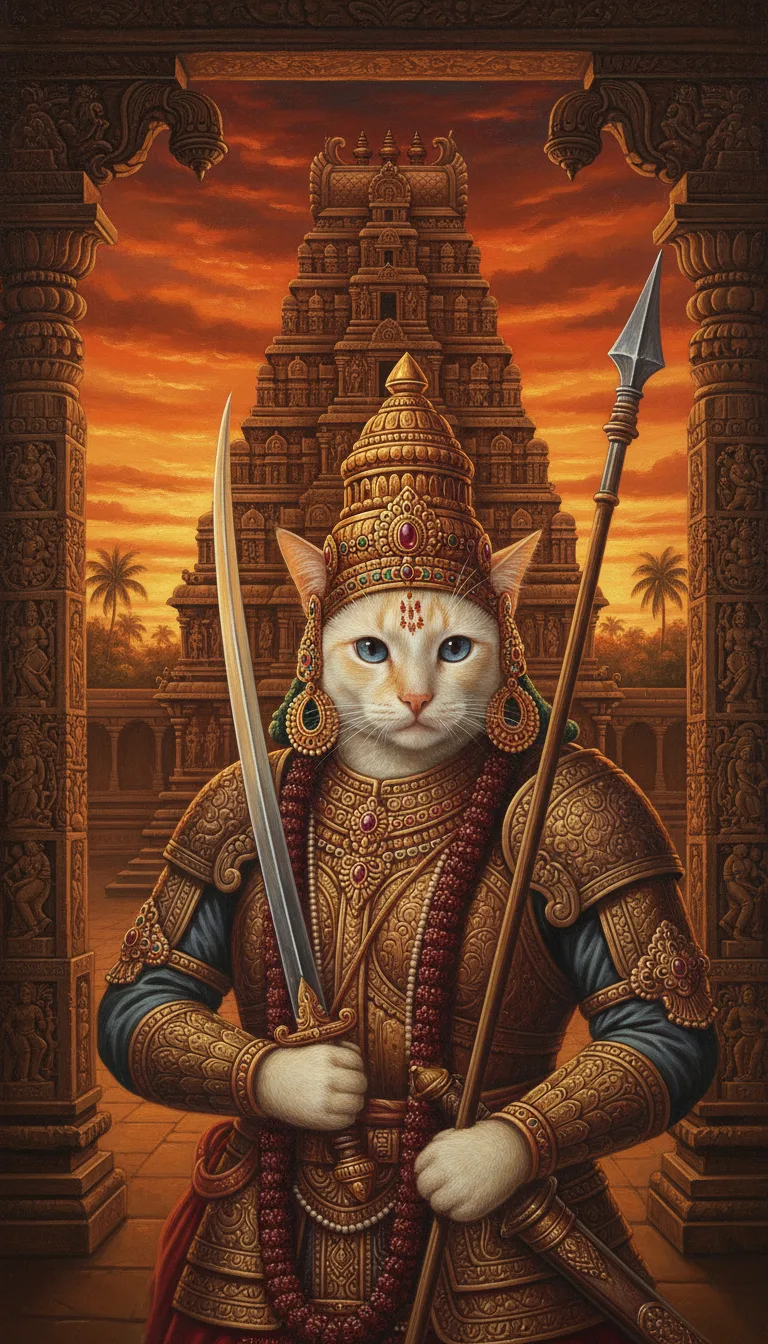
In these records, a Japanese emperor's cat received a court title and a Korean king's cat a silk burial. The cover of this page shows a Siamese cat from our studio examples in the Chola Warrior style, in gold armour and a tall gold crown, holding a sword and a spear in front of a temple tower. Any of the 15 styles can be chosen for a cat, from the Indian styles such as Mughal Emperor and Maharani to the European ones such as Regency Era. The gallery shows finished cat portraits, and the portrait studio takes one clear photo of up to 5 MB. Our pet photo guide explains how to take it.
Questions and answers
Which Japanese emperor wrote about his cat?
Emperor Uda wrote about his black cat in his court diary. In a translation by Judith Rabinovitch and Akira Minegishi, published by Yokohama National University, Uda says the cat had first been given to his father, the former emperor Kōkō. He describes its crow-black fur, says it caught mice at night better than other cats, and says he gave it milk gruel every morning for five years.
Which Japanese emperor gave his cat a court rank?
Emperor Ichijō gave his cat a court rank, according to Sei Shōnagon's Pillow Book. Iwazaki Eiji, a cat folklore researcher interviewed by Nippon.com, says the book shows Ichijō doting on his pet. The Pillow Book says the palace cat was ennobled and addressed by everyone as Myōbu no Omoto, and the Emperor had a dog sent away for chasing her.
What happened to the palace dog in The Pillow Book?
The palace dog Okinamaru, in Sei Shōnagon's Pillow Book, was beaten and sent to Dog Island for chasing the Emperor's cat. An attendant had called him as a joke to scare the cat off the veranda. He came back secretly, shabby and trembling, and the court ladies could not agree whether it was him. He was known when he wept as Sei Shōnagon grieved for him, and the Emperor later forgave him.
When did cats come to Japan?
Cats reached Japan earlier than once thought. Iwazaki Eiji, a veterinary scientist interviewed by Nippon.com, says Japanese house cats were long believed to have arrived along the Silk Road in the Nara or early Heian period, from 710 onward. In 2011, bones from the Karakami ruins on Iki island, dated to the Yayoi period (300 BCE to 300 CE), were identified as a domestic cat, Japan's oldest.
Did King Sukjong have a cat?
King Sukjong of Joseon Korea, who reigned from 1674 to 1720, had a golden cat. The Korea Heritage Service calls him the greatest cat lover of the Joseon royal family. It says the cat was the only creature allowed to eat near the king, and slept beside the king's seat on cold nights. Korea.net, the government's English site, gives the cat's name as Geumson.
What happened to King Sukjong's cat after he died?
King Sukjong's cat stopped eating after the king died in 1720, according to the Korea Heritage Service. It cried for days, and Queen Dowager Inwon brought it back to the palace, but it still refused food. It was found dead on the steps of the hall where the king's coffin lay. On the queen's order it was wrapped in silk and buried beside the road to Myeongneung, Sukjong's tomb.
What is the Tamra Maew?
The Tamra Maew, or Cat-Book Poems, is a Thai manuscript that describes types of cat in verse, with a painting of each. Jana Igunma of the British Library says the treatise told readers that certain cats could bring good luck, prosperity, rank or health. The British Library holds two 19th-century copies, catalogue numbers Or.16797 and Or.16008, made as folding books that open from top to bottom.
How did Siamese cats originate?
Siamese cats originated in Siam, now Thailand, as a local cat the Thais called Wichien Maat. The Governing Council of the Cat Fancy says this old breed is described in the Tamra Maew, a book of cat poems written between the 14th and 18th centuries. The Cat Fanciers' Association says the surviving poems are 100 to 200 years old and describe a white cat with black ears, face, paws and tail.
What were Siamese cats bred for?
Siamese cats were valued in old Siam as lucky cats. Jana Igunma of the British Library writes that the Thai Treatise on Cats says certain types could bring good luck, prosperity, rank or health to their owners. She adds that the breeding of the Wichienmat, the best known Siamese type, was reserved for the royal family. Other writers question that royal link.
What is a royal cat breed?
The Siamese is the cat breed most often called royal, because early English writers named it the Royal Cat of Siam. The Cat Fanciers' Association says those writers claimed the cats were bred under royal protection in Siam, and that many now doubt the story. A 2025 paper in the Wisdom Journal of Humanities and Social Science says the Thai government stated in 1901 that no special palace breed existed.
Who brought the first Siamese cats to England?
Edward Blencowe Gould, the British Consul-General in Bangkok, brought a breeding pair of Siamese cats named Pho and Mia to Britain in 1884, according to the Governing Council of the Cat Fancy. They were a gift for his sister Lilian, who later helped found the Siamese Cat Club in 1901. The Cat Fanciers' Association says Siamese cats already appeared in Crystal Palace show catalogues in 1881.
What was the first Siamese cat in America?
The first Siamese cat in America was a female called Siam, sent to First Lady Lucy Hayes in 1878 by David Sickels, the American consul in Bangkok. The U.S. National Archives says she arrived in 1879. She fell ill, and the President's doctor fed her fish, chicken, duck, cream and oysters, but she died at the White House. Her body, sent to be preserved, was later lost.
Sources
- Some Literary Aspects of Four Kambun Diaries of the Japanese Court: Translation with Commentaries on Excerpts from Uda Tennō Gyoki, Murakami Tennō Gyoki, Gonki, and Gyokuyō, by Judith N. Rabinovitch with Akira Minegishi (1992), Yokohama National University Repository. Accessed September 28, 2026.
- "Waneko" Studies: A Journey into Japan's Cat Lore, Nippon.com. Accessed September 28, 2026.
- The Sketch Book of the Lady Sei Shōnagon, translated by Nobuko Kobayashi (1930), Internet Archive (Digital Library of India copy). Accessed September 28, 2026.
- Makura no sōshi (The Pillow Book), Japanese text, Japanese Text Initiative, University of Virginia Library. Accessed September 28, 2026.
- 조선 제일의 고양이 집사 숙종과 금묘(金猫) 이야기 (King Sukjong, Joseon's greatest cat keeper, and the golden cat), Korea Heritage Service. Accessed September 28, 2026.
- Exploring Joseon royal tombs at night with king's dear cat, Korea.net, Korean Culture and Information Service. Accessed September 28, 2026.
- A Treatise on Siamese Cats, Southeast Asia Library Group (post by Jana Igunma, British Library). Accessed September 28, 2026.
- The Cat's Maew: Thai Treatise on Auspicious Felines (19th Century), The Public Domain Review. Accessed September 28, 2026.
- Siamese, The Governing Council of the Cat Fancy. Accessed September 28, 2026.
- Siamese, The Cat Fanciers' Association. Accessed September 28, 2026.
- Siamese Article 2000: Siamese Profile by Betty White, The Cat Fanciers' Association. Accessed September 28, 2026.
- Korat, The Cat Fanciers' Association. Accessed September 28, 2026.
- Auspicious Cats of Thailand and Their Cultural Significance, by James Vasquez (2025), Wisdom Journal of Humanities and Social Science. Accessed September 28, 2026.
- The Office of the First Cat, U.S. National Archives, Pieces of History. Accessed September 28, 2026.
- With the Empress Dowager of China, by Katharine A. Carl (1905), Project Gutenberg. Accessed September 28, 2026.
Short reads on this topic
Articles from Purrspectives that answer one question each.
Dog years to human years: the chart by size, and the DNA formula
A 1-year-old dog is closer to 15 or 30 in human years than to 7. The AKC chart by size, the 2020 DNA formula, and a dog's life stages, explained simply.
Pug history: from Chinese emperors to the House of Orange
Pugs began as companions of Chinese emperors, reached Holland on Dutch trading ships and became the dog of the House of Orange. Their history, art and health.
Persian cat history: where the breed came from, its first cat show, coat and care
Persian cat history from a cat brought to Italy in 1626 to the 1871 Crystal Palace show, plus face types, coat colours, grooming and how to photograph one.