Indian royal pet portraits: the nine Indian court styles explained
An Indian royal pet portrait dresses your dog or cat as a ruler or warrior from an Indian court. Here are the nine styles and the history behind them.
By Purrealism
An Indian royal pet portrait shows your dog or cat as a ruler or a warrior from one of India's royal courts. Purrealism has nine Indian court styles. Seven of them have a finished portrait in the gallery. The other two, Chola Warrior and Maratha King, have no example yet. This guide goes through the nine styles one at a time. For each one, it says what the gallery portrait shows and gives a fact or two about the court behind the name, with a link to that court's own history guide. If you want help choosing by coat colour or by your pet's character, read how to choose a royal portrait style.
Indian Royalty: the general royal style
Indian Royalty has two portraits in the gallery, more than any other style. The Noble Hound shows a golden retriever wearing a royal crown and a red robe. The Regal Feline shows a ginger cat in a red and gold royal robe.
Its name refers to India's royal families as a group. Many of those families ruled princely states, the parts of India that kept their own rulers. A Government of India paper from the Ministry of Home Affairs says that at independence in 1947, India was made up of British India and the princely states, and that the princely states numbered more than 560.
After independence, the President of India recognised former princes as the Ruler of their old states. The Constitution (Twenty-sixth Amendment) Act of 1971 ended that recognition. It also abolished the privy purse, the money that had been paid to them. The guide to what Maharaja means tells that story in full.
Maharaja and Maharani: the two great titles
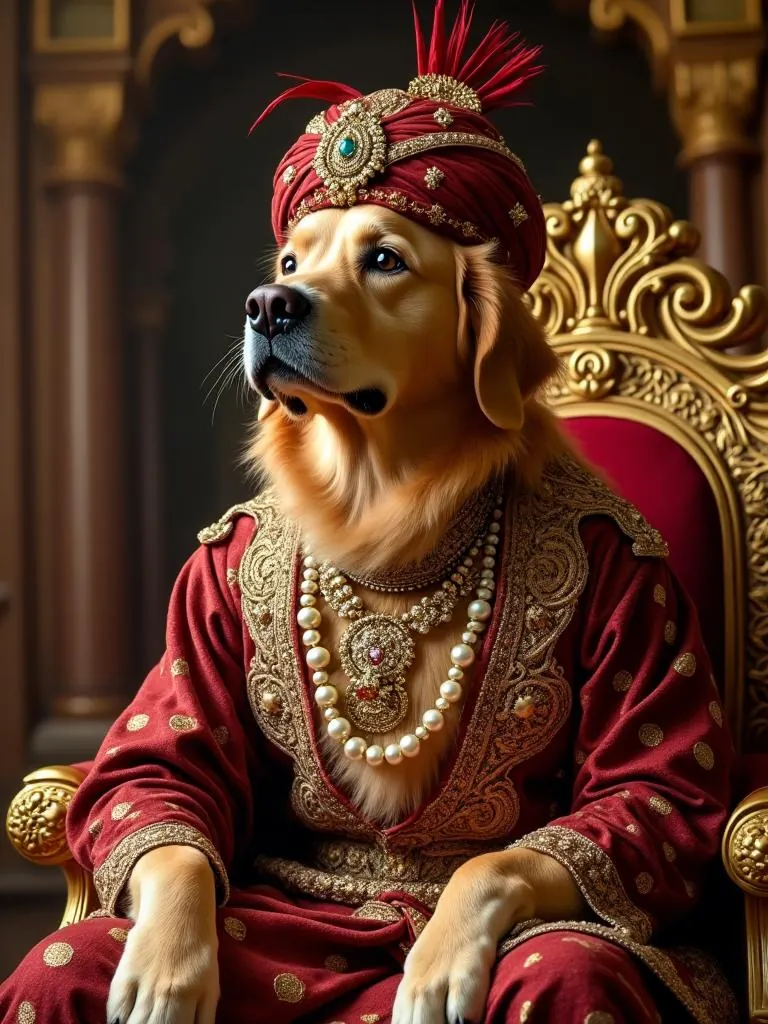
The Maharaja style is the one to choose for a maharaja dog portrait, and it works for a cat too. The Maharaja portrait in the gallery shows a golden retriever in a red jewelled turban, seated on a gold throne.
The word has a plain meaning. The Oxford Advanced Learner's Dictionary traces it to the Hindi mahārājā, which joins the Sanskrit mahā, "great", and rājan, the word behind the English "raja". The dictionary defines a maharaja as an Indian king, especially one who ruled over one of the states of India in the past.
The Maharani portrait shows a white and ginger cat in a green and gold gown. The Cambridge Dictionary defines a maharani as "a female maharaja or the wife of a maharaja". A woman could hold the title in her own right or through her marriage. You can pick either style for a dog or a cat, male or female. The Maharaja guide linked above also explains the related titles Raja and Rani.
Mughal Emperor and Rajput Warrior: courts of the north
Mughal Emperor
The Mughal Emperor portrait in the gallery shows a grey cat wearing a jewelled crown and pearls. The Victoria and Albert Museum (V&A) in London says the Mughal dynasty was founded in 1526, when Babur, a Central Asian Muslim prince, invaded the land he knew as Hindustan.
A later emperor, Shah Jahan, was painted holding the jewels he loved, the V&A says. He also ordered the Taj Mahal: UNESCO says the white marble mausoleum was built in Agra between 1631 and 1648, in memory of his favourite wife.
Dogs lived at this court too. The Cleveland Museum of Art says dogs were kept in the Mughal imperial palace, with one keeper for every two hunting dogs. It adds that Akbar liked dogs so much that he brought in breeds from distant lands. Read more in what is Mughal painting and royal dogs in history.
Rajput Warrior
The Rajput Warrior portrait shows a dog as a Rajput warrior in armour, with a fort at sunset behind it. India's National Council of Educational Research and Training (NCERT) says the scholar Ananda Coomaraswamy coined the term Rajput painting in 1916, because most rulers and patrons of the kingdoms of Rajasthan were Rajputs. NCERT's list of what the court painters recorded includes hunts, wars and victories, and portraits of kings.
Hunting dogs appear in some of these pictures. A painting from Mewar dated 1835, now in the V&A, shows Maharana Jawan Singh twice. In the background he chases two wild boar with his hounds. In the front he strikes the larger boar with his sword while his dogs attack the smaller one. The full history is in what is Rajput painting.
Patiala Royalty: a royal court in Punjab
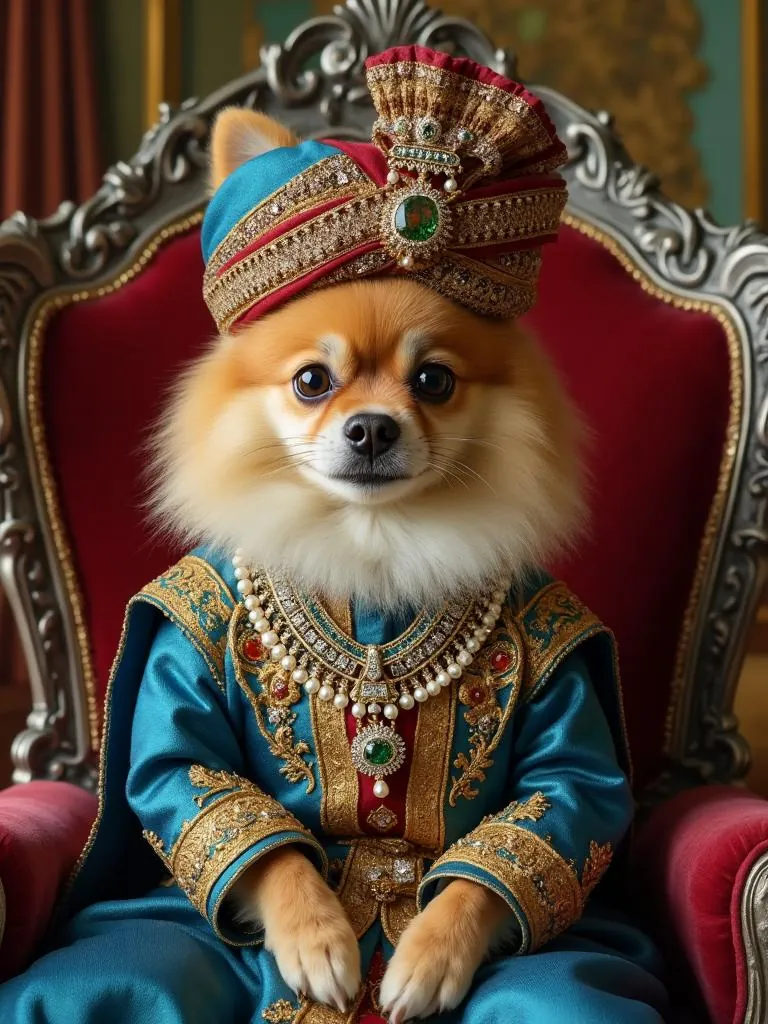
The Patiala Royal portrait shows a Pomeranian as Patiala royalty, in a blue coat and a jewelled turban, on a red throne. The Patiala district administration says the rulers of Patiala came from the Phulkian family, named after one ancestor, Chaudhary Phul. In 1763 Baba Ala Singh laid the foundation of the Qila Mubarak fort, and the city of Patiala was built around it.
One later ruler, Maharaja Bhupinder Singh, was born on 12 October 1891 and placed on the throne in 1901, according to the University of Bristol's South Asian Britain project. The same source says he captained the India team that toured England in 1911 and kept 44 Rolls-Royce cars, all built for him. The V&A describes a ceremonial diamond necklace and choker that the Maharaja of Patiala ordered in 1928, and the Bristol project says the house of Cartier made it for him. For the fort, the palaces and how Patiala joined India, read the Maharajas of Patiala.
Mysore Royal and Chola Warrior: courts of the south
Mysore Royal
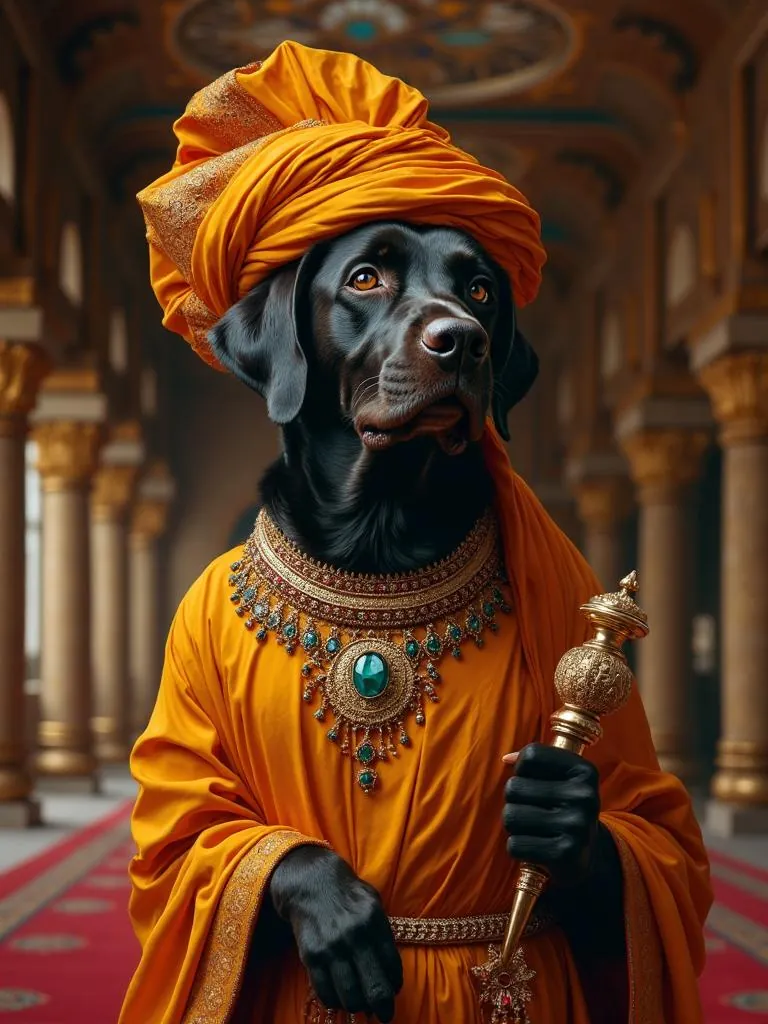
The Mysore Royal portrait shows a black labrador as Mysore royalty, in a saffron turban and holding a gold sceptre. The Salar Jung Museum in Hyderabad says the Kingdom of Mysore lasted from 1399 to 1947, and that the Wodeyar family's kingdom was a princely state under the British until independence.
The museum says the Mysore school of painting reached its high point under Maharaja Krishnaraja Wodeyar III, who lived from 1794 to 1868. Mysore painters used gesso, a paste that painters build up into raised shapes, to pick out jewellery, clothes and buildings. The guide to what is Mysore painting explains how these paintings were made.
Chola Warrior
The Chola Warrior style has no gallery example yet. You can choose it for a dog or a cat in the portrait studio.
Encyclopaedia Britannica describes the Cholas as Tamil rulers from the valley of the Kaveri River in South India, a family so old that nobody knows when it began. UNESCO says the Chola king Rajaraja I began the Brihadisvara temple at Thanjavur in 1003 or 1004 and dedicated it with his own hands in 1009 or 1010. Britannica says the dynasty ended in 1279. The temple still holds worship every day, UNESCO adds. Read the Chola dynasty for the kings, the temples and the bronzes.
Maratha King: the court of Shivaji
Maratha King is the second Indian court style with no gallery example yet, and you can choose it in the portrait studio as well.
The Government of India's Press Information Bureau says Shivaji was crowned at Raigad Fort on 6 June 1674 and took the title Chhatrapati. Encyclopaedia Britannica translates the title as "Keeper of the Umbrella". It dates the formal Maratha Empire from that coronation to 1818, when it ended after defeat by the English East India Company. At its peak, Britannica says, the empire reached from Punjab in the north to Tanjore in the south. The guide to Shivaji and the Maratha kings follows the kings and forts in order.
Portraits of Shivaji were made in his own century. The Rijksmuseum in Amsterdam holds one, painted in Golconda between 1675 and 1685. It shows him from the waist up, facing left, with a sword in his right hand. The page is number 46 of the Witsen Album, a set of 49 Indian miniature portraits of rulers.
Questions and answers
What is an Indian royal pet portrait?
An Indian royal pet portrait shows a dog or a cat dressed as a ruler or a warrior from an Indian royal court. Purrealism offers nine such styles: Indian Royalty, Maharaja, Maharani, Patiala Royalty, Chola Warrior, Mysore Royal, Mughal Emperor, Rajput Warrior and Maratha King. The Maharaja portrait in the Purrealism gallery, for example, shows a golden retriever in a red jewelled turban, seated on a gold throne.
Which Indian court portrait styles have a gallery example?
Seven of Purrealism's nine Indian court portrait styles have a finished example in the gallery: Indian Royalty, which has two, plus Maharaja, Maharani, Mughal Emperor, Rajput Warrior, Mysore Royal and Patiala Royalty. The Chola Warrior and Maratha King styles have no gallery example yet. You can still choose either of them for a dog or a cat in the Purrealism portrait studio.
What is a royal portrait?
A royal portrait is a picture of a king, a queen, an emperor or another ruler. India's royal courts made many of them. The Rijksmuseum in Amsterdam holds a portrait of the Maratha king Shivaji, painted in Golconda between 1675 and 1685, which shows him from the waist up with a sword in his right hand. A royal pet portrait gives a dog or a cat the clothes and setting of such a ruler.
Are royal portraits accurate?
Royal portraits range from close likenesses to idealised images, and the Mughal court made both kinds. According to the Victoria and Albert Museum, portraits of people at court began under Akbar and reached new levels of accuracy under Jahangir, who ruled from 1605 to 1627. India's NCERT art textbook says the painters of the next emperor, Shah Jahan, preferred idealisation and stylisation over accurate likeness, to show the majestic image he wanted to leave behind.
What is Indian royalty?
Indian royalty means the families that ruled kingdoms and states in India, with titles such as Maharaja and Maharani. A Ministry of Home Affairs paper published by the Government of India says the princely states, which had their own rulers, numbered more than 560 at independence in 1947. The Constitution (Twenty-sixth Amendment) Act of 1971 ended official recognition of these rulers and abolished the privy purse, the money paid to them.
Who are Indian royals?
Indian royals are the ruling families of India's past kingdoms, such as the Mughal emperors, whose dynasty Babur founded in 1526, according to the Victoria and Albert Museum. Others include the Rajput rulers of Rajasthan, the Wodeyar family of Mysore, the Phulkian family of Patiala, the Tamil Chola kings, and the Maratha kings, whose first king was Shivaji, according to Encyclopaedia Britannica. Purrealism's nine Indian court portrait styles take their names from these courts.
Which Mughal emperor built the Taj Mahal?
The Mughal emperor Shah Jahan built the Taj Mahal. According to UNESCO, the white marble mausoleum, a large tomb, was built in Agra between 1631 and 1648 by his order, in memory of his favourite wife. India's NCERT art textbook dates his reign from 1628 to 1658 and describes his love for sparkling jewels and gems. The Mughal Emperor portrait in the Purrealism gallery shows a grey cat in a jewelled crown and pearls.
Do Cholas still exist?
The Chola dynasty ended in 1279, according to Encyclopaedia Britannica, after the Pandya kings conquered the Chola country in 1257. Temples the Cholas built are still in use. UNESCO says the Brihadisvara temple at Thanjavur, begun by King Rajaraja I in 1003 or 1004, and two other Chola temples still hold worship daily, weekly and yearly. Purrealism's Chola Warrior portrait style takes its name from these Tamil kings.
What is Maratha empire?
The Maratha Empire was the state of the Marathas, a Marathi-speaking warrior group mostly from today's Maharashtra, and Encyclopaedia Britannica dates it from 1674 to 1818. It began when Shivaji was crowned Chhatrapati, which the Government of India's Press Information Bureau dates to 6 June 1674, at Raigad Fort. Britannica says that at its peak it reached from Punjab in the north to Tanjore in the south, and that it ended after defeat by the English East India Company.
Sources
- The arts of the Mughal Empire, Victoria and Albert Museum
- Taj Mahal, UNESCO World Heritage Centre
- Dog with pups, Cleveland Museum of Art
- The Mughal School of Miniature Painting (An Introduction to Indian Art, Part II, chapter 3), National Council of Educational Research and Training (NCERT)
- The Rajasthani Schools of Painting (An Introduction to Indian Art, Part II, chapter 2), National Council of Educational Research and Training (NCERT)
- Raja Jawan Singh of Mewar, Victoria and Albert Museum
- History, District Administration Patiala, Government of Punjab
- Bhupinder Singh, South Asian Britain: Connecting Histories, University of Bristol
- About the Cartier exhibition, Victoria and Albert Museum
- Marvels of Mysore, Salar Jung Museum, Hyderabad (on Google Arts & Culture)
- Chola dynasty, Encyclopaedia Britannica
- Great Living Chola Temples, UNESCO World Heritage Centre
- Raigad Fort: Capital of most illustrious Maratha sovereign, nurtured by Chhatrapati Shivaji Maharaj, Press Information Bureau, Government of India
- Maratha empire, Encyclopaedia Britannica
- Portrait of Shivaji, Rijksmuseum
- maharaja noun, Oxford Advanced Learner's Dictionary, Oxford University Press
- Meaning of maharani in English, Cambridge University Press
- Sardar Vallabhbhai Patel: The Man Who United the Nation, Ministry of Home Affairs, published by the Press Information Bureau, Government of India
- The Constitution (Twenty-sixth Amendment) Act, 1971, Gazette of India Extraordinary, Legislative Department, Ministry of Law and Justice, Government of India
Go deeper
The full guides on this topic, each a set of pages with sources: