What is Rajput painting? A guide to the art of the Rajput courts
Rajput painting is the court art of Rajasthan and the Punjab hills, made from the 1500s to the 1800s. Ananda Coomaraswamy named it in his 1916 book.
By Purrealism
Rajput painting is the art made for the Hindu royal courts of Rajasthan and the Punjab hills, from the 1500s to the 1800s. Most of the rulers who paid for it were Rajputs, and the name comes from them.
What Rajput painting means
The Museum of Fine Arts, Boston describes its Rajput collection as paintings made for the princes of Rajasthan and the Punjab hills, who were known as Rajputs. The museum says these kingdoms shared one elite culture, and that by the early 1700s each court had its own painting style.
India's National Council of Educational Research and Training (NCERT) lists the kingdoms and estates where the Rajasthani schools grew up: Mewar, Bundi, Kota, Jaipur, Bikaner, Kishangarh, Jodhpur (also called Marwar), Malwa, Sirohi and others. They lie in today's Rajasthan and in parts of Madhya Pradesh. Most of this work was made between the 1500s and the early 1800s.
Scholars now split the art into two groups. Rajasthani painting comes from the plains, and Pahari painting comes from the hills. NCERT calls the older label "Rajput Schools" obsolete and uses these two names instead. Museums still use the Rajput name: the Boston museum's 2011 to 2012 exhibition was called Gems of Rajput Painting.
Who named it: Ananda Coomaraswamy and his 1916 book
The term comes from the scholar Ananda Coomaraswamy. According to NCERT, he coined the term "Rajput Paintings" in 1916 because most rulers and patrons of these kingdoms were Rajputs. He wanted to set this group apart from the better-known Mughal school, which NCERT places at the courts of Delhi, Agra, Fatehpur Sikri and Lahore. Our guide to Mughal painting covers that school.
His book, Rajput Painting, was published in London in 1916 by Humphrey Milford at Oxford University Press. It came in two volumes, one of text and one of plates (pages of pictures). The full title describes it as an account of the Hindu paintings of Rajasthan and the Panjab Himalayas from the sixteenth to the nineteenth century.
In the introduction, Coomaraswamy gives his reason in his own words: "The term Rajput is employed because all the works discussed have been produced under the patronage of Rajput princes." The first part of the book has one chapter on Rajasthani painting and one on Pahari painting. The second part covers the subjects of the paintings, starting with the life of Krishna.
How a Rajput painting was made
According to NCERT, Indian paintings of this period are called miniature paintings because of their small size. People held them in the hand and looked at them up close. Large wall paintings were a separate art, used to decorate the walls of a patron's house.
Painters worked on wasli, several thin sheets of handmade paper glued together until the sheet was thick enough. They drew the outline in black or brown, then added the colour. Most colours came from minerals and from gold and silver, mixed with glue so they would stick. Brushes were made from camel and squirrel hair. When the painting was finished, it was rubbed with agate, a smooth stone, which gave the whole surface an even shine.
One picture was often the work of a team. The master artist planned the scene and made the first drawings. Other painters who were skilled at faces, buildings, landscape or animals painted their parts, and the master added the final touches. A scribe then wrote the verse in a space left open for it, often in a box at the top of the page.
The main schools of Rajasthan
Mewar
Mewar was an early centre of painting in Rajasthan, but long wars with the Mughals destroyed most of its early work. NCERT links the school to a ragamala set (a series of paintings of musical moods) made at Chawand in 1605 by an artist named Nisardin. Under Jagat Singh I, who ruled from 1628 to 1652, the painters Sahibdin and Manohar reshaped the style. Sahibdin painted the battle chapter of the Ramayana in 1652. Mewar painters liked bright colours with strong reds and yellows. In the 1700s they turned to court life: portraits, large court scenes, hunts and festivals.
Bundi and Kota
A Bundi ragamala set dated 1591 belongs to the earliest phase of Bundi painting, and the school flourished in the 1600s. Bundi painters filled their pictures with thick plants, wild animals, birds, hills and water. NCERT calls their drawing of elephants unsurpassed.
Kota belonged to the same kingdom as Bundi until 1625, when Jahangir, who by then held the Mughal throne, divided it. Kota's own school began in the 1660s. According to NCERT, it excels at hunting scenes, and Kota artists seem to have been the first to paint landscape as the main subject of a picture. Umed Singh of Kota came to the throne at the age of 10 and spent most of his time hunting. The Victoria and Albert Museum holds a Kota painting from the late 1700s that shows him shooting a tiger at night.
Kishangarh
Kishan Singh, a son of the king of Jodhpur, founded Kishangarh in 1609. Its painters gave faces a style that is easy to recognise: arched eyebrows, eyes shaped like lotus petals, and a sharp, slender nose. They used a lot of green and liked wide landscapes. Sawant Singh's most celebrated artist, Nihal Chand, worked for him from 1735 to 1757. He painted Radha and Krishna in court settings, often as small figures in a large landscape.
Pahari painting from the hills
Pahari means "hilly or mountainous". Pahari painting was made in towns in the hills of the western Himalayas, such as Basohli, Guler, Kangra, Kullu, Chamba, Mandi and Jammu, from the 1600s to the 1800s. According to NCERT, it began with the bold Basohli style and grew into the refined Kangra style, passing through a Guler phase.
The hill kings had family ties with the royal courts of Rajasthan, and NCERT gives these ties as one way Rajasthani painting became known in the hills. The Rajasthani schools came into prominence in the late 1500s and early 1600s, and the Pahari schools followed in the late 1600s and early 1700s. Coomaraswamy placed both groups in his 1916 book, and the Boston museum's Rajput exhibition included paintings from both regions.
What Rajput paintings show
Many Rajput paintings tell stories from religion and poetry. By the 1500s, the worship of Krishna and Rama had become popular in many parts of western, northern and central India, and Krishna became a favourite subject. Painters illustrated the Gita Govinda, a Sanskrit poem about the love of Radha and Krishna written by Jayadeva in the 1100s. They also painted the Rasikapriya, which the poet Keshav Das wrote in 1591, and the Ramayana, the Mahabharata and the Bhagavata Purana.
Ragamala paintings show music as pictures. A raga is a musical form, and each one is linked to a mood, a time of day and a season. Musicians and poets imagined each raga as a god or a person, and the painters showed it that way. According to NCERT, a ragamala album holds 36 or 42 pages.
The other large group of paintings records life at court. NCERT lists court scenes, hunts, wars and victories, garden parties, music and dance, festivals, wedding processions, portraits of kings and their families, city views, birds and animals. The Boston museum names four central themes: heroic stories, women and romance, Krishna and Hindu devotion, and court life.
Dogs appear in some of the hunting pictures. A Mewar painting from 1835, now in the Victoria and Albert Museum, shows Maharana Jawan Singh twice. In the background he chases two wild boar with his hounds. In the front he strikes the larger boar with his sword while his dogs attack the smaller one. The ruler and his attendants wear green, and the museum says the picture may mark a ritual hunt called Aheriya, for which everybody wore green robes.
From the Rajput courts to the Rajput Warrior portrait
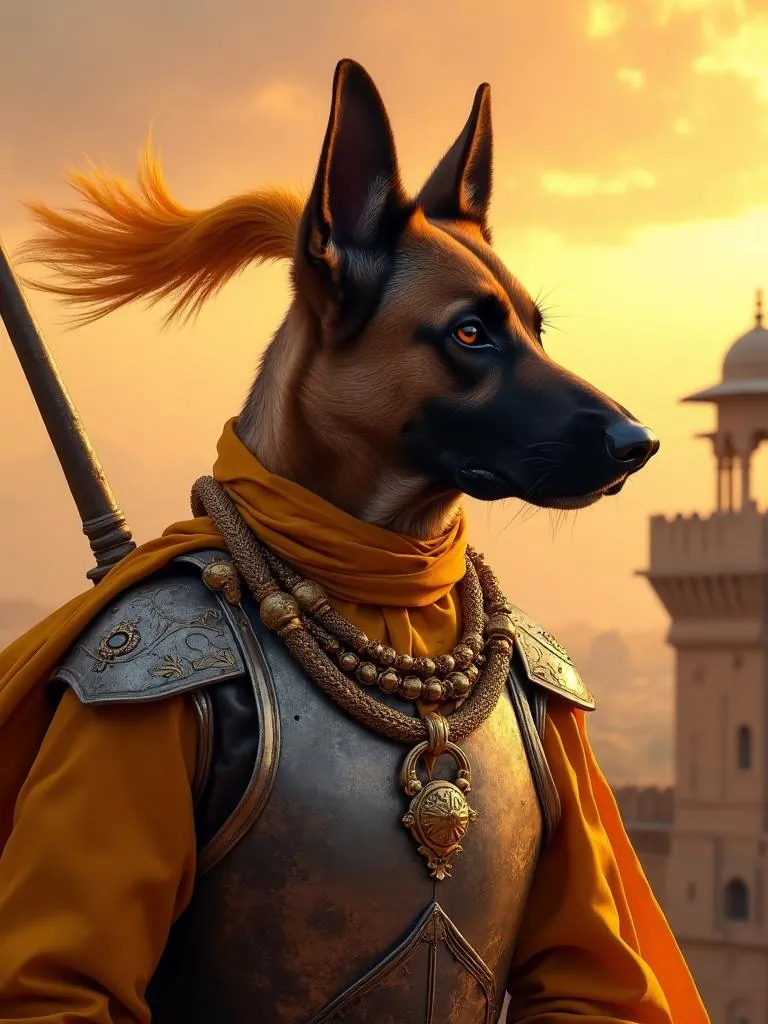
The Rajput Warrior portrait style takes its name from the rulers of these courts. The Rajput Warrior portrait in the gallery shows a dog as a Rajput warrior in armour, with a fort at sunset behind it. Rajput Warrior is one of nine Indian court styles on the site. If you are still choosing, our guide on how to choose a royal portrait style compares them by coat colour and character. In the portrait studio you pick a style and add a photo of your pet of up to 5 MB.
One clear difference between the old paintings and a modern print is size. A Rajput miniature was made to be held in the hand. Purrealism art prints come in four sizes, from 8 × 10 to 24 × 36 inches, on matte or glossy paper. The Rajput Warrior portrait has a fort and a sunset behind the figure, and the larger print sizes give that background more space, so it can be seen from across a room.
Questions and answers
What is Rajput painting?
Rajput painting is the art made for the Hindu royal courts of Rajasthan and the Punjab hills from the 1500s to the 1800s. According to India's National Council of Educational Research and Training (NCERT), most rulers and patrons of these kingdoms were Rajputs, which gave the art its name. Scholars now divide it into Rajasthani painting from the plains, made at courts such as Mewar, Bundi, Kota and Kishangarh, and Pahari painting from the hills.
What is Rajput miniature painting?
Rajput miniature painting is the small, detailed painting made for the Rajput courts, meant to be held in the hand and looked at up close. According to NCERT, Indian paintings of this period are called miniatures because of their small size. Painters worked on wasli, thin sheets of handmade paper glued together, with colours made from minerals, gold and silver. The finished page was rubbed with agate, a smooth stone, to give it an even shine.
Who coined the term Rajput painting?
The scholar Ananda Coomaraswamy coined the term Rajput painting in 1916. According to NCERT, he chose it because most rulers and patrons of these kingdoms were Rajputs, and to set this group of paintings apart from the better-known Mughal school. In his own book he wrote that he used the term because all the works he discussed were made under the patronage of Rajput princes.
Who wrote the book Rajput Painting?
Ananda Coomaraswamy wrote Rajput Painting, published in 1916 in London by Humphrey Milford at Oxford University Press. The book came in two volumes, one of text and one of plates, which are pages of pictures. According to its title page, it is an account of the Hindu paintings of Rajasthan and the Panjab Himalayas from the sixteenth to the nineteenth century, with chapters on the Rajasthani and Pahari schools.
What is Mewar painting?
Mewar painting is the school of Rajput painting from the kingdom of Mewar in Rajasthan, an early centre of painting in the region. According to NCERT, the school is linked to a ragamala set, a series of paintings of musical moods, made at Chawand in 1605 by an artist named Nisardin. Under Jagat Singh I (1628 to 1652), the painters Sahibdin and Manohar reshaped the style. Mewar painters favoured bright reds and yellows.
Which colours were used in Rajasthani paintings?
Rajasthani paintings used colours made mostly from minerals and from gold and silver, mixed with glue so the paint would hold on the paper. According to NCERT, each court also had its own taste in colour. Mewar painters preferred bright colours with strong reds and yellows. Kishangarh painters used a lot of green, and Bundi painting in the 1700s shows a love of bright, vivid colours.
When is the Rajasthani painting style considered to be started?
The Rajasthani painting style is considered to have started in the late 1500s and early 1600s. According to NCERT, the Rajasthani schools came into prominence in that period, and the Pahari schools of the hills followed in the late 1600s and early 1700s. Early dated works include a Bundi ragamala set from 1591 and a Mewar ragamala set painted at Chawand in 1605.
What is Rajasthani painting?
Rajasthani painting is the group of court painting schools from the kingdoms of Rajasthan and parts of Madhya Pradesh, made mostly between the 1500s and the early 1800s. According to NCERT, these schools include Mewar, Bundi, Kota, Jaipur, Bikaner, Kishangarh, Jodhpur (Marwar), Malwa and Sirohi. Ananda Coomaraswamy grouped them under the name Rajput painting in 1916, and scholars now call this branch Rajasthani painting.
How is Pahari painting related to Rajput painting?
Pahari painting is the hill branch of Rajput painting, made in towns of the western Himalayas from the 1600s to the 1800s. According to NCERT, its centres included Basohli, Guler, Kangra, Chamba, Mandi and Jammu, and the hill kings had family ties with the royal courts of Rajasthan. Ananda Coomaraswamy covered Pahari painting next to Rajasthani painting in his 1916 book Rajput Painting.
How is the Rajput Warrior portrait style connected to Rajput painting?
The Rajput Warrior portrait style takes its name from the Rajput rulers whose courts paid for Rajput painting. According to NCERT, many paintings from those courts show hunts, wars and victories, and portraits of kings. At Purrealism, the Rajput Warrior portrait in the gallery shows a dog as a Rajput warrior in armour, with a fort at sunset behind it. It is one of nine Indian court styles on the site.
Sources
- The Rajasthani Schools of Painting (An Introduction to Indian Art, Part II, chapter 2), National Council of Educational Research and Training (NCERT)
- The Pahari Schools of Painting (An Introduction to Indian Art, Part II, chapter 5), National Council of Educational Research and Training (NCERT)
- The Mughal School of Miniature Painting (An Introduction to Indian Art, Part II, chapter 3), National Council of Educational Research and Training (NCERT)
- The Manuscript Painting Tradition (An Introduction to Indian Art, Part II, chapter 1), National Council of Educational Research and Training (NCERT)
- Rajput Painting, by Ananda Coomaraswamy, volume 1 (1916), Oxford University Press, digitized by the Getty Research Institute
- Gems of Rajput Painting, Museum of Fine Arts, Boston
- Raja Jawan Singh of Mewar, Victoria and Albert Museum
- Maharao Umed Singh of Kota hunting at night, Victoria and Albert Museum
Go deeper
The full guides on this topic, each a set of pages with sources: