Shivaji and the Maratha kings: a short history of the Maratha Empire
Shivaji founded the Maratha kingdom and was crowned Chhatrapati at Raigad Fort on 6 June 1674. The Maratha Empire he began lasted until 1818.
By Purrealism
Chhatrapati Shivaji Maharaj founded the Maratha kingdom in India in the 17th century. His coronation in 1674 began what Encyclopaedia Britannica calls the Maratha Empire, and Maratha rule lasted until 1818. This guide covers his life, the hill and sea forts that UNESCO added to the World Heritage List in 2025, the kings and chief ministers who came after him, and the portraits of Maratha leaders that museums hold today.
Who was Shivaji?
Shivaji was the son of Shahaji Bhosale, a Maratha general who served the Deccan sultanates, the kingdoms that ruled the Deccan region of central India. Britannica gives two possible birth dates, April 1627 or 19 February 1630, and places his birth at Shivneri, near Pune. ICOMOS, the expert body that reviews sites for UNESCO, also describes Shivneri Fort as his birthplace.
According to Britannica, Shivaji took his first fort in 1645. Over the next years he fought the Bijapur sultanate and the Mughal Empire. In 1659 Bijapur sent an army against him under its general Afzal Khan. Britannica records that Shivaji killed Afzal Khan at a meeting between the two men, and that his troops then defeated the Bijapur army. ICOMOS links this battle to Pratapgad, a hill fort built on Shivaji's order in 1656.
The Mughal emperor Aurangzeb then sent a large army against him. Shivaji made peace and agreed to attend the Mughal court at Agra, where he and his son were kept under house arrest. On 17 August 1666, Britannica says, the two escaped by having themselves carried past the guards in large baskets of sweets. Shivaji went on to build a navy, and he used it for both trade and defence.
When and where was Shivaji crowned?
Shivaji was crowned on 6 June 1674 at Raigad Fort, in what is now the state of Maharashtra. The Government of India's Press Information Bureau and its tourism site, Incredible India, both give this date and place. At the ceremony he took the title Chhatrapati. Britannica translates the word as "Keeper of the Umbrella" and treats the coronation as the formal beginning of the Maratha Empire. The anniversary, called Shivrajyabhishek Din, is still marked at Raigad every 6 June.
Raigad was his second capital. The ICOMOS evaluation explains that his first capital was Rajgad, a different hill fort that had been part of his father's lands. Shivaji rebuilt Raigad in 1662 with a royal palace, a market and a system for collecting rainwater, and it became the centre of his government and of royal ceremony.
After the coronation, Shivaji ruled for six years with a council of eight ministers. Incredible India gives the council's name as the Ashtapradhan Mandal. He died at Raigad on 3 April 1680, according to Britannica. The Press Information Bureau reports that his samadhi, a memorial to him, stands on the fort today.
The Maratha forts on the UNESCO World Heritage List
In 2025 UNESCO added the Maratha Military Landscapes of India to its World Heritage List. The site has 12 forts that the Marathas built, adapted or expanded between the late 17th and early 19th centuries. Eleven are in Maharashtra and one is in Tamil Nadu. The ICOMOS evaluation sorts them by setting:
- Hill forts in the Sahyadri range, also called the Western Ghats: Salher, Shivneri, Lohagad, Raigad, Rajgad, Pratapgad and Panhala.
- Sea forts on the Konkan coast: Khanderi, Suvarnadurg, Sindhudurg and Vijaydurg.
- A hill fort in the Eastern Ghats: Gingee, in Tamil Nadu.
The ICOMOS evaluation also gives the history of each fort. Sindhudurg, which Shivaji built on Kurte Island in 1664, became the headquarters of the Maratha navy. Gingee began as a stronghold of the Chola dynasty. Shivaji's forces captured it in 1677, and the Mughals took it in 1698. Raigad held out through several Mughal sieges and passed to the British in 1818.
The Maratha kings after Shivaji
Shivaji's son Sambhaji took the throne in 1680. Britannica records that he ruled until 1689, when Aurangzeb captured and executed him. Aurangzeb also captured Sambhaji's son Shahu, so Sambhaji's half-brother Rajaram became king.
After Aurangzeb died in 1707, the new Mughal emperor, Bahadur Shah I, released Shahu. Shahu claimed the throne against Shivaji II, the son of Rajaram, who ruled with the support of his mother, Tarabai. The dispute became a civil war. Britannica dates Shahu's reign from 1708 to 1749.
The Peshwas and the end of the Maratha Empire
A peshwa was the chief minister of the Maratha state. Britannica explains that the peshwa first led Shivaji's advisory council. Shahu appointed Balaji Vishvanath as peshwa, which began the peshwa era. In Britannica's words, "all effective power was concentrated in the peshwa", and Pune became the peshwas' capital. Balaji's son Baji Rao I served as peshwa from 1720 to 1740 and made the post pass from father to son. Under him the Marathas took Malwa and Gujarat.
Between 1720 and 1761 the Maratha Empire grew fast. At its peak, Britannica writes, it controlled most of the subcontinent, from Rajasthan and Punjab in the north to Bengal and Orissa in the east and Tanjore in the south. In 1761 the Maratha army lost the Third Battle of Panipat to Ahmad Shah Durrani, the founder of the Durrani empire of Afghanistan.
The peshwa Madhavrao I rebuilt Maratha power after Panipat and gave the Maratha chiefs more freedom to govern their own lands. This led to the Maratha confederacy, a group of allied Maratha states. Its leading families included the Gaekwars of Baroda, the Sindhias of Gwalior and the Holkars of Indore.
The Marathas then fought three wars with the English East India Company. They won the first, from 1775 to 1782, and lost land in the second, from 1803 to 1805. The third war ended in 1818 with a Maratha defeat. The last peshwa, Baji Rao II, was sent into exile, and Maratha lands came under direct British rule. Baroda and Indore continued as princely states, the states that kept their own rulers under British power. Our guide to what Maharaja means explains how those states worked.
Why Shivaji built forts instead of one capital city
Shivaji's kingdom depended on a network of hill and sea forts rather than a single fortified capital, and the ICOMOS evaluation cited above treats this as the defining feature of the whole Maratha Military Landscapes site. Each fort in the network, hill or sea, could hold its own garrison and its own stores, which meant no single battle or siege could end Maratha resistance. An enemy that wanted to defeat the Marathas had to take the forts one at a time, at a cost in time and soldiers that a single decisive battle would not have required.
This is also why the same UNESCO listing groups land forts and sea forts together rather than treating them separately. Sindhudurg, described above as the headquarters of the Maratha navy, defended the Konkan coast in the same way Raigad and Rajgad defended the hills: as one part of a wider system built to make the Maratha kingdom hard to conquer by any single stroke.
Maratha King compared with the other Indian court styles
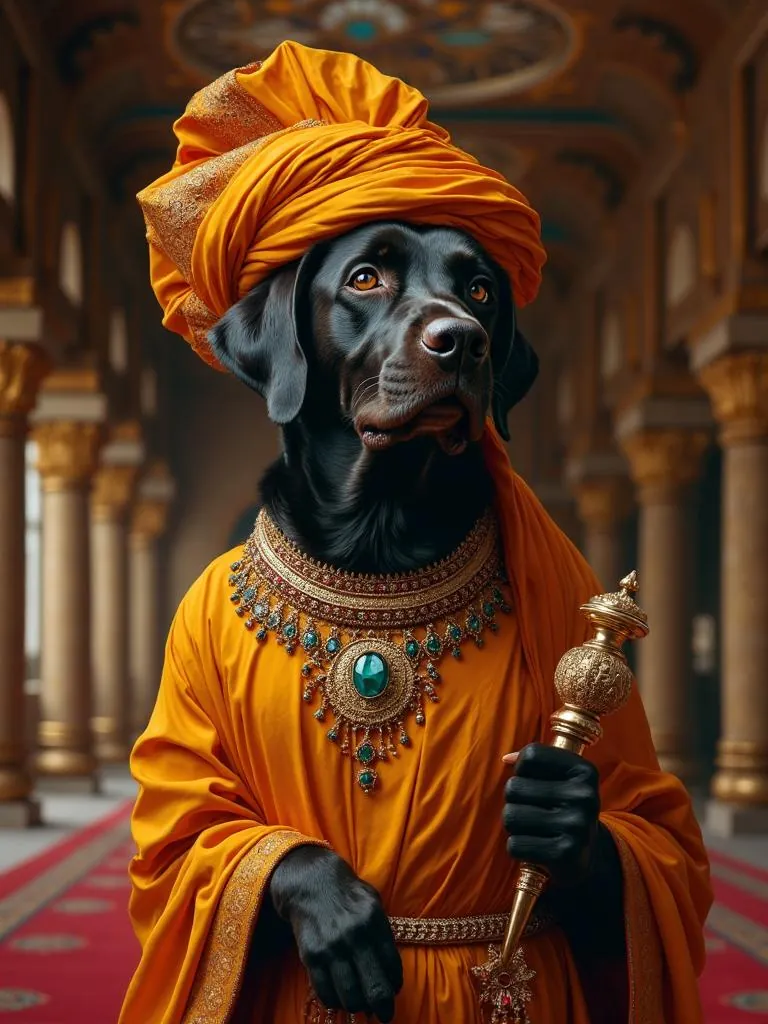
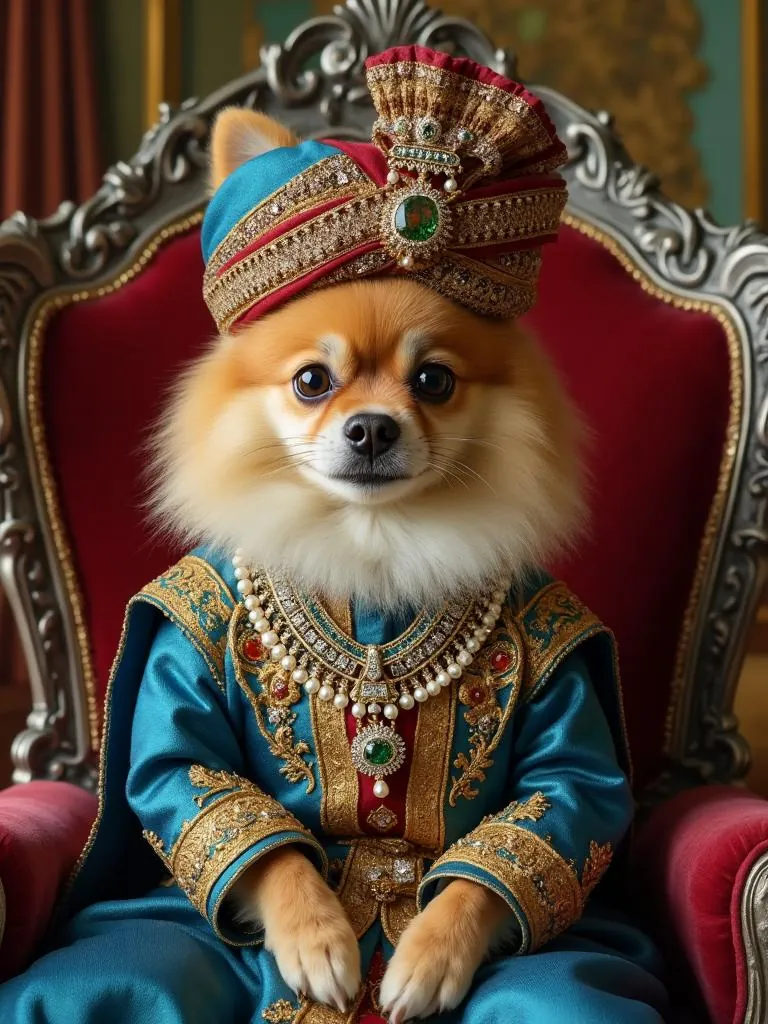
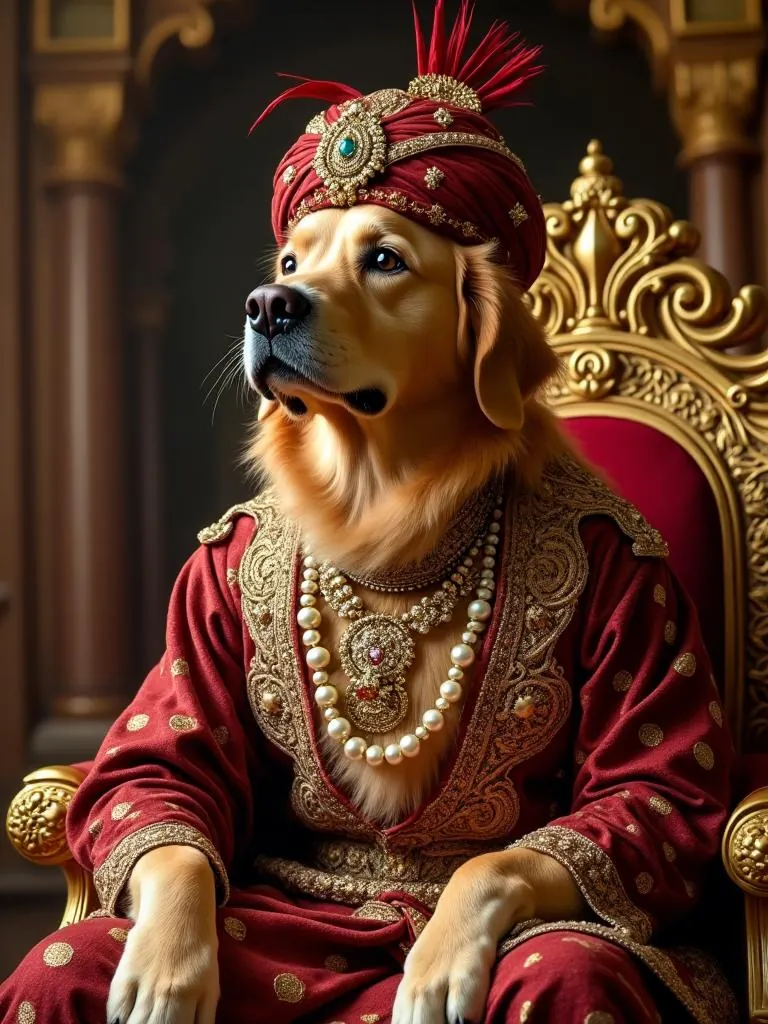
Maratha King sits alongside eight other Indian court portrait styles on Purrealism, and each one draws on a different regional history. The Rajput Warrior style draws on the Rajput clans of northern and western India, covered in our guide to Rajput painting. The Chola Warrior style draws on the older Chola dynasty of southern India, which the Chola dynasty guide covers, and whose reach touched Gingee, one of the same 12 forts later held by the Marathas. The Maratha King style is the one most directly tied to a single named historical figure, Shivaji, rather than to a dynasty spanning many rulers.
If your pet has a strong, alert character rather than a calm, seated one, the guide to choosing a royal portrait style groups Maratha King with the other warrior styles, since a pet that guards the door or reacts to every sound tends to suit a warrior pose better than a seated ruler.
How Maratha rulers were painted
The Rijksmuseum in Amsterdam holds a Portrait of Shivaji painted by an unknown artist in Golconda, one of the Deccan sultanates. The museum dates it between 1675 and 1685. It is painted in gouache, a thick watercolour that covers the paper fully, with gold leaf, on a sheet 203 millimetres high and 140 millimetres wide. Shivaji is shown from the hips up, facing left, with a sword in his right hand. In his armoured left hand he holds what the museum lists, with a question mark, as a lance. The page is number 46 of the Witsen Album, a set of 49 Indian miniature portraits of rulers. Small labels pasted above and below the picture give his name in Persian and in Portuguese.
The Victoria and Albert Museum in London holds a later Deccan painting from the late 18th century, made in opaque watercolour and gold on paper. It shows the Maratha commander Sadashivrao Bhau riding a horse, with eight soldiers walking beside him at the foot of a grassy hill. For the court painting traditions of the same centuries, see our guides to Mughal painting and Rajput painting.
Maratha King is one of the 15 royal portrait styles on Purrealism, beside Indian court styles such as Maharaja and Mughal Emperor. The eight finished portraits in the gallery show other styles. To see the Maratha King style with your own pet, choose it in the portrait studio and add a clear photo of your dog or cat.
Questions and answers
Who are the Maratha kings?
The Maratha kings were the rulers of the Maratha state, beginning with Shivaji, its first king. According to Encyclopaedia Britannica, Shivaji was followed by his son Sambhaji in 1680, then by Sambhaji's half-brother Rajaram, and later by Shahu, who reigned from 1708 to 1749. From Shahu's time, the peshwas, the kings' chief ministers, held most of the real power from Pune.
Who founded Maratha empire?
Shivaji founded the Maratha Empire. According to Encyclopaedia Britannica, he founded the Maratha kingdom in 17th-century India, and his coronation as Chhatrapati in 1674 marked the formal beginning of the empire. He was the son of Shahaji Bhosale, a Maratha general who served the Deccan sultanates, and he made the hill fort of Raigad his capital.
Why Shivaji Maharaj is called Chhatrapati?
Shivaji Maharaj is called Chhatrapati because he took that title when he was crowned at Raigad Fort on 6 June 1674, according to the Government of India's Press Information Bureau. Encyclopaedia Britannica translates Chhatrapati as 'Keeper of the Umbrella'. Britannica also says he was enthroned as an independent ruler, and it treats the coronation as the formal beginning of the Maratha Empire.
When did Maratha empire start and end?
The Maratha Empire started in 1674 and ended in 1818, according to Encyclopaedia Britannica. It began with the coronation of Shivaji as Chhatrapati. It ended after the Marathas lost the Third Anglo-Maratha War to the English East India Company. At its peak in the 18th century, Britannica says, the empire controlled most of the Indian subcontinent, from Punjab in the north to Tanjore in the south.
What is Raigad fort famous for?
Raigad Fort is famous as the place where Shivaji was crowned Chhatrapati on 6 June 1674, and as the capital of his kingdom, according to the Government of India's Press Information Bureau. Shivaji died at Raigad in 1680, and his samadhi, a memorial to him, stands on the fort. Since 2025, Raigad has been one of the 12 forts in the UNESCO World Heritage site called Maratha Military Landscapes of India.
Is Raigad and Rajgad fort same?
Raigad and Rajgad are two different hill forts in Maharashtra, and each served as a capital of Shivaji. According to the ICOMOS evaluation written for UNESCO, Rajgad in Pune District was his first capital and had been part of his father's lands. Shivaji later moved his capital to Raigad, in Raigad District, which he rebuilt in 1662. Both forts belong to the same World Heritage site.
Who became Maratha king after Sambhaji?
Rajaram, the half-brother of Sambhaji, became Maratha king after Sambhaji, according to Encyclopaedia Britannica. Sambhaji ruled from 1680 until 1689, when the Mughal emperor Aurangzeb captured and executed him. Aurangzeb also held Sambhaji's son Shahu, so Rajaram took the throne. Shahu was released after Aurangzeb died in 1707, and Britannica dates his reign from 1708 to 1749.
How did Maratha empire end?
The Maratha Empire ended in 1818, when the Marathas lost the Third Anglo-Maratha War to the English East India Company, according to Encyclopaedia Britannica. The last peshwa, Baji Rao II, was sent into exile, and Maratha territory came under direct British rule. Some Maratha states, such as Baroda and Indore, continued as princely states under the British.
Which forts are in the Maratha Military Landscapes of India?
The Maratha Military Landscapes of India, a UNESCO World Heritage site since 2025, has 12 forts. According to the ICOMOS evaluation written for UNESCO, they are Salher, Shivneri, Lohagad, Raigad, Rajgad, Pratapgad, Panhala, Khanderi, Suvarnadurg, Vijaydurg, Sindhudurg and Gingee. Eleven are in Maharashtra and Gingee is in Tamil Nadu. Khanderi, Suvarnadurg, Sindhudurg and Vijaydurg are sea forts on the Konkan coast.
Is there a Maratha King pet portrait style?
Maratha King is one of the 15 royal portrait styles that Purrealism offers for dogs and cats, and one of nine styles drawn from Indian royal courts. The Purrealism gallery has no finished Maratha King portrait yet. To see the style with your own pet, choose it in the portrait studio and add a clear photo of your dog or cat, saved as an image file of up to 5 MB.
Sources
- Shivaji, Encyclopaedia Britannica
- Maratha empire, Encyclopaedia Britannica
- Peshwa, Encyclopaedia Britannica
- Baji Rao I, Encyclopaedia Britannica
- Maratha Military Landscapes of India, UNESCO World Heritage Centre
- Maratha Military Landscapes of India (India), No 1739: ICOMOS evaluation, ICOMOS, published by the UNESCO World Heritage Centre
- Raigad Fort: Capital of most illustrious Maratha sovereign, nurtured by Chhatrapati Shivaji Maharaj, Press Information Bureau, Government of India
- Shivrajyabhishek Sohala, Incredible India, Ministry of Tourism, Government of India
- Portrait of Shivaji, Rijksmuseum
- Painting: Sadashivrao Bhau, Victoria and Albert Museum
Go deeper
The full guides on this topic, each a set of pages with sources: