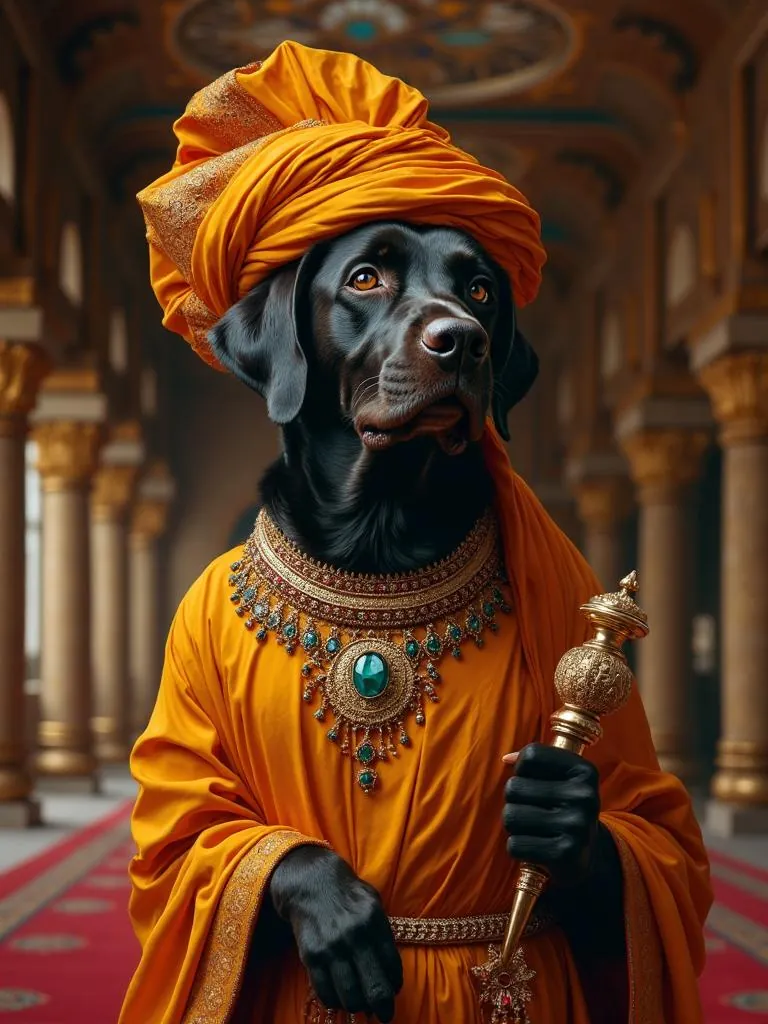
What does Maharaja mean? Maharaja, Maharani and other royal titles of India
Maharaja means 'great king', from the Sanskrit mahā (great) and rājan (king). A Maharani is a female Maharaja or a Maharaja's wife.
By Purrealism
Maharaja is a royal title from India, and it has a plain meaning: "great king". This guide explains where the word comes from, what Maharani means, how the other royal titles of India differed, and what happened to the titles after India became independent. It ends with the two portrait styles on this site that take their names from these titles.
What the word Maharaja means
Maharaja is made of two words from Sanskrit, an old language of India. According to the Oxford Advanced Learner's Dictionary, the English word comes from the Hindi mahārājā, which joins the Sanskrit mahā, meaning "great", and rājan, meaning "king". Put together, the title reads "great king".
The dictionary defines a maharaja as "an Indian king, especially one who ruled over one of the states of India in the past". The Cambridge Dictionary gives a shorter definition: "in the past, the male ruler of an Indian state". Both dictionaries place the title in the past. The section on independence below explains what happened to India's ruling princes.
You will also see the spelling maharajah, with an "h" at the end. Both dictionaries list it as another way to write the same word.
What Maharani means
Maharani is the female title that matches Maharaja. The Oxford dictionary traces it to the Hindi mahārānī, from the Sanskrit mahā, "great", and rājñī, the word behind rani. The same dictionary defines a rani as "an Indian queen" and says the Sanskrit rājñī is the female form of rājan, "king". So Maharani reads "great queen".
A woman could be a Maharani in two ways. The Cambridge Dictionary defines the word as "a female maharaja or the wife of a maharaja". In the first case the woman held the title in her own right. In the second she held it through her marriage.
The simpler title Rani works the same way. Cambridge defines a rani as "a female Indian ruler or the wife of an Indian ruler".
Raja, Maharaja and the other royal titles
Raja and Maharaja each have a female form. Here is what each title means, according to the Oxford and Cambridge dictionaries:
| Title | Meaning of the word | Female form |
|---|---|---|
| Raja | king, from the Sanskrit rājan | Rani, a queen or the wife of a raja |
| Maharaja | great king, from mahā and rājan | Maharani, a great queen or the wife of a maharaja |
The Oxford dictionary defines a raja as "an Indian king or prince who ruled over a state in the past". The difference between Raja and Maharaja sits in the first part of the word: mahā adds "great" to "king".
Some rulers used other titles. The nawab was, in the Oxford dictionary's words, "an Indian ruler during the Mughal Empire". The ruler of Hyderabad was called the Nizam. A Government of India paper from the Ministry of Home Affairs, described in the next section, names two such rulers from 1947 and 1948: the Nawab of Junagadh and Nizam Mir Usman Ali Khan Bahadur of Hyderabad.
The princely states: how many there were
Many maharajas ruled what were called princely states. When India became independent in 1947, the country had two parts. One part was British India, made up of provinces. The other part was the princely states, each with its own ruler.
The Ministry of Home Affairs paper Sardar Vallabhbhai Patel: The Man Who United the Nation, published by the Press Information Bureau, gives the numbers. At independence there were 17 British Indian provinces, and the princely states "numbered more than 560". The same paper says each ruler could choose to join India, join Pakistan, or join neither.
The paper tells how the new government handled this choice. A States Department was formed on 25 June 1947, led by Sardar Vallabhbhai Patel, with V. P. Menon as its secretary. Some rulers took time to decide. The paper describes these cases:
- Travancore. In July 1947 Travancore announced that it would stay independent. Patel later persuaded its ruler, the Raja of Travancore, to join India.
- Junagadh. The Nawab of Junagadh chose Pakistan, while the people of the state opposed it. In February 1948 the people voted, and most of them chose to remain in India.
- Hyderabad. The Nizam signed a temporary agreement with India. After violence in the state, the Indian Army moved in, and on 17 September 1948 the Nizam announced a ceasefire. Hyderabad then became part of India.
By the paper's count, Patel brought 565 princely states into the Union of India before his death on 15 December 1950. It gives "more than 560" for the states at independence and 565 for the states Patel brought in.
What happened to the titles after independence
After the princely states joined India, the President of India recognised former princes and chiefs as the "Ruler" of their old states. These former rulers were also paid a sum of money called a privy purse.
That ended in 1971. The Constitution (Twenty-sixth Amendment) Act, 1971 received the President's assent on 28 December 1971 and was published in the Gazette of India the next day. It did two things:
- Every person recognised by the President as the Ruler of an Indian State, or as the successor of a Ruler, stopped being recognised as such.
- The privy purse was abolished. All rights and duties connected to it ended, and no former Ruler or successor would be paid any sum as privy purse again.
From the end of 1971, no maharaja or other former prince held official recognition as a Ruler under the Constitution of India.
Maharaja compared with other Indian rulers' titles
India used more than one title for a ruler, and the titles were not interchangeable. A Raja ruled a smaller state. A Maharaja ruled a larger one, or held higher standing among other rulers. The Ministry of Home Affairs paper cited above names two rulers who used other titles entirely: the Nawab of Junagadh and the Nizam of Hyderabad, Mir Usman Ali Khan Bahadur. Nawab and Nizam were not "lesser" versions of Maharaja. They were separate titles tied to Muslim-ruled states, in the same way Maharaja and Raja were tied to Hindu-ruled ones.
A Rajput Maharaja is a further example of how the titles combined with identity. Rajput names a warrior clan of northern and western India, and many Rajput rulers held the title Maharaja alongside it, such as the Maharajas of Jaipur, Jodhpur and Udaipur. The Rajput painting guide covers the art these courts produced. The title told you the rank. The clan name told you the family.
Why these titles still appear today
The 1971 amendment ended official recognition, but it did not erase the word from everyday use. Families that once held the title are still called Maharaja or Maharani informally, by their own communities and in the Indian press, in the same way a British family that lost a title by law might still be called "Lord" socially. Several former royal residences, including the Rambagh Palace in Jaipur and the Umaid Bhawan Palace in Jodhpur, now operate as hotels connected to the families that once ruled from them, which is one reason the title stays familiar to travellers and readers outside India.
The word also lives on in ordinary English. Both the Oxford and Cambridge dictionaries listed above still carry entries for maharaja and maharani as current English words, not as historical footnotes only, because English speakers still use them to describe India's past rulers and, informally, anyone who acts with that kind of authority.
The Maharaja and Maharani portrait styles
Purrealism has 15 royal portrait styles, and two of them take their names from these titles: Maharaja and Maharani. You can see a finished portrait in each style in the gallery.
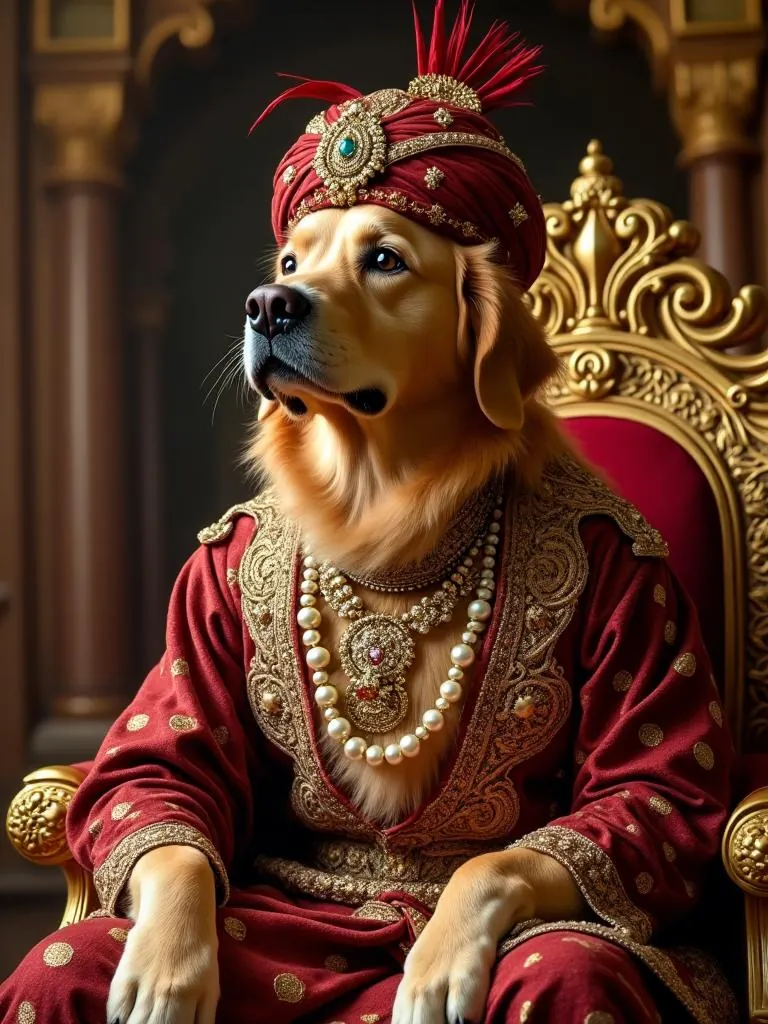
The Maharaja portrait shows a golden retriever in a red jewelled turban, seated on a gold throne. The Maharani portrait shows a white and ginger cat in a green and gold gown. Both styles work for a dog or a cat, so a female dog can be a Maharani and a male cat can be a Maharaja. You pick the style and add your pet's photo in the portrait studio.
If you would like to compare these two with the other Indian court styles, such as Mughal Emperor, Rajput Warrior, Mysore Royal and Patiala Royalty, the guide on how to choose a royal portrait style goes through them by coat colour and by your pet's character. For the story of one real royal family, read about the Maharajas of Patiala.
Questions and answers
What does Maharaja mean?
Maharaja means 'great king'. According to the Oxford Advanced Learner's Dictionary, the word comes from the Hindi mahārājā, which joins the Sanskrit mahā, meaning 'great', and rājan, meaning 'king'. The same dictionary defines a maharaja as an Indian king, especially one who ruled over one of the states of India in the past. The word is also spelled maharajah.
What is a maharaja in India?
A maharaja in India was the male ruler of an Indian state, and the Cambridge Dictionary places the title in the past. Many of these rulers governed princely states, the states that had their own rulers instead of being part of British India. According to a Government of India paper from the Ministry of Home Affairs, there were more than 560 princely states when India became independent in 1947.
Does Maharani mean queen?
Maharani means 'great queen'. The Oxford Advanced Learner's Dictionary traces the word to the Hindi mahārānī, from the Sanskrit mahā, meaning 'great', and rājñī, the word behind rani, which the same dictionary defines as an Indian queen. The Cambridge Dictionary gives two uses: a woman who holds the title of maharaja herself, or the wife of a maharaja.
What is the difference between a Raja and a Maharaja?
A Raja is a king, and a Maharaja is a 'great king'. The Oxford Advanced Learner's Dictionary traces raja to the Sanskrit rājan, meaning 'king', and maharaja to mahā, meaning 'great', joined to the same rājan. It defines a raja as an Indian king or prince who ruled over a state in the past. The female forms are Rani and Maharani.
What are princely states in India?
Princely states were the parts of India ruled by their own princes, such as maharajas, nawabs and the Nizam of Hyderabad, at the time of independence in 1947. A Ministry of Home Affairs paper published by the Government of India says that India then consisted of British India and the princely states, and that each ruler could choose to join India, join Pakistan, or join neither.
How many princely states were there in India?
India had more than 560 princely states at independence in 1947, according to a Ministry of Home Affairs paper published by the Government of India's Press Information Bureau. The same paper counts 17 British Indian provinces at that time. It credits Sardar Vallabhbhai Patel, who led the new States Department from 25 June 1947, with bringing 565 princely states into the Union of India.
What happened to the maharajas of India?
The maharajas of India lost their official recognition as rulers in 1971. The Constitution (Twenty-sixth Amendment) Act, 1971, which received the President's assent on 28 December 1971, ended the recognition of every prince or chief whom the President had recognised as the Ruler of an Indian State. The same Act abolished the privy purse, the sum of money that had been paid to these former rulers.
Do maharajas still exist in India?
Maharajas have held no official recognition as rulers in India since 1971. The Constitution (Twenty-sixth Amendment) Act, 1971 says that any person recognised by the President as the Ruler of an Indian State stopped being recognised as that Ruler, and that the privy purse was abolished. Today the word describes India's past rulers, and it names one of the royal portrait styles on Purrealism.
What is a privy purse?
A privy purse was a sum of money paid to the former rulers of India's princely states after independence. The Constitution (Twenty-sixth Amendment) Act, 1971, published in the Gazette of India, abolished the privy purse, ended all rights and duties connected to it, and said that no former Ruler or successor would be paid any sum as privy purse from then on.
Can my pet be shown as a Maharaja or a Maharani?
A dog or a cat can be shown as a Maharaja or a Maharani, because both are among the 15 royal portrait styles on Purrealism. The gallery shows a golden retriever as a Maharaja in a red jewelled turban on a gold throne, and a white and ginger cat as a Maharani in a green and gold gown. You choose the style in the portrait studio.
Sources
- maharaja noun, Oxford Advanced Learner's Dictionary, Oxford University Press
- maharani noun, Oxford Advanced Learner's Dictionary, Oxford University Press
- raja noun, Oxford Advanced Learner's Dictionary, Oxford University Press
- rani noun, Oxford Advanced Learner's Dictionary, Oxford University Press
- nawab noun, Oxford Advanced Learner's Dictionary, Oxford University Press
- Meaning of maharaja in English, Cambridge University Press
- Meaning of maharani in English, Cambridge University Press
- Meaning of rani in English, Cambridge University Press
- Sardar Vallabhbhai Patel: The Man Who United the Nation, Ministry of Home Affairs, published by the Press Information Bureau, Government of India
- The Constitution (Twenty-sixth Amendment) Act, 1971, Gazette of India Extraordinary, Legislative Department, Ministry of Law and Justice, Government of India
Go deeper
The full guides on this topic, each a set of pages with sources: