What is Mughal painting? The emperors, the artists and their animals
Mughal painting is the miniature painting of India's Mughal court, made from the 1500s to the mid-1800s in a mix of Persian, Indian and European styles.
By Purrealism
Mughal painting is the art made for the Mughal emperors of India. The dynasty began in 1526, when Babur, a Muslim prince from Central Asia, took power in Delhi. His descendants paid for large workshops of painters, and those painters made detailed pictures in opaque colour and gold. Some of the paintings show animals and birds that an emperor asked his artists to record.
What Mughal painting is
India's National Council of Educational Research and Training (NCERT) defines Mughal painting as the style of miniature painting that grew up in the northern Indian subcontinent in the 16th century and lasted until the mid-19th century. A miniature painting is a small picture with fine detail. NCERT's art textbook says most Mughal miniatures were parts of manuscripts (books written by hand) and royal albums, where pictures and words shared the page. They recorded events, people and the emperors' own interests, and were meant for the royal family to see.
For a sense of size, a painting of a blue-throated barbet by the artist Mansur, now in the Victoria and Albert Museum (V&A) in London, is 14.3 cm tall and 7.7 cm wide without its borders.
Artists painted on handmade paper with opaque colours, meaning paint that fully covers what is under it. NCERT lists where the colours came from: red from a mineral called cinnabar, blue from the stone lapis lazuli, bright yellow from a mineral called orpiment, and white from ground shells. Gold and silver powder added shine. The brushes were made from the hair of squirrels or kittens. When a painting was finished, it was rubbed with agate, a smooth stone, to set the colours.
How the workshops began: Humayun and Akbar
Babur's son Humayun lost his throne and took refuge at the court of Shah Tahmasp, the Safavid ruler of Persia (Iran). NCERT says he watched Persian painters at work there. When he regained power, he invited two of them, Mir Sayyid Ali and Abd us Samad, to set up a studio at his court. Both were known for their portraits. Humayun also founded a painting workshop as part of his library.
His son Akbar became emperor in 1556, at the age of 13. The V&A says the two Iranian masters who had served Humayun directed Indian artists in Akbar's royal House of Books, which held the library and was also where books were made. Hindu and Muslim artists from northern India worked there beside masters from Iran. Akbar's court historian, Abul Fazl, recorded more than a hundred artists in the royal workshop.
In the V&A's copy of the Akbarnama, the illustrated history of Akbar's reign, a line of writing under each of its 116 paintings names the artists. One artist designed the picture and a second filled in the colours. For some scenes, a portrait specialist painted the faces of the main people.
The first large project was the Hamzanama, the adventures of the hero Hamza. The V&A says the tales filled 12 or 14 volumes of 100 paintings each, and fewer than 200 of those paintings survive. NCERT says these pages were large, painted on cloth backed with paper, and held up for the emperor to see while a storyteller read the tale aloud. The V&A says their tall shape and high point of view came from Iranian painting, while the lifelike animals and birds came from Indian traditions.
European pictures arrived next. In 1580 the first Jesuit mission, a group of Catholic priests, reached Akbar's court at Fatehpur and showed paintings of Christian subjects. Akbar sent for his artists to see them. By his death in 1605, the V&A says, Mughal art had brought together styles from India, Iran and Europe.
Jahangir, portraits and the natural world
Akbar's son Jahangir ruled from 1605 to 1627. The V&A calls the art of the book "Jahangir's great passion". NCERT says his workshop preferred fewer, finer paintings, each by a single master artist, and that single paintings mounted in albums became popular in his reign.
The court had begun painting likenesses of real people under Akbar, and under Jahangir they became more lifelike than ever before. The V&A links this to European portraits. The English ambassador Sir Thomas Roe lent Jahangir a miniature portrait by Isaac Oliver. A court artist copied it, and when Roe was shown his original together with five copies, he had trouble telling which one was his.
Jahangir also asked his leading artists to paint the events, people, birds and animals he described in his memoirs. NCERT says that under him, Mughal painting reached its highest level of natural, scientific accuracy.
Mansur and the emperor's animals
The V&A says Mansur was famous for his studies of birds, animals and flowers. He began his career under Akbar and kept working for Jahangir, who gave him the title Nadir al-'Asr, meaning "Wonder of the Age". Only he and one other artist, Abu'l Hasan, are recorded with this honour.
In March 1621, during the New Year festival of Nowruz, Jahangir received a zebra that had been brought from Ethiopia. Some people at court thought it was a horse with painted stripes, so the emperor examined it closely. Mansur painted it, and Jahangir wrote on the painting, in Persian, that its likeness was drawn by the Wonder of the Age, Master Mansur. The emperor then decided to send the zebra to Shah Abbas of Iran as a gift. The painting is in the V&A.
In 1612 a shipment of rare birds and animals reached the court from the port of Cambay, on India's west coast. One was a turkey from North America. Jahangir wrote that he "ordered that painters should draw them", and Mansur's painting of the turkey is also in the V&A. The emperor took artists with him on his travels too. The blue-throated barbet that Mansur painted lives in the Himalayan foothills, including Kashmir, which Jahangir visited several times with Mansur among his painters.
One story in NCERT's textbook will interest cat owners. Shah Abbas of Persia sent Jahangir a falcon as a gift. A cat attacked the falcon and it died, and the emperor asked his painters to paint the dead bird so that its memory would be kept.
Shah Jahan and the royal albums
Jahangir's son Shah Jahan became emperor in 1628 and ruled until 1658. The V&A says he placed paintings he inherited from his father into new albums with new work. Panels of calligraphy (fine handwriting) by Iranian masters were pasted on the back of each painting, and flowered borders were added to both sides of every page. Mansur's zebra received its flowered border this way.
Many portraits of Shah Jahan and his sons were made, and the V&A says he was painted holding the jewels he loved. NCERT says his painters made the emperor look ideal and grand, with jewel-like colours and fine lines.
Is Mughal art Islamic or Indian?
Mughal art has both roots, with European art added. The dynasty was Muslim: the V&A describes its founder, Babur, as a Central Asian Muslim prince, and calls Islam Akbar's own faith. Persian, the language of culture across Iran and Central Asia, was the language of the court. The empire itself was mostly Hindu, and Hindu and Muslim artists worked side by side. Akbar had major Hindu texts in Sanskrit translated into Persian, and the most important were then illustrated. He also married some of the daughters of Hindu Rajput rulers. The painting of the Rajput courts has its own guide: what is Rajput painting.
NCERT describes Mughal painting at its peak as a blend of Islamic, Hindu and European visual culture, and says the style holds a definite place within the Indian school of painting.
From the Mughal court to your pet's portrait
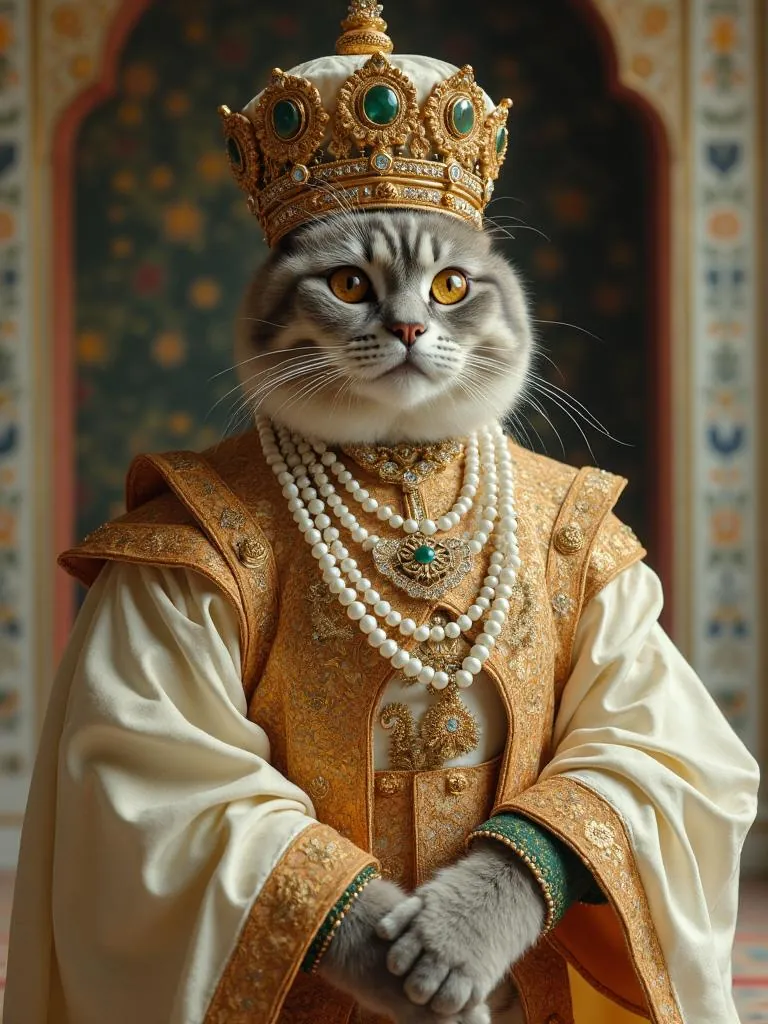
The Mughal Emperor style on Purrealism takes its name from these rulers. In the gallery, the Mughal Emperor portrait shows a grey cat wearing a jewelled crown and pearls. Jewels and animals both appear in the history above: Shah Jahan was painted holding the jewels he loved, and Jahangir asked his painters to record his zebra, his turkey and his falcon. You can start a Mughal Emperor portrait of your own cat or dog in the portrait studio with one clear photo of up to 5 MB. If you are still comparing styles, how to choose a royal portrait style goes through them by coat colour and character.
Scale matters for a style that began as small book paintings. Mansur's barbet is 14.3 cm tall. The smallest print size on Purrealism is 8 × 10 inches, which is 20.3 × 25.4 cm, so it is the size closest to that barbet. The 8 × 10 print guide explains that size in more detail.
Questions and answers
What is Mughal painting?
Mughal painting is the style of miniature painting made for the Mughal emperors in northern India, from the 16th century to the mid-19th century, according to India's National Council of Educational Research and Training (NCERT). The paintings are detailed pictures in opaque colours and gold, made for books and royal albums. The Victoria and Albert Museum says Hindu and Muslim artists from northern India worked with masters from Iran to create the style.
What is Mughal miniature painting?
A Mughal miniature painting is a small, finely detailed picture made for a book or a royal album at the Mughal court. NCERT's art textbook says most Mughal miniatures were parts of manuscripts and albums, painted on handmade paper with colours ground from natural materials such as lapis lazuli. A painting of a blue-throated barbet by the artist Mansur, now in the Victoria and Albert Museum, measures 14.3 by 7.7 cm without its borders.
Which Mughal emperor loved painting?
Jahangir, who ruled from 1605 to 1627, is the Mughal emperor known for his love of painting. The Victoria and Albert Museum calls the art of the book, meaning illustrated books and albums, "Jahangir's great passion". He asked his leading artists to paint the events, people, birds and animals he described in his memoirs, and he gave the painter Mansur the title "Wonder of the Age".
Which Mughal ruler started portrait painting?
Portrait painting at the Mughal court began under Akbar, who ruled from 1556 to 1605, according to the Victoria and Albert Museum, and it reached a new level of accuracy under his son Jahangir. NCERT adds that the two Persian painters invited by Akbar's father, Humayun, were known for their portraits. Under Jahangir, single portraits were used as models to place the same person into large court scenes.
What are the main features of Mughal miniature painting?
The main features of Mughal miniature painting are fine detail, opaque colours with gold, lifelike portraits and careful studies of plants and animals. NCERT lists court scenes, portraits and accurate plants and animals as favourite subjects, and says the style mixed Indian, Persian and European elements. In the workshops, painting was usually shared by a team, with separate stages for the design, the faces and the colour, and a finished painting was rubbed with agate stone to set the colours.
Which style influenced the Mughal painting school?
Persian painting, the painting traditions already in India, and later European art all influenced the Mughal painting school. NCERT says the first Mughal painting workshop was set up by two Persian masters, and that Indian and Iranian artists worked side by side in it. The Victoria and Albert Museum says European influence grew after Jesuit priests showed Christian paintings at Akbar's court in 1580.
Is Mughal art Islamic?
Mughal art mixes Islamic, Hindu and European art. The Victoria and Albert Museum describes Babur, who founded the Mughal dynasty in 1526, as a Central Asian Muslim prince. NCERT says paintings made for Akbar showed Persian and Islamic themes next to Hindu stories, and it describes Mughal painting at its peak as a blend of Islamic, Hindu and European visual culture.
Is Mughal art Indian?
Mughal art is Indian art, made in the northern Indian subcontinent for emperors whose capitals included Agra, Lahore and Delhi. India's National Council of Educational Research and Training says the Mughal style holds a definite place within the Indian school of painting. The Victoria and Albert Museum says Hindu and Muslim artists from northern India worked with masters from Iran in the royal workshops.
Which Mughal ruler started miniature painting?
Humayun, the second Mughal emperor, started the Mughal tradition of miniature painting. According to NCERT, he saw Persian painters at work while in exile at the court of Shah Tahmasp, then invited two of them, Mir Sayyid Ali and Abd us Samad, to set up a studio at his court. His son Akbar later employed more than a hundred artists, as recorded by the court historian Abul Fazl.
Who was Mansur, the Mughal painter of animals?
Mansur was a Mughal court painter famous for his studies of birds, animals and flowers, according to the Victoria and Albert Museum. He began working under Akbar and continued under Jahangir, who gave him the title Nadir al-'Asr, meaning "Wonder of the Age". His paintings in the V&A include a zebra from Ethiopia, dated 1621, and a North American turkey that reached the Mughal court in 1612.
Sources
- The arts of the Mughal Empire, Victoria and Albert Museum
- Painting of a zebra by Mansur, 1621, Victoria and Albert Museum
- Painting of a turkey cock by Mansur, circa 1612, Victoria and Albert Museum
- Painting of a blue-throated barbet by Mansur, 1610 to 1625, Victoria and Albert Museum
- Painting of a cheer pheasant by Mansur, circa 1620, Victoria and Albert Museum
- The Mughal School of Miniature Painting, in An Introduction to Indian Art, Part II, National Council of Educational Research and Training (NCERT)
Go deeper
The full guides on this topic, each a set of pages with sources: