Royal dogs in history: the kings, queens and emperors who loved dogs
Mughal emperors, Charles II, Frederick the Great and Queen Elizabeth II all kept dogs. Meet the royal dogs of history and the portraits made of them.
By Purrealism
Kings, queens and emperors have kept dogs, and many of those dogs were painted, modelled or photographed. This guide follows royal dogs through four courts: the Mughal emperors of India, Charles I and Charles II in England, Frederick the Great in Prussia, and the British royal family up to Queen Elizabeth II. It ends with how to get a royal dog portrait of your own dog.
Dogs at the Mughal court
The Cleveland Museum of Art says dogs were kept in the Mughal imperial palace and looked after with care, with one keeper for every two hunting dogs. The museum adds that the biography of the emperor Akbar records that he liked dogs so much he brought in different breeds from distant lands. The emperor Jahangir asked the English ambassador, Sir Thomas Roe, for English hunting dogs.
According to the museum, later emperors and the kings who ruled under them kept up the habit of collecting dogs. Its own example is Dog with pups, an 18th-century painting on paper from Ajmer in Rajasthan, which the museum links to painters at Sawar. The picture area is 22 by 16.5 centimetres.
The emperors and their painters have their own guide: what is Mughal painting. The painting of the Rajasthan courts is covered in what is Rajput painting.
Why is it called a King Charles spaniel?
The King Charles spaniel carries the name of two English kings. The Royal Collection Trust, which cares for the British royal art collection, says Charles I made the breed popular in the 17th century, and that several of these spaniels appear in court portraits by Anthony van Dyck.
One of those portraits, The Five Eldest Children of Charles I, is signed and dated 1637. Among the children is the future Charles II as a young prince, and the Trust's catalogue lists a King Charles spaniel and a mastiff among the painting's subjects. The guide to Baroque art looks at this painting and other court portraits with dogs.
The American Kennel Club ties the breed to that boy, Charles II, who lived from 1630 to 1685, and calls him a passionate dog breeder. The club quotes the British diarist Samuel Pepys, who wrote after a council meeting in 1666 that the king played with his dog the whole time and paid no attention to the business. Pepys also recorded that the king's dogs could go anywhere in Whitehall Palace. The AKC says this may be how a popular story began: that an Act of Parliament lets the spaniels enter any building in Britain. The club calls that story a legend.
The name was settled much later. The Royal Kennel Club says it planned to call the breed the Toy Spaniel, but King Edward VII wanted the royal link kept, so King Charles Spaniel became the breed's name.
Old paintings also helped bring back a second breed. In 1926, the AKC says, an American named Roswell Eldridge placed an advertisement in a dog show catalogue. It offered prize money for "Blenheim Spaniels of the Old Type, as shown in pictures of Charles II's time." Blenheim is a chestnut and white colouring. The AKC says the Duke of Marlborough bred a line of chestnut and white spaniels that took the name of his Blenheim Palace. At the Crufts dog show in 1928, breeders founded a club for these dogs, first treated as a "Cavalier type" of King Charles spaniel. The Royal Kennel Club recognised the King Charles and the Cavalier King Charles as two separate breeds in 1945.
Frederick the Great and his greyhounds
Frederick II of Prussia, known as Frederick the Great, became king in 1740 and ruled for 46 years, according to an article in the Deutsches Tierärzteblatt, the journal of Germany's federal chamber of veterinarians. His favourite dogs were Italian greyhounds, which the article describes as a small form of the greyhound. They went with him on rides, on army exercises and even to war. They could move freely through every room of the palace, and he fed them pieces of meat from his own hand at the table.
His favourite home was Sanssouci, at Potsdam. The Prussian Palaces and Gardens Foundation, which looks after the palace today, says it was the place where he most liked to retreat with his dogs.
When his favourite dog, Biche, died, Frederick wrote to his most trusted servant, Fredersdorf, that ten doctors had treated her to death. He ordered that no dog doctor should touch his other dog, Alcmène.
Dogs that died before him were buried on the palace terrace, and the king had his own crypt built beside their graves while he was still alive. Frederick died in his armchair in his study at Sanssouci on 17 August 1786. His body was moved to the terrace only in August 1991, on the 205th anniversary of his death. He now lies beside his dogs, including Biche, Alcmène, Thisbe, Superbe and Pax. The Tierärzteblatt article says the picture of the king with his dogs became a favourite subject for later painters and sculptors.
Royal dogs in the Royal Collection
The Royal Collection, the art collection of the British royal family, holds many pictures of royal pets. One is Fino and Tiny by George Stubbs, dated 1791, an oil painting 102 by 127.4 centimetres. The Royal Collection Trust says it was acquired by George IV while he was Prince of Wales. It shows a black and white dog, Fino, standing side-on, and a small brown spaniel, Tiny, up on its hind legs, with mountains and water behind them.
Queen Victoria and Prince Albert kept many dogs, and their story has its own guide: Queen Victoria and her dogs. The Trust says the royal kennels built at Windsor in the early 1840s held up to a hundred dogs.
King Edward VII was fond of terriers. The Royal Family's website says his best-known dog was a terrier called Caesar, who went everywhere with the king, even to meetings with politicians. When the king died in 1910, Caesar walked behind his coffin. The Trust says Edward VII asked Fabergé to make models of several of his dogs, and the model of Caesar wears an enamelled collar that reads "I belong to the King".
Queen Elizabeth II and her corgis
The first corgis joined the royal family in 1933. The Royal Collection Trust says the Duke of York, later King George VI, got two for his daughters, Princess Elizabeth and Princess Margaret. The Royal Family's website names the first as Dookie, followed by a second corgi, Jane.
For her eighteenth birthday in 1944, Princess Elizabeth was given a corgi named Susan. The Royal Family's website says every corgi she later bred was descended from Susan. Some of her corgis were crossed with dachshunds, including Princess Margaret's dachshund Pipkin, to make a mix called the dorgi. In all, she owned more than 30 corgis and dorgis. The Trust calls her one of the longest-established breeders of Pembroke corgis in the world, and says corgis became an internationally recognised symbol of her reign.
The Trust says photography gives the clearest record of the royal family's love of dogs, and that George VI, a keen amateur photographer, took many photographs of his young daughters playing with the family's dogs. For her 90th birthday in 2016, the Queen was photographed with her corgis and dorgis by Annie Leibovitz, according to the Royal Family's website.
A royal portrait of your own dog
A royal dog portrait from Purrealism puts your own dog in the royal role.
The gallery shows five dogs in royal portraits:
- a golden retriever as a Maharaja, in a red jewelled turban on a gold throne
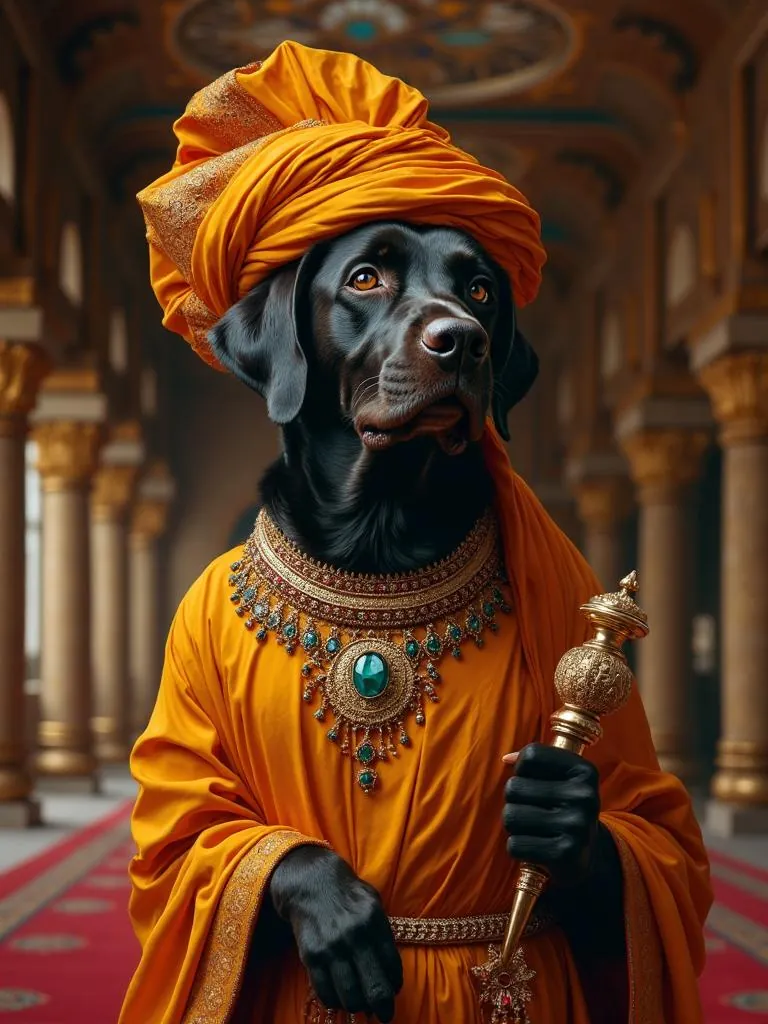
- a black labrador as Mysore royalty, in a saffron turban and holding a gold sceptre
- a Pomeranian as Patiala royalty, in a blue coat and jewelled turban on a red throne
- a dog as a Rajput warrior in armour, with a fort at sunset behind
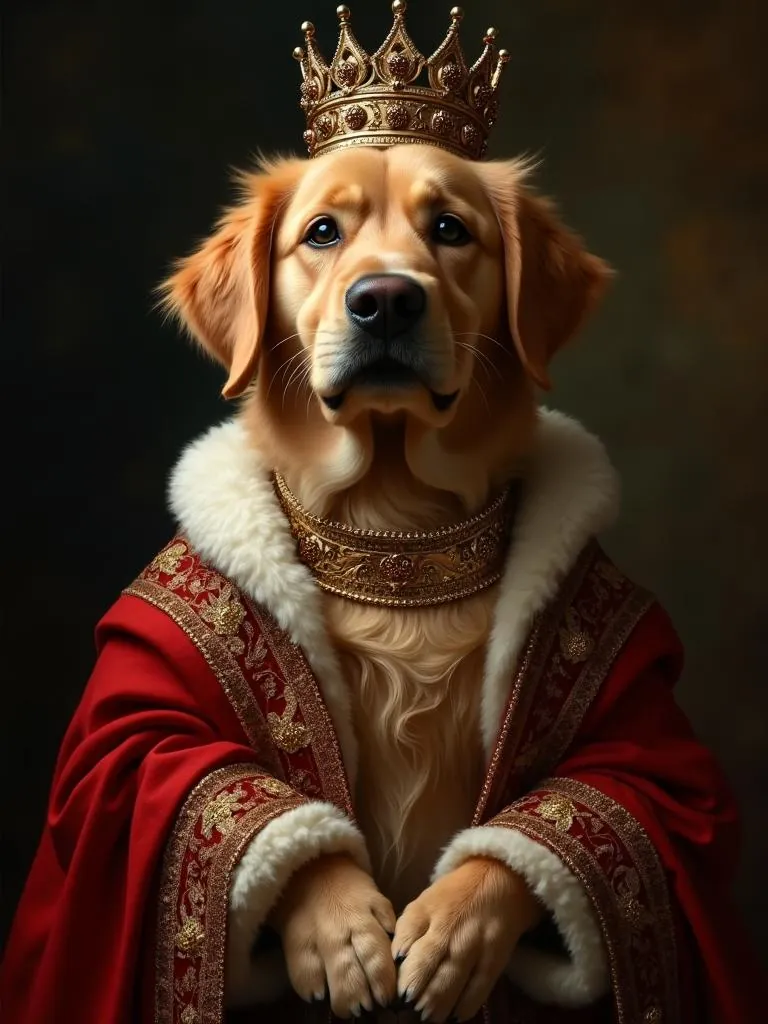
- a golden retriever wearing a royal crown and red robe
There are 15 styles in all: nine from Indian royal courts and six from European periods, including Renaissance Royal, Baroque Aristocrat and Regency Era. The European styles have no gallery example, so if you want one of those, start in the portrait studio and pick the style there.
Then choose the photo. Use a clear photo of your dog's face, taken at eye level in daylight, saved as an image file of up to 5 MB. The guide to photographing your pet for a portrait explains how, and how to choose a royal portrait style helps you match a style to your dog's coat and character.
Questions and answers
Why is it called a King Charles spaniel?
The King Charles spaniel takes its name from two 17th-century kings, Charles I and his son Charles II. The Royal Collection Trust says Charles I made the breed popular, and the American Kennel Club says the breed is closely tied to Charles II, a passionate dog breeder. According to the Royal Kennel Club, the name stayed because King Edward VII wanted the royal link kept when the club planned to call the breed the Toy Spaniel.
Can you take King Charles spaniels anywhere?
King Charles spaniels have no special right to go anywhere, and the American Kennel Club calls the story of a law allowing them into any building a legend. The AKC says the British diarist Samuel Pepys recorded that Charles II's dogs could go anywhere in Whitehall Palace, the royal home. According to the club, this may be where people got the idea that an Act of Parliament lets the spaniels enter any building in Britain.
Are there two types of King Charles spaniel?
Two breeds carry the King Charles name: the King Charles spaniel and the Cavalier King Charles spaniel. The Royal Kennel Club says the two were shown together until 1945, when it recognised them as separate breeds, and that the King Charles has a domed skull, a shorter muzzle and a smaller body. The American Kennel Club added the Cavalier in 1996 as its 140th breed, and it calls the older breed the English Toy Spaniel.
How many corgis did Queen Elizabeth have?
Queen Elizabeth II owned more than 30 corgis and dorgis during her lifetime, according to the official website of the Royal Family. A dorgi is a cross between a corgi and a dachshund. The website says she was given a corgi named Susan for her eighteenth birthday in 1944, and that all the corgis she bred after that were descended from Susan.
When did Queen Elizabeth get corgis?
Queen Elizabeth II first had corgis in her family in 1933, when she was Princess Elizabeth. The Royal Collection Trust says her father, then Duke of York and later King George VI, got two corgis that year for his daughters, Elizabeth and Margaret. The Royal Family's website names the first royal corgi as Dookie. Elizabeth received a corgi of her own, Susan, for her eighteenth birthday in 1944.
Why are corgis royal dogs?
Corgis are called royal dogs because Queen Elizabeth II kept and bred them, starting with a corgi named Susan in 1944. The Royal Collection Trust says corgis became an internationally recognised symbol of her reign, and calls her one of the longest-established breeders of Pembroke corgis in the world. According to the Royal Family's website, she owned more than 30 corgis and dorgis in her lifetime.
What are royal dog breeds?
Royal dog breeds are the breeds that kings and queens chose to keep. The Royal Family's website links the King Charles spaniel to Charles I, dachshunds and collies to Queen Victoria, terriers to Edward VII and George V, Labradors to George VI, and corgis to Elizabeth II. In Prussia, Frederick the Great kept Italian greyhounds, according to the German veterinary journal Deutsches Tierärzteblatt.
Where are Frederick the Great's greyhounds buried?
Frederick the Great's Italian greyhounds are buried on the top terrace of Sanssouci, his palace at Potsdam, next to the king's own grave. According to the Deutsches Tierärzteblatt, dogs that died before him were buried there, and he had his crypt built beside them in his lifetime. The Prussian Palaces and Gardens Foundation says his wish to lie on that terrace was granted in 1991.
Did Mughal emperors keep dogs?
Mughal emperors kept hunting dogs in the imperial palace, with one keeper for every two dogs, according to the Cleveland Museum of Art. The museum says the biography of the emperor Akbar records that he liked dogs so much he brought in breeds from distant lands. It adds that Jahangir asked the English ambassador, Sir Thomas Roe, for English hunting dogs.
What is a royal dog portrait?
A royal dog portrait is a picture of a dog that belonged to a king or queen, or a portrait that shows a pet dog as royalty. The Royal Collection holds Fino and Tiny, painted by George Stubbs in 1791 and acquired by George IV while he was Prince of Wales. It shows his black and white dog Fino and a small brown spaniel, Tiny. Purrealism offers the second kind, in 15 royal portrait styles.
Sources
- Dog with pups, Cleveland Museum of Art
- Royal Pets, Royal Collection Trust
- Anthony van Dyck, The Five Eldest Children of Charles I (RCIN 404405), Royal Collection Trust
- English Toy Spaniel History: Behind Great Britain's King Charles Spaniel, American Kennel Club
- Cavalier King Charles Spaniel History: Where the Breed Originated, American Kennel Club
- King Charles Spaniel, The Royal Kennel Club
- Der Preußenkönig Friedrich II. und die Tiere, Deutsches Tierärzteblatt (Bundestierärztekammer)
- Sanssouci Palace, Prussian Palaces and Gardens Foundation Berlin-Brandenburg (SPSG)
- Kartoffeln am Grab. Zum Tod Friedrichs des Großen in Sanssouci am 17. August 1786, Prussian Palaces and Gardens Foundation Berlin-Brandenburg (SPSG)
- Sanssouci Palace in Potsdam, Berlin.de, official website of the city of Berlin
- George Stubbs, Fino and Tiny (RCIN 400943), Royal Collection Trust
- Royal Dogs, The Royal Family
- Queen Elizabeth II's hobbies and interests, The Royal Family
Go deeper
The full guides on this topic, each a set of pages with sources: