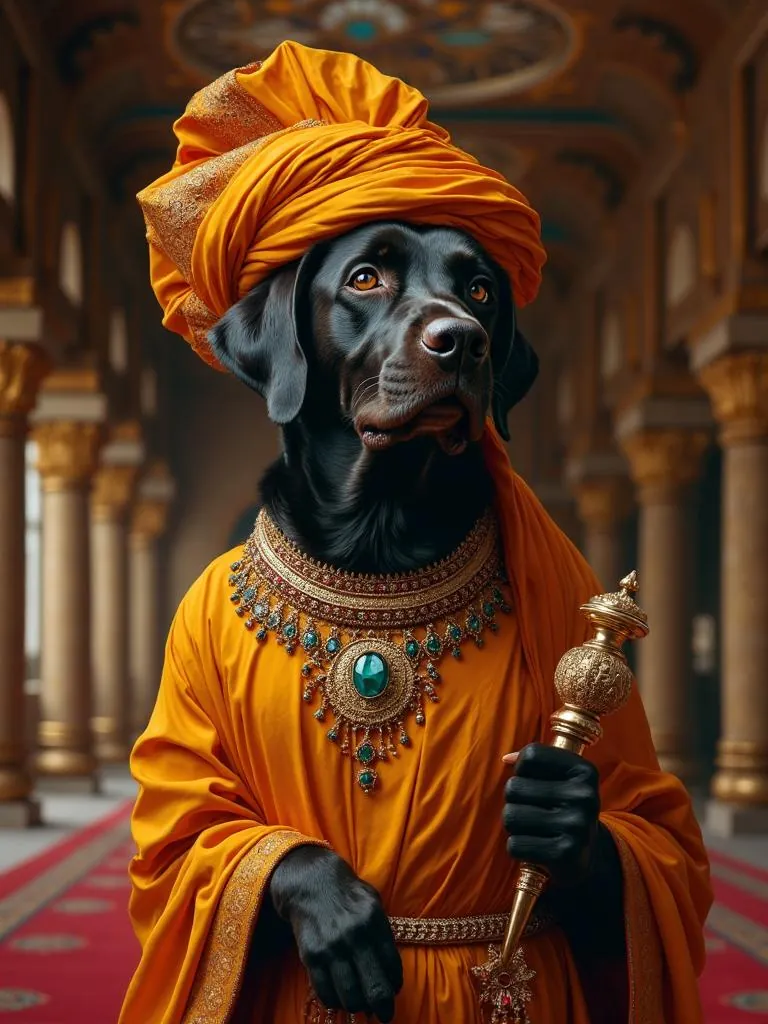
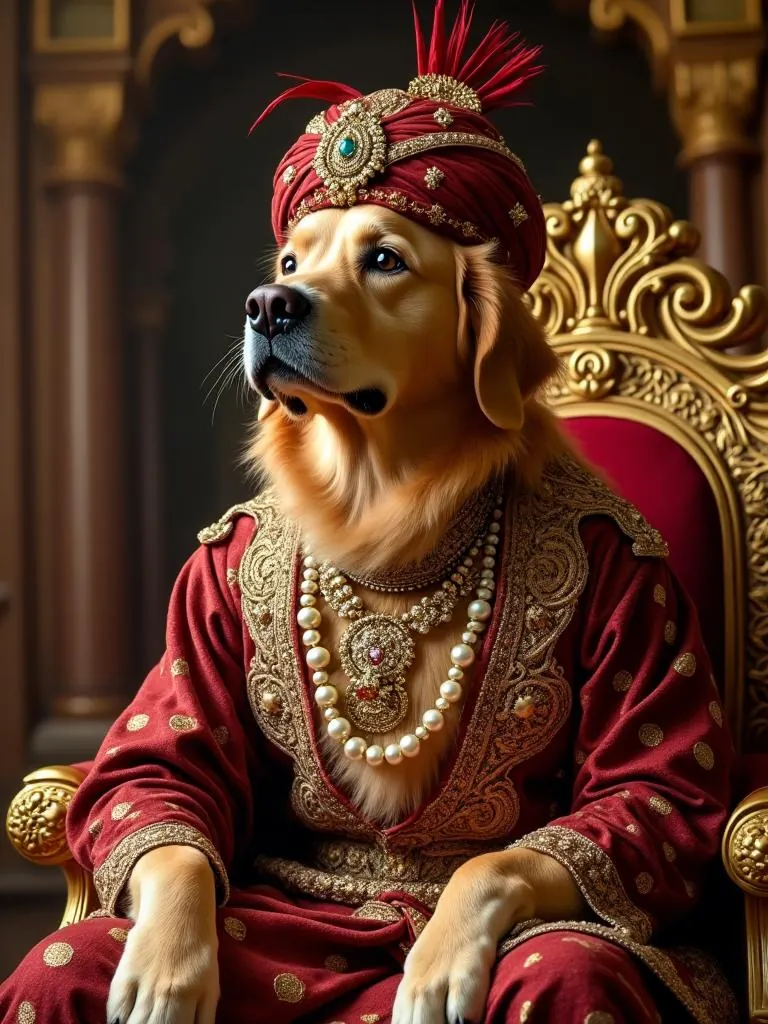
The Maharajas of Patiala: the history behind Patiala royalty
The Phulkian rulers of Patiala founded their capital in 1763. Who built Qila Mubarak, who Bhupinder Singh was, and how Patiala joined India.
By Purrealism
Patiala is a city in the Malwa region of Punjab, in north India. From 1763 until 1948 it was the capital of a princely state, a state ruled by its own royal family, the Phulkian family. Below you will find who founded the state, the fort and palaces its rulers built, Maharaja Bhupinder Singh and the Patiala Necklace, and how Patiala became part of India. The last section links this history to the Patiala Royalty style in the Purrealism gallery.
Who founded Patiala
The Patiala district administration, part of the Government of Punjab, tells the early story of the state. The rulers of three Sikh states, Patiala, Nabha and Jind, traced their family back to one man, Chaudhary Phul. The family name Phulkian comes from him.
Phul's grandson, Ala Singh, became leader of the family in 1714. He started with a landholding of 30 villages, with the town of Barnala as its first centre, and built it into an independent state. Under the rulers who came after him, the state grew until it reached the Shivalik hills in the north and Rajasthan in the south.
In 1763 Baba Ala Singh laid the foundation of the Patiala fort, Qila Mubarak, and the city of Patiala grew up around it. A district profile from India's Ministry of Micro, Small and Medium Enterprises also calls him the first ruler of the Phulkian State and dates the founding of Patiala to 1763.
After Ala Singh died, his grandson Amar Singh took the throne. He received the royal title Raja-i-Rajgan and the right to make his own coins. In 1808 the Raja of Patiala signed a treaty with the British against Ranjit Singh, whose lands lay to the north.
Later rulers named by the district administration include Karam Singh, Narendra Singh (also spelled Narinder), Mahendra Singh, Rajinder Singh, Bhupinder Singh and Yadvindra Singh. Maharaja Narendra Singh, who ruled from 1845 to 1862, built ramparts (thick defensive walls) and ten gates around the city. Maharaja Mahendra Singh opened Mohindra College in 1870 for the people of Patiala.
Qila Mubarak and the palaces of Patiala
Qila Mubarak began as a mud fort. According to the district administration, Ala Singh rebuilt it as a solid fort after he conquered Sirhind. The fort has two parts. Ala Singh built the inner part, the Qila Androon, which stands on a mound. Maharaja Karam Singh built the outer part, between the inner fort and the outer walls, with the secretariat (the government offices) on one side and the Darbar Hall on the other.
The Darbar Hall is now a small museum. It shows old weapons and armour, including a sword of Nadir Shah known as Shikar Gah, and chandeliers made of Bohemian cut glass. The walls of the palaces inside the fort carry murals painted in the Kangra and Rajasthan styles.
Maharaja Narendra Singh built the Moti Bagh Palace in 1847. The district administration says it was designed on the pattern of the Shalimar Gardens of Lahore, with terraces, water channels and a garden. It has four storeys, stone walls, arched openings and domes on top. Part of the palace now houses a national sports institute named after Subhash Chander Bose.
The Sheesh Mahal is part of the Moti Bagh Palace, with a large water tank in front of it. Narendra Singh invited painters from Kangra and Rajasthan to paint its walls with scenes from the poetry of Keshav, Surdas and Bihari. Its museum holds miniature paintings (small, detailed paintings) from the middle of the 19th century, and large portraits of the rulers of Patiala hang on the walls of its main hall. The medal gallery there shows 3,200 medals and decorations that Maharaja Bhupinder Singh collected. His son Yadvindra Singh gave the whole collection to the Punjab Government Museum.
Maharaja Bhupinder Singh
The district administration credits Maharaja Bhupinder Singh with giving Patiala a leading place in Indian politics and in international sports. It adds that most of Patiala's grand buildings went up during his reign.
The South Asian Britain project at the University of Bristol gives the details of his life. He was born in Patiala on 12 October 1891. He was placed on the throne in 1901, a year after his father died. He studied at Aitchison Chiefs' College in Lahore and played polo and cricket. In 1911 he captained the India cricket team that toured England, and in the 1926 to 1927 season he played as a member of the Marylebone Cricket Club.
During the First World War, Patiala State sent more than 28,000 men to fight, and in 1918 he was a member of the Imperial War Council. In 1925 he represented India at the League of Nations assembly.
The same source records his private life and his spending. He married ten times and had 88 children. His garage at Moti Bagh held 44 Rolls-Royce cars, all built for him. He died in Patiala in March 1938, and his eldest son, Yadavindra Singh, took the throne.
The Patiala Necklace
The South Asian Britain project calls the Patiala Necklace one of the most expensive pieces of jewellery ever made, and says the house of Cartier made it for Bhupinder Singh in 1928.
The Victoria and Albert Museum in London showed the necklace in its Cartier exhibition, which ran from 12 April to 16 November 2025. The museum describes it as a ceremonial diamond necklace and choker (a necklace worn close around the neck) commissioned by the Maharaja of Patiala. Its label reads that Cartier Paris made it in 1928 as a special order for Sir Bhupindra Singh, Maharaja of Patiala, that it was restored between 1999 and 2002, and that it now belongs to the Cartier Collection.
How Patiala joined India
Yadavindra Singh was the ruler of Patiala when India became independent. The district administration says he was among the princes who came forward readily to sign the Instrument of Accession, the document by which a princely state joined India. Sardar Vallabhbhai Patel, then India's Deputy Prime Minister, praised him for it. Patel said the Maharaja's example helped change how the other princes saw joining India.
In 1948 a new state was formed: the Patiala and East Punjab States Union, known as PEPSU, with Patiala as its capital. Yadavindra Singh became its Rajpramukh, the formal head of the union. The union lasted eight years. The States Reorganisation Act of 1956 formed a new State of Punjab from 1 November 1956, made up of the old State of Punjab and PEPSU. Patiala is now a district of Punjab. For the meaning of the word Maharaja itself, read what does Maharaja mean.
The Patiala Royalty portrait style
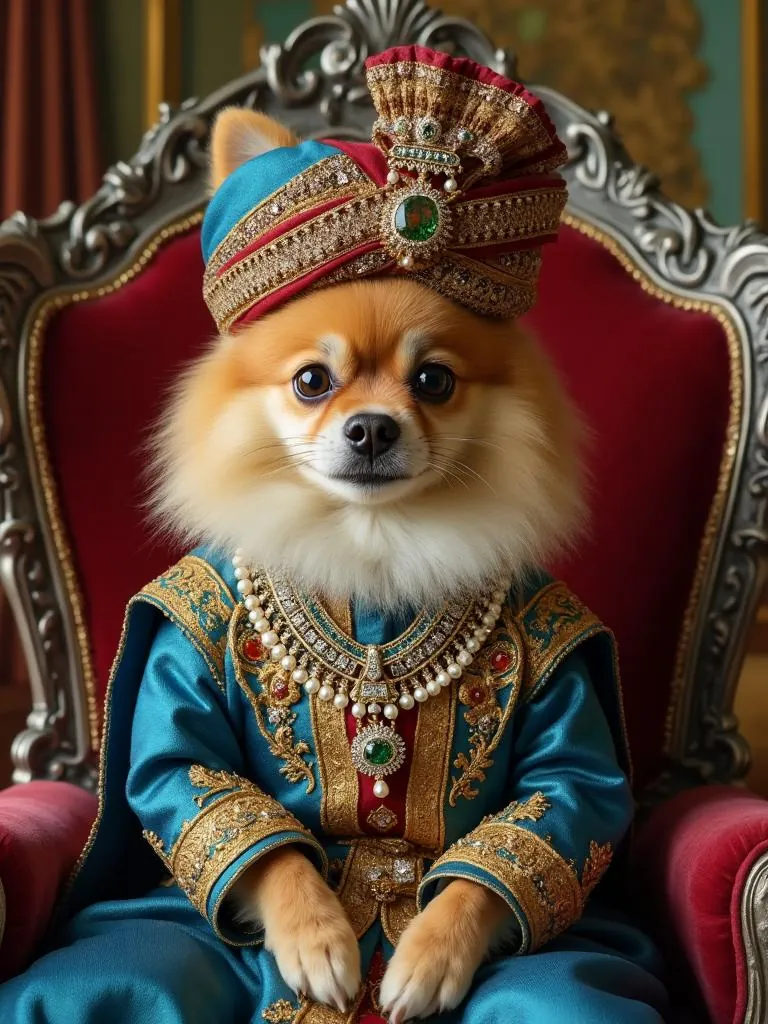
Purrealism has 15 royal portrait styles, and Patiala Royalty is one of the nine that come from Indian royal courts. The style takes its name from the Phulkian court at Patiala. The Patiala Royal portrait in the gallery shows a Pomeranian as Patiala royalty, in a blue coat and a jewelled turban, on a red throne.
Large portraits of the rulers of Patiala still hang on the walls of the museum hall in the Sheesh Mahal. A royal portrait of your dog or cat in Patiala dress brings the same kind of picture into your own home. The portrait studio lets you pick the Patiala Royalty style for a dog or a cat.
The blue coat and red throne give strong colour, so think about your pet's coat when you choose. Our guide on how to choose a royal portrait style suggests blue or deep red clothes for golden, ginger and cream coats. Art prints come in four sizes: 8 × 10, 12 × 16, 18 × 24 and 24 × 36 inches, on matte or glossy paper. A single figure on a throne is easy to see at 8 × 10 inches on a desk or a shelf. A larger print shows the jewels on the turban more clearly from across a room.
Questions and answers
Who was the first maharaja of Patiala?
The first ruler of Patiala was Baba Ala Singh, who founded the state. According to the Patiala district administration, he became leader of the Phulkian family in 1714 and laid the foundation of the Qila Mubarak fort in 1763, and the city grew up around it. The same source says the royal title Raja-i-Rajgan came later, to his grandson and successor, Amar Singh.
Who was the last maharaja of Patiala?
The last Maharaja to rule Patiala as a state was Yadavindra Singh, also spelled Yadvindra Singh. According to the University of Bristol's South Asian Britain project, he took the throne when his father, Bhupinder Singh, died in March 1938. The Patiala district administration says he signed the Instrument of Accession to join India and then became Rajpramukh, the formal head, of the new state of PEPSU.
Who was maharaja of Patiala in 1861?
Maharaja Narendra Singh, also spelled Narinder Singh, ruled Patiala in 1861. The Patiala district administration dates his reign from 1845 to 1862. He built the ramparts and ten gates around the city of Patiala, and in 1847 he built the Moti Bagh Palace, designed on the pattern of the Shalimar Gardens of Lahore. He also invited painters from Kangra and Rajasthan to paint the walls of the Sheesh Mahal.
Who was Maharaja Bhupinder Singh of Patiala?
Maharaja Bhupinder Singh ruled the Sikh princely state of Patiala from 1901 until his death in March 1938. According to the University of Bristol's South Asian Britain project, he was born in 1891, captained the India cricket team that toured England in 1911, and sat on the Imperial War Council in 1918. The same source says Cartier made the Patiala Necklace for him in 1928.
How many wives of maharaja Patiala?
Maharaja Bhupinder Singh of Patiala married ten times, according to the University of Bristol's South Asian Britain project. The same source says he had 88 children. He ruled Patiala from 1901 until his death in March 1938, and his eldest son, Yadavindra Singh, then took the throne and became the last Maharaja to rule Patiala as a state.
What is Patiala necklace?
The Patiala Necklace is a ceremonial diamond necklace and choker that Cartier Paris made in 1928 as a special order for Sir Bhupindra Singh, Maharaja of Patiala. The Victoria and Albert Museum in London showed it in its Cartier exhibition, which ran from 12 April to 16 November 2025. The University of Bristol's South Asian Britain project calls it one of the most expensive pieces of jewellery ever made.
Who owns the Patiala necklace now?
The Patiala Necklace now belongs to the Cartier Collection, according to the Victoria and Albert Museum, which listed it that way in its 2025 Cartier exhibition. The museum's label says Cartier Paris made the necklace in 1928 as a special order for Sir Bhupindra Singh, Maharaja of Patiala, and that it was restored between 1999 and 2002.
Who built Qila Mubarak Patiala?
Baba Ala Singh, the founder of Patiala state, built Qila Mubarak. According to the Patiala district administration, he laid its foundation in 1763, and the city of Patiala grew up around the fort. He built the inner part, the Qila Androon, and Maharaja Karam Singh later built the outer part with the Darbar Hall, which is now a small museum of weapons and chandeliers.
How rich was maharaja of Patiala?
The wealth of Maharaja Bhupinder Singh of Patiala shows in what he owned, since the sources for this guide give no total figure. According to the University of Bristol's South Asian Britain project, he kept 44 Rolls-Royce cars, all built for him, at Moti Bagh, and Cartier made the Patiala Necklace for him in 1928. The Patiala district administration says he collected 3,200 medals and decorations.
What does the Patiala Royal portrait in the Purrealism gallery show?
The Patiala Royal portrait in the Purrealism gallery shows a Pomeranian as Patiala royalty, in a blue coat and a jewelled turban, on a red throne. Patiala Royalty is one of the nine Indian court styles among Purrealism's 15 portrait styles, and it takes its name from the princely state of Patiala in Punjab. You can choose it for a dog or a cat in the portrait studio.
Sources
- History, District Administration Patiala, Government of Punjab
- Architecture, District Administration Patiala, Government of Punjab
- Brief Industrial Profile of District Patiala, MSME Development Institute Ludhiana, Ministry of MSME, Government of India
- Bhupinder Singh, South Asian Britain: Connecting Histories, University of Bristol
- Cartier, Victoria and Albert Museum
- About the Cartier exhibition, Victoria and Albert Museum
- The States Reorganisation Act, 1956, Government of India (text published by the High Court of Tripura)
Go deeper
The full guides on this topic, each a set of pages with sources: