What is Mysore painting? Gold, gesso and the Wodeyar court
Mysore painting is a South Indian court style from Karnataka, known for fine lines, gentle colours, raised gesso and gold. It grew under the Wodeyar kings.
By Purrealism
Mysore painting is a school of painting from South India. It grew at the court of the Wodeyar kings of Mysore, in what is now the state of Karnataka. People know it for fine lines, gentle colours, raised gesso work and gold leaf. This guide explains where the style came from, which king supported it, how a painting is made, and how it compares with Tanjore painting. It ends with the Mysore Royal portrait style on this site.
What is Mysore painting?
The Salar Jung Museum in Hyderabad calls Mysore painting one of the classical South Indian schools of painting. It began around the town of Mysore. The museum describes the paintings as having delicate lines, fine brushwork and soft colours made from plants.
Karnataka Tourism, the state government's tourism department, describes it in similar words. Its page says Mysore painting is known for refined lines, muted colours and pure gold foil detail. It also says the gold leaf gives the paintings a soft glow.
The artists who made these paintings were called chitrakaras. According to the Salar Jung Museum, you can find paintings in the Mysore style in many places: Mysore, Shrirangapatna, Shravanabelagola, Sira, Chitradurga, Mudukutore, Hampi and Raichur in Karnataka, and Lepakshi in Andhra Pradesh.
Where Mysore painting came from
The Salar Jung Museum explains that Mysore painting developed from the painting school of the Vijayanagara empire.
In 1565, after the battle of Talikota, the Vijayanagara empire fell, and its painters moved to nearby places. The museum names three places they went: Mysore, Tanjore and Surpur. In Mysore, the painters mixed what they had learned at Vijayanagara with local ideas, and the Mysore school was the result.
Tanjore painting, from the Thanjavur region, came from the same Vijayanagara school, according to the same museum.
Which king encouraged Mysore painting?
The Wodeyar family ruled the Kingdom of Mysore. According to the Salar Jung Museum, the kingdom lasted from 1399 to 1947. The Wodeyars had first served as local lords under the Vijayanagara empire.
The museum says the Mysore maharajas supported painting from the 17th to the 19th century. The court also supported music, Kannada literature, drama and theatre, and the kings were writers themselves. The chitrakaras kept working when Hyder Ali and his son Tipu Sultan held real power in Mysore. After the British defeated Tipu Sultan in 1799, they restored the Wodeyars as rulers.
The king most closely tied to Mysore painting is Maharaja Krishnaraja Wodeyar III, who lived from 1794 to 1868. The Salar Jung Museum says he revived older styles of painting and that the Mysore school reached its high point under him.
Krishnaraja Wodeyar III also wrote. The University of Mysore's Oriental Research Institute describes him as a writer in Kannada and Sanskrit. It credits him with the Sritattvanidhi, a work in nine volumes that covers many parts of traditional Indian knowledge. The institute says the traditional paintings and other illustrations in it add to its appeal.
How a Mysore painting is made
Two public sources describe the method in plain steps.
The Salar Jung Museum says the painters worked on paperboard, or on cloth pasted on wood. They made the sketch first. Then they painted with colours made from stones and plant material. They also added gesso. Gesso is a paste that painters build up into raised shapes, and in Mysore painting it was used to highlight jewellery, clothes and buildings. One painting in the museum's collection, a Raja with three others before a temple, has gold foil across the whole surface.
Karnataka Tourism describes the same order in short form:
- The painter starts on handmade paper, or on cloth pasted on wood.
- The painter adds layers of natural mineral colours.
- The painter finishes with 24-karat gold leaf.
You can see the method in a museum piece. The National Gallery of Modern Art in New Delhi holds a Mysore school painting of Saraswati, the goddess of learning, by the painter Chitragara Krishnappa. The gallery's description says the decoration sits on a raised limestone paste, and that the painter used both gold and silver leaf. The goddess sits inside a decorated arch.
To see Mysore painting today, Karnataka Tourism suggests the Chamarajendra Academy of Visual Arts in Mysuru and the Karnataka Chitrakala Parishath in Bengaluru. Both show exhibitions, and visitors can learn about the techniques there.
Mysore and Tanjore painting compared
Both styles come from the Vijayanagara school, and both use gesso and gold. The sources describe clear differences in how they use them.
| Mysore painting | Tanjore painting | |
|---|---|---|
| Colours | Gentle colours from plants and minerals | Vivid colours |
| Gesso | Used to highlight jewellery, clothes and buildings | Large areas of gesso under the gold |
| Gold | 24-karat gold leaf with a soft glow | Gold foil laid over the gesso |
The National Museum in New Delhi describes Tanjore paintings as simple, icon-like pictures with vivid colours and gold foil over large areas of gesso. They are set with glass beads and semi-precious stones, and most show Hindu gods, goddesses and saints. Karnataka Tourism sets the strong, bright strokes of Tanjore painting against the delicate brushwork and careful composition of Mysore painting.
What Mysore painters showed
Most Mysore paintings tell religious stories. The Salar Jung Museum lists stories from the Mahabharata, the Ramayana, the Bhagavata Purana and Jain texts. Favourite subjects included the goddess Raja Rajeshwari, the crowning of Rama, and Rama holding his bow and arrow.
The painters also showed court life. The museum says Mysore paintings include court scenes, battle scenes and epic heroes. Its own collection of 19th-century Mysore paintings has a royal couple on a swing with two attendants holding fans, and a Raja seated with his queen and a physician.
Rulers had their portraits made too. The Metropolitan Museum of Art in New York holds a portrait of Maharaja Krishnaraja Wodeyar III from Mysore. The museum dates it to 1870 or close to that year, and lists it as opaque watercolour and gold on paper.
Mysore painting and the Dasara festival
Mysore Palace, the seat of the Wodeyar court that supported this painting school, is still the centre of one living tradition. Karnataka Tourism describes Mysuru Dasara as a ten-day festival built around the worship of the goddess Chamundeshwari, held each year during Navaratri. The same department's page says the palace is lit with more than 100,000 bulbs each evening of the festival. A visitor who wants to see the palace that once housed the chitrakaras, rather than only their work in a museum case, can time a visit to Mysuru around the festival.
Where to see a real Mysore painting today
Three of the sources for this guide hold Mysore paintings a reader can look up directly. The Metropolitan Museum of Art in New York holds the 1870 portrait of Krishnaraja Wodeyar III described above. The National Gallery of Modern Art in New Delhi holds Chitragara Krishnappa's Saraswati, with its raised limestone paste and gold and silver leaf. The Salar Jung Museum in Hyderabad holds a wider collection, including the Raja-before-a-temple painting with gold foil across its full surface. Each museum's own catalogue page, linked in the citations below, shows a clearer image than any written description can give.
The Mysore Royal portrait style
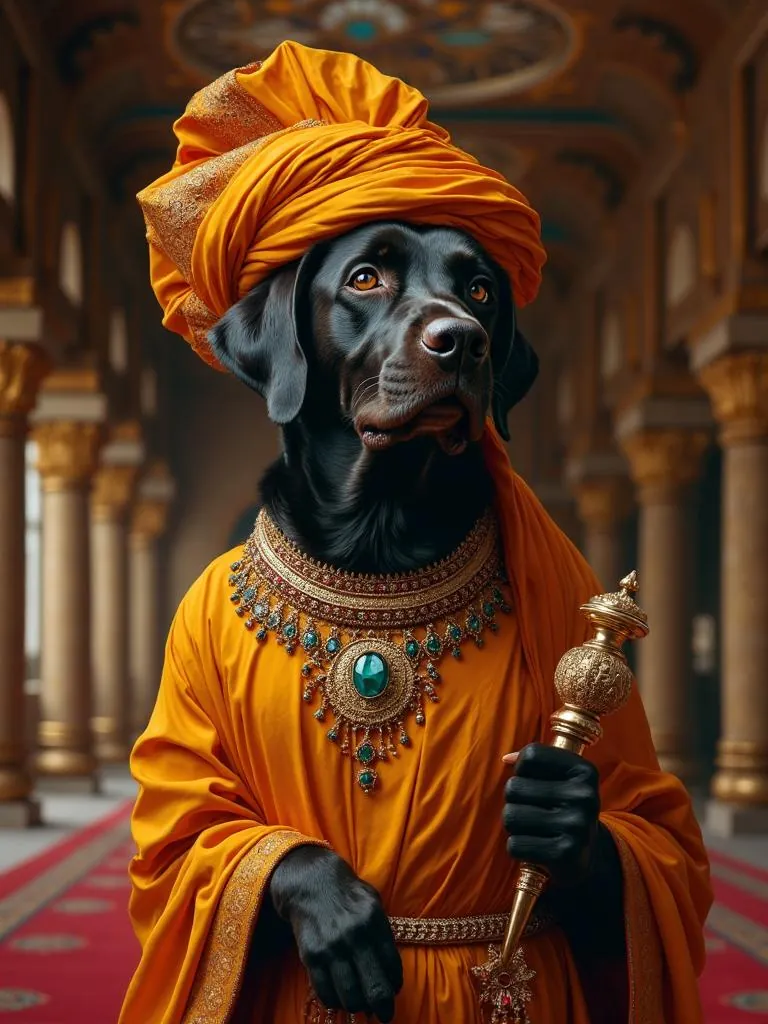
Purrealism has 15 royal portrait styles, and Mysore Royal is one of the nine Indian court styles. The Mysore Royal portrait in the gallery shows a black labrador as Mysore royalty, in a saffron turban and holding a gold sceptre. You can choose the same style for your own dog or cat in the portrait studio.
To compare the Mysore court with other Indian courts, read what is Mughal painting and what does maharaja mean.
The light saffron and gold in the Mysore Royal portrait also stand out against a dark coat, as the black labrador in the gallery shows. If your pet is black or dark brown, the guide to choosing a royal portrait style explains how to match clothes to coat colour.
Questions and answers
What is Mysore painting?
Mysore painting is a classical South Indian school of painting that began around the town of Mysore, in present-day Karnataka, according to the Salar Jung Museum in Hyderabad. The museum describes delicate lines, fine brushwork and gentle colours made from plants, with raised gesso work that picks out jewellery, clothes and buildings. Most Mysore paintings tell religious stories from the epics, and some show court life and battles.
What is Mysore style painting?
Mysore style painting is known for refined lines, muted colours and pure gold foil detail, according to Karnataka Tourism, the Government of Karnataka's tourism department. Its page says each painting is made on handmade paper or cloth pasted on wood, layered with natural mineral colours, and finished with 24-karat gold leaf that gives a soft glow. Gods and goddesses often sit inside decorated arches and gardens.
Which king encouraged Mysore painting?
Maharaja Krishnaraja Wodeyar III of Mysore, who lived from 1794 to 1868, is the king most closely tied to Mysore painting. According to the Salar Jung Museum, he revived older styles of painting, and the Mysore school reached its high point during his rule. The University of Mysore's Oriental Research Institute credits him with the Sritattvanidhi, a nine-volume work that includes traditional paintings.
Who encouraged Mysore painting?
The Wodeyar kings of Mysore encouraged Mysore painting by supporting the artists at their court. The Salar Jung Museum says the Mysore maharajas supported these paintings from the 17th to the 19th century. The museum adds that the artists, called chitrakaras, also did well when Hyder Ali and Tipu Sultan held real power in the kingdom, and that the same court supported music, Kannada literature and theatre.
How to do Mysore painting?
A Mysore painting is made in stages. According to the Salar Jung Museum, the artist works on paperboard or cloth pasted on wood, draws the sketch first, paints with colours made from stones and plants, and adds raised gesso work to pick out jewellery, clothes and buildings. Karnataka Tourism says 24-karat gold leaf goes on last, and names the Chamarajendra Academy of Visual Arts in Mysuru as a place to learn the techniques.
Who is Krishnaraja Wodeyar?
Krishnaraja Wodeyar III was a Maharaja of Mysore from the Wodeyar family, born in 1794 and died in 1868, according to the Salar Jung Museum. The museum says he revived older styles in Mysore painting. The University of Mysore's Oriental Research Institute describes him as a writer in both Kannada and Sanskrit. The Metropolitan Museum of Art in New York holds a portrait of him from Mysore, made in opaque watercolour and gold on paper.
Who were the Wodeyars of Mysore?
The Wodeyars were the royal family of the Kingdom of Mysore, which lasted from 1399 to 1947, according to the Salar Jung Museum. The family first ruled as local lords under the Vijayanagara empire. After the British defeated Tipu Sultan in 1799, they restored the Wodeyars as rulers, and Mysore stayed a princely state (a kingdom under British control) until India's independence in 1947.
Is Tanjore painting made of gold?
Tanjore painting uses gold foil, laid over large areas of gesso, according to the National Museum in New Delhi. Gesso is a paste that painters build up into raised shapes. The museum also lists glass beads and semi-precious stones set into the painting, with vivid colours. Mysore painting uses gold as well: Karnataka Tourism says Mysore paintings are finished with 24-karat gold leaf.
What is the difference between Mysore and Tanjore painting?
Mysore and Tanjore painting both came from the older Vijayanagara school of painting, according to the Salar Jung Museum. The National Museum in New Delhi describes Tanjore painting as vivid colours and gold foil over large areas of gesso, set with glass beads and semi-precious stones. Karnataka Tourism sets the strong, bright strokes of Tanjore work against the delicate brushwork of Mysore painting, where gesso highlights jewellery, clothes and buildings.
What does the Mysore Royal pet portrait on Purrealism show?
The Mysore Royal portrait in the Purrealism gallery shows a black labrador dressed as Mysore royalty, in a saffron turban and holding a gold sceptre. Mysore Royal is one of nine Indian court styles among Purrealism's 15 royal portrait styles. You can choose it for a dog or a cat in the Purrealism portrait studio, and add one photo of your pet of up to 5 MB.
Sources
- Marvels of Mysore, Salar Jung Museum, Hyderabad (on Google Arts & Culture)
- Mysore Painting, Department of Tourism, Government of Karnataka
- Thanjavur Paintings, National Museum, New Delhi
- Oriental Research Institute, University of Mysore
- Maharaja Krishnaraja Wodeyar III, The Metropolitan Museum of Art
- Saraswati, Chitragara Krishnappa, National Gallery of Modern Art, New Delhi (on Google Arts & Culture)
- Experience the Mysuru Dasara festivities in Karnataka, Department of Tourism, Government of Karnataka
Go deeper
The full guides on this topic, each a set of pages with sources: