What is Tanjore painting? Gold foil, gesso and the Thanjavur court
Tanjore painting is a South Indian style from Thanjavur, made on a wooden board with raised gesso, gold foil and glass stones. Where it came from and how it is made.
By Purrealism
Tanjore painting is a style of religious painting from Thanjavur, a town in the South Indian state of Tamil Nadu. Tanjore is the older English spelling of the same name. In a Tanjore painting the gods stand in raised shapes covered in gold foil, with coloured glass and stones pressed into the surface. This guide explains where the style came from, which rulers supported it, how a painting is built up in layers, and how it differs from its close neighbour, Mysore painting.
What is Tanjore painting?
The National Museum in New Delhi describes Tanjore paintings as simple, icon-like pictures with vivid colours and gold foil laid over large areas of gesso. Gesso is a paste that painters build up into raised shapes. The museum says the paintings are set with glass beads and semi-precious stones, and that they serve as devotional icons, which means pictures made for worship.
The local name is palagai oviyam. D'source, a design learning site whose Tanjore pages were documented at the National Institute of Design in Bengaluru, uses this name and sums up the art in three words: gods, gold and gemstones. Another D'source page calls Tanjore paintings panel paintings made on solid wood planks.
Two details help you recognise the style. The first is the gold, which sits on raised areas and shines when light moves across it. The second is the face. D'source points to fine lines, soft washes of colour on the skin, and kayal vizhi eyes, the fish-shaped eyes that Tamil poets wrote about.
Where Tanjore painting came from
The story begins with the fall of a great South Indian empire. The Salar Jung Museum in Hyderabad explains that after the Vijayanagara empire fell at the battle of Talikota in 1565, its artists moved to nearby places, and it names Mysore, Tanjore and Surpur. The museum calls Tanjore painting an offshoot of the Vijayanagara school, and says the same about Mysore painting.
At Thanjavur, the painters found new patrons. D'source dates the art form to 1600 AD, during the rule of the Nayaks. It lists the families that ruled Tanjore over the centuries: the Cholas, the Pandyas, the Vijayanagara empire, the Nayaks, the Marathas and the British. Thanjavur's own district administration says the town's palace was built partly by the Nayaks and partly by the Marathas. It adds that the Saraswathi Mahal Library, which holds manuscripts, maps and paintings, was built up by both families over time.
D'source describes the painting style as a mix of Nayak, Maratha and British elements. The Nayak period gave it its start. Under the Maratha rajas, and in the years of British power in South India, the style took the form most people know today.
For the rulers who came long before the Nayaks, and who built the great temple at Thanjavur, read our guide to the Chola dynasty.
The Maratha rajas and Serfoji II
The Marathas came to Thanjavur from western India, where Shivaji had founded their kingdom. Our guide to Shivaji and the Maratha kings tells that story.
The best-known Maratha ruler of Thanjavur is Serfoji II, also called Sarabhoji. The Los Angeles County Museum of Art (LACMA) says he was born in 1777 into the Maratha royal clan and was adopted in 1787. The British installed him as king of Thanjavur in 1798, and he ruled until his death in 1832, with his power limited to the fort of Thanjavur and the land around it. LACMA holds a painting of a royal procession with Serfoji II, made around 1800 to 1810 in opaque watercolour and gold on paper.
Serfoji II lived at the same time as a great patron of Mysore painting. The Salar Jung Museum says Krishnaraja Wodeyar III of Mysore, who revived older styles of painting at his court, was a contemporary of Serfoji II of Thanjavur. For how painters at Thanjavur portrayed Serfoji II and the rajas before him, see Maratha court portraits.
How a Tanjore painting is made
A Tanjore painting is built up in layers, and the base takes more time than the paint. D'source records the steps as they are followed by painters in Thanjavur today:
- The board. The painter takes a wooden board of the size needed and places a sheet of cardboard on it. D'source says painters traditionally chose jackfruit wood, because termites leave it alone and it does not rot easily.
- The cloth. Cotton fabric is stretched over the board and pasted down with a local gum.
- The base coat. The cloth is covered with a paste made from a chalk powder and glue. Three coats go on over a span of ten days.
- The sketch. The painter draws the figure, often using templates of religious scenes.
- The raised work. A second paste of chalk powder, a local stone and gum from the karuvela tree is used to build up raised shapes. Coloured glass or kundan stones are pressed into it.
- The gold. A thin sheet of gold foil is laid on each raised area, cut to shape, and glued down. In summer it takes three hours to dry. D'source says artisans once made the foil themselves, by beating a small piece of gold on animal skin.
- The colour. Poster colour, mooligai colour (made from leaves, roots and bark), or a mix of both, goes on in several coats, and each coat dries before the next.
- The frame. The finished painting is set in a teak frame with clear glass on top.
D'source says older paintings used natural colours made from flowers and stones, with gold used to pick out clothing and jewellery.
What Tanjore paintings show
Most Tanjore paintings are pictures of gods. The National Museum in New Delhi says the subjects are mostly Hindu gods, goddesses and saints, and that painters also showed episodes from the Puranas, the Sthala-puranas and other religious texts. The Puranas are old collections of stories about the gods, and a Sthala-purana tells the story of one temple.
D'source links the rise of the style to the spread of Vaishnavism, the worship of the god Vishnu, in South India. It says most themes come from stories of Vishnu, and that the image painters return to most is Baby Krishna holding a pot of butter. Another D'source page adds the crowning of Rama, and Vishnu with the goddess Lakshmi, with animals as smaller figures.
Tanjore painters also made portraits of rulers. D'source says the art began with pictures of the gods and later extended to royal portraiture. Painters at Thanjavur also painted on sheets of glass. The Victoria and Albert Museum in London holds a portrait of Raja Sarabhoji (Serfoji II), painted in gouache and gold leaf on glass around 1860.
Tanjore and Mysore painting: how to tell them apart
Tanjore and Mysore painting share a history. Both grew from the Vijayanagara school, both use gesso and gold, and both mostly show Hindu gods. Our guide to Mysore painting covers the Mysore side in full, and compares the colours and brushwork of the two styles. Three more differences are worth knowing.
The base. Tanjore paintings are made on a wooden board covered with cloth, and D'source calls them panel paintings on solid wood planks. The Salar Jung Museum says Mysore painters worked on paperboard as well as on cloth pasted on wood.
The glass and stones. The National Museum in New Delhi lists glass beads and semi-precious stones as part of Tanjore painting, and D'source says they are pressed into the raised paste before the gold goes on. The Salar Jung Museum's account of Mysore painting describes gesso and gold foil, with no set stones.
The legal name. Each style has its own entry on the Government of India's list of registered geographical indications. A geographical indication is a legal name for a product that comes from one place. Thanjavur Painting is application number 47, filed on 4 January 2006, under Tamil Nadu. Mysore Traditional Paintings is application number 32, filed on 31 March 2005, under Karnataka. Both are listed as handicrafts.
The Victoria and Albert Museum points out that sorting old South Indian gold-leaf paintings into one school can be hard. In a 2024 article on its collection, the museum says the Surapura style shares gesso, bright colour and gold leaf with the Mysore and Tanjore traditions, and that some of its religious paintings could belong to either the Thanjavur or the Mysuru school.
Tanjore painting and royal pet portraits
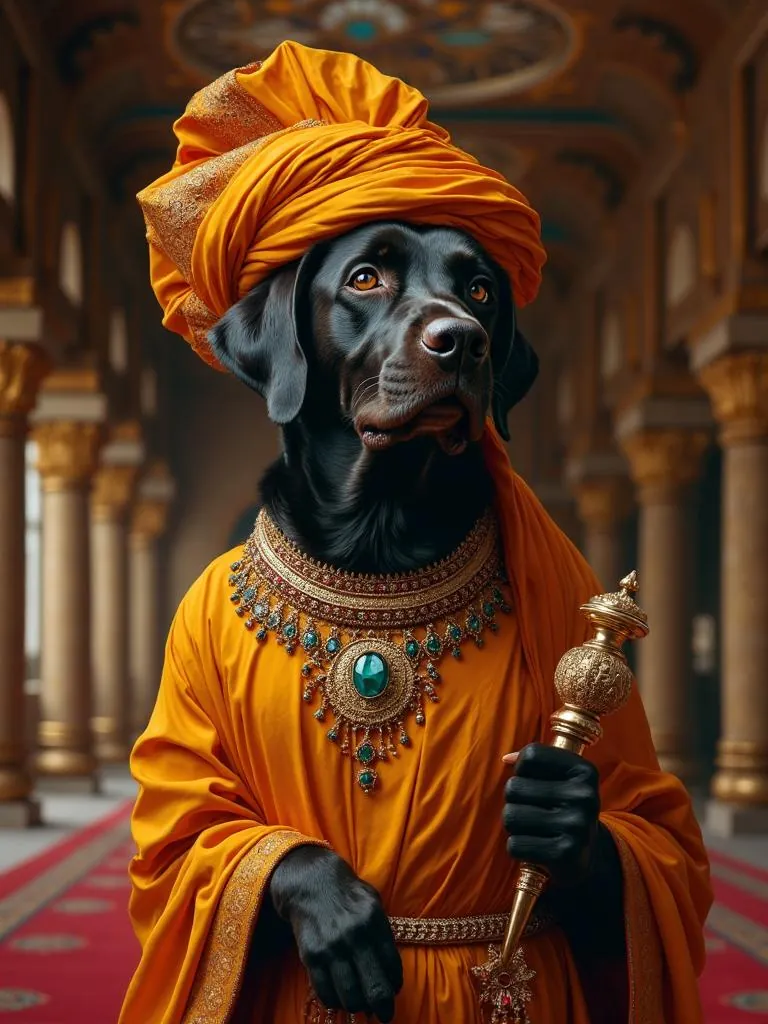
Purrealism has 15 royal portrait styles, and nine of them come from Indian courts. A true Tanjore painting is made by hand on a wooden board, with raised paste and hand-cut gold foil, so the site has no Tanjore style. The closest style on the site is Mysore Royal, from the court that shared Tanjore's Vijayanagara roots. The Mysore Royal portrait in the gallery shows a black labrador as Mysore royalty, in a saffron turban and holding a gold sceptre. Maratha King and Chola Warrior are also on the list, named for the two ruling families whose history runs through Thanjavur.
You can choose any of these styles for your own dog or cat in the portrait studio, from one clear photo of up to 5 MB.
Questions and answers
What is Tanjore painting?
Tanjore painting is a classical South Indian style of painting named after the Thanjavur region, also spelled Tanjore, in Tamil Nadu. The National Museum in New Delhi describes it as simple, icon-like pictures with vivid colours and gold foil laid over large areas of gesso, a paste built up into raised shapes. Glass beads and semi-precious stones are set into the surface, and most paintings show Hindu gods, goddesses and saints.
What is special about Tanjore painting?
Tanjore painting is known for raised areas covered in gold foil, which catch the light and stand out from the flat colour around them. The National Museum in New Delhi also names glass beads and semi-precious stones set into the painting. D'source, a design learning site documented at the National Institute of Design in Bengaluru, adds fine lines, soft washes on skin, and the fish-shaped eyes that Tamil poets praised.
How are Tanjore paintings made?
A Tanjore painting is made in layers on a wooden board. D'source, documented at the National Institute of Design in Bengaluru, says the painter pastes cotton cloth onto the board, coats it with a chalk paste in three coats over ten days, and draws the sketch. Raised shapes are built up with a second paste, glass or kundan stones are pressed in, gold foil is cut and glued over the raised areas, and colours go on last.
Which state is Tanjore painting from?
Tanjore painting is from the state of Tamil Nadu in South India, and takes its name from the town of Thanjavur. The Government of India's list of registered geographical indications places Thanjavur Painting under Tamil Nadu, in the handicraft group. A geographical indication is a legal name for a product tied to one place, like Mysore Traditional Paintings from Karnataka, which is on the same list.
How old is Tanjore painting?
Tanjore painting is a little over four hundred years old. D'source, documented at the National Institute of Design in Bengaluru, dates the art form to 1600 AD, during the rule of the Nayaks at Thanjavur. The Salar Jung Museum in Hyderabad traces it back further, to the painters of the Vijayanagara empire, who moved to Tanjore and other towns after the empire fell at the battle of Talikota in 1565.
What paint is used for Tanjore painting?
Tanjore painting today uses poster colour, herbal colour, or both, depending on the grade of the painting. D'source, documented at the National Institute of Design in Bengaluru, calls the herbal paint mooligai colour and says the colours go on in several coats, each left to dry. The same source says older paintings used natural pigments made from flowers and stones, with gold used on clothing and jewellery.
Why are Tanjore paintings expensive?
Tanjore paintings cost more than most paintings because of their materials and the time they take. The National Museum in New Delhi describes gold foil laid over large areas of gesso, set with glass beads and semi-precious stones. D'source, documented at the National Institute of Design in Bengaluru, says the base alone takes three coats of paste over ten days, and each piece of gold foil is cut to shape by hand.
Can Tanjore painting be done on canvas?
Tanjore painting has always used cloth, glued onto a wooden board. D'source, documented at the National Institute of Design in Bengaluru, says the painter stretches cotton fabric over the board and pastes it down with a local gum before any paint goes on. The traditional wood came from the jackfruit tree. The local name, palagai oviyam, refers to this wooden base, and the finished piece is set in a teak frame under glass.
Does Thanjavur painting have a GI tag?
Thanjavur painting has a GI tag, which means geographical indication. The Government of India's list of registered geographical indications, published by Intellectual Property India, shows Thanjavur Painting as application number 47 from Tamil Nadu, filed on 4 January 2006 and registered. A GI tag protects a product name that is tied to one region. Mysore Traditional Paintings, from Karnataka, holds its own registration on the same list.
Which rulers supported Tanjore painting?
Tanjore painting grew under two ruling families at Thanjavur: the Nayaks, and after them the Maratha rajas. D'source, documented at the National Institute of Design in Bengaluru, calls the style a mix of Nayak, Maratha and British elements. The best-known Maratha ruler was Serfoji II, who ruled from 1798 until 1832, according to the Los Angeles County Museum of Art.
Sources
- Thanjavur Paintings, National Museum, New Delhi
- Thanjavur Painting: Introduction, D'source (documented at the National Institute of Design, Bengaluru)
- Thanjavur Painting: Making Process, D'source (documented at the National Institute of Design, Bengaluru)
- Thanjavur Painting: Tools and Raw Materials, D'source (documented at the National Institute of Design, Bengaluru)
- Tanjore Painting, Tanjore, Tamil Nadu: Introduction, D'source (documented at the National Institute of Design, Bengaluru)
- Marvels of Mysore, Salar Jung Museum, Hyderabad (on Google Arts & Culture)
- Details of GI Applications Registered as on December 31, 2025, Intellectual Property India, Government of India
- Royal Procession with Maharaja Serfoji II of Thanjavur (r. 1798 to 1832), Los Angeles County Museum of Art
- Places of Interest, Thanjavur District Administration, Government of Tamil Nadu
- South Indian gold-leaf paintings, Victoria and Albert Museum
Share this guide
The button copies a ready-written post, then opens LinkedIn. Paste the text into the post box.
Go deeper
The full guides on this topic, each a set of pages with sources: