Deccan court portraits: how the sultans of Bijapur, Golconda and Hyderabad were painted
Deccan sultans were painted with long straight swords, fine muslin and at times halos. How Bijapur, Golconda, Ahmadnagar and Hyderabad made royal portraits.
By Purrealism. Part of Indian court painting: how India's royal courts portrayed their rulers.
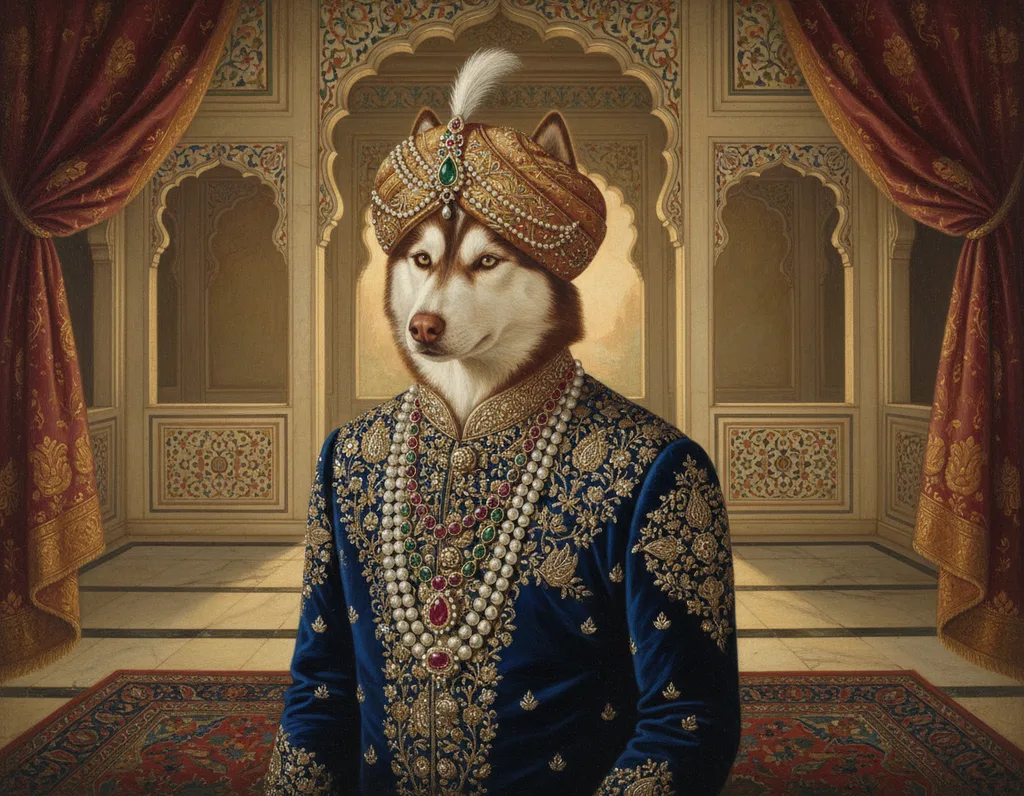
This page is about the royal portraits of the Deccan, the high plateau of south central India. From the late 1500s, Muslim sultans ruled kingdoms there with their own courts and their own painters. Here you will find how the rulers of Ahmadnagar, Bijapur and Golconda were painted, what their swords, clothes and halos meant, how a Mughal artist portrayed them, how Golconda painters sold royal portraits to Europeans, and how the Nizams of Hyderabad continued the tradition. For how the Deccan fits among India's other royal courts, start at the Indian court painting guide.
The Deccan courts and their painters
India's National Council of Educational Research and Training (NCERT) says the history of Deccan painting can be traced mainly from the late 16th century until the 1680s, when the Mughals conquered the Deccan. The style continued after that, in Hyderabad under the Asafiya dynasty, the family of the Nizams, and at smaller courts in the Nizam's lands.
The Victoria and Albert Museum (V&A) in London says there were five Muslim sultanates in the Deccan at the end of the 16th century. Three of them are known to have produced painting, and little has survived from any of them. NCERT names the three: Bijapur, Golconda and Ahmadnagar. It describes their court painting as rich in colour and dense in composition, with a high round horizon and a gold sky that came from Persian painting.
NCERT points to Persian, Turkish and Mughal influences in Deccan painting, and treats the Deccan as a distinct school. For the Mughal side of this story, our page on Mughal royal portraits shows the pose and symbols the Mughal emperors used, and our article on what Mughal painting is covers the Mughal workshops as a whole.
Ahmadnagar: the earliest royal pictures
NCERT says the earliest known Deccan paintings are in a book of poems that celebrates the reign of Hussain Nizam Shah I of Ahmadnagar, who ruled from 1553 to 1565. The book has 12 paintings. NCERT says most of the battle scenes are of no artistic interest, but it praises the pictures of the queen and her marriage for their colour and line. One page, dated 1565 to 1569, shows the king sitting on his throne. It belongs to the Bharata Itihasa Samshodaka Mandala in Pune.
The men in these pictures wear a long coat called a jama, with pointed ends, and a small turban. NCERT calls this men's dress northern, and says the pointed jama probably began in the area between Delhi and Ahmedabad.
Malik Ambar, painted from life
One portrait of an Ahmadnagar ruler shows a man who was born far from India. The V&A says Malik Ambar was born in Ethiopia in 1548 with the name Chapu and was sold into slavery. A leading member of the Nizam Shahi court of Ahmadnagar bought him. He became a soldier, then a commander of the army, and led it against the Mughal emperor Akbar. By 1600 he was regent, and he ruled Ahmadnagar in practice until his death in 1626.
The Mughal artist Hashim painted him around 1622. The V&A thinks Hashim travelled with an envoy of the Mughal prince Shah Jahan, who had rebelled against his father and was looking for allies in the Deccan, and painted Malik Ambar after seeing him in person. Malik Ambar stands facing right on a plain light green ground. He wears layers of fine white muslin, mauve trousers and red shoes, and holds a Deccan sword in a red scabbard. The Persian inscription reads "Likeness of [Malik] Anbar, the work of Hashim." The painted figure measures 19.5 by 11.7 centimetres.
Bijapur: Ibrahim Adil Shah II and his painters
NCERT says painting at Bijapur was supported by Ali Adil Shah I, who ruled from 1558 to 1580, and by his successor Ibrahim II, who ruled from 1580 to 1627. Ibrahim was an expert in Indian music and wrote a book on it, the Nauras-nama. He owned an illustrated encyclopaedia called the Nujum al-Ulum, dated 1570, which has 876 small paintings. The V&A calls Ibrahim Adil Shah the most outstanding patron of painting in the Deccan.
Two portraits of Ibrahim show how his painters saw him. NCERT lists Sultan Adil Shah II Playing the Tambura, painted by Farrukh Beg in Bijapur between 1595 and 1600, now in the National Museum in Prague. The tambura is a string instrument. The second portrait, which NCERT places at the Institute of the Peoples of Asia in Leningrad (now St Petersburg), shows Ibrahim hawking. NCERT describes a bright red on the legs and tail of his galloping horse, his flowing robe, a dark forest in olive green, emerald green and cobalt blue, cranes in the background and a sunlit gold and blue sky. A white hawk sits at the centre of the picture, next to the finely painted face of the sultan. NCERT sees Persian influence in the horse and the rocks, and Indian taste in the plants.
The V&A holds a smaller Bijapur painting from around 1600, a horse and its groom on a green field, that it thinks was made at Ibrahim's court. It measures 11.4 by 10.3 centimetres.
What happened to Bijapur's portraits
Bijapur was absorbed into the Mughal empire in 1686. The V&A holds a Bijapur portrait from around 1650 of a Sayyid, a man descended from the Prophet Muhammad, with a grey beard, an orange turban and a staff. An inscription on the back, dated 1691, records that it was then kept in the treasury at Adoni, in the Deccan.
Painters kept portraying Bijapur's royal family after its fall. The V&A holds a painting made in Hyderabad around 1730 of a princess out hunting on horseback. A Persian inscription names her as the daughter of Ali Adil Shah, King of Bijapur. She chases a blackbuck, and one of her ladies carries a hawk on her fist. The princess wears a plume in her turban and the lady does not.
Golconda: from court scenes to single portraits
NCERT says Golconda became an independent state in 1512 and was the richest Deccan kingdom by the end of the 16th century, from trade in iron and cotton goods and, early in the 17th century, from newly found diamonds. Golconda paintings show gold jewellery worn by men and women alike.
The earliest paintings identified as Golconda work are five miniatures bound into a book of poems by Hafiz. NCERT says they show a young ruler seated on a throne, holding a long, straight Deccan sword and wearing a white coat with embroidered bands. A later portrait shows Muhammad Qutb Shah, who ruled from 1611, sitting on a low seat early in his reign in Golconda dress and a tight cap.
A Mughal artist paints a Golconda sultan
Hashim also painted Muhammad Qutb Shah. The V&A says the portrait was probably made while Hashim travelled with Shah Jahan during the Mughal campaigns in the Deccan from 1623. The sultan stands facing left with his face in full profile against a plain green ground. He wears white clothes and a thin muslin shawl edged with gold, a striped turban with an orange band and red velvet shoes. His hands rest on the hilt of a straight sword. Hashim signed his name in gold near the sultan's feet. A black Persian line, probably in Shah Jahan's own hand, reads "A good likeness of Sultan Muhammad Qutb al-Mulk."
Abdullah Qutb Shah on horseback and on his throne
The Cleveland Museum of Art says Abdullah Qutb Shah came to the throne of Golconda at the age of 12. When Shah Jahan invaded the Deccan in 1635, Abdullah kept his throne, but on Mughal terms: he paid tribute and accepted a Mughal agent at his court. Cleveland's portrait from around 1635 shows the young sultan on horseback, in a thin shawl over an embroidered robe, on a horse almost as richly dressed in jewels as he is.
The art historian Marta Becherini, of Columbia University, writes that Golconda became a Mughal protectorate in 1636, and that official portraits of the Golconda sultans and nobles began under Abdullah. She compares his V&A portrait of around 1650 with Hashim's work. Both place the sitter on a plain background and combine a side view of the face and legs with a turned view of the chest. In the V&A portrait, Abdullah stands in profile with one hand on his sword and a dagger in the other, in a green gown and an ochre cloak, against a blue ground, with a halo around his head. NCERT describes another portrait of him, in the National Museum in New Delhi, where he sits on a throne with a sword that stands for his power to rule and a halo around his head.
The nobles were painted in the same way. The V&A holds a portrait of Neknam Khan, who served as commander in chief to Abdullah Qutb Shah and died in 1672.
Portraits for European buyers
Golconda's wealth brought European traders. Becherini writes that the Dutch East India Company opened a trading office in Hyderabad, the Golconda capital, in 1662. During the reign of the last sultan, Abul Hasan Qutb Shah, from 1672 to 1687, painters began to sell sets of royal portraits to European officers and merchants. She writes that hundreds of these portraits reached Europe and are now spread across its museums and libraries.
The sets follow a fixed order. They start with the Mughal emperors and princes, then Mughal officials, then the Golconda family, then the Bijapur family, and end with the kings of Persia. Most figures stand, with the face in profile or turned partway to the viewer, on a single-colour background with a thin row of clouds at the top and grass at the bottom.
Becherini shows that the painters traced their figures from older court portraits. Two portraits of Abdullah Qutb Shah, one in Paris and one in Dresden, match line for line when laid over each other. Portraits of Abul Hasan show his fur wrap and gold coat with a pointed collar, which she links to the Central Asian dress of his dynasty's founders. The Rijksmuseum in Amsterdam holds one such set, the Witsen Album, with 49 miniatures of rulers made in Golconda.
Hyderabad under the Nizams
The V&A tells how the Nizams began. After the death of the emperor Aurangzeb, the Mughal empire began to break apart. In 1724 a noble called Nizam al-Mulk left the Mughal court for the Deccan. Within a year he controlled the whole of the Mughal-ruled Deccan, and the emperor then gave him the title Asaf Jah and the right to rule on his own. The V&A holds a portrait of his son, Nasir Jang, painted in Hyderabad around 1745.
Hyderabad portraits made the ruler's wealth and rank easy to see. A V&A painting of Sikandar Jah, who ruled from 1803 to 1829, shows him giving audience to four ministers around 1810, wearing jewellery with a decorated dagger and sword. The museum calls these emblems of his position. In another Hyderabad painting, Nawab I'tisam al-Mulk rides a decorated elephant, and a Persian inscription above his head names him. The V&A says the shield and the flywhisk carried by his attendants are emblems of royalty.
Hyderabad painters also painted queens of the old sultanates. A V&A painting of around 1750 shows Chand Bibi, whom the museum calls a regent and warrior of Bijapur, kneeling to aim a gun at a deer, with a golden halo that marks her royal status.
How to read a Deccan royal portrait
| What you see | What it tells you | Example in the sources |
|---|---|---|
| A long, straight sword held upright | The sitter's power to rule | Abdullah Qutb Shah at the National Museum, New Delhi |
| Fine white muslin in layers | Rank and family, since painters copied dress with care | Malik Ambar by Hashim |
| A halo around the head | Royal rank | Abdullah Qutb Shah at the V&A; Chand Bibi |
| A plain green or blue ground | Keeps the face and dress easy to read | Muhammad Qutb Shah by Hashim |
| Attendants with a shield and flywhisk | The rider is a ruler | Nawab I'tisam al-Mulk in Hyderabad |
| A name written above the figure | Who the sitter was | The inscriptions on the Hashim portraits |
Golconda painters also painted the Maratha leader Shivaji. Our page on Maratha court portraits follows that story. The Deccan's hawks, horses and elephants have their own page, animals in Indian court painting, and the tracing method the Golconda painters used is explained in how Indian miniature paintings were made.
What this means for a royal portrait of your pet
Purrealism's nine Indian styles take their names from other courts. The Indian Royalty style is a general Indian court look, and the studio examples in the gallery show it on a Siberian Husky, a German Shepherd, a Cavalier King Charles Spaniel and a Corgi and Husky mix. If the plain-ground Deccan portrait appeals to you, choose a photo where your pet stands or sits clear of clutter, with the face and body in sharp focus. The portrait studio takes one photo of up to 5 MB.
Questions and answers
What is Deccan painting?
Deccan painting is the court painting of the Muslim kingdoms of the Deccan plateau in south central India. According to India's National Council of Educational Research and Training (NCERT), its history runs mainly from the late 16th century to the 1680s, when the Mughals conquered the Deccan. NCERT names Bijapur, Golconda and Ahmadnagar as its main centres and says the style continued later at Hyderabad under the Nizams.
How big is a Deccan miniature portrait?
A Deccan miniature portrait is small. The Victoria and Albert Museum measures the painted area of Hashim's portrait of Malik Ambar, made around 1622, at 19.5 by 11.7 centimetres, on an album page 38.6 by 26.5 centimetres. A Bijapur painting of a horse and groom from around 1600, also at the V&A, measures 11.4 by 10.3 centimetres.
Who was Ibrahim Adil Shah 2?
Ibrahim Adil Shah II was the sultan of Bijapur, in the Deccan, who ruled until 1627. NCERT says he was an expert in Indian music, wrote a book on music called the Nauras-nama, and was a leading patron of painting. His court painters showed him playing a stringed instrument and hawking on a galloping horse, with a white hawk at the centre of the scene.
Who was Malik Ambar in history?
Malik Ambar was an Ethiopian-born soldier who became regent of the Deccan kingdom of Ahmadnagar. According to the Victoria and Albert Museum, he was born in 1548, sold into slavery, rose to command the Nizam Shahi army, became regent by 1600 and ruled Ahmadnagar in practice until his death in 1626. The Mughal artist Hashim painted his portrait around 1622.
Who is Abdullah Qutb Shah?
Abdullah Qutb Shah was the sultan of Golconda who came to the throne at the age of 12, according to the Cleveland Museum of Art. After Shah Jahan invaded the Deccan, he kept his throne on Mughal terms. Official portraits of Golconda's sultans and nobles began under him, the art historian Marta Becherini writes. A portrait at the Victoria and Albert Museum shows him with a sword, a dagger and a halo.
How many Deccan sultanates were there?
There were five Muslim sultanates in the Deccan at the end of the 16th century, according to the Victoria and Albert Museum. The museum says three of them are known to have produced painting, and that little has survived from any of them. NCERT names those three painting courts as Bijapur, Golconda and Ahmadnagar, each with its own school of court painting.
Who was the first Nizam of Hyderabad?
The first Nizam of Hyderabad was Nizam al-Mulk, a Mughal noble who left for the Deccan in 1724, according to the Victoria and Albert Museum. Within a year he controlled the whole of the Mughal-ruled Deccan, and the Mughal emperor then gave him the title Asaf Jah and the right to rule on his own. The V&A holds a portrait of his son, Nasir Jang, painted in Hyderabad around 1745.
Why do Deccan sultans hold swords in their portraits?
Deccan sultans hold swords in their portraits as a sign of their power to rule. NCERT describes a portrait of Sultan Abdullah Qutb Shah in the National Museum, New Delhi, in which he holds a sword that symbolises his political sovereignty. The Deccan sword was long and straight, and the earliest paintings identified as Golconda work already show a young ruler holding one.
Why were Golconda portraits sold to Europeans?
Golconda portraits were sold to Europeans because Dutch and English traders in the kingdom wanted pictures of India's rulers. The art historian Marta Becherini writes that the Dutch company opened a trading office in Hyderabad in 1662, and that painters there began selling sets of royal portraits to European buyers in the 1670s. Many copies were traced from older court portraits.
Why does Chand Bibi have a halo in a Hyderabad painting?
Chand Bibi has a halo in a Hyderabad painting because the halo marks her royal status. The Victoria and Albert Museum holds the painting, made around 1750, and describes her as a regent and warrior of Bijapur. She kneels and aims a gun at a deer, resting it against a tree, while her ladies follow behind her. The golden halo sets her apart from them.
What happened to the Deccan sultanates?
The Deccan sultanates were taken over by the Mughal empire in the 1680s. The Victoria and Albert Museum says Bijapur's fort was captured and the kingdom absorbed into the Mughal empire in 1686. Golconda's last sultan, Abul Hasan Qutb Shah, ruled until 1687, the art historian Marta Becherini writes. NCERT says the Deccan style of painting continued after the conquest, at Hyderabad under the Nizams.
Sources
- The Deccani Schools of Painting (An Introduction to Indian Art, Part II, chapter 4), National Council of Educational Research and Training (NCERT). Accessed September 28, 2026.
- Malik Ambar, painting by Hashim, c. 1622, Victoria and Albert Museum. Accessed September 28, 2026.
- Sultan Muhammad Qutb Shah of Golconda, painting by Hashim, Victoria and Albert Museum. Accessed September 28, 2026.
- Sultan Abdullah Qutb Shah, painting, Golconda, c. 1650, Victoria and Albert Museum. Accessed September 28, 2026.
- Sultan Abdullah Qutb Shah (1614-74) on Horseback, c. 1635, The Cleveland Museum of Art. Accessed September 28, 2026.
- Painting of a horse and groom, Bijapur, c. 1600, Victoria and Albert Museum. Accessed September 28, 2026.
- Portrait of a Sayyed, painting, Bijapur, c. 1650, Victoria and Albert Museum. Accessed September 28, 2026.
- Princess hunting on horseback, painting, Hyderabad, c. 1730, Victoria and Albert Museum. Accessed September 28, 2026.
- Neknam Khan, painting, Deccan, Victoria and Albert Museum. Accessed September 28, 2026.
- Effigies in Transit: Deccan Portraits in Europe at the Turn of the 18th Century, Journal18 (Marta Becherini, Columbia University). Accessed September 28, 2026.
- The Witsen Album with 49 miniatures of rulers, Rijksmuseum. Accessed September 28, 2026.
- Nawab Sikander Jah, painting, Hyderabad, c. 1810, Victoria and Albert Museum. Accessed September 28, 2026.
- Nasir Jang, painting, Hyderabad, c. 1745, Victoria and Albert Museum. Accessed September 28, 2026.
- Nawab I'tisam al-Mulk, painting, Hyderabad, Victoria and Albert Museum. Accessed September 28, 2026.
- Chand Bibi, painting, Hyderabad, c. 1750, Victoria and Albert Museum. Accessed September 28, 2026.
Short reads on this topic
Articles from Purrspectives that answer one question each.
What is Tanjore painting? Gold foil, gesso and the Thanjavur court
Tanjore painting is a South Indian style from Thanjavur, made on a wooden board with raised gesso, gold foil and glass stones. Where it came from and how it is made.
Indian royal pet portraits: the nine Indian court styles explained
An Indian royal pet portrait dresses your dog or cat as a ruler or warrior from an Indian court. Here are the nine styles and the history behind them.

The Maharajas of Patiala: the history behind Patiala royalty
The Phulkian rulers of Patiala founded their capital in 1763. Who built Qila Mubarak, who Bhupinder Singh was, and how Patiala joined India.