Animals in Indian court painting: elephants, horses, cheetahs and falcons
Elephants, horses, cheetahs, falcons, dogs and cats in Indian royal paintings: how court artists painted them beside rulers, and what each animal showed.
By Purrealism. Part of Indian court painting: how India's royal courts portrayed their rulers.
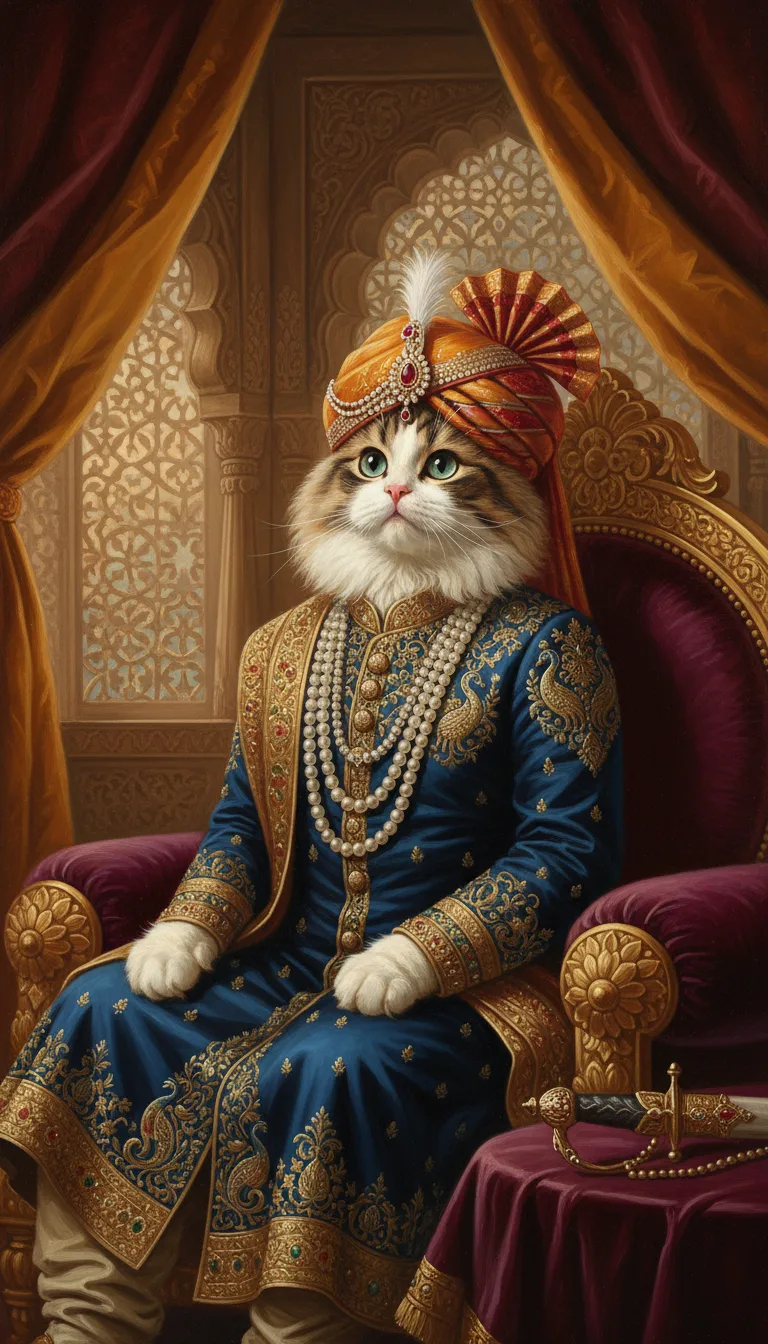
This page looks at the animals that share the picture with India's rulers in court paintings from the 1500s to the 1800s: elephants, horses, cheetahs, falcons, dogs and cats. It explains how painters placed each animal beside a king or prince, and what the animal told a viewer about the man in the picture. For the other signs of royalty in these portraits, start at the Indian court painting guide.
Why rulers were painted with animals
The Cleveland Museum of Art says elephants have been an emblem of royalty in India for more than 3,000 years. The same museum says the Mughal emperors kept portraits of animals, and that patrons in the smaller kingdoms under Mughal rule took up the habit.
The hunt itself had a political purpose. The Victoria and Albert Museum (V&A) in London sums up what Akbar's court historian, Abu'l Fazl, wrote about it. A hunt let the emperor see how his men behaved in danger, so he could place them well in battle. It gave him a reason to arrive without warning in any part of his lands and see for himself whether they were run with justice. It also let him move large numbers of armed men into areas that might rebel, as a silent threat.
Elephants: the royal mount
Akbar and the elephant Hawa'i
The V&A calls Akbar's ride on the elephant Hawa'i one of the most dramatic adventures of his life. The museum holds the two Akbarnama pages, designed by Basawan, that show what happened outside Agra in 1561. The museum says elephant fighting was a favourite sport of the court, and that Akbar chose to ride Hawa'i, known for his difficult character and bad temper, against another royal elephant called Ran Bagha. When Ran Bagha ran, Hawa'i chased him onto a bridge of boats over the Yamuna river. The bridge lurched under the weight, and the people on it dived into the water.
The V&A says the drama comes from the rough water and from the elephant breaking out of the frame of the picture, since facial expressions are rare in Mughal manuscript painting. Onlookers press a finger to their lips, a standard gesture of worry and awe taken from Iranian painting.
Size shows rank
Another Akbarnama page in the V&A shows Akbar crossing the Ganges on an elephant to fight two rebel brothers. The museum says the royal elephant and the emperor are drawn larger than the rest of the group to show their importance. The animals wear gold chains and other jewellery, and Akbar steers his elephant with a gold goad, the hooked rod used to guide an elephant.
Elephants at the Rajput courts
The Rajput courts painted their elephants too. The Cleveland Museum of Art holds Prince Amar Singh Drives His Own Elephant, made in Mewar around 1695. The young prince, in yellow, holds the goad himself. Behind him an attendant holds a flywhisk, a royal emblem, which streams back with the speed of the running elephant.
At Udaipur, the court recorded its elephants one by one. Cleveland's Royal Elephant Ramkali with a Mahout, from around 1761, belongs to a series showing the elephants in the royal stables, each named in the upper margin. A mahout, or elephant driver, steers the female elephant at a brisk trot while her bells swing. India's National Council of Educational Research and Training (NCERT) says Sawai Ishwari Singh of Jaipur, who ruled from 1743 to 1750, had his pastimes painted, including elephant rides and elephant fights.
Horses: the ruler in the saddle
Cleveland's Equestrian Portrait of Maharana Raj Singh II of Mewar, from around 1760, shows the young ruler with the first signs of facial hair. He rides a black stallion through the grass, with fresh flowers tucked into his jewelled turban band and a dagger with a lion's head in his belt. Rain clouds gather, and he signals to his attendants not to be afraid.
A horse could also mark an event. Cleveland's Prince Mathu Singh of Jatoli on a Blue Horse Riding to Udaipur, from around 1720, celebrates a ride that the museum puts at nearly 600 kilometres, from the small state of Jatoli to the Mewar capital. The stallion rears on its hind legs to mark the start of the journey, and a servant waving a flywhisk shows that the rider is royal.
Horses show courage in the hunt as well. A Mughal drawing in Cleveland from around 1600 shows a prince killing a lion with one blow of his sword while his horse lunges toward the animal. The museum calls the lion hunt an ancient display of a king's courage and power, most of all in Iran and the Near East, where the Mughals traced their cultural roots.
Horses were also royal gifts. On a V&A Akbarnama page showing Akbar as the guest of his foster brother Azim Khan at Dipalpur in 1571, attendants bring horses and other gifts, alongside a trained hunting cheetah, a falconer and elephants. Our page on Rajput court portraits covers the Bundi horse that gallops so high the ground disappears. At the Deccan courts, NCERT describes a painting of Sultan Ibrahim Adil Shah II out hawking, with brilliant red on his horse's legs and tail and a white hawk at the centre; our page on Deccan court portraits looks at the Deccan sultans.
Cheetahs: partners in the royal hunt
A V&A Akbarnama page shows the first time Akbar watched wild cheetahs being caught, to be tamed and used for hunting. The museum says Abu'l Fazl called this the most remarkable of all the arts of the hunt in Hindustan. The cats were lured into specially dug pits so they would not be hurt, and in the painting Akbar helps lift one out.
Other pages show the cheetahs at work. In a V&A painting of a hunt in 1572, a cheetah has been released from an empty bullock cart and brings down a grown male blackbuck, an antelope. A second cheetah is still blindfolded and held by its keeper, and Akbar holds the horse he would ride to follow the chase. In a painting of a qamargah, or ring hunt, in the Lahore region, three cheetahs chase blackbuck while keepers prepare to release two more. The V&A says this page includes early work by Mansur, who became one of the greatest Mughal painters.
The ring hunt was a royal privilege. The V&A explains that beaters spread out over a huge area and then moved inward, trapping the animals in a circle. Hunting them was the emperor's right, and the leading men of the court joined only when he invited them. In the V&A's painting of such a hunt at Palam, near Delhi, Akbar's rank shows in his central place, his turban plume and jewels, and the wrapped weapons carried by his servants.
A cheetah could also carry a second meaning. The Cleveland Museum of Art holds an antelope and deer hunt from around 1602 to 1604, made for Prince Salim, the future Jahangir, while he held his own court at Allahabad in defiance of his father. A cheetah in a red collar catches a blackbuck. The museum says the image of a cheetah catching a blackbuck was repeated often, and that here it echoes Salim's wish to take the throne from Akbar.
Falcons on the wrist
A falcon points to one of the favourite sports of the court. The Cleveland Museum of Art says falconry, hunting small game with a bird of prey, was popular among the highest ranks of Mughal royalty. It adds that falcons were prized members of royal hunts, and that a painting of a lone falcon on a perch, made at Amber in Rajasthan around 1610, may be a portrait of a favourite bird or of a gift from an ally.
A falcon could also be a gift within the royal family. Cleveland's Akbar and Jahangir Examine a Ghir Falcon while Prince Khusrau Stands Behind, from around 1602 to 1604, shows an aged Akbar under a canopy examining a trained falcon. The museum says the bird seems to be a gift from his son, Prince Salim, who stands before him. A black antelope, a wild animal kept as a pet, wears a harness and a bell at the foot of the steps.
In some later portraits the falcon wears jewels too. In a posthumous portrait of the emperor Muhammad Shah, who ruled from 1719 to 1748, painted in 1764 against a black background, his hunting falcon wears a ruby necklace. In Cleveland's Maharana Jawan Singh of Mewar Holding a Falcon, from around 1835, the ruler looks his bird straight in the eye. The falcon wears a gold plumed cap and a gold necklace, and the museum lists pearls and silk among the materials of the painting.
Hounds and other dogs
In one Rajput hunting scene, dogs work as helpers. Cleveland's Maharana Jagat Singh II Hunting, painted at Udaipur in 1747, is a large picture, 42.5 by 47 cm. The museum says Rajput hunting scenes were often larger than other Indian paintings. Servants set off firecrackers to drive tigers, bears, wild boar, deer and antelope toward the shooting box where the royal party waits. A second group of servants, with dogs, comes from the other side to cut off the animals' escape. An inscription on the back names the ruler, his brother and the others in the hunting party.
A different kind of dog picture comes from Lucknow. Cleveland's Dog Walker, painted at Lucknow in the early 1830s for a buyer linked to the British East India Company, shows an Indian servant trying to follow the British habit of walking dogs on a lead. For the dogs the emperors kept, read royal dogs in history.
Cats in stories and music
Cats appear in court painting in stories and in pictures of music. A Tuti-nama, or Tales of a Parrot, made at the Mughal court around 1560 and now in Cleveland, tells of a cat who served a lion as magistrate of his court, guarding against mice. The cat's son killed every mouse, and the lion, who no longer needed a cat, dismissed the father from his post.
Cleveland's Patamanjari Ragini of Dipak, a Pahari painting from around 1740 to 1750, belongs to a ragamala, a set of paintings of musical moods. The museum says the poem behind it describes a lovesick girl playing with a cat to pass the time, and that performances of this melody are based on the sound of a cat's voice.
Reading the animals in a royal painting
| Animal | What it shows in these paintings | Example in this guide |
|---|---|---|
| Elephant | Royalty; the royal elephant is drawn larger than the rest | Akbar crossing the Ganges (V&A) |
| Horse | A ruler riding out, on a journey or at the hunt | Raj Singh II on a black stallion (Cleveland) |
| Cheetah | A royal hunt, led by the emperor | Akbar's blackbuck hunt of 1572 (V&A) |
| Falcon | A favourite sport of the highest ranks; a gift within the family | Jawan Singh with his falcon (Cleveland) |
| Dog | Helpers in a large hunt | Jagat Singh II's hunt of 1747 (Cleveland) |
| Cat | Stories and music | Patamanjari Ragini (Cleveland) |
The teams who painted these animals worked in stages, and animal painting could be a specialist's job. Our page on how Indian miniature portraits were made explains who did what.
Your pet in the ruler's place
In a Purrealism portrait, your pet becomes the ruler. In the gallery, the Maharaja portrait shows a golden retriever in a red jewelled turban, seated on a gold throne. The studio examples include a cat in the same Maharaja style. If you are choosing among the nine Indian styles, the style finder further down this page asks a few questions about your pet and suggests one. When you are ready, the portrait studio takes one clear photo of up to 5 MB.
Try it
Indian style finder
Answer four questions about your pet. The finder suggests one of the Indian court styles and shows a portrait painted in it.
Answer all four questions to see your suggestion.
Questions and answers
Why do elephants appear in Indian royal paintings?
Elephants appear in Indian royal paintings because they were a sign of kingship. The Cleveland Museum of Art says elephants have been a potent emblem of royalty in India for more than 3,000 years. In the Victoria and Albert Museum's Akbarnama, a page of Akbar crossing the Ganges draws the royal elephant and the emperor larger than the rest of the group, and decorates the animals with gold chains.
What happened when Akbar rode the elephant Hawa'i?
Akbar rode the elephant Hawa'i against another royal elephant, Ran Bagha, outside Agra in 1561, and chased it across a bridge of boats on the Yamuna. The Victoria and Albert Museum holds the two Akbarnama pages that show the event, designed by Basawan. The museum says Hawa'i was known for his bad temper, and that servants on the bridge jumped into the river to escape.
How did the Mughals catch cheetahs for hunting?
The Mughals caught wild cheetahs by luring them into specially dug pits, so that the animals were not hurt, and then tamed them for the hunt. The Victoria and Albert Museum holds an Akbarnama page showing the first time Akbar watched this, in which he helps lift a cheetah out of a pit. The museum says Abu'l Fazl called cheetah capture the most remarkable of all the arts of hunting in Hindustan.
How were cheetahs used in Akbar's hunts?
Cheetahs in Akbar's hunts were carried to the hunting ground and released to chase blackbuck, a kind of antelope. The Victoria and Albert Museum holds an Akbarnama page of a hunt in 1572 in which one cheetah has been let out of an empty bullock cart and brings down a grown male blackbuck. A second cheetah is still blindfolded and held by its keeper, while Akbar holds his horse ready to follow.
What is a qamargah hunt in Mughal painting?
A qamargah is a Mughal ring hunt, in which beaters spread out over a huge area and then moved inward, trapping the animals inside a circle for the emperor to hunt. The Victoria and Albert Museum says it was a Timurid way of hunting, and that the elite of the court could join only at the emperor's invitation. Its Akbarnama pages of a qamargah in the Lahore region include early work by the painter Mansur.
Why did Mughal emperors go hunting?
Mughal emperors went hunting for reasons of state as well as sport. The Victoria and Albert Museum says the court historian Abu'l Fazl gave several purposes: the hunt let Akbar see how his men behaved under danger, arrive without warning to check that his lands were run with justice, and move armed men into restless areas as a silent threat. Hunting scenes in the Akbarnama record these royal hunts.
Why are Indian rulers painted holding falcons?
Indian rulers are painted holding falcons because falconry, hunting small game with a trained bird, was a sport of the highest ranks at court. The Cleveland Museum of Art says this about a Pahari falcon painting from around 1770. Its portrait of Maharana Jawan Singh of Mewar, from around 1835, shows the ruler looking his falcon in the eye, and the bird wears a gold plumed cap and a gold necklace.
Which painting shows Akbar and Jahangir with a falcon?
Akbar and Jahangir Examine a Ghir Falcon while Prince Khusrau Stands Behind, painted around 1602 to 1604, shows the two with a trained hunting falcon. The Cleveland Museum of Art, which owns it, says the aged Akbar examines a falcon that seems to be a gift from his son, Prince Salim, the future Jahangir. A black antelope, a wild animal kept as a pet, wears a harness and a bell by the steps.
Why did the Udaipur court paint its elephants one by one?
The Udaipur court painted its elephants one by one as a series recording the animals in the royal stables, with each elephant's name written in the upper margin. The Cleveland Museum of Art holds one page, Royal Elephant Ramkali with a Mahout, from around 1761, when Ari Singh ruled Mewar. The mahout, or elephant driver, steers the female elephant at a brisk trot with her bells swinging.
Do dogs appear in Rajput hunting paintings?
Dogs do appear in Rajput hunting paintings, for example as helpers who drive the game. The Cleveland Museum of Art holds Maharana Jagat Singh II Hunting, painted at Udaipur in 1747. Servants with firecrackers drive tigers, bears, boar and deer toward the royal shooting box, while another group of servants with dogs closes the animals' way of escape. An inscription on the back names the members of the hunting party.
Which Indian painting links a melody to a cat's voice?
Patamanjari Ragini of Dipak, a Pahari painting from around 1740 to 1750, links a melody to a cat's voice. The Cleveland Museum of Art says the poem behind it describes a lovesick girl who plays with a cat to pass the time. The museum says musical performances of Patamanjari Ragini are based on the sound of a cat's voice, and express the girl's longing for her lover.
Which Mewar painting shows a prince on a blue horse?
Prince Mathu Singh of Jatoli on a Blue Horse Riding to Udaipur, painted around 1720, shows a prince on a rearing blue stallion. The Cleveland Museum of Art says it marks a journey of nearly 600 kilometres from the small state of Jatoli to Udaipur, capital of Mewar. The rearing horse marks the start of the ride, and a servant waving a flywhisk shows that the rider is royal.
Sources
- Akbar riding the elephant Hawa'i, Akbarnama, painting by Basawan and Chetar, c. 1590 to 1595, Victoria and Albert Museum. Accessed September 28, 2026.
- Akbar crossing the Ganges on an elephant, Akbarnama, painting by Ikhlas and Madhav, c. 1590 to 1595, Victoria and Albert Museum. Accessed September 28, 2026.
- Akbar assists in capturing a cheetah, Akbarnama, painting by Tulsi and Narayan, c. 1590 to 1595, Victoria and Albert Museum. Accessed September 28, 2026.
- Akbar hunting blackbuck with cheetahs, Akbarnama, painting by La'l and Sanwala, c. 1590 to 1595, Victoria and Albert Museum. Accessed September 28, 2026.
- Akbar hunting in a qamargah, Akbarnama, painting by Miskina and Mansur, c. 1590 to 1595, Victoria and Albert Museum. Accessed September 28, 2026.
- Akbar hunting at Palam, near Delhi, Akbarnama, painting by Mukund and Manohar, c. 1590 to 1595, Victoria and Albert Museum. Accessed September 28, 2026.
- Akbar and Azim Khan at Dipalpur, Akbarnama, painting by Jagan and Asir, c. 1590 to 1595, Victoria and Albert Museum. Accessed September 28, 2026.
- Royal Elephant Ramkali with a Mahout, c. 1761, Cleveland Museum of Art. Accessed September 28, 2026.
- Prince Amar Singh (1672 to 1710) Drives His Own Elephant, c. 1695, Cleveland Museum of Art. Accessed September 28, 2026.
- Equestrian Portrait of Maharana Raj Singh II of Mewar (r. 1755 to 1762), c. 1760, Cleveland Museum of Art. Accessed September 28, 2026.
- Prince Mathu Singh of Jatoli on a Blue Horse Riding to Udaipur, c. 1720, Cleveland Museum of Art. Accessed September 28, 2026.
- A Mounted Prince Hunting Lion in a Rocky Landscape, c. 1600, Cleveland Museum of Art. Accessed September 28, 2026.
- Antelope and deer hunt, c. 1602 to 1604, Cleveland Museum of Art. Accessed September 28, 2026.
- Akbar and Jahangir Examine a Ghir Falcon while Prince Khusrau Stands Behind, c. 1602 to 1604, Cleveland Museum of Art. Accessed September 28, 2026.
- Maharana Jawan Singh of Mewar (r. 1828 to 1838) Holding a Falcon, c. 1835, Cleveland Museum of Art. Accessed September 28, 2026.
- Posthumous portrait of the Mughal emperor Muhammad Shah holding a falcon, 1764, Cleveland Museum of Art. Accessed September 28, 2026.
- Falcon on a Perch, c. 1610, Cleveland Museum of Art. Accessed September 28, 2026.
- Falcon, c. 1770, Cleveland Museum of Art. Accessed September 28, 2026.
- Maharana Jagat Singh II Hunting, 1747, Cleveland Museum of Art. Accessed September 28, 2026.
- Dog Walker, early 1830s, Cleveland Museum of Art. Accessed September 28, 2026.
- Patamanjari Ragini of Dipak, from a Ragamala, c. 1740 to 1750, Cleveland Museum of Art. Accessed September 28, 2026.
- The cat attacks the mice which disturb the lion, from a Tuti-nama (Tales of a Parrot), c. 1560, Cleveland Museum of Art. Accessed September 28, 2026.
- The Rajasthani Schools of Painting (An Introduction to Indian Art, Part II, chapter 2), National Council of Educational Research and Training (NCERT). Accessed September 28, 2026.
- The Deccani Schools of Painting (An Introduction to Indian Art, Part II, chapter 4), National Council of Educational Research and Training (NCERT). Accessed September 28, 2026.
Short reads on this topic
Articles from Purrspectives that answer one question each.
What is Tanjore painting? Gold foil, gesso and the Thanjavur court
Tanjore painting is a South Indian style from Thanjavur, made on a wooden board with raised gesso, gold foil and glass stones. Where it came from and how it is made.
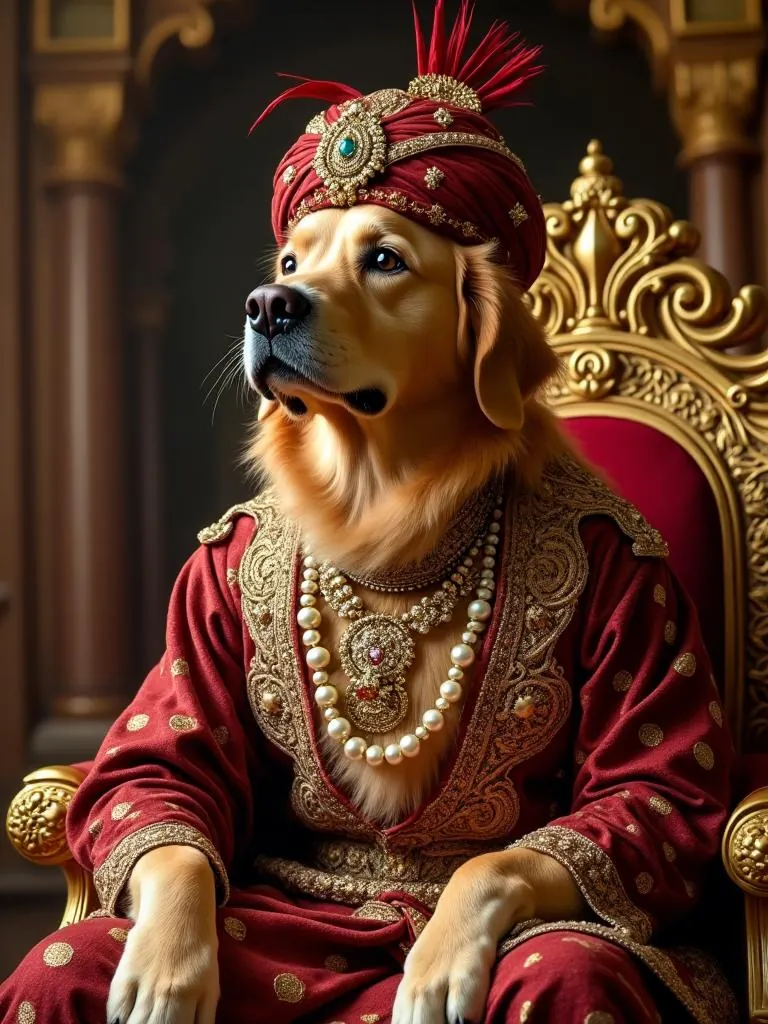
Indian royal pet portraits: the nine Indian court styles explained
An Indian royal pet portrait dresses your dog or cat as a ruler or warrior from an Indian court. Here are the nine styles and the history behind them.
The Maharajas of Patiala: the history behind Patiala royalty
The Phulkian rulers of Patiala founded their capital in 1763. Who built Qila Mubarak, who Bhupinder Singh was, and how Patiala joined India.