How Indian miniature portraits were made: paper, colours, gold and brushes
Indian court portraits were painted on polished handmade paper with ground minerals, gold and squirrel-hair brushes, often by a team with a face specialist.
By Purrealism. Part of Indian court painting: how India's royal courts portrayed their rulers.
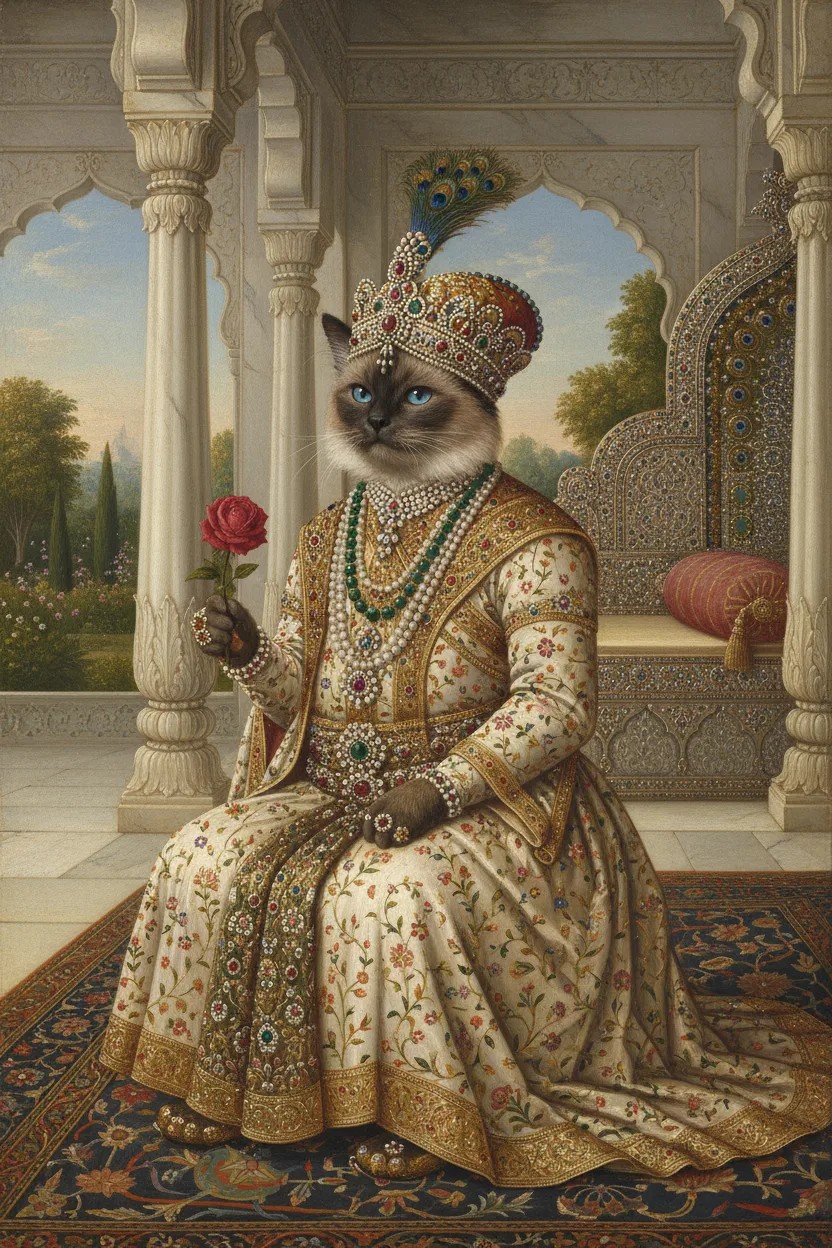
This page follows one royal portrait from a blank sheet to a finished page, as it was made at the Indian courts between the 1500s and the 1800s. It covers how the paper was prepared, how the drawing was laid down and copied, where each colour came from, how gold went on, which brushes were used, and how a team of artists shared the work, with one specialist often painting only the faces. For the story of the Mughal workshops and the emperors who paid for them, read what is Mughal painting. For how these methods served each royal court, start at the Indian court painting guide.
A picture made to be held in the hand
India's National Council of Educational Research and Training (NCERT) explains the word "miniature". Paintings from this period earned the name because they are small. People held them in the hand and looked at them from close by, because of their fine detail. The walls of a patron's house were decorated with separate wall paintings, and NCERT says the miniatures were never meant to hang on a wall.
The rules behind the work are older than any of the courts. NCERT points to the Chitrasutra, a chapter of the Vishnudharmottara Purana, a text from the 5th century. It deals with tools, materials, proportion and the use of brush and colour. It names the "limbs" of painting, among them pramana (measurement and proportion) and sadrishya (resemblance, the likeness between a picture and its subject). NCERT says artists read and followed these rules for centuries.
Preparing the paper
Paper came to India late. An essay by Alanna M. Benham, written for Brown University Library's collection of Persian, Mughal and Indian miniatures, says it probably arrived in the late 14th century. Before that, Indian Buddhist texts were written on strips of palm leaf. The essay lists three kinds of paper in common use in India: bansaha, made from crushed bamboo; tatha, made from jute; and tulat, made from cotton, which was always bleached first. Waste rag, linen and silk from weaving were used too.
A painter needed a smooth surface, and apprentices often did this work. They laid each sheet on a plank of smoothed chestnut wood and rubbed it again and again with an egg-shaped stone of crystal or agate. The essay says the paper became as shiny as glass and less absorbent, so the paint did not run or spread across it. Painters also coated the sheet with a thin wash called a size, which helped the brush make a smooth line. Iranian paper makers used egg white. Indian makers preferred a starch made from rice water.
Thickness was built up by hand. In its chapter on the Rajasthani schools, NCERT describes wasli: several thin sheets of handmade paper glued together until the sheet was thick enough to paint on. At the Mughal court, NCERT says, paper was made specially for painting. For a book, sheets were cut to size, a space was left for the picture, and the page was ruled and written first. Only then did it go to the artist.
Laying down the drawing
The first lines were made with cheap colours. The Brown essay says red ochre, a pigment made from iron oxide, was easy to get, low in cost, and often used for the first sketch. Black came from soot collected from burning bone, oil or wood, and was used for sketches and the drawing under the paint. Twigs were burned to make sticks of charcoal for drawing. White, made from lead white, zinc white or chalk, was brushed over the paper as a first coat before the colours.
NCERT describes the order on a Rajasthani painting. The painter drew the outline on the wasli in black or brown. Then the colour for each area was fixed with short written labels or small sample patches.
Some drawings were studies for a later painting. The Cleveland Museum of Art holds a drawing from around 1600 of a Mughal prince on horseback killing a lion with one blow of his sword. The museum says it may have been a study for a full-colour painting, and that the areas left white around the main figures show the artist working out where everything should go.
Copying a drawing by pouncing
Court workshops copied good drawings again and again. The Brown essay says pouncing was the method used most often, and describes it step by step:
- A student was given a master drawing and a sheet of thin, transparent vellum, which is prepared animal skin.
- He pricked holes with a fine needle along the main lines of the drawing.
- The pricked vellum was fixed to a sheet of paper on a wooden board, and he dusted it from a small bag of charcoal powder.
- The powder passed through the holes and left dotted lines on the paper. It had no binder, so it brushed off easily.
- The student joined the dots in light red ochre, and the master corrected any errors in permanent black or red ochre ink.
Painters kept the pricked sheets as valued records of designs that had worked. The Victoria and Albert Museum (V&A) in London holds one from Marwar in Rajasthan, made around 1700: a brush drawing of a Rajput prince, 180 by 99 mm, pricked for use as a pinhole stencil. Our page on Rajput court portraits shows how Jaipur copied its rulers' portraits the same way, and our page on Mughal royal portraits shows one courtier's portrait copied at the same size into a court scene.
Where the colours came from
Every pigment had to be prepared before use. The Brown essay gives three steps: grind the pigment to a fine powder with a mortar and pestle, wash it several times to remove dirt, then mix it with a binder. The binder made the paint flow, let it mix with water, and held it to the paper once the water had dried. Gum arabic was the most common plant binder for Persian and Indian artists alike. Animal glue was made by boiling buffalo hide, then cooling it and rolling it into balls that could be stored and melted in hot water when needed. NCERT says Rajasthani painters also mixed their colours with glue.
| Colour | What it was made from | Source |
|---|---|---|
| Red | Cinnabar (vermilion); red ochre from iron oxide | NCERT; Brown essay |
| Blue | Lapis lazuli, a costly stone used in small areas; indigo dye | NCERT; Brown essay |
| Yellow | Orpiment, a mineral containing arsenic; yellow ochre from filtered soil | NCERT; Brown essay |
| White | Ground shells; lead white, zinc white, chalk | NCERT; Brown essay |
| Black | Lampblack from charcoal; soot from bone, oil or wood | NCERT; Brown essay |
| Green | Verdigris, from copper filings and vinegar; or yellow mixed with blue | Brown essay |
| Purple | Vermilion mixed with indigo | Brown essay |
Painters mixed these pure colours to get many more shades. White was added to blues and purples to make pale tints.
Green caused the most damage. The Brown essay says verdigris eats into paper. It can flake off, leaving a brown stain that soaks through to the back of the sheet, and in bad cases it makes the paper so brittle that the painted area breaks away. Damp makes it worse. The essay says Indian painters more often mixed a stable yellow with a blue to get green. Green could be a hazard at the Rajput courts as well. The Cleveland Museum of Art calls the plain green background of a Mewar painting from around 1695, Prince Amar Singh driving his own elephant, "a highly corrosive pigment".
On museum labels you will see the finished paint called "opaque watercolour" (the V&A's term) or "gum tempera" (the Cleveland Museum of Art's term).
Gold and silver
Gold was beaten before it was painted. The Brown essay says small pieces of metal were stacked between sheets of soft deerskin, tied into a bundle and pounded with a wooden mallet. To make gold paint, the thin gold was mixed with gum arabic or glue into a paste and washed with clear water. The purest gold sank to the bottom. It was collected and mixed with saffron and dry glue.
Specialists laid the metal leaf. They stuck it down with rice water, which does not stay sticky once dry, or with gum arabic, animal glue or starch paste. Gold marked armour, buildings, metal vessels, the sky, and the flaming halo around the head of a holy figure. Silver showed water and armour. The essay says the silver in miniature paintings has since turned dark black, and that the layer is too thin and fragile for the black to be removed. For gold-flecked borders, workers either dusted gold flakes from a cloth bag onto a sized sheet or flicked gold paint onto it from a loaded brush. NCERT says Mughal painters also mixed gold and silver powder into their colours or sprinkled it on.
Gold also carried meaning. A portrait of a young prince in the V&A's Small Clive Album gives him a yellow halo with an outer band of gold, which the museum says shows his royal birth. The edges of that album page are gilded.
The brushes
NCERT says Mughal brushes were made from the hair of squirrels or kittens, and Rajasthani brushes from camel and squirrel hair. The Brown essay adds detail. Mughal artists favoured the soft fur of a common squirrel, while Persian artists used the hair of a white cat bred for the purpose. Coarser brushes used hair from inside a goat's ear, or plant fibres. The hairs were gathered inside the quill of a pigeon's feather, which was trimmed and fixed to a handle. Brushes came in many thicknesses, and a painter kept one brush for each colour so that the colours stayed clean.
Burnishing the finished page
Agate appears twice in the process. The paper was polished before painting, and the finished painting was polished again. NCERT says that once a Mughal painting was complete, it was rubbed with agate, a gemstone, to set the colours and give the picture its glow. For the Rajasthani courts, NCERT says the agate gave the surface an even shine.
The V&A holds a set of agate burnishers made in India around 1850, the longest 86.4 mm. They came from the India Museum in London and passed in 1879 to the South Kensington Museum, which later became the V&A. The museum says stone burnishers like these are used in bookbinding, watercolour painting and enamelling, and are especially useful when laying gold leaf onto leather or paper.
A team of specialists
NCERT names three stages in a Mughal painting: tarh, the composition; chiharanama, the portraits; and rangamizi, the colouring. The work was usually shared. NCERT says the first drawing, the grinding and filling in of colour and the fine details were divided among a group, although one artist could also make a whole painting alone. Records show that artists received rewards and pay rises according to the work they did.
The V&A's copy of the Akbarnama, the official history of Akbar's reign, shows this system by name. The court historian Abu'l Fazl wrote the text between 1590 and 1596, and at least 49 artists from Akbar's studio painted the pictures while he wrote. Under each picture, a librarian of the time wrote in red ink, in Persian, who did what.
- Akbar at the shrine at Ajmer in 1562. Composition by Basawan, painting by Ikhlas, faces by Nanha. The V&A says Nanha painted the faces of the most important figures, which probably includes the emperor.
- Akbar greeting Rajput rulers and nobles, probably in 1577. Composition by Miskin, painting by Sarwan, "faces and eight portraits" by Madhav.
- Adham Khan thrown from the palace walls at Agra in 1562. Miskin designed the picture and painted the faces himself. Shankar painted the rest.
- Celebrations after the birth of Akbar's son Murad in 1570. Bhura designed and painted the picture. The portraits are by Basawan, whom the V&A calls the more famous of the two.
The V&A says Abu'l Fazl listed many of the leading court artists in the A'in-i Akbari, the third volume of his history. Some of those names appear under these pictures, which shows that this was a royal copy made for Akbar himself.
The Rajput courts worked the same way. NCERT says the master artist planned the picture and made the first drawings. Pupils or experts in colour, portraits, buildings, landscape or animals then painted their parts, and the master added the final touches. A scribe wrote the verse in a space left for it. Our page on animals in Indian court painting looks at the horses, elephants and cheetahs those animal specialists painted.
What unfinished paintings show
An unfinished painting stops partway through the process. The V&A holds one from Kota, made around 1830. It shows Maharao Ram Singh II, ruler of Kota from 1822 to 1866, riding an elephant in a procession, with attendants holding a ceremonial umbrella and fans of peacock feathers over him. The museum lists it as a brush drawing in ink and watercolour, unfinished and fragmentary.
How big were the paintings?
Most were small. The V&A's Akbarnama page of Akbar at Ajmer measures 32.8 by 20.1 cm. The young prince in the Small Clive Album is 17 by 8.6 cm without his borders, on a page of 35.5 by 23.5 cm. The Cleveland lion hunt drawing is on a page of 33 by 22.2 cm. The Kota procession drawing measures 22.8 by 44 cm.
From the workshop to a portrait of your pet
The Mughal Emperor style on Purrealism takes its name from the rulers these workshops painted. In the gallery, the Mughal Emperor portrait shows a grey cat wearing a jewelled crown and pearls, and the studio examples include a Siamese cat in the same style. A Purrealism portrait comes as a digital download or as an art print on matte or glossy paper. The smallest print, 8 × 10 inches, is 20.3 cm wide, against 20.1 cm for the Akbarnama page at Ajmer. The largest, 24 × 36 inches, is 61 by 91.4 cm. For how a modern art print is made and kept, see the art prints and paper guide.
In the Akbarnama, the faces went to a specialist, and the face is also the part of your photo to check first. Choose one where your pet's eyes, nose and markings are sharp and well lit. The portrait studio takes one photo of up to 5 MB.
Questions and answers
Why are Indian court paintings called miniatures?
Indian court paintings are called miniatures because of their small size. India's National Council of Educational Research and Training (NCERT) says these paintings were held in the hand and looked at from close by, because of their fine detail. NCERT adds that the walls of a patron's house were decorated with separate wall paintings, and that the miniatures were never meant to hang on a wall.
What is wasli paper?
Wasli is the paper that Rajasthani court painters worked on, made from several thin sheets of handmade paper glued together until the sheet was thick enough. India's National Council of Educational Research and Training (NCERT) describes wasli in its chapter on the Rajasthani schools. The painter drew the outline on the wasli in black or brown ink, then marked the planned colours with short labels or small test patches before painting.
How was paper polished before a miniature was painted?
Paper for a miniature was polished by rubbing it again and again with a smooth, egg-shaped stone of crystal or agate. An essay by Alanna M. Benham for Brown University Library says apprentices laid each sheet on a plank of smoothed chestnut wood to do this. The rubbing left the surface shiny as glass and less absorbent, so the paint did not run. Indian paper makers also coated the sheet with rice water starch.
What is pouncing in Indian miniature painting?
Pouncing is a way of copying a drawing by pricking tiny holes along its main lines and dusting charcoal powder through them onto a fresh sheet. An essay by Alanna M. Benham for Brown University Library says a student then joined the dots in light red ochre and the master corrected them. The Victoria and Albert Museum holds a Rajput prince drawn in Marwar around 1700 that is pricked for use as a stencil.
Who painted the faces in Akbarnama paintings?
Faces in the Akbarnama paintings were often painted by a specialist whose name was written under the picture. The Victoria and Albert Museum holds a page showing Akbar at the shrine at Ajmer in 1562, designed by Basawan and painted by Ikhlas, with the faces of the main figures by Nanha. On another V&A page, the red ink label credits Madhav with the faces and eight portraits.
What do tarh, amal and chehra nami mean on Mughal paintings?
Tarh, amal and chehra nami are Persian words in the labels under Mughal paintings that name who did each stage. The Victoria and Albert Museum translates tarh as composition, amal as the work of painting, and chehra nami as faces or portraits. On one Akbarnama page the label reads Tarh Basawan, amal Ikhlas, chehreh nami Nanha, so three artists shared that single picture.
How many artists worked on the Akbarnama?
At least 49 artists from Akbar's studio worked on the Victoria and Albert Museum's copy of the Akbarnama, the official history of his reign. The V&A says the court historian Abu'l Fazl wrote the text between 1590 and 1596, and the pictures were painted while he wrote. Librarians of the time wrote the artists' names in red ink under the pictures, and some of those names appear in Abu'l Fazl's own list of leading painters.
What was used to make paint stick in Indian miniature paintings?
Indian miniature painters mixed their ground colours with gum arabic or animal glue so the paint would flow and then hold to the paper. An essay by Alanna M. Benham for Brown University Library calls gum arabic the most common plant binder used by Persian and Indian artists alike. Animal glue was made by boiling buffalo hide, then cooling it into balls that could be stored and melted in hot water.
How was gold paint made for Mughal miniatures?
Gold paint for Mughal miniatures was made from gold leaf that had been beaten thin, mixed with gum or glue, washed, and mixed again with saffron and dry glue. An essay by Alanna M. Benham for Brown University Library describes the method and says the gold leaf was beaten between sheets of deerskin with a wooden mallet. The purest gold settled at the bottom of the wash water and was collected.
Which green paint damages old Indian miniature paintings?
Verdigris, a green made from copper filings mixed with vinegar, damages old miniature paintings because it eats into the paper. An essay by Alanna M. Benham for Brown University Library says it can flake off, leave a brown stain that soaks through the sheet, and in bad cases make the paper so brittle that it breaks away. The essay says Indian painters more often mixed yellow and blue to make green.
What brushes did Mughal painters use?
Mughal painters used fine brushes made from the downy fur of a common squirrel, according to an essay by Alanna M. Benham for Brown University Library. The hairs were gathered inside the quill of a pigeon's feather, which was fixed to a handle. India's National Council of Educational Research and Training (NCERT) adds kitten hair, and names camel and squirrel hair for Rajasthani brushes. Painters generally kept one brush for each colour.
Why do some Indian miniature paintings look unfinished?
Some Indian miniature paintings look unfinished because they were never completed, and they show the stages of the work. The Victoria and Albert Museum holds an unfinished brush drawing from Kota, made around 1830, of Maharao Ram Singh II riding an elephant in a procession. The Cleveland Museum of Art holds a drawing of a Mughal prince fighting a lion, around 1600, that may have been a study for a full-colour painting.
Sources
- The Mughal School of Miniature Painting (An Introduction to Indian Art, Part II, chapter 3), National Council of Educational Research and Training (NCERT). Accessed September 28, 2026.
- The Rajasthani Schools of Painting (An Introduction to Indian Art, Part II, chapter 2), National Council of Educational Research and Training (NCERT). Accessed September 28, 2026.
- The Manuscript Painting Tradition (An Introduction to Indian Art, Part II, chapter 1), National Council of Educational Research and Training (NCERT). Accessed September 28, 2026.
- The Production of Miniature Painting, by Alanna M. Benham (The Minassian Collection of Persian, Mughal, and Indian Miniature Paintings), Brown University Library, Center for Digital Scholarship. Accessed September 28, 2026.
- Akbar at the shrine of Mu'in ad-Din Chishti, Akbarnama, painting by Basawan, Ikhlas and Nanha, c. 1590 to 1595, Victoria and Albert Museum. Accessed September 28, 2026.
- Akbar greeting Rajput rulers and nobles, Akbarnama, painting by Miskin, Sarwan and Madhav, c. 1590 to 1595, Victoria and Albert Museum. Accessed September 28, 2026.
- Adham Khan, Akbarnama, painting by Miskin and Shankar, c. 1590 to 1595, Victoria and Albert Museum. Accessed September 28, 2026.
- Celebrations at Fathpur on the birth of Murad, Akbarnama, painting by Bhura and Basawan, c. 1590 to 1595, Victoria and Albert Museum. Accessed September 28, 2026.
- Brush drawing of a Rajput prince, pricked for pouncing, Marwar, c. 1700, Victoria and Albert Museum. Accessed September 28, 2026.
- Burnishers, agate, India, c. 1850, Victoria and Albert Museum. Accessed September 28, 2026.
- Portrait of a young prince, Small Clive Album, 17th or 18th century, Victoria and Albert Museum. Accessed September 28, 2026.
- Maharao Ram Singh II, unfinished brush drawing, Kota, c. 1830, Victoria and Albert Museum. Accessed September 28, 2026.
- A Mounted Prince Hunting Lion in a Rocky Landscape, c. 1600, Cleveland Museum of Art. Accessed September 28, 2026.
- Prince Amar Singh (1672 to 1710) Drives His Own Elephant, c. 1695, Cleveland Museum of Art. Accessed September 28, 2026.
Short reads on this topic
Articles from Purrspectives that answer one question each.
What is Tanjore painting? Gold foil, gesso and the Thanjavur court
Tanjore painting is a South Indian style from Thanjavur, made on a wooden board with raised gesso, gold foil and glass stones. Where it came from and how it is made.
Indian royal pet portraits: the nine Indian court styles explained
An Indian royal pet portrait dresses your dog or cat as a ruler or warrior from an Indian court. Here are the nine styles and the history behind them.
The Maharajas of Patiala: the history behind Patiala royalty
The Phulkian rulers of Patiala founded their capital in 1763. Who built Qila Mubarak, who Bhupinder Singh was, and how Patiala joined India.