Mughal royal portraits: how the emperors and their courts were painted
Mughal emperors were painted in strict profile with halos, jewels and parasols. How court artists made these portraits, and what each royal symbol meant.
By Purrealism. Part of Indian court painting: how India's royal courts portrayed their rulers.
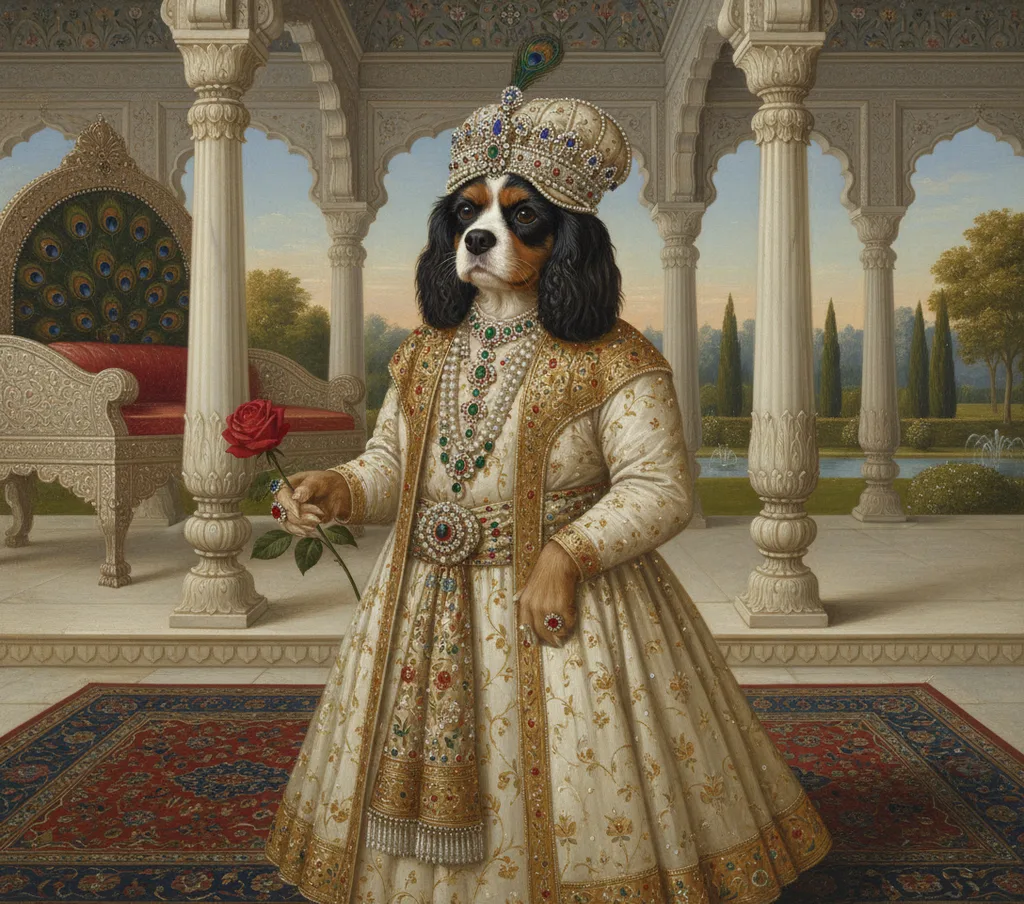
This page looks closely at one kind of Mughal painting: the royal portrait. It explains the pose the emperors were painted in, the signs that told a viewer "this is a king", how one portrait was reused in other pictures, and why some faces were painted over years later. For the wider story of the Mughal workshops and their animal studies, read what is Mughal painting. For how the Mughal court fits among India's other royal courts, start at the Indian court painting guide.
How portrait painting grew at the Mughal court
The Mughal emperors cared about faces from the start. India's National Council of Educational Research and Training (NCERT) says Babur, the first Mughal emperor, had a keen eye for portraits and wrote about painters in his memoirs. He wrote about the Persian master Bihzad of Herat in detail. Babur said that Bihzad's work was dainty and that he drew bearded faces admirably, but that he did not draw other faces well and greatly lengthened the double chin.
Under Babur's son Humayun, the court produced Princes of the House of Timur, painted between 1545 and 1550 in opaque watercolour on cotton. NCERT says it is probably by the Persian artist Abd us Samad and shows members of the family outdoors among trees and blossoms. Later artists painted new faces over the old ones, so that Akbar, Jahangir and Shah Jahan all appear in a picture begun during Humayun's reign.
The Victoria and Albert Museum (V&A) in London says the practice of taking likenesses of people at court began under Akbar, who ruled from 1556 to 1605, and reached new levels of accuracy under his son Jahangir, who ruled from 1605 to 1627. The sections below look at what those likenesses had in common.
The standard pose: one figure, in profile, on green
Most single Mughal portraits follow the same plan. One person stands with the face in strict profile, which means a pure side view with only one eye visible. The background is a plain field of colour, most often green.
The V&A describes a portrait of the emperor Aurangzeb shown full length, in profile, against a plain pale green background. The museum says this continued a tradition in Mughal portraits that had begun in the late 16th century. Manohar's portrait of the courtier Mirza Ghazi, painted early in Jahangir's reign, uses the same pale green ground. Abu'l Hasan's portrait of the young Shah Jahan, from the 1610s, puts the prince in strict profile against a deep green background filled with flowering plants.
The profile has a practical side. A side view shows the shape of the nose, the lips, the beard and the turban clearly. That made each courtier easy to recognise, which mattered because these portraits were records of real people.
The signs that marked a ruler
A viewer in the 1600s could tell an emperor from a courtier at a glance, even in a crowded scene. Painters used a small set of signs.
| Sign | What it shows | Example the source describes |
|---|---|---|
| Halo of light around the head | The person is a ruler | Aurangzeb's portrait at the V&A |
| Parasol held over the head | The person is the king | Shah Jahan on horseback, his son holding the parasol |
| Jewels held in the hand | Wealth and the ruler's own taste | Shah Jahan holding the jewels he loved |
| Turban jewel | Rank and royal favour | The young Shah Jahan holding up a turban ornament |
| Title written above the head | The person's name and status | "Shah Jahan" in gold above the prince |
The halo
The V&A says the halo characterised imperial figures from the reign of Jahangir. A second V&A record, for a drawing of Raja Jaswant Singh of Jodhpur made between 1640 and 1650, explains where the idea came from. It says the halo of rays of light was borrowed from Mughal artists, who had taken it from Western art, and that the same sign had appeared much earlier in Buddhist paintings in India. The Jodhpur drawing shows how quickly the halo spread from the Mughal court to the Rajput courts. Our page on Rajput court portraits follows it there.
The parasol
The V&A calls the parasol one of the main emblems of royalty. Shah Jahan was painted on horseback with a parasol held over his head by his son. Two centuries later, painters in the Punjab still used the parasol to mark Maharaja Ranjit Singh as king, as our page on Sikh court painting shows.
Jewels and titles
Shah Jahan loved jewels and knew a great deal about them, according to the V&A, and he was often painted holding them. In Abu'l Hasan's portrait, the prince holds up a turban ornament. The title "Shah Jahan", meaning "King of the World", is written above his head in gold. NCERT adds that portraits of Shah Jahan carried grand titles and that his painters preferred an ideal, polished image over a plain record.
Pictures with a message
Some royal portraits carried a political message through symbols. NCERT describes Jahangir's Dream, painted by Abu'l Hasan between 1618 and 1622. The emperor had dreamed that Shah Abbas of Persia, his rival, visited him. In the painting, the two kings embrace while standing on a globe. Jahangir stands on a lion and the Persian Shah on a sheep. Two winged angels hold a golden halo of the sun and the moon behind them. NCERT says these images came from European art that had reached the court.
In Jahangir Enthroned on an Hourglass, painted by Bichitra in 1625, the emperor sits on an hourglass and hands a book to Shaikh Husain of the Chishti shrine. NCERT says the painting includes figures who resemble the Ottoman Sultan and King James I of England, and the painter himself, holding a painting as an offering.
European ideas also show in Bichitr's portrait of Asaf Khan, the father-in-law of Shah Jahan, dated to the third year of Shah Jahan's reign (1630 to 1631). The V&A points to the putti (small winged children from European art) hovering in the sky and to the use of perspective, and calls the painting an example of how fully European conventions had been absorbed into Mughal art.
Writing on the picture
Mughal portraits often name the sitter, the artist, or both. The portrait of Mirza Ghazi is inscribed in Persian "Likeness of Mirza Ghazi, son of Mirza Jani, the work of Manohar". The V&A says Mirza Ghazi led Mughal armies for Jahangir and wrote Persian verse that the emperor admired.
Emperors sometimes added their own words. Years after Abu'l Hasan painted him, Shah Jahan wrote in the border that it was "a good likeness of me in my twenty-fifth year" and the fine work of Nadir al-Zaman, the title given to Abu'l Hasan. In large court scenes, tiny Persian labels name the courtiers. NCERT says that in Jahangir in Darbar, painted in 1620, the courtiers stand in order of rank, and even a Jesuit priest, Father Corsi, has his name written beside him.
One face, many pictures
Court artists reused portraits. The V&A explains that single portraits served as templates for scenes of the court. Manohar's portrait of Mirza Ghazi was copied at exactly the same size into Manohar's painting of Jahangir in a garden, where the emperor, in strict profile, greets his son Prince Parviz. The V&A counts 11 courtiers to Jahangir's right and 4 to his left in that scene. Because each person was traced from a separate study, the figures are not all drawn to the same scale.
The artists sometimes painted themselves in. In a scene painted between 1615 and 1618 showing the ruler of Mewar submitting to Prince Khurram (the future Shah Jahan), the artist Nanha included himself kneeling at the side, sketching the Rana's portrait. The V&A dates the event to February 1615.
These studies were drawn and coloured in stages, with a team of specialists. Our page on how Indian miniature paintings were made explains the steps from drawing to burnishing.
Portraits that were changed later
A portrait could be edited when a new emperor wanted a different story. The V&A says Shah Jahan seems to have tried to erase the record of his father. In one painting, Akbar hands the imperial crown straight to Shah Jahan and leaves Jahangir out. In another painting by Manohar, the artist Murar painted Shah Jahan's head over Jahangir's, and replaced the young Shah Jahan with his own son, Dara Shikoh. Murar signed his work in tiny writing behind the new emperor.
Albums: where the portraits lived
The portraits were kept in books and albums. NCERT says that under Jahangir, single paintings were mounted in albums, called muraqqa, with margins decorated in gold. The V&A describes borders of gold flowering plants painted on indigo-dyed paper, and says Shah Jahan combined his father's paintings with new ones in new albums, pasting calligraphy on the back of each page.
Many of these pages were later separated. A group sold at auction in London in 1925, known as the Minto Album, was divided between the V&A and the Chester Beatty Library in Dublin. It includes the young Shah Jahan, Asaf Khan and the garden scene with Mirza Ghazi.
What this means for a Mughal Emperor portrait of your pet
The Mughal Emperor style on Purrealism takes its name from these rulers. In the gallery, the Mughal Emperor portrait shows a grey cat wearing a jewelled crown and pearls. The studio examples also include a Cavalier King Charles Spaniel and a Siamese cat in the same style.
If the profile tradition appeals to you, look through your photos for one that shows your pet's face clearly, with the eyes, nose and markings in focus. The portrait studio takes one photo of up to 5 MB. If you are still deciding between the nine Indian styles, the style finder further down this page asks a few questions about your pet and suggests one, and our page on animals in Indian court painting shows how these same artists painted dogs, cats and horses.
Try it
Indian style finder
Answer four questions about your pet. The finder suggests one of the Indian court styles and shows a portrait painted in it.
Answer all four questions to see your suggestion.
Questions and answers
Why are Mughal emperors painted in profile?
Mughal emperors are painted in profile because the side view became the fixed pose for royal portraits at their court. The Victoria and Albert Museum describes a portrait of Aurangzeb standing full length in profile against a plain pale green background, and says this continued a tradition that began in the late 16th century. A face in profile shows the line of the nose, lips and beard clearly, so the person is easy to recognise.
What does the halo mean in Mughal paintings?
A halo in a Mughal painting marks the person as a ruler. The Victoria and Albert Museum says the halo characterised imperial figures from the reign of Jahangir, who ruled from 1605 to 1627. The same museum says Mughal artists had taken the idea from Western art, and that the halo had also appeared much earlier in Buddhist paintings in India. Rajput painters later copied it for their own kings.
What does a parasol over a king mean in Indian court paintings?
A parasol held over a ruler's head in an Indian court painting shows that he is the king. The Victoria and Albert Museum calls the parasol one of the main emblems of royalty and says Shah Jahan was painted on horseback with his son holding a parasol over him. Painters at other courts used the same sign, including the artists who painted Maharaja Ranjit Singh of the Punjab.
Who painted Shah Jahan as a prince?
Abu'l Hasan, the leading artist of Jahangir's court, painted Shah Jahan as a prince in the 1610s. According to the Victoria and Albert Museum, which owns the painting, the prince stands in strict profile holding a turban jewel. Years later Shah Jahan wrote in the border that it was a good likeness of him in his twenty-fifth year and the fine work of Nadir al-Zaman, the title given to Abu'l Hasan.
How were portraits copied into Mughal court scenes?
Mughal artists copied portraits into court scenes by tracing a single study of each person and transferring it into the larger picture. The Victoria and Albert Museum shows this with Manohar's portrait of the courtier Mirza Ghazi, which was copied at exactly the same size into a scene of Jahangir in a garden. Because each figure came from a separate study, the people in such scenes are not always drawn at the same scale.
Did Mughal emperors write on their own portraits?
Some Mughal emperors did write on their portraits. The Victoria and Albert Museum holds a portrait of the young Shah Jahan by Abu'l Hasan with the emperor's own Persian words written in the border, which calls it a good likeness of him at 25. The museum also records that Jahangir wrote on a painting of a zebra by Mansur, naming the artist and the date the animal came to court.
What did Babur say about the painter Bihzad?
Babur, the first Mughal emperor, wrote that the Persian painter Bihzad drew bearded faces admirably but did not draw other faces well. According to India's National Council of Educational Research and Training (NCERT), Babur's memoirs also say that Bihzad greatly lengthened the double chin. NCERT describes Bihzad as a master of the Persian school of Herat and says Babur had a keen eye for portraits.
Why was Jahangir's head replaced in a Mughal painting?
Jahangir's head was replaced in a Mughal painting because his son Shah Jahan wanted the picture to show himself as emperor. The Victoria and Albert Museum says the artist Murar painted Shah Jahan's head over Jahangir's in a painting by Manohar, and replaced the crown prince with Shah Jahan's own son, Dara Shikoh. Murar signed his work in tiny writing hidden in the scene.
What is the Minto Album?
The Minto Album is a group of loose pages from Mughal royal albums, sold at auction in London in 1925 and then divided between the Victoria and Albert Museum and the Chester Beatty Library in Dublin. According to the V&A, the group includes Abu'l Hasan's portrait of the young Shah Jahan, Bichitr's portrait of Asaf Khan and Manohar's scene of Jahangir in a garden.
What does the Mughal painting Jahangir's Dream show?
Jahangir's Dream, painted by Abu'l Hasan between 1618 and 1622, shows the emperor Jahangir embracing Shah Abbas, the ruler of Persia, while both stand on a globe. According to NCERT, Jahangir stands on a lion and the Shah on a sheep, and two winged angels hold a halo of the sun and moon behind them. NCERT says these symbols came from European art that reached the Mughal court.
Sources
- The arts of the Mughal Empire, Victoria and Albert Museum. Accessed September 28, 2026.
- The Mughal School of Miniature Painting (An Introduction to Indian Art, Part II, chapter 3), National Council of Educational Research and Training (NCERT). Accessed September 28, 2026.
- Shah Jahan, painting by Abu'l Hasan, c. 1616, Victoria and Albert Museum. Accessed September 28, 2026.
- Mirza Ghazi, painting by Manohar, c. 1610, Victoria and Albert Museum. Accessed September 28, 2026.
- Jahangir in a garden, painting by Manohar, c. 1610 to 1615, Victoria and Albert Museum. Accessed September 28, 2026.
- The emperor 'Alamgir (Aurangzeb), painting, Victoria and Albert Museum. Accessed September 28, 2026.
- Asaf Khan, painting by Bichitr, c. 1630 to 1631, Victoria and Albert Museum. Accessed September 28, 2026.
- Maharana of Mewar and Prince Khurram, painting by Nanha, c. 1615 to 1618, Victoria and Albert Museum. Accessed September 28, 2026.
- Raja Jaswant Singh of Jodhpur with nobles, brush drawing, c. 1640 to 1650, Victoria and Albert Museum. Accessed September 28, 2026.
Short reads on this topic
Articles from Purrspectives that answer one question each.
What is Tanjore painting? Gold foil, gesso and the Thanjavur court
Tanjore painting is a South Indian style from Thanjavur, made on a wooden board with raised gesso, gold foil and glass stones. Where it came from and how it is made.
Indian royal pet portraits: the nine Indian court styles explained
An Indian royal pet portrait dresses your dog or cat as a ruler or warrior from an Indian court. Here are the nine styles and the history behind them.
The Maharajas of Patiala: the history behind Patiala royalty
The Phulkian rulers of Patiala founded their capital in 1763. Who built Qila Mubarak, who Bhupinder Singh was, and how Patiala joined India.