Maratha court portraits: how Shivaji, the Peshwas and the Thanjavur rajas were painted
Maratha rulers were painted in Golconda, at the Peshwa court in Pune and at Thanjavur. Who made the portraits, what they show, and how to read them.
By Purrealism. Part of Indian court painting: how India's royal courts portrayed their rulers.
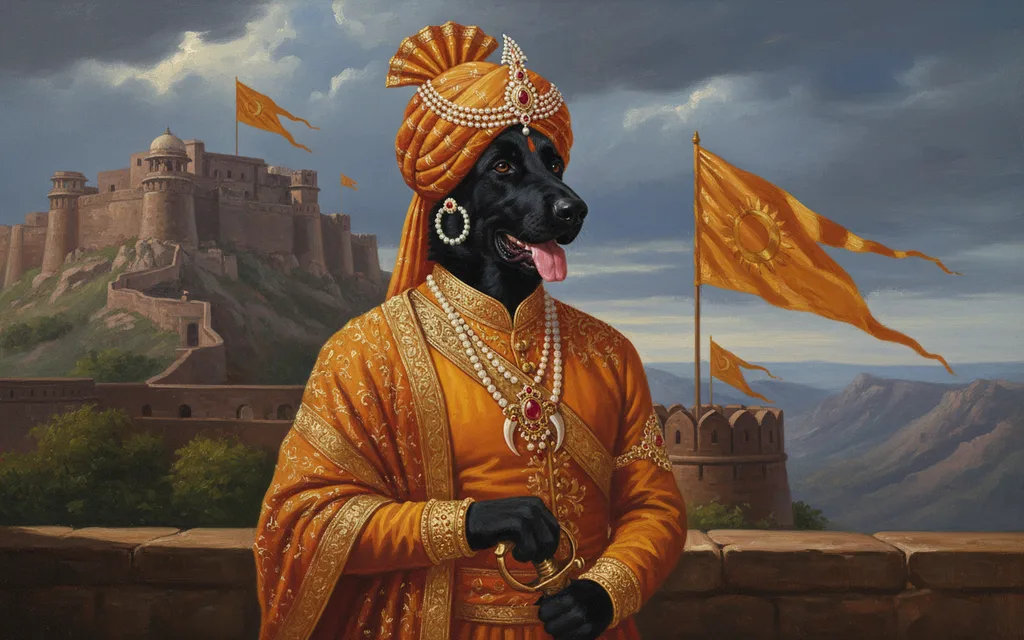
This page looks at how the Maratha rulers were portrayed, in three places and over two centuries. It starts with the likenesses of Shivaji that painters in Golconda sold to European traders, moves to the court of the Peshwas at Pune, where a British painter and an Indian painter worked side by side, and ends at Thanjavur in the far south, where Maratha rajas ruled into the 1800s. For the history of Shivaji and the Maratha Empire itself, read Shivaji and the Maratha kings. For how these portraits fit among India's other royal courts, start at the Indian court painting guide.
Shivaji in the portrait sets of Golconda
Portraits of Shivaji made in his own century survive from Golconda, one of the Deccan sultanates. The art historian Marta Becherini, of Columbia University, has studied sets of royal portraits that painters in Golconda sold to Dutch and other European traders during the reign of the last Golconda sultan, Abul Hasan Qutb Shah, from 1672 to 1687.
These sets follow a fixed order: Mughal emperors and princes first, then Mughal officials, then the Golconda and Bijapur royal families, and last the kings of Persia. Becherini writes that some sets add Shivaji, the only Maratha in them, and that Shivaji, who died in 1680, is prominently represented in the surviving sets. She links this to trade: his talks with Dutch officials helped the Dutch company against the other European companies in the region.
The figures in these sets mostly stand, with the face in profile or turned partway to the viewer. Each one is set against a single colour, with a thin row of clouds at the top and grass at the bottom. Becherini shows that the painters traced their figures from older portraits, so one likeness could appear in several sets. The Rijksmuseum in Amsterdam holds one of these Shivaji portraits, dated to around 1675 to 1685. It shows him to the hips with a sword in his right hand and a lance in his armoured left hand.
For the Golconda painters and the sultans they painted first, see our page on Deccan court portraits.
The Peshwa court at Pune
In the 1700s the Peshwas held court at Pune. The Victoria and Albert Museum (V&A) in London says the Peshwa palace there, which it calls the Shanwar Palace, was built by Peshwa Baji Rao in 1736, and that fire destroyed most of it in 1827 and 1828. The V&A holds a watercolour of one of its gateways painted in 1850 by the British artist William Carpenter, with a vegetable market in the square in front.
A British painter at the Peshwa's court
The Yale Center for British Art, a museum at Yale University, tells how European portrait painting reached the Peshwa court. Charles Warre Malet was the East India Company's Resident at Pune, its official representative at the Maratha court, from 1785 to 1798. In 1790 he arranged a treaty between the Peshwa and the British against Tipu Sultan, the ruler of Mysore. The painter James Wales had arrived in Bombay (now Mumbai) in 1791. In June 1792 Malet called him to Pune "by desire of the [Maratha] Court", and by July Wales had arrived with his assistant, Robert Mabon, to paint portraits of the Marathas.
The Royal Asiatic Society in London owns one result. Madhu Rao Narayan, the Maratha Peshwa, with Nana Fadnavis and attendants is an oil painting of 1792, 228 by 190 centimetres. The society says the Peshwa commissioned it shortly after Wales arrived in Pune in July 1792. Yale adds that Mabon made detailed sketches for Wales's portraits of the Marathas.
The treaty painting
By October 1792, Wales had begun a large painting for Malet that he called the "Great Treaty Durbar Group". Yale calls it a monumental, nine-foot painting. It shows the court in the Ganapati Hall of the Peshwa's palace. Malet offers the treaty to the young Peshwa Madhu Rao Narayan, who lived from 1774 to 1795 and sits on a low throne next to his adviser Nana Fadnavis. Yale calls Nana Fadnavis the power behind the Peshwa's rule.
Wales died in 1795 with the painting unfinished. Malet asked the British painter Thomas Daniell to complete it, and it was shown at the Royal Academy in London in 1805. Yale quotes Edward Moor, a Company officer, who praised the picture in 1810 but wrote that Daniell had added more "mythological ornaments than are actually in the room". Yale explains that Daniell was working from Wales's unfinished painting and Mabon's sketches of an event 15 years earlier.
An Indian painter at the same court
Yale also records an Indian artist who worked beside Wales. Gangaram Chintaman Tambat was a painter and sculptor whom Malet employed in the 1790s to draw the life, buildings and landscape of Pune and the land around it. He was probably trained in Pune's local tradition, and he learned European methods of perspective and the camera obscura, a box that projects a view onto paper for tracing, from Malet and Wales. He drew the cave temples at Ellora and made small sculptures of animals, possibly from the Peshwa's own collection of animals.
The Maratha rajas of Thanjavur
Rulers from the Maratha royal clan held Thanjavur, in today's Tamil Nadu, far to the south of Pune. Three of the V&A's Thanjavur portraits on this page are what the museum calls Company paintings: pictures made by Indian artists for the British in India.
A raja on a white horse
The V&A's portrait of Raja Tulsaji of Tanjore, another name for Thanjavur, painted around 1770, is 75.5 by 55.5 centimetres. The raja wears a gold robe and a turban and holds a rose in his right hand. He rides a white horse in rich trappings while his escort marches around him.
Two rulers in one procession
Around 1797 a Thanjavur artist painted a procession 125 centimetres wide, now at the V&A. It shows Amar Singh, who ruled Thanjavur until 1798, and Sarabhoji, whom LACMA also calls Serfoji II. White bullocks pull their carriages, with elephants, horses, soldiers and attendants around them. The V&A reads the scene by the size of the carriages: Amar Singh rides in the larger gilded one, so the museum dates the painting before 1798, when the British pensioned him off and recognised Sarabhoji as ruler.
A painting renamed
The Los Angeles County Museum of Art (LACMA) shows how a portrait can be misread. LACMA says Serfoji II, also called Sarabhoji II Bhonsle, was born in 1777 and adopted in 1787 by King Tulajaji II. The British installed him as king in 1798, with his power limited to the Thanjavur fort and the land around it, and he reigned until his death in 1832.
When LACMA acquired a procession painting of around 1800 to 1810 in 1990, the ruler on the elephant was named as Amar Singh. The museum now names him as Serfoji II. The reason is an English official seated in the carriage directly behind the ruler. Amar Singh had resisted the British, so LACMA thinks the pair are more likely Serfoji II and one of two British officials, the District Collector Charles Harris or the Resident William Blackburne. The museum adds that grand processions were a fashionable show of royal splendour in Thanjavur, above all during the Dussehra festival in September or October.
Serfoji II in glass and marble
Serfoji II was painted on glass as well as paper. The V&A holds a head and shoulders portrait of him, painted by a local artist on glass around 1860, long after his death. He holds a flower. The V&A says the flower is a common feature of portraits of Indian rulers and stands for a sensitive and cultured nature. Another V&A painting, of an unnamed ruler from Tanjore or Madras made between 1780 and 1800, shows the same gesture: a short brocade coat, a long muslin robe and a flower in the hand.
The glass portrait is 20 by 15 centimetres, in gouache, a thick watercolour, with gold leaf. The V&A says Chinese artists seem to have brought glass painting to India in the late 18th century. Glass paintings broke easily, so the British seldom brought them home, and the V&A holds only eight.
Serfoji II also stands in marble. The V&A holds a photograph by Linnaeus Tripe, official photographer to the Madras government, taken in 1858 and published in 1860 under the title "Sivaji's Statue". It shows a white marble statue of Serfoji in the quadrangle of the Thanjavur palace, ordered by his son, Raja Sivaji of Thanjavur, the next ruler, who lived more than a century after the Maratha founder Shivaji. The V&A names the sculptor as John Flaxman, while the text printed with the photograph in 1860 names Chantrey. That text says the raja stands in an attitude of adoration, a pose of worship, looking toward the great temple in the fort, on a stone where the old Nayakar kings once sat to give justice.
A Maratha chief at Gwalior
The V&A calls Daulat Rao Sindhia of Gwalior a Maratha chief, the great-nephew and adopted son of Madhoji Sindhia, and holds a painting of him made around 1825 by Khairullah of Delhi. He sits on green and gold cushions under a canopy, dressed in yellow, with courtiers and attendants around him. The museum says he took power in March 1794, lost to the British at Assaye in 1803 and reigned for 33 years.
Artists also painted Maratha princes on small surfaces: the V&A holds a 19th century portrait of a Maratha prince painted on an oval plaque of conch shell.
How to read a Maratha royal portrait
| What you see | What it tells you | Example in the sources |
|---|---|---|
| A flower held in the hand | A sensitive, cultured nature | Serfoji II on glass; Raja Tulsaji |
| A white horse with an escort on foot | The rider is the ruler | Raja Tulsaji of Tanjore |
| The larger, gilded carriage | The higher rank in a procession | Amar Singh and Sarabhoji |
| A British official close behind the ruler | The years of British control after 1798 | LACMA's Serfoji II procession |
| A low throne with an adviser beside it | Who held power at court | The Peshwa and Nana Fadnavis |
| A marble figure facing a temple | A ruler shown in worship | The statue of Serfoji II |
For the older kings of Thanjavur and their temples, see our page on Chola royal portraits. Tipu Sultan, the enemy in the Pune treaty, appears in our page on Mysore court portraits.
The Maratha King style
Maratha King is one of the 15 portrait styles on Purrealism. The studio examples in the gallery show it on a German Shepherd, a Pomeranian, a Shih Tzu and a Persian cat. If you like the upright, formal pose of the Golconda portraits of Shivaji, choose a photo where your pet sits or stands straight, with the head and chest clear and in focus. The portrait studio takes one photo of up to 5 MB.
Questions and answers
What is Maratha style painting?
Maratha style painting, in the sense of portraits of Maratha rulers, was made by several groups of artists in different places. Painters in Golconda painted Shivaji for European buyers, the art historian Marta Becherini writes. At Pune, the Peshwa asked the British artist James Wales to paint him in 1792, according to the Royal Asiatic Society. Painters at Thanjavur made portraits of the Maratha rajas there.
Who was Serfoji II?
Serfoji II was the Maratha raja of Thanjavur, in South India, from 1798 until his death in 1832. According to the Los Angeles County Museum of Art (LACMA), he was born in 1777 into the Maratha royal clan and adopted in 1787 by King Tulajaji II. The British installed him as king in 1798, with his power limited to the Thanjavur fort and the land around it.
Who painted Peshwa Madhu Rao Narayan?
The British painter James Wales painted the Peshwa Madhu Rao Narayan in Pune in 1792. The Royal Asiatic Society in London owns the oil painting, which shows the Peshwa with his adviser Nana Fadnavis and attendants and measures 228 by 190 centimetres. The society says the Peshwa commissioned it shortly after Wales arrived in Pune in July 1792.
Who was Nana Fadnavis in Maratha portraits?
Nana Fadnavis was the adviser of the young Peshwa Madhu Rao Narayan, and he sits beside the Peshwa in the portraits of the Pune court. The Yale Center for British Art calls him the power behind the Peshwa's rule. In the treaty painting that Thomas Daniell finished from James Wales's work, the Peshwa sits on a low throne with Nana Fadnavis next to him.
Who was Gangaram Tambat?
Gangaram Chintaman Tambat was an Indian painter and sculptor who worked in Pune in the 1790s for the British Resident, Charles Warre Malet. The Yale Center for British Art says he was probably trained in Pune's local tradition and then learned European perspective and the camera obscura from Malet and James Wales. He drew the cave temples at Ellora and made small sculptures of animals.
When was the Peshwa palace in Pune built?
The Peshwa palace in Pune, which the Victoria and Albert Museum calls the Shanwar Palace, was built by Peshwa Baji Rao in 1736. The museum says fire destroyed most of it in 1827 and 1828. The V&A holds a watercolour of one of its gateways, painted by the British artist William Carpenter in 1850, with a vegetable market in the square in front of it.
Why do Thanjavur rulers hold a flower in their portraits?
Thanjavur rulers hold a flower in their portraits to show a sensitive and cultured nature. The Victoria and Albert Museum says this about a glass painting of Raja Sarabhoji (Serfoji II), made around 1860, and calls the flower a common feature of portraits of Indian rulers. A V&A painting of Raja Tulsaji shows him holding a rose on horseback.
What does the marble statue of Serfoji at Thanjavur show?
The marble statue of Serfoji at Thanjavur shows the raja standing in an attitude of adoration, a pose of worship, facing the great temple. The Victoria and Albert Museum holds a photograph of it by Linnaeus Tripe, taken in 1858 in the quadrangle of the palace. The text printed with the photograph in 1860 says the statue stands on a stone where the old Nayakar kings once sat to give justice.
How were Thanjavur glass portraits made?
Thanjavur glass portraits were painted in gouache, a thick watercolour, with gold leaf on a sheet of glass. The Victoria and Albert Museum says Chinese artists seem to have brought glass painting to India in the late 18th century. Its glass portrait of Raja Sarabhoji measures 20 by 15 centimetres. Glass paintings were fragile, so the British seldom brought them back, and the museum holds only eight.
Why was Shivaji painted in Golconda?
Shivaji was painted in Golconda because painters there sold sets of royal portraits to European traders, and Shivaji mattered to their business. The art historian Marta Becherini writes that the Golconda sets sometimes added Shivaji as the only Maratha, and that his talks with Dutch officials helped the Dutch company in the region. She writes that he is prominently represented in the surviving sets.
Who ruled Thanjavur before Serfoji II?
Amar Singh ruled Thanjavur before Serfoji II. According to the Los Angeles County Museum of Art, he was regent from 1787 to 1793, then took the throne and ruled until 1798, when the British restored Serfoji II. The Victoria and Albert Museum holds a procession painting of around 1797 that shows Amar Singh in a large gilded carriage and Serfoji in a smaller one.
How was Daulat Rao Sindhia painted?
Daulat Rao Sindhia, the Maratha ruler of Gwalior, was painted seated on green and gold cushions under a canopy, dressed in yellow and surrounded by courtiers. The Victoria and Albert Museum says Khairullah of Delhi painted it around 1825. The museum says Sindhia came to power in 1794, lost to the British at Assaye in 1803 and reigned for 33 years.
Sources
- Effigies in Transit: Deccan Portraits in Europe at the Turn of the 18th Century, Journal18 (Marta Becherini, Columbia University). Accessed September 28, 2026.
- Portrait of Shivaji, Rijksmuseum. Accessed September 28, 2026.
- Madhu Rao Narayan, the Maratha Peshwa, with Nana Fadnavis and attendants (RAS 01.014), Royal Asiatic Society of Great Britain and Ireland. Accessed September 28, 2026.
- Adapting the Eye: An Archive of the British in India, 1770 to 1830 (exhibition guide), Yale Center for British Art. Accessed September 28, 2026.
- Gateway to the Shanwar Palace, watercolour by William Carpenter, 1850, Victoria and Albert Museum. Accessed September 28, 2026.
- Raja Tulsaji of Tanjore, painting, c. 1770, Victoria and Albert Museum. Accessed September 28, 2026.
- Processional scene with Amar Singh, ruler of Thanjavur (Tanjore), and Sarabhoji, c. 1797, Victoria and Albert Museum. Accessed September 28, 2026.
- Royal Procession with Maharaja Serfoji II of Thanjavur (r. 1798-1832), c. 1800 to 1810, Los Angeles County Museum of Art. Accessed September 28, 2026.
- Portrait of Raja Sarabhoji of Tanjore, painting on glass, c. 1860, Victoria and Albert Museum. Accessed September 28, 2026.
- An unidentified ruler, painting, Tanjore, c. 1780 to 1800, Victoria and Albert Museum. Accessed September 28, 2026.
- Sivaji's Statue, photograph by Linnaeus Tripe, 1858, Victoria and Albert Museum. Accessed September 28, 2026.
- Portrait of Maharaja Ali Jah Daulat Rao Sindhia of Gwalior, c. 1825, Victoria and Albert Museum. Accessed September 28, 2026.
- Portrait of a Maratha prince, painting on shell, 19th century, Victoria and Albert Museum. Accessed September 28, 2026.
Short reads on this topic
Articles from Purrspectives that answer one question each.
What is Tanjore painting? Gold foil, gesso and the Thanjavur court
Tanjore painting is a South Indian style from Thanjavur, made on a wooden board with raised gesso, gold foil and glass stones. Where it came from and how it is made.
Indian royal pet portraits: the nine Indian court styles explained
An Indian royal pet portrait dresses your dog or cat as a ruler or warrior from an Indian court. Here are the nine styles and the history behind them.
The Maharajas of Patiala: the history behind Patiala royalty
The Phulkian rulers of Patiala founded their capital in 1763. Who built Qila Mubarak, who Bhupinder Singh was, and how Patiala joined India.