Sikh court portraits: Ranjit Singh, Lahore and the maharajas of Patiala
Sikh rulers were painted on white horses under a parasol, on golden thrones and later from photographs. How Lahore and Patiala portrayed their maharajas.
By Purrealism. Part of Indian court painting: how India's royal courts portrayed their rulers.
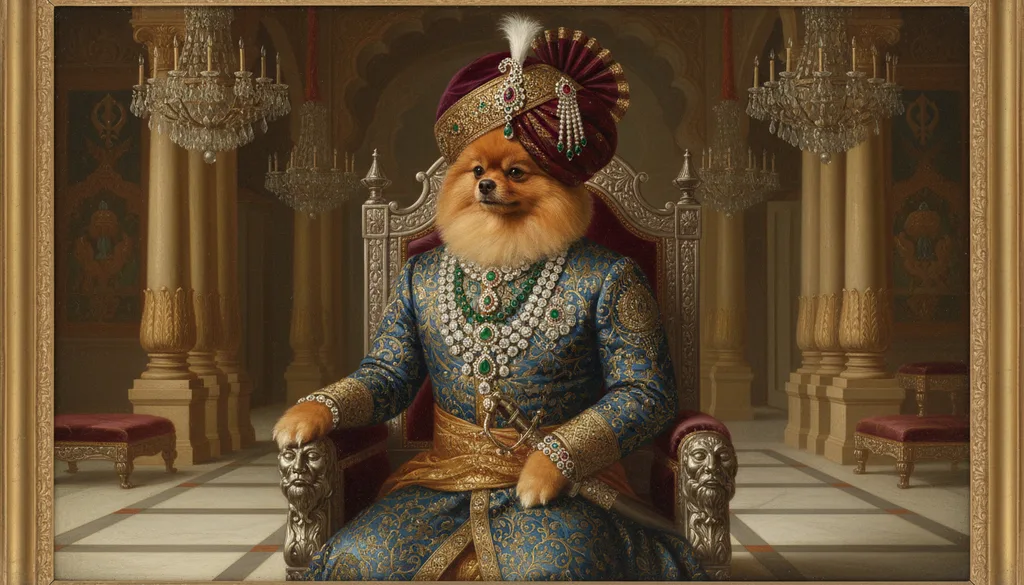
This page looks at how the Sikh rulers of the Punjab were portrayed in the 1800s. It starts at the court of Maharaja Ranjit Singh in Lahore, where painters had to picture a king with one blind eye, and follows his sons, his courtiers and the European artists who drew them. It ends with the Sikh courts south of the Sutlej river, especially Patiala, where later rulers were painted from photographs. For the history of the Patiala rulers themselves, read the Maharajas of Patiala. For how the Sikh courts fit among India's other royal courts, start at the Indian court painting guide.
The court at Lahore
The Wallace Collection in London tells the story of Ranjit Singh, who lived from 1780 to 1839. He seized Lahore in 1799, and two years later he was anointed maharaja, meaning great king, of the Sikhs. The Victoria and Albert Museum (V&A) calls him the first Sikh maharaja of the Punjab and dates his rule from 1801 until his death in 1839.
Lahore had been a Mughal capital. According to the Wallace Collection, the Lahore Fort was built by the Mughal emperor Akbar in the late 1500s, and one of Ranjit Singh's first projects was to improve it as the setting for his court. The court also travelled for hunts, wars and religious festivals, and a tent could be put up wherever the maharaja stopped.
The wealth of this court drew painters. The Wallace Collection names Kehar Singh and Imam Bakhsh Lahori as painters who had many patrons there, and says Imam Bakhsh was a favourite of Ranjit Singh's French generals. The V&A says the Sikh kingdom also attracted artists from the Hindu kingdoms of the nearby Punjab Hills. India's National Council of Educational Research and Training (NCERT) says the Sikhs came to employ painters trained in the Kangra style. Our page on Pahari court portraits shows how those hill artists had painted their own rajas.
A king with one eye
Ranjit Singh's face was a problem for his painters. The Wallace Collection says he lost the sight of one eye to smallpox at the age of five, and that his appearance was plain, even unattractive to some who met him. The V&A says the smallpox left him blind in his left eye and scarred his skin.
Painters handled this in two ways. The V&A describes a portrait from the late 1830s in which he is shown from his right profile, so the blind eye is out of view. In another, the unknown artist marks the smallpox scars on his face, in the museum's words, discreetly. Several V&A portraits, and the medal described below, show him facing right.
He also dressed simply. According to the Asian Art Museum of San Francisco, Ranjit Singh liked plain clothes of fine cotton for himself, but insisted that his courtiers, his army and even their horses wear rich silks and jewels, especially when foreign guests came to court. A V&A portrait from the late 1830s shows him in saffron clothes and a short brocade coat, with long ropes of pearls and an armband as his only jewels. His white horse wears gold chains and turban jewels.
The old signs of kingship
Sikh court painters kept the signs of royalty that Mughal painters had used. The V&A says so directly about a portrait of Ranjit Singh on a white stallion: the artist included the halo and the parasol, the traditional signs of royalty, taken from Mughal painting. Our page on Mughal royal portraits explains where those signs came from.
The horseback portrait became a standard design at Lahore. The V&A holds several versions with the same parts:
| Detail | What the V&A describes |
|---|---|
| The horse | A white stallion, in some versions with henna-dyed lower legs |
| The parasol | Held over his head by an attendant who walks beside the horse |
| The halo | A ring of light around his head, in the Mughal manner |
| His dress | All yellow in one version, all green in another, saffron in a third |
| His weapons | In one version, a black shield strapped to his back |
One painting shows him dressed entirely in yellow. The V&A suggests this may show him at the spring festival, when everyone wore that colour. Another version, formerly owned by Queen Mary, shows him in green with a parasol and a turban jewel. An English inscription on it says the likeness is poor.
The saffron portrait adds a group of companions around him, many of them carrying weapons wrapped in cloth, another sign of royalty. According to the Van Cortlandt family's account, which the V&A records, this was one of a pair of portraits his court artist made for Ranjit Singh. The maharaja kept one and gave the other to Colonel Henry Charles Van Cortlandt, who entered his service in 1832.
On a chair and on a golden throne
Other Lahore portraits show the maharaja seated. A V&A painting from the late 1830s shows him on a gold Western-style chair with his legs tucked under him on the seat. The museum says this is how European visitors often saw him. He sits with Hira Singh, a young courtier he made a raja in 1828 and called his "favoured son". Lord Auckland, the British Governor-General, visited the Sikh court in 1838 and took the painting to England in 1842.
His real throne survives. The goldsmith Hafiz Muhammad Multani made it, probably between 1805 and 1810. According to the V&A, it has a core of wood and resin covered with thick sheets of gold, and its base is two rows of lotus petals. The Wallace Collection points to the handles at its base, which let the throne travel with the court. The British took it with the Sikh treasury in 1849, and it has been in the V&A since 1879. A portrait from 1839 or 1840 in the V&A shows Ranjit Singh in yellow on a golden throne on a palace terrace, with a halo, while a servant waves a fan behind him. It is one of five portraits once owned by Shankarnath, the court astrologer at Lahore.
Portraits of the court circle
The court's ministers and princes had portraits of their own. The V&A says senior members of the court circle were as likely to be Hindus or Muslims as Sikhs. A painting from the late 1830s shows Ranjit Singh's grandson, Nau Nihal Singh, on a Western-style chair, which the museum calls typical of the Sikh court, with the minister Dhian Singh seated on the ground at his feet.
The V&A calls its portrait of Gulab Singh of Jammu, painted close to 1846, famous. It says the unknown artist captured the "undoubted wiliness" of his subject, a man who served Ranjit Singh and later sided with the British.
Portraits also appeared on medals and small objects. The V&A holds an Order of Merit made in Lahore between 1837 and 1839: an enamelled gold medal set with emeralds, with a tiny round portrait of Ranjit Singh on a terrace, holding a bow and facing right. The museum says the idea came from the French award worn by one of his generals, Allard. After his death, Lahore painters kept painting him. A portrait on glass in the V&A, 50.8 by 40.6 cm, carries a Persian inscription naming Kehar Singh, painter of Lahore. Small portraits on ivory, 5.2 cm across, show him in profile holding a flower.
European artists at the Sikh court
European artists also portrayed the rulers of Lahore. The Wallace Collection shows a portrait of Ranjit Singh by the French artist Alfred De Dreux, painted close to 1837 and now in the Louvre. It also shows a picture of a favourite horse of Ranjit Singh by Emily Eden, from her book Portraits of the Princes and People of India, published in 1844. The Asian Art Museum of San Francisco names Eden, with W. G. Osborne, among the Europeans whose writings and drawings record how the Sikh courts looked to visitors. After Ranjit Singh's death, his son Sher Singh welcomed the Hungarian oil painter August Schoefft and ordered royal portraits from him. One shows Sher Singh on the golden throne, painted in the early 1840s.
Duleep Singh in England
The last Sikh maharaja of Lahore was painted in England. The Wallace Collection says Duleep Singh, born on 23 September 1838, came to the throne at the age of five in 1843. The British took over his kingdom in 1849, when he was ten. In May 1854 he arrived in London and met Queen Victoria.
The art historian Julie Codell writes that the Queen ordered a portrait of him that same year from her court painter, Franz Xaver Winterhalter. The Victorian Web lists it as an oil painting, 2038 by 1095 mm, at Osborne House on the Isle of Wight. Codell describes a figure who looks straight at the viewer with the proud pose and gaze of a European aristocrat. Photographs followed. A V&A photograph by the London studio Mayall, dated 1875, shows him standing full length in ceremonial dress with a jewelled turban.
Patiala and the Phulkian courts
Not every Sikh court was ruled from Lahore. According to the Asian Art Museum of San Francisco, the Sikh kingdoms of Patiala and Nabha signed treaties with the British, mainly to protect themselves against Ranjit Singh's growing power. This let them keep their courts and armies. The museum says their maharajas paid artists and craftsmen to make rich jewellery for them and to record their appearance in portraits. The Wallace Collection adds that after 1849 some Lahore artists found work at the smaller Sikh courts south of the Sutlej river, such as Patiala.
A watercolour by the English painter George Landseer, now in the V&A, shows the chiefs of Patiala, Jind and Nabha arriving with their followers at a darbar, a formal royal gathering, held by the British Governor-General at Shaikabad on 14 January 1860. The V&A also holds a steel shield from Patiala, bought at the Great Exhibition in London in 1851, with gold pictures of Maharaja Ranjit Singh and Maharaja Sher Singh riding elephants.
Painted from a photograph
Photographs also served as models for painted portraits at Patiala. The Asian Art Museum of San Francisco holds a portrait of Maharaja Mohinder Singh of Patiala, painted between 1870 and 1876 in watercolour and gold, which is based on a photograph by Bourne and Shepherd, a British-run studio in India. The museum says many portraits of the maharajas show personal wealth and magnificent jewels as signs of rank. It adds that some rulers posed in cloaks embroidered with the Star of India, an honour from the British sovereign.
Codell writes that the first 25 members of the Order of the Star of India, created in 1861, included the maharajas of Patiala and Gwalior. She also records that a Maharaja of Patiala once ordered five dozen prints of a photograph in a single order, and that the Vandyk studio made private pictures of the Patiala royal family marked "not for publication".
The Patiala Royalty style
Purrealism's Patiala Royalty style takes its name from this court. The Patiala Royal portrait in the gallery shows a Pomeranian as Patiala royalty in a blue coat and jewelled turban on a red throne. The studio examples also include a Shiba Inu in the same style. Its jewelled turban and throne use the same signs of rank as the Lahore and Patiala portraits on this page: rich dress, a throne and jewels.
The Lahore painters chose one clear view of the face. You can do the same: choose a photo where your pet's face is clear and well lit. The portrait studio takes one photo of up to 5 MB. Our page on animals in Indian court painting shows how horses and hunting animals appear in Indian royal portraits.
Questions and answers
Why was Maharaja Ranjit Singh painted from the side?
Maharaja Ranjit Singh was often painted from the side to hide his blind eye. The Victoria and Albert Museum says one Lahore portrait shows him from his right profile to hide the eye he lost to childhood smallpox. Another V&A portrait, painted in the late 1830s, shows the smallpox scars on his face, which the museum says the artist marked with care.
Which eye was Maharaja Ranjit Singh blind in?
Maharaja Ranjit Singh was blind in his left eye. The Victoria and Albert Museum says childhood smallpox left him blind in that eye and scarred his skin. The Wallace Collection in London says he lost the sight of the eye at the age of five. Court painters at Lahore often showed him in right profile, facing right, which kept the blind eye out of the picture.
Why is Ranjit Singh dressed in yellow in some portraits?
Ranjit Singh may be dressed in yellow in some portraits because they show the spring festival, when everyone wore that colour. That is the reading of the Victoria and Albert Museum for a portrait painted in the late 1830s, in which he rides a white stallion with henna-dyed legs, dressed entirely in yellow, while an attendant holds a golden parasol over his head.
What signs of a king do Sikh court painters give Ranjit Singh?
Sikh court painters give Ranjit Singh the halo, the parasol held over his head and the turban jewel. The Victoria and Albert Museum says the halo and the parasol came to Sikh painting from Mughal painting, and calls the parasol the ancient emblem of kings. In several V&A portraits he rides a white stallion while a walking attendant holds the parasol above him.
Who were the court painters of Ranjit Singh at Lahore?
Kehar Singh and Imam Bakhsh Lahori were two of the painters with many patrons at Ranjit Singh's court in Lahore, according to the Wallace Collection. It says Imam Bakhsh was a favourite of the maharaja's French generals. The Victoria and Albert Museum adds that the Sikh kingdom attracted artists from the Hindu kingdoms of the nearby Punjab Hills, and it holds a portrait on glass whose Persian inscription names Kehar Singh, painter of Lahore.
Why does Ranjit Singh sit on a chair with his legs tucked under him?
Ranjit Singh sits on a chair with his legs tucked under him because that is how he often received European visitors. The Victoria and Albert Museum says so for a painting from the late 1830s showing him on a gold Western-style chair beside the young courtier Hira Singh. Lord Auckland, the British Governor-General, brought that painting to England in 1842 after visiting the Sikh court in 1838.
Who made Maharaja Ranjit Singh's golden throne?
The goldsmith Hafiz Muhammad Multani made Maharaja Ranjit Singh's golden throne, probably between 1805 and 1810. According to the Victoria and Albert Museum, it has a core of wood and resin covered with thick sheets of gold, and its base is shaped as two rows of lotus petals. The British took it from Lahore in 1849, and it has been in the V&A since 1879.
Who painted Maharaja Duleep Singh in 1854?
Franz Xaver Winterhalter, Queen Victoria's court painter, painted Maharaja Duleep Singh in 1854. The art historian Julie Codell writes that Queen Victoria ordered the oil portrait. The Victorian Web gives its size as 2038 by 1095 mm and places it at Osborne House on the Isle of Wight. According to the Wallace Collection, Duleep Singh had arrived in London in May of that same year.
When did Duleep Singh come to England?
Duleep Singh came to England in May 1854, according to the Wallace Collection. He was a son of Ranjit Singh and had become maharaja of Lahore at five, in 1843, before the British took over his kingdom in 1849. On arrival in London he met Queen Victoria, and he was encouraged to spend holidays with the royal princes at Osborne House.
How were portraits of the Patiala maharajas painted from photographs?
Some portraits of the Patiala maharajas were painted in watercolour and gold by copying a studio photograph. The Asian Art Museum of San Francisco holds a portrait of Maharaja Mohinder Singh of Patiala, painted between 1870 and 1876, that is based on a photograph by Bourne and Shepherd, a British-run photo studio in India. The museum says such portraits used jewels to show wealth and rank.
What is the Sikh Order of Merit with Ranjit Singh's portrait?
The Sikh Order of Merit with Ranjit Singh's portrait is a gold medal set with emeralds, made in Lahore between 1837 and 1839. The Victoria and Albert Museum says Ranjit Singh introduced the order, inspired by the French award worn by his general Allard. Its front holds a small round portrait of the maharaja on a terrace, holding a bow and facing right.
Which European artists portrayed the Sikh rulers of Lahore?
European artists who portrayed the Sikh rulers of Lahore include Emily Eden, August Schoefft and Alfred De Dreux. The Wallace Collection says Eden drew Ranjit Singh's favourite horse for her 1844 book of portraits, and that Maharaja Sher Singh ordered royal portraits from Schoefft, a Hungarian oil painter. It also shows De Dreux's portrait of Ranjit Singh, painted close to 1837 and now in the Louvre.
Sources
- The Lahore Durbar: The Court of Lahore, The Wallace Collection. Accessed September 28, 2026.
- Maharaja Ranjit Singh: Lion of the Punjab, The Wallace Collection. Accessed September 28, 2026.
- Legacies: Duleep Singh Family, The Wallace Collection. Accessed September 28, 2026.
- Maharaja Ranjit Singh on horseback, painting, c. 1838 to 1840, Victoria and Albert Museum. Accessed September 28, 2026.
- Ranjit Singh on horseback, painting, c. 1835 to 1838, Victoria and Albert Museum. Accessed September 28, 2026.
- Maharaja Ranjit Singh, painting, Lahore, c. 1835 to 1840, Victoria and Albert Museum. Accessed September 28, 2026.
- Maharaja Ranjit Singh, painting, c. 1840, Victoria and Albert Museum. Accessed September 28, 2026.
- Ranjit Singh with Hira Singh, painting, c. 1838 to 1840, Victoria and Albert Museum. Accessed September 28, 2026.
- Raja Nau Nihal Singh with Raja Dhian Singh, painting, c. 1838 to 1840, Victoria and Albert Museum. Accessed September 28, 2026.
- Raja Dhian Singh, painting, c. 1838, Victoria and Albert Museum. Accessed September 28, 2026.
- Portrait of Maharaja Ranjit Singh on a golden throne, Lahore, c. 1839 to 1840, Victoria and Albert Museum. Accessed September 28, 2026.
- Maharaja Ranjit Singh's throne, by Hafiz Muhammad Multani, c. 1805 to 1810, Victoria and Albert Museum. Accessed September 28, 2026.
- Order of Merit with a Portrait of Ranjit Singh, Victoria and Albert Museum. Accessed September 28, 2026.
- Portrait of Maharaja Ranjit Singh, nimbate, by Kehar Singh, gouache on glass, Victoria and Albert Museum. Accessed September 28, 2026.
- Maharaja Ranjit Singh, portrait miniature on ivory, Victoria and Albert Museum. Accessed September 28, 2026.
- Maharaja Gulab Singh, painting, Lahore, c. 1846, Victoria and Albert Museum. Accessed September 28, 2026.
- A portrait of 'Maharajah Duleep Singh', photograph by Mayall, c. 1875, Victoria and Albert Museum. Accessed September 28, 2026.
- Portrait of Maharaja Duleep Singh by Franz Xaver Winterhalter, The Victorian Web. Accessed September 28, 2026.
- Photographic Interventions and Identities: Colonising and Decolonising the Royal Body, by Julie F. Codell, The Victorian Web (essay by Julie F. Codell, Arizona State University). Accessed September 28, 2026.
- Maharaja Mohinder Singh of Patiala, Asian Art Museum of San Francisco, on Google Arts and Culture. Accessed September 28, 2026.
- Darbar at Shaikabad, 1860, watercolour by George Landseer, Victoria and Albert Museum. Accessed September 28, 2026.
- Shield (dhal), watered steel with gold, Patiala, c. 1850, Victoria and Albert Museum. Accessed September 28, 2026.
- The Pahari Schools of Painting (An Introduction to Indian Art, Part II, chapter 5), National Council of Educational Research and Training (NCERT). Accessed September 28, 2026.
Short reads on this topic
Articles from Purrspectives that answer one question each.
What is Tanjore painting? Gold foil, gesso and the Thanjavur court
Tanjore painting is a South Indian style from Thanjavur, made on a wooden board with raised gesso, gold foil and glass stones. Where it came from and how it is made.
Indian royal pet portraits: the nine Indian court styles explained
An Indian royal pet portrait dresses your dog or cat as a ruler or warrior from an Indian court. Here are the nine styles and the history behind them.
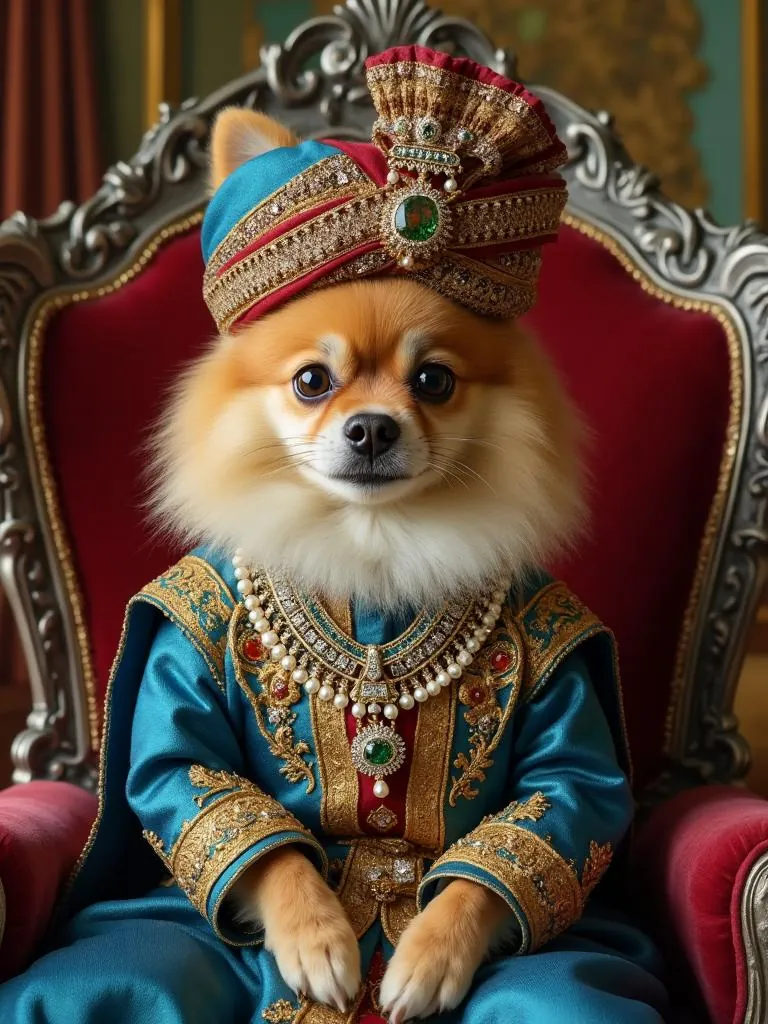
The Maharajas of Patiala: the history behind Patiala royalty
The Phulkian rulers of Patiala founded their capital in 1763. Who built Qila Mubarak, who Bhupinder Singh was, and how Patiala joined India.