Mysore court portraits: Tipu Sultan, the Wodeyar kings and their painters
How the rulers of Mysore were portrayed, from Tipu Sultan in green and pearls to Wodeyar kings in processions, oil paintings and printed portraits.
By Purrealism. Part of Indian court painting: how India's royal courts portrayed their rulers.
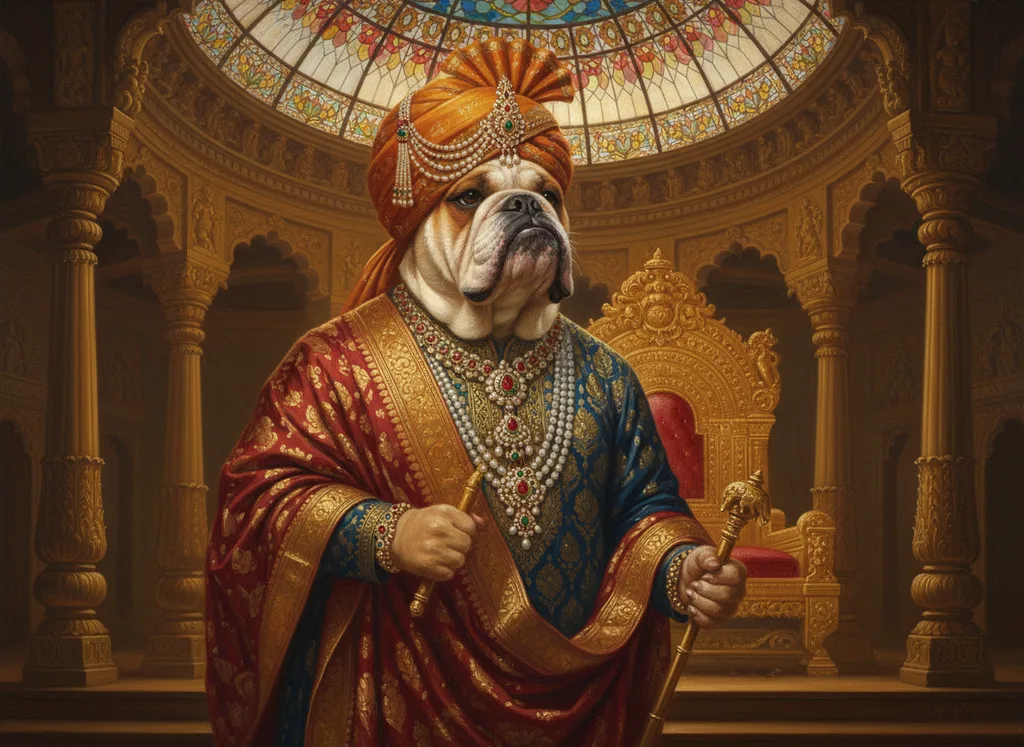
This page looks at how the rulers of Mysore, in South India, were portrayed between the late 1700s and the early 1900s. It covers Tipu Sultan's own portrait and the tiger he used as his sign, the painted palace at Srirangapatna, the pictures his British enemies made, the long procession scroll of Krishnaraja Wodeyar III, and the oil paintings and printed portraits of a later Wodeyar king. For the gold and raised gesso work that Mysore painting is known for, read what is Mysore painting. For the place of Mysore among India's other royal courts, start at the Indian court painting guide.
Who ruled Mysore, and why it shaped the portraits
Mysore had two kinds of ruler in the years this page covers, and each kind left different pictures. India's National Council of Educational Research and Training (NCERT) says Mysore grew strong under Haidar Ali, who ruled from 1761 to 1782, and his son Tipu Sultan, who ruled from 1782 to 1799. The Salar Jung Museum in Hyderabad calls the two men the de facto rulers of Mysore, which means they held the real power in the kingdom.
The British East India Company fought four wars with Mysore, in 1767 to 1769, 1780 to 1784, 1790 to 1792 and 1799, NCERT says. Tipu Sultan was killed defending his capital, Srirangapatna, on 4 May 1799. The British then placed Mysore under the Wodeyars, the family that had ruled it before. The Victoria and Albert Museum (V&A) in London says the new Maharaja, Krishnaraja Wodeyar III, was five years old when the British installed him.
So the portraits fall into three groups: pictures made for Tipu Sultan's court, pictures of the Mysore family made by the British, and pictures made for the restored Wodeyar kings.
Tipu Sultan's portrait: green silk and pearls
The V&A holds a portrait of Tipu Sultan painted by an unknown Indian artist around 1790, probably in Mysore. It is small, 27 cm high and 21.5 cm wide, in opaque watercolour (a thick paint that covers the paper completely) on paper. Tipu wears a bright green tunic and a matching green turban with a jewelled turban ornament. Three pearl necklaces hang on his chest, each with a jewelled pendant. A jewelled sash crosses his right shoulder and holds a gold sword at his left hip, and a green and yellow striped sash is tied at his waist. He leans against a red bolster, a long firm cushion, and the background is plain blue.
The V&A draws attention to the jewellery. It says the pieces Tipu wears are distinctively different from the fashions of northern India, and it uses that jewellery to link later copies back to this portrait. After Tipu's death, artists in Delhi added him to the series of famous Indian rulers that they often painted, and the V&A says they seem to have used this portrait as their model.
One of those Delhi copies is also at the V&A. It is an oval miniature on ivory, 9.5 cm high, painted around 1860 and labelled "Tippoo Sooltaun". Tipu is shown to the waist, with a string of large pearls holding a jewelled ornament on his turban, a necklace of large pearls, a striped coat and a gold-hilted sword in his belt. The V&A says Delhi ivory painters of the mid 1800s began to include rulers from other parts of India in their sets, and that this one was almost certainly copied from an earlier South Indian portrait.
The tiger as a royal sign
Tipu Sultan also used a second sign for himself: the tiger. NCERT says he had the image of a tiger on his flag and that he came to be known as the "Tiger of Mysore". The V&A says objects made for Tipu personally were decorated with tiger motifs and tiger stripes. Its collection includes a gilded silver pole end from a palanquin, a covered seat carried on poles by bearers, made in the shape of a tiger's head. The museum identifies it as Tipu's by the exact form of the stripes and the shape of the eye.
The best-known example is Tippoo's Tiger, a wooden figure of a tiger attacking a man in European clothes, with a small organ hidden inside. The V&A says it already existed in 1792 and that British soldiers found it in the music room of Tipu's palace after the siege of 1799.
The tiger stayed in Mysore court art after Tipu. On a V&A procession scroll painted around 1860, the Wodeyar king rides an elephant whose howdah, the seat on the elephant's back, is painted with tiger stripes of the form tied to Tipu Sultan. The V&A explains that the British gave the young king some of Tipu's possessions, almost certainly including howdahs and other fittings for elephants.
The painted palace at Srirangapatna
Tipu Sultan's summer palace, the Daria Daulat Bagh, stands in Srirangapatna, 20 km from Mysore. Karnataka Tourism, the state government's tourism department, says it is made almost entirely of teakwood and that its walls are covered with paintings of battles, kings and court life. The murals show royal processions with elephants and horses, and Tipu riding into battle. One battle mural shows Tipu Sultan defeating the British at the Battle of Pollilur.
Here the ruler appears as a commander inside a crowded scene of war, painted large on a wall where every visitor would see it.
The British painted the palace too. The V&A holds a watercolour of its interior made between 1795 and 1800, probably by an Indian artist working for British buyers. It shows a richly decorated room seen through an arch, with three soldiers in tiger-striped uniforms. The V&A says it came from a volume of 49 watercolours called Views in India, and that a similar painting is in the Royal Collection.
How the British pictured Tipu's family
The wars produced their own portraits. NCERT reproduces a painting by Daniel Orme, dated 1793, of Lord Cornwallis receiving two of Tipu Sultan's sons as hostages after the treaty of 1792. NCERT comments that British painters liked to paint scenes that showed the triumph of British power.
A smaller picture from the same year shows one of the hostages. The British miniature painter John Smart painted Tipu's eldest legitimate son, Abdul Khaliq, on 8 August 1792, while the boy was held by the British. The V&A says Smart's portraits of the princes were sent to Tipu, most likely to show that the boys were being treated kindly. The V&A's version is unfinished: the boy's face and his red turban are fully painted, and the rest is bare ivory. The museum says the miniature was thought lost until it was found in a private collection in 2023.
Later British artists painted Tipu's death. The V&A holds a watercolour titled The Finding of the Body of Tipu Sultan at Seringapatam, painted between 1840 and 1860 and possibly by John Absolon.
Krishnaraja Wodeyar III in procession
Krishnaraja Wodeyar III ruled Mysore from 1799 to 1868, according to the V&A. The Salar Jung Museum says he revived older styles of Mysore painting and lived at the same time as Serfoji II of Thanjavur. Our page on Maratha court portraits covers Serfoji's court.
The most detailed picture of this king at the V&A is a scroll painted around 1860, probably in Mysore. It is 21.5 cm high and 732 cm long, in opaque watercolour on paper backed with cloth. It shows a religious procession in honour of the god Shiva. Dancing girls, musicians, chauri bearers (servants carrying fly whisks) and men with lamps and fireworks walk in front of the king's elephant. Behind him ride the British Resident, Colonel Mark Cubbon, and two Indian commanders, followed by elephants carrying kettledrums, horsemen and a crowd. Further along, temple cars pulled with ropes carry images of Durga and Shiva.
The scroll also shows that a royal figure can be misnamed. The V&A records that the king on the elephant was once wrongly identified as Raja Sarabhoji (Serfoji) of Tanjore. In a procession the ruler is one small figure in a long line of people. The V&A record reports the view of its curator Susan Stronge that the king sits in the howdah, with Colonel Cubbon, the British Resident, riding behind him.
Kings shown at worship
Several Mysore court paintings show the ruler as a worshipper. The Salar Jung Museum's group of 19th-century Mysore paintings includes a Raja and his queen praying to the goddess Chamundeswari, and a Raja praying before a Shiva linga, the rounded stone form in which Shiva is worshipped. In that scene a priest, the king with his hands folded and a turbaned companion stand before the shrine. Other paintings in the group show a Raja feeding an elephant at a temple and a Raja with his son before a temple.
Mysore painters also copied older portraits from other courts. The V&A holds a painting of Azam Shah, the third son of the Mughal emperor Aurangzeb, hawking on horseback with an attendant on foot. It was made around 1780, probably in Mysore, and the V&A calls it a later version of a Golconda original of around 1680. Our page on Deccan court portraits explains the Golconda court behind the first version. Kings shown at worship also appear in South Indian temple art many centuries earlier, as our page on Chola royal portraits shows.
Oil paint, a jewelled throne and printed portraits
By the early 1900s the Wodeyar kings were painted in new materials. The V&A holds an oil portrait of Maharaja Krishnaraja Wodeyar IV, painted in 1906 by the Mysore artist K. Keshavayya. The museum says the maharaja was born in 1884 and became ruler in 1895, and that the painting was given to the museum in 1923. It is 30.4 cm high, in oil on canvas backed with card. The king is shown to the waist and faces the viewer directly. He wears a pink satin brocade coat from Benares, buttoned to the neck. His pink and gold turban carries a sarpich, a turban ornament, here with feathers and trimmed with pearls, and his jewels are set with diamonds and emeralds.
Set beside Tipu Sultan's portrait from more than a hundred years earlier, the oil painting keeps the same royal signs: the jewelled ornament on the turban, the pearls and the jewels.
The same king was painted by Raja Ravi Varma, who lived from 1848 to 1906. A watercolour by Ravi Varma dated 1905, now in the Ganesh Shivaswamy Foundation in Bengaluru, shows the Dasara darbar of Krishnaraja Wadiyar IV at the Jaganmohan Palace. A darbar is a formal royal court gathering, and Dasara is the festival when this one was held. The foundation's description says the king sits on the Rathna-Simhasana, the jewelled throne. Karnataka Tourism says the Maharaja's Golden Throne at Mysuru Palace is displayed only for Dasara, and that the palace murals show the royal family's grand processions.
Ravi Varma's royal portraits also reached people outside the palace as prints. The same foundation holds a colour print from the 1930s, made by the Ravi Varma Press from a Ravi Varma painting of this maharaja. The foundation says the press was set up in Mumbai in 1894 to reproduce his pictures, and that the maharaja was one of the artist's important supporters.
What this means for a Mysore Royal portrait of your pet
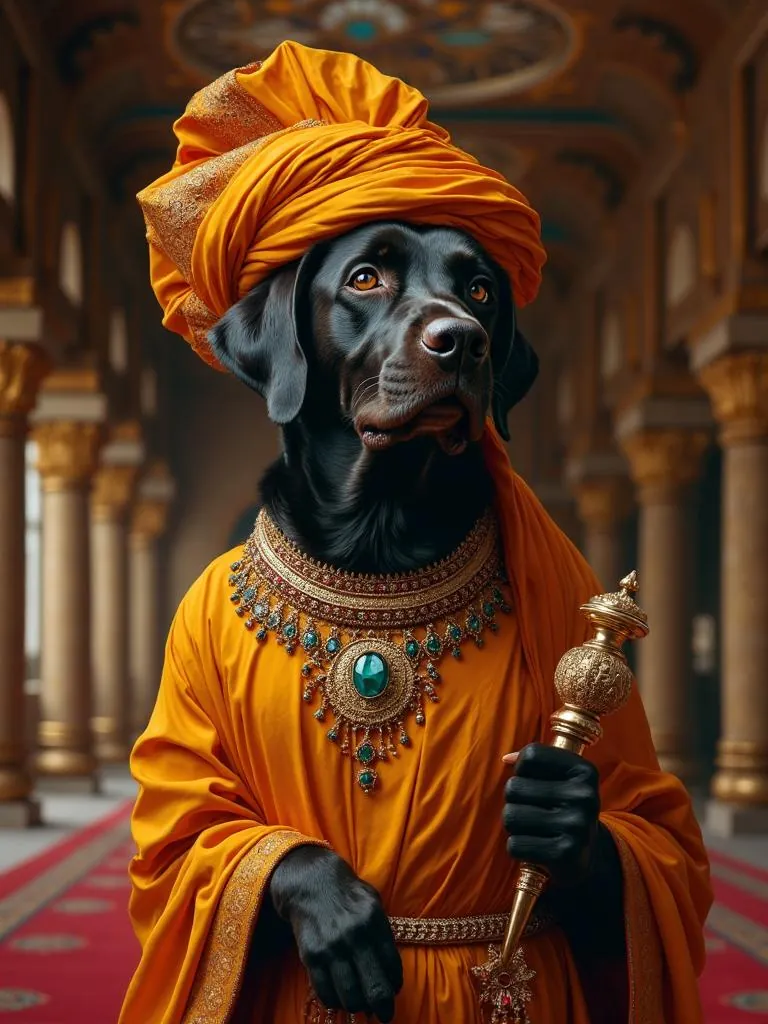
The Mysore Royal style on Purrealism takes its name from this court. In the gallery, the Mysore Royal portrait shows a black labrador as Mysore royalty in a saffron turban, holding a gold sceptre. The studio examples in the gallery also include an English Bulldog and a Rottweiler in the same style.
The Mysore portraits on this page show the most detail on the head and chest: the turban ornament, the pearls and the jewels. A photo that shows your pet's head and chest clearly suits this style. The portrait studio takes one photo of up to 5 MB. To see how the elephants and tigers of these courts were painted, read our page on animals in Indian court painting.
Questions and answers
What did Tipu Sultan look like in portraits?
Tipu Sultan appears in a Mysore portrait from around 1790, now at the Victoria and Albert Museum, wearing a bright green tunic and a green turban with a jewelled turban ornament. He wears three pearl necklaces with jewelled pendants and a gold sword on a jewelled sash, and he leans on a red cushion against a blue background. The V&A says his jewellery is distinctively different from the fashions of northern India.
Who ruled the Mysore kingdom?
The Mysore kingdom was ruled by the Wodeyar family, apart from the years when Haidar Ali and Tipu Sultan held power. According to India's NCERT, Haidar Ali ruled from 1761 to 1782 and his son Tipu Sultan from 1782 to 1799. After Tipu Sultan was killed in 1799, the British placed Mysore under the Wodeyars again, and the Victoria and Albert Museum says the five-year-old Krishnaraja Wodeyar III became Maharaja.
Is Tipu Sultan's palace the same as Mysore Palace?
Tipu Sultan's summer palace and Mysuru Palace are two separate buildings. The summer palace, called the Daria Daulat Bagh, stands in Srirangapatna, 20 km from Mysore, and Karnataka Tourism says it is made almost entirely of teakwood, with murals of battles, kings and court life. Mysuru Palace is in the city of Mysuru, and Karnataka Tourism says the Maharaja's Golden Throne is displayed there only during the Dasara festival.
What paintings are in Tipu Sultan's summer palace?
Tipu Sultan's summer palace at Srirangapatna has walls covered with paintings of battles, kings and court life, according to Karnataka Tourism, the Government of Karnataka's tourism department. The murals show royal processions with elephants and horses and Tipu Sultan riding into battle. One battle mural shows Tipu Sultan defeating the British at the Battle of Pollilur, painted on the wall as a crowded scene of war.
Why was Tipu Sultan called the Tiger of Mysore?
Tipu Sultan was called the Tiger of Mysore because of a story about him and because he made the tiger his royal sign. India's NCERT tells the legend that he killed a tiger while hunting after his gun failed, and says he had the image of a tiger on his flag. The Victoria and Albert Museum says the tiger was his emblem of state and that the British came to know him by this name.
Where was Tippoo's Tiger found?
Tippoo's Tiger was found by British soldiers in the music room of Tipu Sultan's palace at Srirangapatna after the siege of 1799, according to the Victoria and Albert Museum, which now holds it. The wooden figure shows a tiger attacking a man in European clothes and has a small organ hidden inside. The V&A says it already existed in 1792, when an English military artist, James Hunter, drew it.
Which year did Tipu Sultan die?
Tipu Sultan died in 1799. India's NCERT says he was killed on 4 May 1799 while defending his capital, Srirangapatna, in the last of four wars between Mysore and the British East India Company. Later British artists painted his death. The Victoria and Albert Museum holds a watercolour titled The Finding of the Body of Tipu Sultan at Seringapatam, painted between 1840 and 1860 and possibly by John Absolon.
Why were Tipu Sultan's sons taken as hostages?
Tipu Sultan's sons were taken as hostages under a treaty he was forced to sign with the British in 1792, according to India's NCERT. The British painter John Smart made a portrait of the eldest legitimate son, Abdul Khaliq, on 8 August 1792. The Victoria and Albert Museum says Smart's portraits of the boys were sent to Tipu, most likely to show that they were being treated kindly.
When did Krishnaraja Wodeyar III become king?
Krishnaraja Wodeyar III became Maharaja of Mysore in 1799, at the age of five, after the British defeated Tipu Sultan. The Victoria and Albert Museum says the British installed him and gave him some of Tipu Sultan's possessions, almost certainly including elephant howdahs. He ruled until 1868, and the V&A holds a painted scroll from around 1860 that shows him leading a religious procession on an elephant.
What does the Mysore procession scroll at the V&A show?
The Mysore procession scroll at the Victoria and Albert Museum shows Krishnaraja Wodeyar III on an elephant leading a religious procession in honour of Shiva. Painted around 1860, it is 21.5 cm high and 732 cm long. Dancers, musicians, fly whisk bearers and men with fireworks walk in front, and the British Resident, Colonel Mark Cubbon, rides behind. The V&A says the king was once wrongly identified as Sarabhoji (Serfoji) of Tanjore.
Who painted the Maharaja of Mysore in 1906?
The Mysore artist K. Keshavayya painted Maharaja Krishnaraja Wodeyar IV in 1906, in oil on canvas backed with card. According to the Victoria and Albert Museum, which received the painting in 1923, the maharaja faces the viewer in a pink satin brocade coat from Benares and a pink and gold turban with a feathered turban ornament trimmed with pearls. His jewels are set with diamonds and emeralds.
Did Raja Ravi Varma paint the Maharaja of Mysore?
Raja Ravi Varma did paint the Maharaja of Mysore. A 1905 watercolour by Ravi Varma in the Ganesh Shivaswamy Foundation, Bengaluru, shows Krishnaraja Wadiyar IV seated on the jewelled throne at his Dasara court at the Jaganmohan Palace. The same foundation holds a 1930s colour print from the Ravi Varma Press, made after a Ravi Varma painting of the same maharaja.
How did Delhi artists paint Tipu Sultan?
Delhi artists painted Tipu Sultan in the decades after his death, as one of the famous Indian rulers in the series of portraits they often painted. The Victoria and Albert Museum says they seem to have copied a Mysore portrait of around 1790. The V&A holds one Delhi copy, an oval miniature on ivory from around 1860, labelled Tippoo Sooltaun and showing him with a jewelled turban ornament and large pearls.
Sources
- From Trade to Territory (Our Pasts III, Class 8 history, chapter 2), National Council of Educational Research and Training (NCERT). Accessed September 28, 2026.
- Tipu Sultan, painting, Mysore, c. 1790, Victoria and Albert Museum. Accessed September 28, 2026.
- Half-length portrait of Tipu Sultan of Mysore, Delhi, c. 1860, Victoria and Albert Museum. Accessed September 28, 2026.
- Tippoo's Tiger, c. 1790, Victoria and Albert Museum. Accessed September 28, 2026.
- Palanquin pole-end in the form of a tiger's head, Mysore, c. 1790 to 1795, Victoria and Albert Museum. Accessed September 28, 2026.
- The Darya Daulat Bagh, painting, c. 1795 to 1800, Victoria and Albert Museum. Accessed September 28, 2026.
- Abdul Khaliq Sultan (1782 to 1806), portrait miniature by John Smart, Victoria and Albert Museum. Accessed September 28, 2026.
- The Finding of the Body of Tipu Sultan at Seringapatam, watercolour, Victoria and Albert Museum. Accessed September 28, 2026.
- A scroll-painting, Mysore, c. 1860, Victoria and Albert Museum. Accessed September 28, 2026.
- Azam Shah, painting, probably Mysore, c. 1780, Victoria and Albert Museum. Accessed September 28, 2026.
- Portrait of Maharaja Sir Sri Krishnaraja Wodeyar Bahadur, oil painting by K. Keshavayya, Victoria and Albert Museum. Accessed September 28, 2026.
- Marvels of Mysore, Salar Jung Museum, Hyderabad (on Google Arts & Culture). Accessed September 28, 2026.
- Tipu Sultan's Summer Palace, Srirangapatna, Department of Tourism, Government of Karnataka. Accessed September 28, 2026.
- Mysuru Palace, Department of Tourism, Government of Karnataka. Accessed September 28, 2026.
- Dasara Darbar at Jaganmohan Palace, Mysore, Raja Ravi Varma, 1905, The Ganesh Shivaswamy Foundation, Bengaluru (on Google Arts & Culture). Accessed September 28, 2026.
- Maharaja of Mysore, Raja Ravi Varma and Ravi Varma Press, The Ganesh Shivaswamy Foundation, Bengaluru (on Google Arts & Culture). Accessed September 28, 2026.
Short reads on this topic
Articles from Purrspectives that answer one question each.
What is Tanjore painting? Gold foil, gesso and the Thanjavur court
Tanjore painting is a South Indian style from Thanjavur, made on a wooden board with raised gesso, gold foil and glass stones. Where it came from and how it is made.
Indian royal pet portraits: the nine Indian court styles explained
An Indian royal pet portrait dresses your dog or cat as a ruler or warrior from an Indian court. Here are the nine styles and the history behind them.
The Maharajas of Patiala: the history behind Patiala royalty
The Phulkian rulers of Patiala founded their capital in 1763. Who built Qila Mubarak, who Bhupinder Singh was, and how Patiala joined India.