Famous paintings of dogs: 10 works to know and where to see them
Ten famous paintings of dogs, from Titian's emperor in 1533 to Balla's dachshund in 1912, with the museum that holds each one and what the dog does.
By Purrealism
Dogs sit beside emperors, walk with a young couple and sleep in the snow in some of the best-known paintings in the world. This guide lists 10 of them, from Titian's portrait of Emperor Charles V in 1533 to Giacomo Balla's dachshund in 1912. For each one you get the artist, the date, the museum and what the dog is doing, as the holding museum describes it.
Why dogs appear in famous paintings
Museums give three reasons for the dogs in old paintings.
- Faithfulness. The National Gallery in London says the small dog in Jan van Eyck's Arnolfini Portrait may stand for the couple's faithfulness to each other. Our guide to Renaissance painting looks at that dog and at Titian's Eleonora Gonzaga.
- Rank. The Museo del Prado in Madrid says portraits of rulers with dogs had a long tradition at the court of Burgundy, a region of France.
- Stories. The National Gallery says a dog is one of the signs of Diana, the goddess of hunting.
Many other dog paintings are portraits of a loved pet. The guide to what pet portraits are covers George Stubbs's foxhounds and Edwin Landseer's spaniel Dash, so the 10 works below are different ones.
Dogs at royal courts: 1533 and 1656
1. Emperor Charles V with a Dog, Titian, 1533 (Museo del Prado, Madrid). The emperor stands in a silver cloak and a fur coat, and a large dog is at his side. The Prado says it looks much like a portrait of the emperor in the same pose by Jacob Seisenegger, dated 1532. In a letter of 1535, Seisenegger wrote that he painted the dog from life, and that it was a female of an English breed. X-rays show that Titian changed the dog's pose as he worked. The Prado's page lists it in Room 27.
2. Las Meninas, Diego Velázquez, 1656 (Museo del Prado, Madrid). Velázquez painted this group portrait in a room of the Alcázar, the royal palace in Madrid. The Infanta Margarita, the king's young daughter, stands in the centre between two maids of honour. Velázquez shows himself at work on a large canvas, and a mirror at the back reflects the king and queen. At the front right, Nicolasito Pertusato teases a mastiff, the large dog in the corner. In 1724 the writer Antonio Palomino gave it a section of its own in his history of Spanish painters, the only painting he treated that way. The Prado lists it in Room 12.
The 1700s: a litter of puppies and a morning walk
3. Dog with pups, unknown artist, Rajasthan (Cleveland Museum of Art). Cleveland dates this painting on paper to 1780 or close to it, and places it in Ajmer, in Rajasthan. A dog is shown with its newborn puppies, which the museum says are still too young to open their eyes. The museum explains that dogs were kept in the Mughal imperial palace, with one keeper for every two hunting dogs, and that the emperor Jahangir asked the English ambassador Sir Thomas Roe for English hunting dogs. Our guides to Rajput painting and Mughal painting cover these courts.
4. Mr and Mrs William Hallett ('The Morning Walk'), Thomas Gainsborough, 1785 (National Gallery, London). William Hallett and Elizabeth Stephen walk arm in arm with a Pomeranian sheepdog, shortly before their wedding on 30 July 1785. The groom ordered the painting. The National Gallery says Gainsborough painted the dog's thick, soft coat with sparse, light brushstrokes. It hangs in Room 34.
The 1800s: grief, a Calcutta house and a dog named Tama
5. The Drowning Dog, Francisco de Goya, 1820 to 1823 (Museo del Prado, Madrid). Goya painted this scene straight onto a wall beside a door on the upper floor of his country house outside Madrid. It is one of his Black Paintings, which the Prado says are named for their dark colours and sad subjects. Only the dog's head shows, behind a wide area of colour that Goya left without detail. The dog looks toward something outside the picture. The Prado connects it with the idea that death cannot be avoided, and calls it the most mysterious of the Black Paintings. The page lists Room 67.
6. The Old Shepherd's Chief Mourner, Edwin Landseer, 1837 (Victoria and Albert Museum, London). In a room with little furniture, a dog rests its head on the coffin of its master, a shepherd. The V&A says it was a great success at the Royal Academy in 1837, helped by a print of it that sold widely the next year. It is on display in the British Galleries, Room 122. Landseer also painted many portraits of Queen Victoria and her pets, and our guide to Queen Victoria and her dogs covers them.
7. Two dogs in the compound of a Calcutta house, Shaikh Muhammad Amir, 1845 or close to it (Victoria and Albert Museum, London). This is a Company painting, the name for pictures made by Indian artists for British people living in India. Two salukis are in the yard of a house. On the left is General, a Feathered Saluki. On the right is the female, Aiyar, a Smooth Saluki. The V&A says it comes from a set made for a Calcutta resident, showing his house, servants and pets.
8. Tama, the Japanese Dog, Edouard Manet, 1875 or close to it (National Gallery of Art, Washington). A small, shaggy black and white dog stands in a room with wooden walls. It turns its head to the left with its pink tongue out. Manet painted its long, feathery fur with loose brushstrokes. The name "TAMA" is painted in block letters at the upper left, and what looks like a stuffed toy lies on the floor.
The 1900s: colour and movement
9. Dog Lying in the Snow, Franz Marc, 1911 or close to it (Städel Museum, Frankfurt). Marc painted his own dog, Russi, a white shepherd mix, asleep on the snow. The Städel says he wanted to see how the white of the fur changes against white snow. The museum bought the painting from Marc's widow in 1919. In 1937 the Nazi government removed it, with 76 other works, as "degenerate art". The Städel bought it back in 1961.
10. Dynamism of a Dog on a Leash, Giacomo Balla, 1912 (Buffalo AKG Art Museum, Buffalo, New York). A dachshund hurries along beside its owner's feet. Balla blurred and repeated the dog's body, the leash and the feet to show speed. He painted it in May 1912 while visiting a student at Montepulciano in Tuscany. In 1910, Balla and other Futurist artists had written that "all things move, all things run, all things are rapidly changing".
Where to see these paintings
| Painting | Artist | Date | Museum |
|---|---|---|---|
| Emperor Charles V with a Dog | Titian | 1533 | Museo del Prado, Madrid |
| Las Meninas | Diego Velázquez | 1656 | Museo del Prado, Madrid |
| Dog with pups | Unknown, Rajasthan | 1780 or close to it | Cleveland Museum of Art |
| The Morning Walk | Thomas Gainsborough | 1785 | National Gallery, London |
| The Drowning Dog | Francisco de Goya | 1820 to 1823 | Museo del Prado, Madrid |
| The Old Shepherd's Chief Mourner | Edwin Landseer | 1837 | V&A, London |
| Two dogs in the compound of a Calcutta house | Shaikh Muhammad Amir | 1845 or close to it | V&A, London |
| Tama, the Japanese Dog | Edouard Manet | 1875 or close to it | National Gallery of Art, Washington |
| Dog Lying in the Snow | Franz Marc | 1911 or close to it | Städel Museum, Frankfurt |
| Dynamism of a Dog on a Leash | Giacomo Balla | 1912 | Buffalo AKG Art Museum |
The room numbers in the list above are the ones each museum's page gave in September 2026. The Cleveland and Washington pages list their paintings as not on view, and the V&A shows the Calcutta painting by appointment. Check the page again before you travel.
How a modern pet portrait follows these paintings
Several of these works show one real animal that someone knew. Seisenegger painted the emperor's dog from life. Marc painted his own dog, Russi. Tama's name is on the canvas, and General and Aiyar belonged to a Calcutta household. Our guide to dogs in art goes deeper into these painters and traditions, from van Eyck's small pet to Maud Earl's grieving terrier.
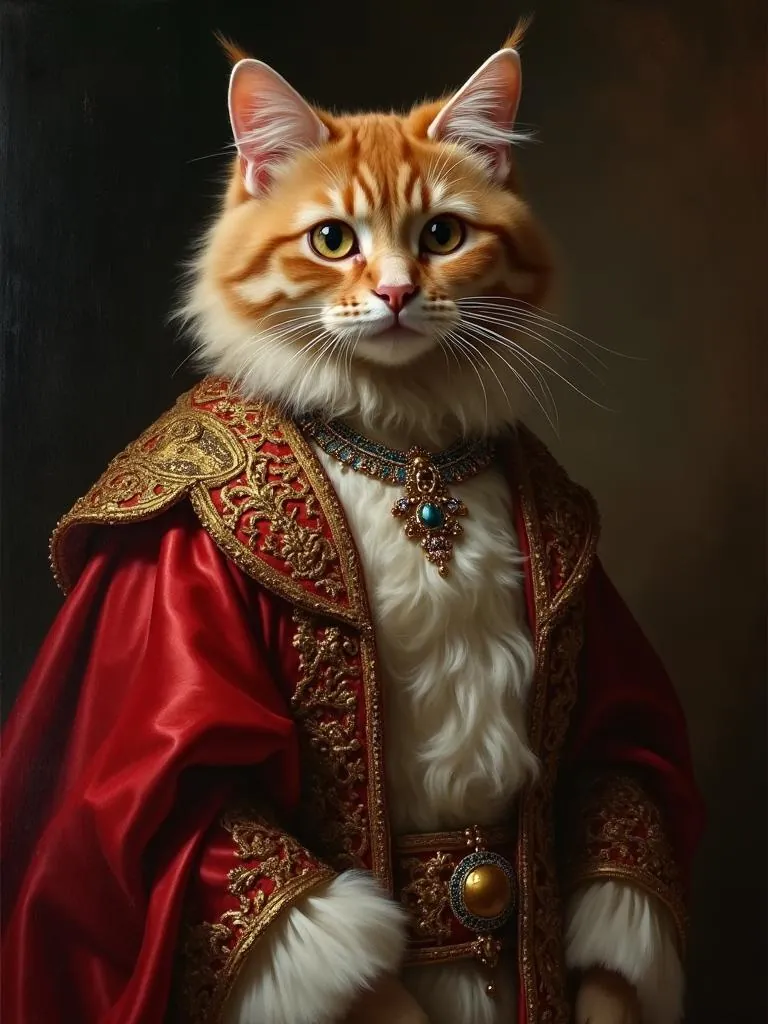
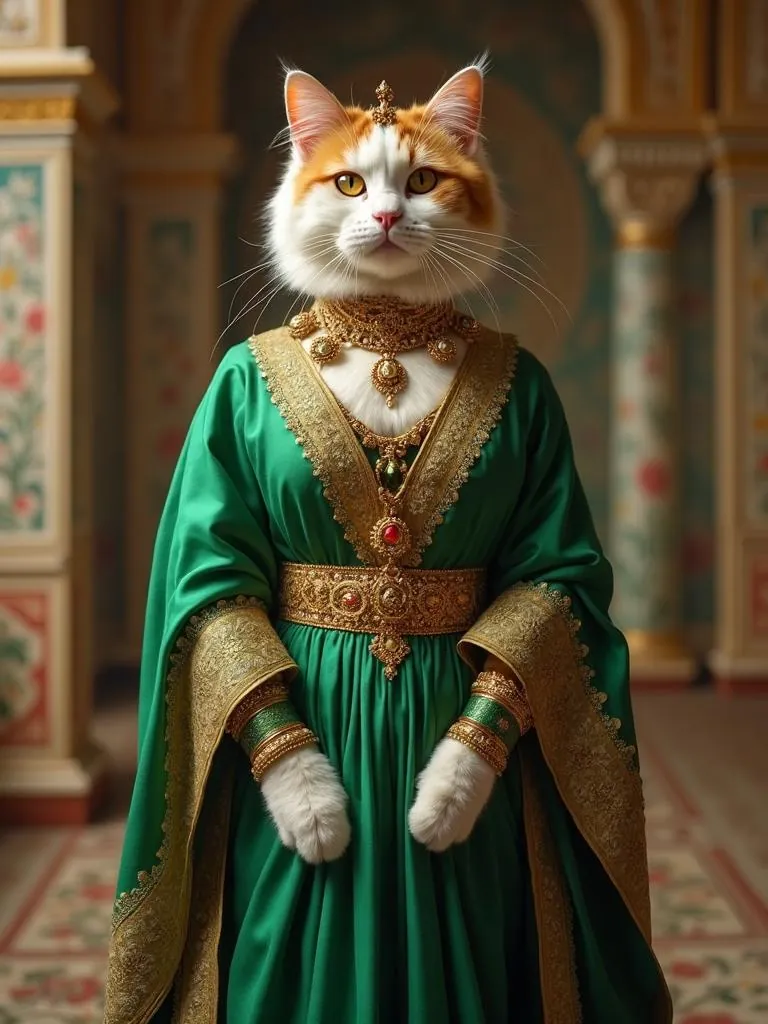
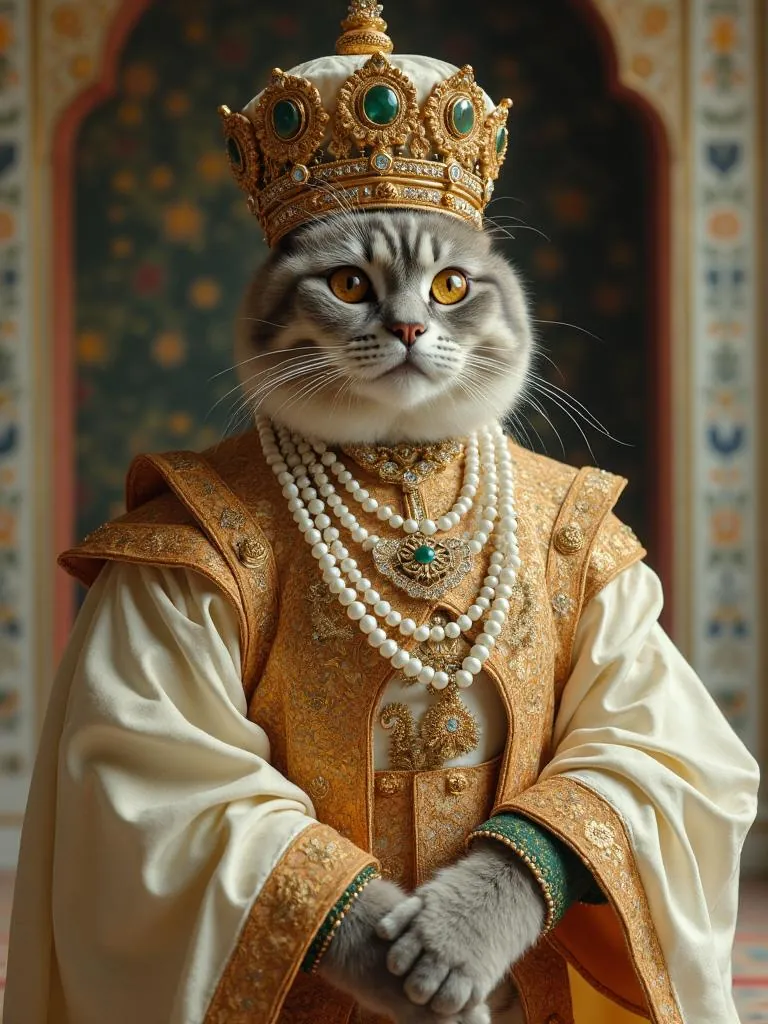
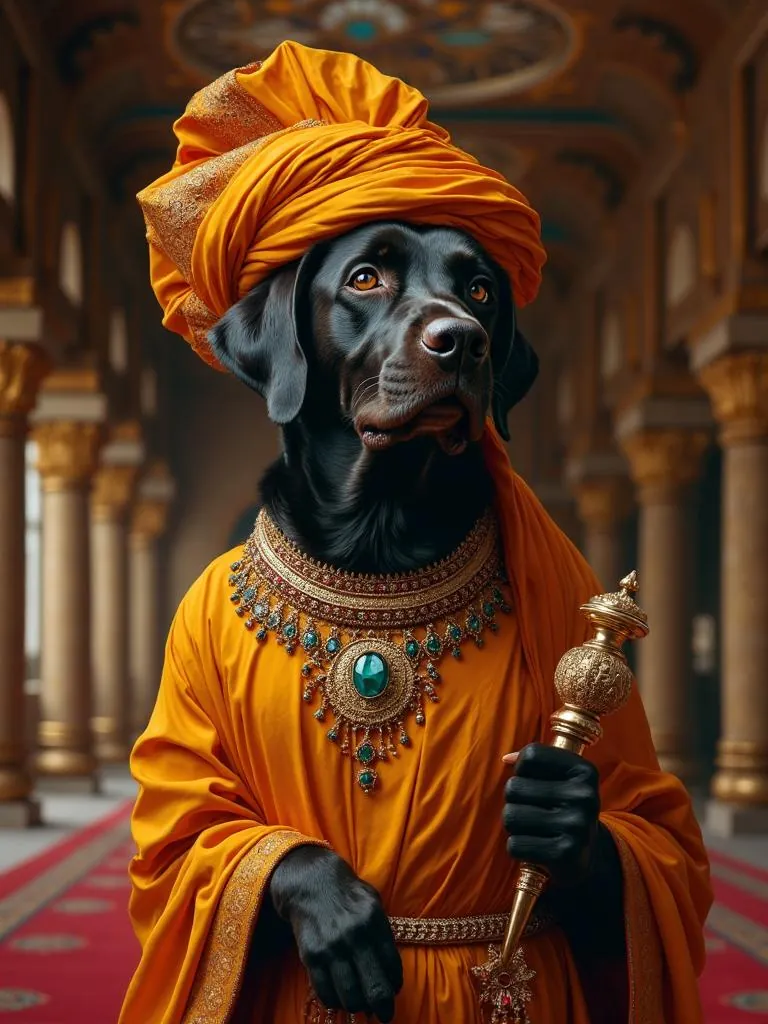
A royal pet portrait keeps that idea and puts your dog or cat at the centre, dressed as a ruler. Purrealism offers 15 royal portrait styles. In the gallery, the Mysore Royal portrait shows a black labrador in a saffron turban holding a gold sceptre, and the Maharaja portrait shows a golden retriever in a red jewelled turban on a gold throne. The European styles, such as Renaissance Royal, Baroque Aristocrat and Regency Era, can be chosen in the portrait studio.
The likeness starts with your photo. Use one where your pet's eyes and markings are sharp, taken at eye level, saved as an image file of up to 5 MB. Our guide on how to photograph your pet for a portrait goes through each step.
Questions and answers
What do dogs mean in old paintings?
Dogs in old paintings can stand for faithfulness, show a ruler's rank, or belong to a story. The National Gallery in London says the small dog in Jan van Eyck's Arnolfini Portrait may stand for the couple's faithfulness, and that a dog is one of the signs of Diana, the goddess of hunting. The Museo del Prado says portraits of rulers with dogs had a long tradition at the court of Burgundy.
Who painted Las Meninas?
Diego Velázquez painted Las Meninas in 1656, in a room of the Alcázar, the royal palace in Madrid, according to the Museo del Prado. The painting now hangs in the Prado, which lists it in Room 12. A large dog, a mastiff, is at the front right of the picture, where Nicolasito Pertusato is teasing it. The canvas is 320.3 cm high and 279.1 cm wide.
Is Las Meninas a portrait?
Las Meninas is a group portrait, according to the Museo del Prado in Madrid. It shows real people from the Spanish court in a real room of the royal palace, with the young Infanta Margarita in the centre and Velázquez himself at work on a large canvas. A mirror at the back reflects King Philip IV and Queen Mariana of Austria. The Prado says its many meanings bring it closer to history painting.
What does Las Meninas mean?
Las Meninas means the maids of honour, the young women who served the Spanish queen. According to the Museo del Prado, the two meninas in Velázquez's painting of 1656 are María Agustina Sarmiento and Isabel de Velasco. They attend the Infanta Margarita, the king's daughter, and María Agustina kneels to offer her a jug of water. A mastiff is at the front right of the same scene.
What is a Goya painting?
A Goya painting is a work by Francisco de Goya, a Spanish painter born in Fuendetodos in 1746 who died in Bordeaux in 1828, according to the Museo del Prado. The Prado holds his Drowning Dog, painted between 1820 and 1823 on a wall of his country house outside Madrid. It is one of the Black Paintings, named for their dark colours and sad subjects. Only the dog's head shows, behind a wide area of colour.
What is a Landseer dog?
A Landseer dog is the black and white Newfoundland breed, named after the British painter Edwin Landseer, according to the National Gallery of Art in Washington. Landseer, who lived from 1802 to 1873, is known today as the animal painter. His painting The Old Shepherd's Chief Mourner, from 1837, shows a dog resting its head on its master's coffin. The Victoria and Albert Museum in London holds it.
Why did Franz Marc paint animals?
Franz Marc painted animals to show them living in harmony with nature, using colour as a symbol, according to the Städel Museum in Frankfurt. From 1910 his animal pictures became more and more simplified. In Dog Lying in the Snow he painted his own dog, Russi, a white shepherd mix, asleep. The Städel says he showed the dog sleeping to express the pure and peaceful nature of animals.
Who is Franz Marc?
Franz Marc was a painter born in Munich in 1880, according to the Städel Museum in Frankfurt. In 1911 he and other artists founded the Blauer Reiter group, which Wassily Kandinsky and August Macke joined. From 1910 he painted more and more simplified animal pictures, such as Dog Lying in the Snow. He volunteered for military service in 1914 and died at the front near Verdun in 1916.
Where can I see famous paintings of dogs?
Famous paintings of dogs hang in museums in Madrid, London, Frankfurt and the United States. The Museo del Prado in Madrid holds three: Titian's Emperor Charles V with a Dog, Velázquez's Las Meninas and Goya's Drowning Dog. In London, the National Gallery shows Gainsborough's Morning Walk and the Victoria and Albert Museum shows Landseer's Old Shepherd's Chief Mourner. Check each museum's page first, because some works are not on view.
What dog did Giacomo Balla paint?
Giacomo Balla painted a dachshund on a leash in 1912, in the work Dynamism of a Dog on a Leash, now at the Buffalo AKG Art Museum in New York State. According to the museum, he painted it in May 1912 while visiting a student at Montepulciano in Tuscany. The dog's body, the leash and the owner's feet are blurred and repeated, so the dog seems to be moving fast.
Sources
- Emperor Charles V with a Dog, Titian, Museo Nacional del Prado
- Charles the Fifth with a Dog. Titian (easy-to-read), Museo Nacional del Prado
- Las Meninas, Diego Velázquez, Museo Nacional del Prado
- Las Meninas. Diego Velázquez (easy-to-read), Museo Nacional del Prado
- The Drowning Dog, Francisco de Goya, Museo Nacional del Prado
- Francisco de Goya y Lucientes, Museo Nacional del Prado
- Dogs, The National Gallery, London
- Mr and Mrs William Hallett ('The Morning Walk'), Thomas Gainsborough, The National Gallery, London
- Dog with pups, Cleveland Museum of Art
- The Old Shepherd's Chief Mourner, Edwin Henry Landseer, Victoria and Albert Museum
- Two dogs in the compound of a Calcutta house, Shaikh Muhammad Amir, Victoria and Albert Museum
- Tama, the Japanese Dog, Edouard Manet, National Gallery of Art, Washington
- Who Is Sir Edwin Landseer? 10 Things to Know, National Gallery of Art, Washington
- Dog Lying in the Snow, Franz Marc, Städel Museum
- Franz Marc, Städel Museum
- Dinamismo di un cane al guinzaglio (Dynamism of a Dog on a Leash), Giacomo Balla, Buffalo AKG Art Museum
Go deeper
The full guides on this topic, each a set of pages with sources: