Queen Victoria and her dogs: Dash, the Pomeranians and their portraits
Queen Victoria's first famous dog was Dash, a King Charles spaniel painted by Landseer. Later she kept collies, pugs and up to 35 Pomeranians.
By Purrealism
Queen Victoria owned dogs from 1833, when she was a 13-year-old princess, until the last years of her reign. Many of them were painted or photographed. The Royal Collection Trust, which cares for the British royal art collection, holds portraits of her dogs by Edwin Landseer and Charles Burton Barber, photographs from the royal kennels, and a drawing of her spaniel made by Victoria herself. This guide goes through her best-known dogs and the pictures made of them.
What was Queen Victoria's dog called?
Her first famous dog was Dash, a King Charles spaniel. The Royal Collection Trust says Sir John Conroy, who managed her mother's household, gave Dash to the Duchess of Kent on 14 January 1833. By April that year the dog went almost everywhere with the young princess. She called him "Dear little Dashy" and wrote that he was "so fond of playing at ball and of barking and jumping".
Victoria drew him herself. The Trust holds her pencil drawing of Dash lying down, dated 9 February 1834. The sheet is 3.9 by 6.8 cm, and she wrote "from nature" along its edge, which means she drew him while looking at him.
In 1836 her mother asked Edwin Landseer to paint Dash as a birthday present for Victoria. That small painting is covered in the guide to what pet portraits are.
By late 1837 Victoria was queen, and she ordered a larger picture from Landseer. Hector, Nero, and Dash with the parrot, Lory is dated 1838 and measures 120.3 by 150.3 cm. Hector, a deerhound, and Nero, a black greyhound, stand beside a stool where Dash lies. In front of them the parrot cracks nuts. Victoria's journal records the painting's progress. On 29 November 1837 she saw it "with the dogs only sketched in". On 9 April 1838 she called the finished work "the most beautiful thing imaginable". It was shown at the Royal Academy that year.
Dash died on 24 December 1840. He was buried at Adelaide Cottage in Windsor Home Park, and a marble statue of him was placed over the grave. The words on it end: "READER, If you would be beloved and die regretted, Profit by the example of DASH."
Eos, Prince Albert's greyhound
Victoria married her cousin Prince Albert of Saxe-Coburg-Gotha on 10 February 1840, according to Encyclopaedia Britannica. Albert brought his favourite greyhound, Eos, with him to England that year. In a letter to Victoria before the wedding, he wrote that Eos "sleeps by the stove" and was "keen on hunting, sleepy after it".
Victoria asked Landseer to paint Eos as a Christmas present for Albert. The painting is signed and dated 1841 and measures 111.8 by 142.9 cm. Eos stands beside Albert's top hat, leather gloves and cane, on a red tablecloth. The Royal Collection Trust says Landseer is said to have borrowed the hat and gloves without asking. Albert's servants could not find them when he wanted to go out. On 24 December 1841 Victoria wrote that the painting "came as a complete surprise" to him.
Eos died in 1844. Victoria wrote that the dog had been with Albert for 10 and a half years, since she was 6 months old. Albert then worked with the sculptor John Francis on two bronze statues of Eos, based on Landseer's painting. One stands in Windsor Home Park and the other at Osborne.
Eos also appears in Landseer's large family picture, Windsor Castle in modern times, painted from 1841 to 1843. Albert sits in his outdoor clothes after a day of shooting, with his hand on Eos. Three more dogs, called Dandy Dinmont, Islay and Cairnach, move around him. Victoria hands him a small bunch of flowers, and their young daughter plays with a kingfisher from his hunt. The Trust says Landseer made more than forty works for Victoria and Albert.
How many dogs did Queen Victoria have?
The Royal Collection Trust says Victoria and Albert were the first royal couple to keep a record of their large group of dogs. The royal kennels, built in Windsor Home Park in the early 1840s, housed up to a hundred dogs. In 1854 Victoria asked the photographer William Bambridge to photograph the dogs in the Windsor kennels, and the project went on until the end of her reign.
She kept many breeds. The Trust names dachshunds, collies and pugs among the breeds she favoured, as well as her Pomeranians. In 1885 Charles Burton Barber painted three of her dogs with a kitten, a picture described in the guide to royal cats in history.
Victoria also cared how her dogs were treated. At a time when cutting dogs' tails and ears was common, she banned it in the royal kennels. In 1885 she became the first royal patron, or official supporter, of Battersea Dogs Home. For other kings and queens who kept dogs, see the guide to royal dogs in history.
The collies called Noble
Queen Victoria owned several collies called Noble. The Royal Collection Trust says the most famous was Noble IV, who lived from 1871 to 1887. Lady Charles Innes-Kerr gave him to the Queen in 1872, and he died at Balmoral on 18 September 1887. Victoria called him "a real friend".
His painter was Barber. The Trust says Barber admired Landseer and specialised in small house and farm animals, above all dogs. Queen Victoria employed him often between 1872 and 1894.
Barber's 1875 painting of Noble IV shows the black and tan collie in a Scottish Highland landscape, with sheep and a lake behind him. Beside him lie a tartan rug and the Queen's own sketchbook and painting things. When Victoria saw the picture on 3 March 1875, she called it "excellent", and it was shown at the Royal Academy that year.
In 1881 Barber painted Noble again, lying on a step at Osborne. For another picture, finished before April 1877, he painted the Queen and her youngest daughter, Princess Beatrice, with four dogs: Waldmann, Fern, Sharp and Noble. The Trust says he painted it from photographs.
Did Queen Victoria have Pomeranians?
Yes. The Kennel Club, founded in Britain in 1873 to set rules for dog shows, says the Pomeranian was first seen in Britain in 1870. It became a great favourite of Queen Victoria, whose dogs were shown at dog shows in London, and royal support helped make the breed popular.
The American Kennel Club says she grew fond of Pomeranians while visiting Florence, Italy, and brought several home. She became a serious breeder, and at one point had as many as 35 Pomeranians in her kennels. The Royal Collection Trust says she showed six of them at the first Crufts dog show in 1891.
The Trust holds pictures of two of her Pomeranians:
- Marco. George Piner Cartland photographed him at the Royal Kennels in Windsor in 1890, lying on a decorated cloth. The artist Frances C. Fairman painted him in watercolour in the 1890s, standing and facing the viewer.
- Turi. Victoria got Turi in 1893. A photograph from the 1890s shows her sitting in her carriage in dark clothes, with Turi on her lap.
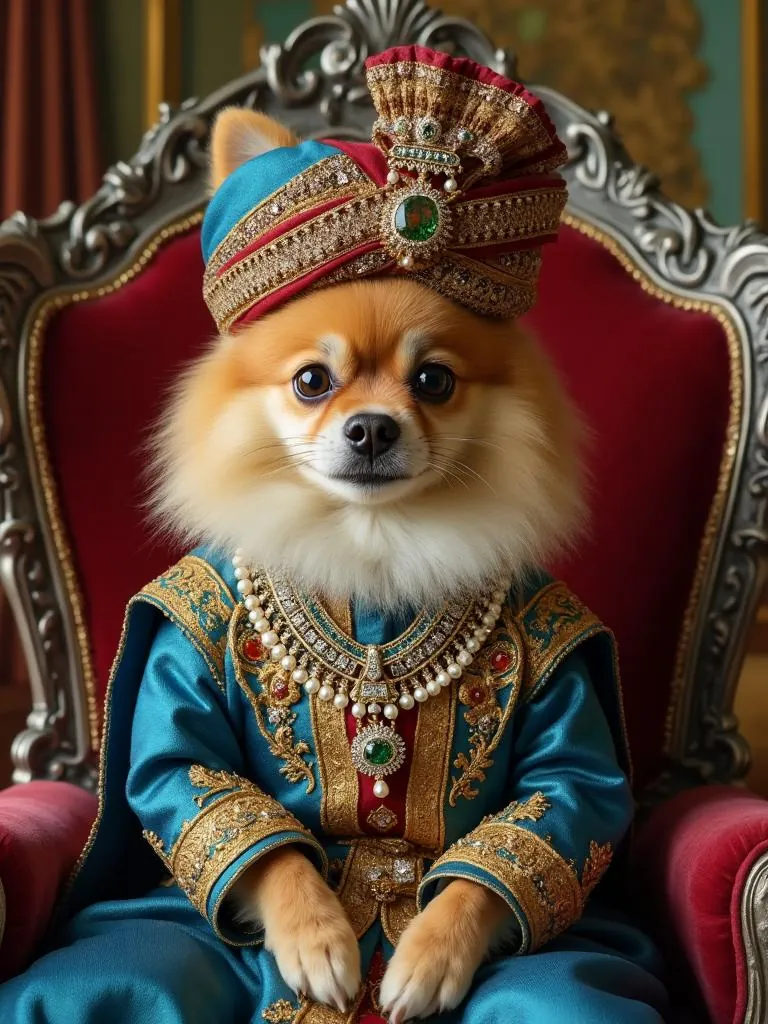
The cover of this guide shows a Pomeranian in Purrealism's Patiala Royalty style. The history behind that style is in the guide to the Maharajas of Patiala.
A Victorian portrait of your own dog
Purrealism has a portrait style called Victorian Noble. It is one of six European period styles, next to nine styles from Indian royal courts. The gallery shows finished portraits in the Indian court styles. To try Victorian Noble for your own dog or cat, choose it in the portrait studio.
Barber painted his portrait of the Queen, Princess Beatrice and their four dogs from photographs. A Purrealism portrait also starts from one photo of your pet, and the studio takes an image file of up to 5 MB. A clear photo taken in daylight at your pet's eye level shows the eyes and markings best, and the guide on how to photograph your pet for a portrait explains each step.
Questions and answers
What was Queen Victoria's dog called?
Queen Victoria's best-known dog was called Dash, a King Charles spaniel she owned as a princess. According to the Royal Collection Trust, Sir John Conroy gave Dash to Victoria's mother, the Duchess of Kent, on 14 January 1833, and by April that year the dog went almost everywhere with the young princess. Victoria later owned many more named dogs, including collies called Noble and the Pomeranians Marco and Turi.
What breed was Queen Victoria's dog Dash?
Queen Victoria's dog Dash was a King Charles spaniel, according to the Royal Collection Trust, which holds a pencil drawing of him that Princess Victoria made herself on 9 February 1834. The Trust says King Charles I made the King Charles spaniel popular in the seventeenth century, and several appear in court portraits by Sir Anthony van Dyck. Edwin Landseer painted Dash in oil in 1836.
When did Queen Victoria's dog Dash die?
Queen Victoria's dog Dash died on 24 December 1840, according to the Royal Collection Trust. He was buried at Adelaide Cottage in Windsor Home Park, under a marble statue of him, and the words on the grave say he died in his 10th year. The inscription praises him: 'His attachment was without selfishness, His playfulness without malice, His fidelity without deceit.'
Does Queen Victoria get another dog after Dash?
Queen Victoria kept many more dogs after Dash died in 1840. According to the Royal Collection Trust, she already had Hector, a deerhound given to her in June 1835, and Prince Albert brought his greyhound Eos to England in 1840. Royal kennels were built at Windsor in the early 1840s, and she went on to own collies, dachshunds, pugs and Pomeranians.
How many dogs did Queen Victoria have?
Queen Victoria's kennels at Windsor housed up to a hundred dogs, according to the Royal Collection Trust. The kennels were built in Windsor Home Park in the early 1840s. From 1854 she asked the photographer William Bambridge to photograph the dogs there, and the project went on until the end of her reign. The American Kennel Club says she once had as many as 35 Pomeranians alone.
How many Pomeranians did Queen Victoria have?
Queen Victoria once had as many as 35 Pomeranians in her kennels, according to the American Kennel Club. The Royal Collection Trust says she showed six of her Pomeranians at the first Crufts dog show in 1891. Her named Pomeranians included Marco, photographed at the Royal Kennels in Windsor in 1890, and Turi, who joined her in 1893.
Which queen had Pomeranians?
Queen Victoria of the United Kingdom, who reigned from 1837 to 1901 according to Encyclopaedia Britannica, kept Pomeranians and helped make the breed popular. The Kennel Club says the Pomeranian was first seen in Britain in 1870 and became a great favourite of Queen Victoria, whose dogs were shown at dog shows in London. The American Kennel Club says she grew fond of the breed while visiting Florence, Italy.
What were Queen Victoria's pets?
Queen Victoria's pets included many dogs, a parrot called Lory and at least one cat. According to the Royal Collection Trust, her uncle Ernest I, Duke of Saxe-Coburg-Gotha, gave her the parrot in May 1836, and Landseer painted it. Her dogs included the spaniel Dash, the deerhound Hector, collies called Noble and many Pomeranians. Charles Burton Barber painted a kitten with three of her dogs in 1885.
Who painted Prince Albert's greyhound Eos?
Sir Edwin Landseer painted Prince Albert's greyhound Eos in 1841, and Queen Victoria gave the painting to Albert on 24 December 1841 as a surprise. According to the Royal Collection Trust, Landseer is said to have borrowed Albert's hat and gloves for the painting without telling him. Eos came with Albert to England in 1840 and died in 1844. The canvas measures 111.8 by 142.9 cm.
Who painted Queen Victoria's collie Noble?
Charles Burton Barber painted Queen Victoria's collie Noble several times. According to the Royal Collection Trust, Barber's 1875 painting shows Noble IV standing in a Highland landscape, and the Queen called it 'excellent' when she saw it on 3 March 1875. Noble IV lived from 1871 to 1887. The Trust says Queen Victoria employed Barber often between 1872 and 1894.
Sources
- Royal Pets, Royal Collection Trust
- Queen Victoria, Dash (RCIN 980015.eo), Royal Collection Trust
- Sir Edwin Landseer (1802-73), Dash (RCIN 403096), Royal Collection Trust
- Sir Edwin Landseer (1802-73), Hector, Nero, and Dash with the parrot, Lory (RCIN 405969), Royal Collection Trust
- Sir Edwin Landseer (1802-73), The Lory (RCIN 403049), Royal Collection Trust
- Sir Edwin Landseer (1802-73), Eos (RCIN 403219), Royal Collection Trust
- Sir Edwin Landseer (1802-73), Windsor Castle in modern times (RCIN 406903), Royal Collection Trust
- Charles Burton Barber (1845-94), "Noble" (1871-1887) (RCIN 406297), Royal Collection Trust
- Charles Burton Barber (1845-94), "Noble" (RCIN 403859), Royal Collection Trust
- Charles Burton Barber (1845-94), Queen Victoria with Princess Beatrice and the dogs Waldmann, Fern, Sharp and Noble (RCIN 406403), Royal Collection Trust
- Charles Burton Barber (1845-94), Cat and Dogs belonging to Queen Victoria (RCIN 403567), Royal Collection Trust
- George Piner Cartland, 'Marco', Queen Victoria's pet Pomeranian dog at the Royal Kennels, Windsor, 1890 (RCIN 2105459), Royal Collection Trust
- Frances C Fairman (1836-1923), Marco, Pomeranian dog, belonging to Queen Victoria (RCIN 923781), Royal Collection Trust
- Queen Victoria with Turi in her carriage (RCIN 2105750), Royal Collection Trust
- Pomeranian, Breeds A to Z, The Royal Kennel Club
- The Royal Kennel Club Timeline (1800s), The Royal Kennel Club
- 6 Reasons Why Pomeranians Are Totally Unforgettable, American Kennel Club
- What Were Toy Group Dogs Bred to Do?, American Kennel Club
- Victoria, queen of United Kingdom, Encyclopaedia Britannica
Go deeper
The full guides on this topic, each a set of pages with sources: