Updated
What are pet portraits? A short history of animals in portrait painting
A pet portrait is a picture of one particular animal. How painters made them for a Mughal emperor, an English lord and Queen Victoria, and what works now.
By Purrealism
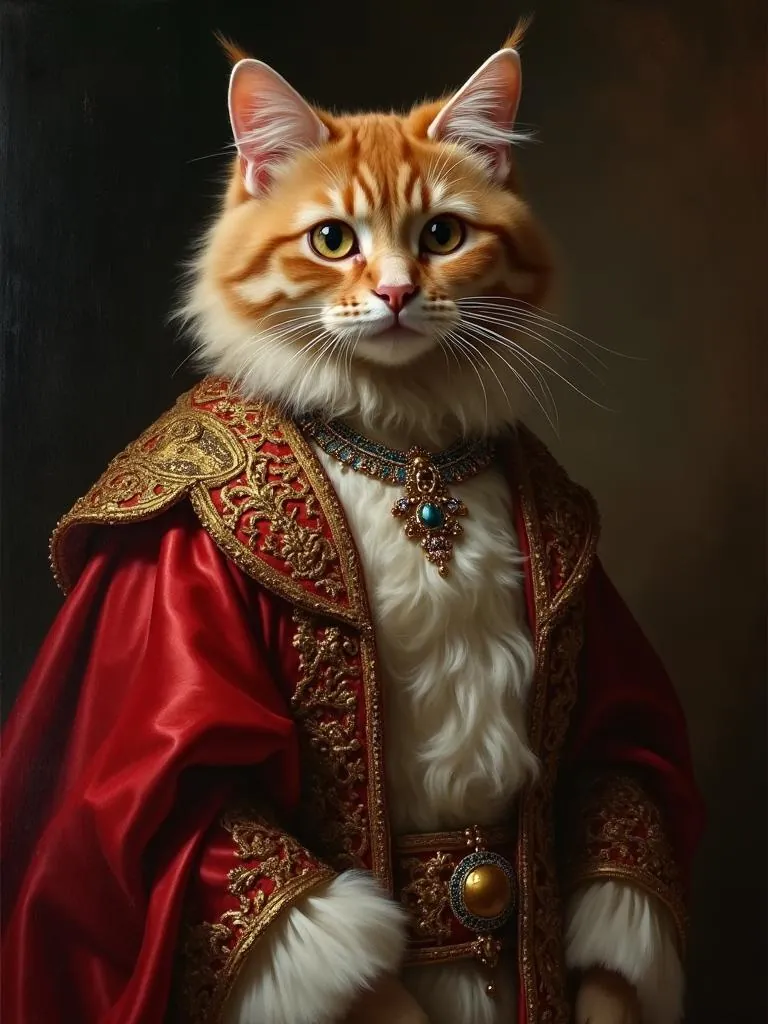
A pet portrait is a picture of one particular animal: your dog, your cat, a favourite horse. Its owner should be able to look at it and say "that is him". Painters made these pictures for a Mughal emperor in the 1620s, an English lord in the 1760s and Princess Victoria in the 1830s. This guide covers what a pet portrait is, three painters from its history, and what makes a good one today.
What is a pet portrait?
Tate, which runs four art galleries in Britain, defines a portrait as "a representation of a particular person". A pet portrait uses the same idea for an animal. It shows one named dog or cat with its own face, coat and markings, so nobody could mistake it for another animal of the same breed.
Tate also explains that portraits have been used to show the power, importance, wealth and taste of the sitter, the person being painted. The National Gallery in London gives the reason behind one famous animal portrait: the owner of the racehorse Whistlejacket bred horses, and saw him as a fine example of pure-bred Arabian stock.
Before photography, Tate says, a painted, sculpted or drawn portrait was the only way to record how someone looked. Photography then became the main way to make portraits, and it made them affordable for almost everyone.
Can a portrait be of an animal?
Yes. Museums and Encyclopaedia Britannica use the word "portrait" for paintings of animals.
- The National Gallery in London calls Whistlejacket, by George Stubbs, "probably the most well-known portrait of a horse".
- Encyclopaedia Britannica says Stubbs built a reputation as "the leading painter of portraits of the horse".
- The National Gallery of Art in Washington says Edwin Landseer "painted many portraits of Queen Victoria and her pets".
- The Metropolitan Museum of Art in New York says Mughal painters gave animals the same plain or calm background they used in portraits of people.
A painting of your cat in a royal robe follows the same practice. The three painters below show how animal portraits developed in India and in Britain.
Animals at the Mughal court
The Mughal emperor Jahangir ruled from 1605 to 1627, according to The Metropolitan Museum of Art. The Met says he encouraged careful studies of plants and animals, and valued realistic portraits. Many painters signed their work in his time, so we know their names.
One of them was Mansur. The Met holds his "Study of a Nilgai (Blue Bull)", painted close to 1620 in ink, watercolour and gold on paper. The nilgai is an antelope from central and northern India and eastern Pakistan. The Met says Mansur probably painted it after watching the animal in Jahangir's zoo.
Mansur painted the swirl of hair where the nilgai's neck meets its body. He left the background plain, with no sign of the place where nilgai live. The Met explains that Mughal animal paintings usually had a plain or calm setting, the same as Mughal portraits of people. The Met also holds Mansur's paintings of a great hornbill and of two vultures, mounted in the same album.
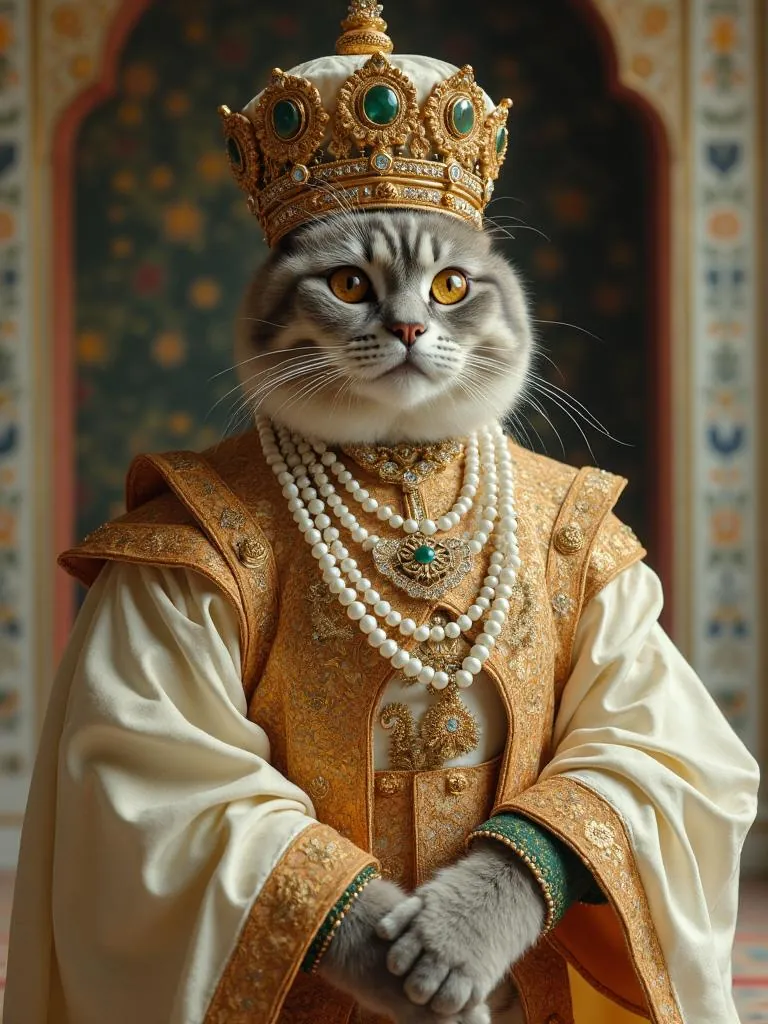
If you like this court's style, the Mughal Emperor portrait in the Purrealism gallery shows a grey cat in a jewelled crown and pearls. The guide to Mughal painting covers the court in more detail.
George Stubbs: horses and hounds
George Stubbs was born in Liverpool on 24 August 1724 and died in London on 10 July 1806, according to Encyclopaedia Britannica. Britannica calls him an English animal painter.
Stubbs wanted to know how a horse's body is built. In the 1750s he rented a farmhouse in Lincolnshire and spent 18 months cutting up and studying the bodies of many horses. He moved to London in 1760. His book of prints, Anatomy of the Horse, came out in 1766. Britannica says it became an important reference for artists and naturalists.
His most famous horse portrait is Whistlejacket, which the National Gallery dates to 1762 or close to it. The National Gallery in London describes it:
- The horse is shown life-size. The canvas is 296.1 by 248 cm.
- Whistlejacket had won a famous race at York in 1759.
- His owner, the 2nd Marquess of Rockingham, asked Stubbs for the painting, and in the end ordered 12 paintings from him.
- Stubbs painted no rider, no saddle and no place. The horse rears up against a plain, pale gold background.
The National Gallery bought the painting in 1997. You can see it in Room 34.
Stubbs painted dogs as well. Tate holds his painting A Couple of Foxhounds, dated 1792. Britannica says he also painted lions, tigers, a giraffe, a monkey and a rhinoceros, which he could study in private collections of wild animals.
Queen Victoria's dogs and Edwin Landseer
Edwin Landseer lived from 1802 to 1873. The National Gallery of Art in Washington says he is known today as the "animal painter". It also says he painted many portraits of Queen Victoria and her pets, and that the queen knighted him in 1850.
The Royal Collection Trust, which cares for the British royal art collection, holds his painting of a spaniel named Dash. Dash had belonged to Princess Victoria since 1833. Her mother, the Duchess of Kent, asked Landseer to paint him. She gave the painting to Victoria on 23 May 1836, the day before her birthday. Dash died on 24 December 1840.
The Dash painting is small: oil paint on a wood panel, 30.3 by 28.6 cm. That is smaller than a 12 × 16 inch print. Whistlejacket is almost ten times as tall, and the National Gallery says Stubbs painted it on a scale more usual for a group portrait or a history painting.
The National Gallery of Art gives two more facts that show how well known Landseer became. A black and white Newfoundland dog breed, called the Landseer, is named after him. He also made the four bronze lions around the base of Nelson's Column in Trafalgar Square, London.
For more examples, see the lists of famous paintings of dogs and famous paintings of cats, and the story of royal dogs in history.
What makes a good pet portrait today
A Purrealism royal portrait starts from one photo of your pet, and three choices decide how it turns out.
A clear photo. The photo sets your pet's face in the portrait. Use one where the eyes and markings are sharp, taken at your pet's eye level and in daylight if you can. The portrait studio accepts one image file of up to 5 MB. The guide on how to photograph your pet for a portrait goes through the steps.
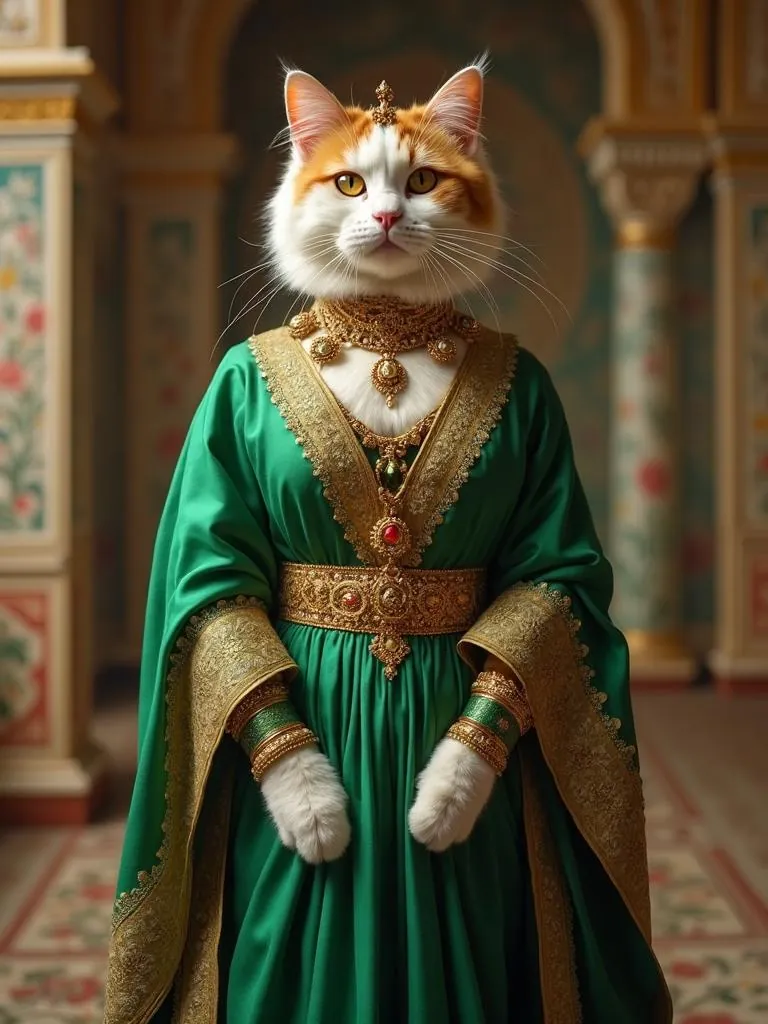
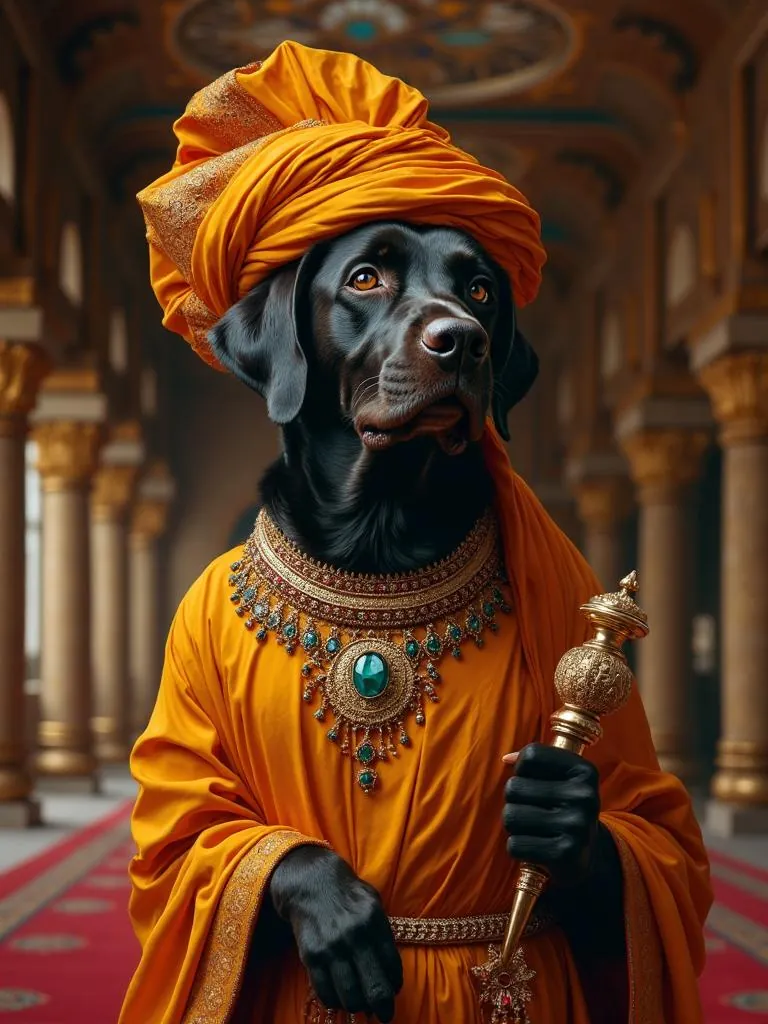
A style that suits your pet. Purrealism has 15 royal styles: nine from Indian royal courts and six from European periods. Pick one whose clothes stand out against your pet's coat. In the gallery, the Mysore Royal portrait puts a black labrador in a saffron turban, and the Maharani portrait puts a white and ginger cat in a green and gold gown. The guide on choosing a royal portrait style covers coat colour and character.
A size for the wall. Art prints come in four sizes: 8 × 10, 12 × 16, 18 × 24 and 24 × 36 inches, on matte or glossy paper. Measure the wall first. An 8 × 10 inch print suits a desk or a shelf, and a 24 × 36 inch print can fill the space above a sofa. The guide to how big an 8 × 10 print is shows the smallest size in real measurements.
Questions and answers
What are pet portraits?
Pet portraits are pictures of one particular animal, such as a family dog, cat or horse, made so that its owner can recognise it. Tate defines a portrait as a representation of a particular person, and museums use the same word for animals. The National Gallery in London calls George Stubbs's Whistlejacket, dated to 1762 or close to it, probably the most well-known portrait of a horse. A Purrealism royal portrait starts from one photo of your dog or cat.
Can portraits be of animals?
Portraits can be of animals, and painters have made them for centuries. Encyclopaedia Britannica says George Stubbs (1724 to 1806) built a reputation as the leading painter of portraits of the horse. The National Gallery of Art in Washington says Edwin Landseer painted many portraits of Queen Victoria and her pets. According to The Metropolitan Museum of Art, Mughal painters gave animals the same plain or calm background they used in portraits of people.
Who does pet portraits?
Pet portraits have long been made by painters working to order for a patron, the person who pays for the art. According to the National Gallery in London, the 2nd Marquess of Rockingham asked George Stubbs to paint his racehorse Whistlejacket, and in the end ordered 12 paintings from him. The Royal Collection Trust says Queen Victoria's mother asked Edwin Landseer to paint Victoria's spaniel Dash in 1836. Today the Purrealism portrait studio offers royal portraits of dogs and cats in 15 styles.
How to make a pet portrait?
A pet portrait starts with a clear, well-lit photo of the animal's face, taken at its eye level. Next, choose a style that suits the pet's coat colour and character, then a size that suits the wall where the portrait will hang. In the Purrealism portrait studio you add one photo of up to 5 MB, pick one of 15 royal styles, and choose an art print of 8 × 10, 12 × 16, 18 × 24 or 24 × 36 inches.
What is dog painting?
Dog painting is a painting with a dog as its main subject, and European painters have made them for more than 200 years. Tate holds George Stubbs's A Couple of Foxhounds, dated 1792. The Royal Collection Trust holds Edwin Landseer's Dash, a small oil painting on a wood panel of Princess Victoria's spaniel, given to her on 23 May 1836. In the Purrealism gallery, a golden retriever sits on a gold throne as a Maharaja.
What is animal painting?
Animal painting is art in which an animal is the main subject, painted with close attention to how its body looks. Encyclopaedia Britannica calls George Stubbs an English animal painter who spent 18 months cutting up and studying horses before he published Anatomy of the Horse in 1766. In India, The Metropolitan Museum of Art says the Mughal emperor Jahangir, who ruled from 1605 to 1627, encouraged careful studies of plants and animals.
How to do dog portraits?
A dog portrait starts with a photo in which the dog's eyes and markings are sharp. Take the photo in daylight at the dog's eye level, then pick a portrait style whose clothes stand out against the coat. In the Purrealism gallery, the Mysore Royal portrait puts a black labrador in a saffron turban with a gold sceptre, and the Rajput Warrior portrait shows a dog in armour with a fort at sunset behind it.
Who painted Queen Victoria's dog Dash?
Edwin Landseer painted Queen Victoria's spaniel Dash in 1836, in oil paint on a wood panel 30.3 by 28.6 cm. According to the Royal Collection Trust, Victoria's mother, the Duchess of Kent, ordered the painting and gave it to her daughter on 23 May 1836, the day before her birthday. Dash had belonged to Victoria since 1833 and died on 24 December 1840. The painting is still in the Royal Collection.
Who was George Stubbs?
George Stubbs was an English animal painter, born in Liverpool on 24 August 1724, who died in London on 10 July 1806, according to Encyclopaedia Britannica. He became known for portraits of horses, and his book of prints, Anatomy of the Horse (1766), became a reference for artists and naturalists. His life-size painting of the racehorse Whistlejacket, dated to 1762 or close to it, is in the National Gallery in London.
What animals did Mughal court painters paint?
Mughal court painters painted animals and birds for emperors such as Jahangir, who ruled from 1605 to 1627. The Metropolitan Museum of Art holds a study of a nilgai, an antelope from India, painted by Mansur close to 1620, probably after he watched the animal in Jahangir's zoo. The Met also holds Mansur's paintings of a great hornbill and of two vultures. The Met says Mughal animal paintings usually had a plain or calm background.
Sources
- Portrait (Art Term), Tate
- George Stubbs, Whistlejacket (NG6569), National Gallery, London
- George Stubbs, Encyclopaedia Britannica
- A Couple of Foxhounds, George Stubbs, 1792, Tate
- Sir Edwin Landseer (1802-73), Dash (RCIN 403096), Royal Collection Trust
- Who Is Sir Edwin Landseer? 10 Things to Know, National Gallery of Art, Washington
- Study of a Nilgai (Blue Bull), Folio from the Shah Jahan Album, The Metropolitan Museum of Art
- The Art of the Mughals after 1600, The Metropolitan Museum of Art
Go deeper
The full guides on this topic, each a set of pages with sources: