What is Baroque art? Drama, light and the portraits of the 1600s
Baroque art is the dramatic European art of the 1600s: strong light against deep shadow, movement and grand scale, from painters such as Caravaggio and Rubens.
By Purrealism
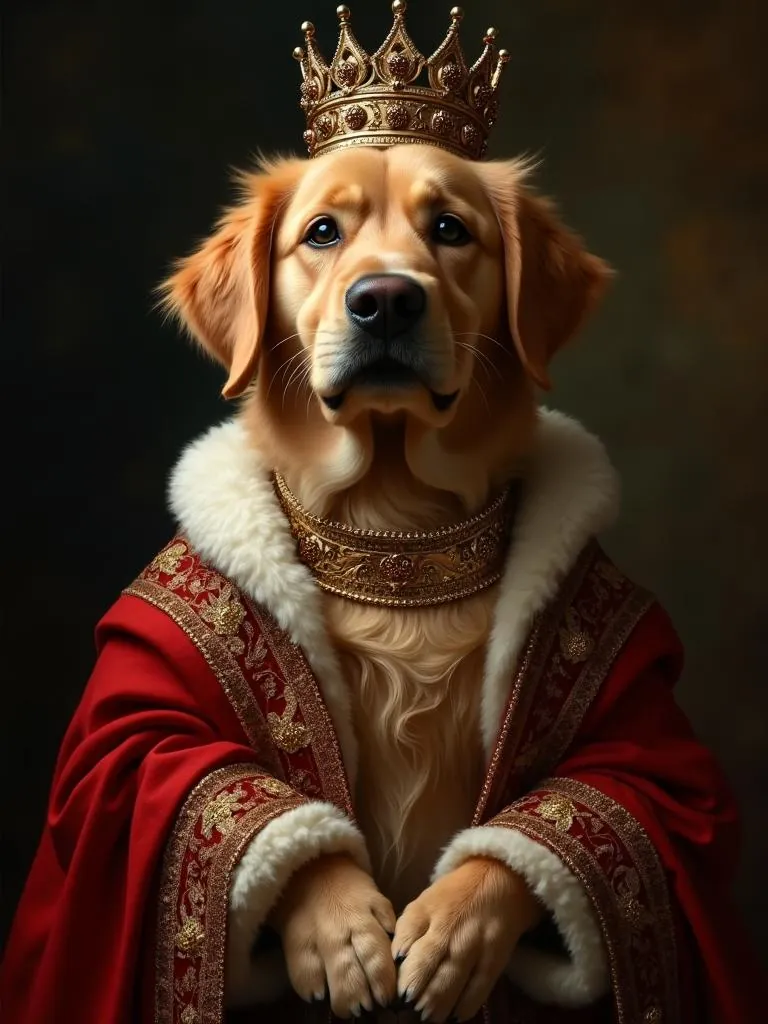
Baroque art is the bold, dramatic art that filled European churches and palaces in the 1600s. The National Gallery in London uses the word for large works, usually from the 17th century, that are dramatic and full of energy, built on diagonal lines, and made to impress the viewer. Baroque painters also painted kings and royal children, several of them with dogs.
What the word Baroque means
Encyclopaedia Britannica gives two possible sources for the word. One is the Italian word barocco, which philosophers in the Middle Ages used for a problem in logic. The other is the Portuguese word barroco, a pearl with an irregular shape.
At first, Baroque was an insult. Britannica says that until the late 19th century, critics used it for art they found odd, exaggerated or overdecorated. In 1888 Heinrich Wölfflin published his study Renaissance und Barock, and after that the word became the name of a style.
When and where the Baroque happened
Britannica places the Baroque in the 17th century. The first Baroque works appeared in Italy in the last decades of the 16th century. In Germany and in colonial South America, some of the greatest Baroque works came in the 18th century.
Britannica links the style to three changes in Europe:
- The Catholic Church. After the Council of Trent (1545 to 1563), the Roman Catholic Church wanted art that would strengthen people's faith. It asked for paintings and churches that spoke to the emotions and the senses.
- Powerful kings. Rulers built huge palaces to show the power of the state. Britannica names the royal palace and gardens at Versailles, in France, as the best example.
- Science and travel. Science and voyages around the world showed how vast nature is. Landscape paintings with tiny human figures reflect this.
Britannica names Rome for Caravaggio and Bernini, Spain for Velázquez, and the Spanish-ruled region that is now Belgium for Rubens. It says the Baroque in France was calmer and more orderly, as in the paintings of Nicolas Poussin.
How to recognize a Baroque painting
Britannica lists the qualities most often linked with the Baroque: grandeur, a richness that appeals to the senses, drama, movement, tension and strong emotion. In a painting, you can look for four signs.
Strong light against deep shadow. Many Baroque painters lit only the most important parts of a scene. The National Gallery calls this tenebrism, from the Italian word tenebroso, meaning darkened. Faces and hands shine out of a mostly dark setting. The gallery says Caravaggio's late paintings, and those of many of his followers, are often described as tenebrist.
Movement in the middle of an action. In Caravaggio's The Supper at Emmaus of 1601, the National Gallery points out one disciple about to jump out of his chair, with his elbow pushing toward the viewer, while the other throws out his arms. The gallery says the stark lighting adds to the drama of the moment.
Diagonal lines. The National Gallery's definition of Baroque names diagonal compositions, meaning the main shapes run across the picture at a slant. Britannica calls the diagonal compositions of Rubens the most typical Baroque painting.
Large size and painted space that looks real. The National Gallery's definition describes Baroque works as large, and names illusionistic effects, meaning paint that makes a flat surface look like real space. Britannica says painted church ceilings of the time seemed to open up into the sky, to turn the viewer's thoughts toward heaven.
How Baroque art differs from the Renaissance
The National Gallery dates the Renaissance from the 15th century to the end of the 16th century. It describes Baroque works as usually 17th-century.
Our guide on what makes a Renaissance painting explains the Renaissance tools: linear perspective, oil paint in thin layers, and chiaroscuro, the contrast of light and shadow that makes a figure look round and solid. Tenebrism uses the same contrast, but leaves most of the picture dark and lights only the faces, hands and other key details.
Britannica says critics first used the word Baroque for art that broke the rules and proportions set during the Renaissance. Between the two came a refined court style called Mannerism. By the last decades of the 16th century, Britannica says, Mannerism no longer worked well for religious art, and the Baroque style developed after it.
The Baroque painters still learned from the Renaissance. The National Gallery says Rubens spent eight years in Italy copying Renaissance and ancient works, and that both Velázquez and Van Dyck studied the paintings of the Venetian painter Titian.
Famous Baroque painters
- Caravaggio (1571 to 1610). He moved to Rome in 1592, and used ordinary working people as models for saints. The National Gallery says his paintings were known for their dramatic, theatrical lighting, and that they influenced painters all over Europe.
- Artemisia Gentileschi. Britannica says she was recognized in the 20th century for her technical skill and her ambitious history paintings, meaning pictures that tell a story.
- Peter Paul Rubens (1577 to 1640). In 1609 he became court painter to Archduke Albert and Archduchess Isabella, the rulers of the Netherlands. The National Gallery says he also worked as a diplomat.
- Diego Velázquez (1599 to 1660). Court painter to King Philip IV of Spain from 1623.
- Anthony van Dyck (1599 to 1641). A Flemish painter who settled at the English court in 1632.
- Rembrandt (1606 to 1669). The National Gallery says the influence of Caravaggio shows in his work from the 1630s, and that he found a new way to describe faces through patterns of light and shadow.
Baroque court portraits
The National Gallery says Philip IV was so pleased with Velázquez's first portrait of him, in 1623, that he made Velázquez a court painter and from then on allowed no one else to paint him. Velázquez painted the king and his family for four decades. In Philip IV of Spain in Brown and Silver, from 1631 to 1632, the king holds a paper signed by Velázquez as "Painter to Your Majesty".
His most famous court picture is Las Meninas. The Museo del Prado says it was painted in 1656 in a room of the Alcázar palace in Madrid, the same room seen in the picture. Members of the court gather around the young Infanta (princess) Margarita, who is attended by two of the queen's maids of honour. Velázquez shows himself at work on a large canvas. The faces of her parents, Philip IV and Mariana of Austria, appear in a mirror on the back wall, watching the scene.
In England, Van Dyck painted Charles I. The National Gallery says his flattering portraits of the king and his family set a new standard for English portraits. His Equestrian Portrait of Charles I, from 1638 to 1639, shows the king in armour on a large horse. At over 3.5 metres high, it is the largest of his portraits of Charles. The gallery says a gold chain marks him as a member of the Order of the Garter, and the baton in his hand shows his high military rank.
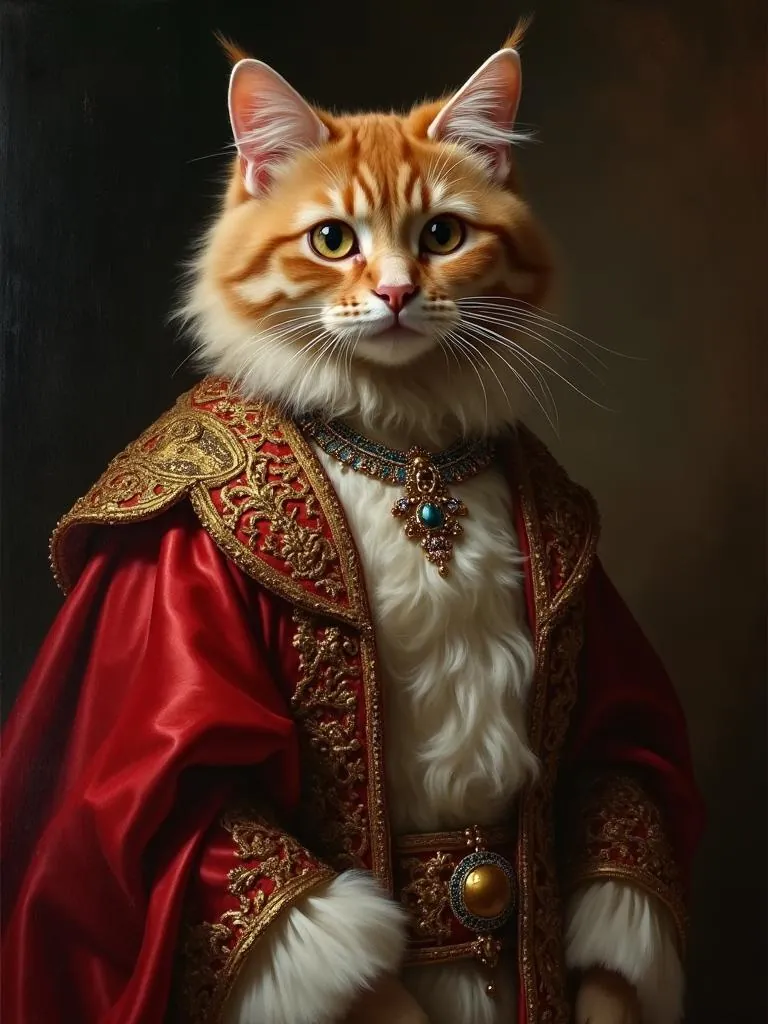
Purrealism's portrait studio includes a Baroque Aristocrat style, one of its six European period styles. The gallery does not yet show a finished Baroque Aristocrat portrait. You can choose the style in the portrait studio, and our guide on how to choose a royal portrait style compares all 15 styles.
Dogs in Baroque portraits
Las Meninas, Velázquez, 1656 (Museo del Prado, Madrid). The Prado names a mastiff among the figures, and says Nicolasito Pertusato, a member of the court, is provoking it.
Prince Baltasar Carlos in Hunting Dress, Velázquez, 1635 to 1636 (Museo del Prado, Madrid). The son of Philip IV was six years old. The Prado says hunting was one of the first parts of his education, and that he holds a gun given to his father as a child. The museum adds that the right side of the canvas was cut at some point, and old copies show one more dog there.
The Five Eldest Children of Charles I, Van Dyck, 1637 (Royal Collection, Windsor Castle). Charles I ordered it. The Royal Collection Trust says the children are posed with two dogs, and lists a mastiff and a King Charles spaniel among its subjects. A print made after the painting describes the future Charles II standing in the centre with his right arm resting on a dog's head. The Trust says the portrait shows the children as young and royal at once, where earlier portraits had presented royal children as small adults.
The Night Watch, Rembrandt, 1642 (Rijksmuseum, Amsterdam). This group portrait of a city guard company is 379.5 by 453.5 centimetres. The Rijksmuseum's catalogue describes a barking dog on the right. The museum says Rembrandt used light to pick out details, such as the captain's hand and a young girl in the background.
Questions and answers
What is baroque art?
Baroque art is the dramatic, large-scale European art of the 17th century. The National Gallery in London describes Baroque works as dramatic and full of energy, built on diagonal lines and on painted effects that make flat surfaces look real, all made to impress the viewer. The gallery names the Flemish painter Peter Paul Rubens and the Roman sculptor Gian Lorenzo Bernini as typical Baroque artists.
When did baroque art start and end?
Baroque art started in Italy in the last decades of the 16th century and lasted through the 17th century, according to Encyclopaedia Britannica. In some places it lasted longer. Britannica says some of the greatest Baroque works in Germany and in colonial South America were made in the 18th century. The National Gallery in London describes Baroque works as usually 17th-century.
How is baroque art different from renaissance?
Baroque art followed the Renaissance and is known for drama, movement and strong contrast. The National Gallery in London dates the Renaissance from the 15th century to the end of the 16th century, and Baroque works to the 17th century. According to Encyclopaedia Britannica, critics first used the word Baroque for art that broke the rules and proportions set during the Renaissance.
Who are famous baroque artists?
Famous Baroque artists include the painters Caravaggio, Artemisia Gentileschi, Peter Paul Rubens, Diego Velázquez and Rembrandt, and the sculptor and architect Gian Lorenzo Bernini. According to Encyclopaedia Britannica, Caravaggio and Annibale Carracci helped start the Baroque in Italy. Britannica calls the diagonal compositions of Rubens the most typical Baroque painting, and names Bernini the greatest Baroque sculptor and architect.
Why are baroque paintings so dark?
Many Baroque paintings look dark because the painter lit only the important parts, such as faces and hands, and left the rest in shadow. The National Gallery in London calls this way of painting tenebrism, from the Italian word tenebroso, meaning darkened. The gallery says the late paintings of Caravaggio and those of many of his followers are often described as tenebrist.
Is baroque art religious?
Much Baroque art is religious, and much of it was made for the Roman Catholic Church. According to Encyclopaedia Britannica, after the Council of Trent (1545 to 1563) the Church wanted art that would strengthen people's faith through emotion and the senses. Baroque artists also painted royal portraits for kings, and realistic pictures for a growing middle-class market.
Does baroque art use tenebrism?
Baroque art often uses tenebrism, a way of painting in which faces and hands are brightly lit against a mostly dark setting. The National Gallery in London says the late paintings of Caravaggio and many of his followers are often called tenebrist. The same museum says the influence of Caravaggio's lighting shows in Rembrandt's work from the 1630s.
Is the Arnolfini portrait baroque?
The Arnolfini Portrait is a Renaissance painting. The National Gallery in London dates Jan van Eyck's portrait of the couple to 1434, and the same museum places the Renaissance period from the 15th century to the end of the 16th century. According to Encyclopaedia Britannica, the first Baroque works appeared in Italy in the last decades of the 16th century, more than a century after the Arnolfini Portrait was painted.
Why was baroque art so dramatic?
Baroque art was dramatic because the people who paid for it wanted art that moved viewers. According to Encyclopaedia Britannica, the Roman Catholic Church used dramatic effects to stir faith and to show the splendour of God, and kings built huge Baroque palaces, such as Versailles, to show the power of the state. Britannica says the wish to stir feelings through the senses is the common aim of Baroque art.
Which Baroque portraits include dogs?
Several famous Baroque portraits include dogs. In Velázquez's Las Meninas of 1656, the Museo del Prado says the court member Nicolasito Pertusato is provoking a mastiff. The Royal Collection Trust lists a mastiff and a King Charles spaniel in Van Dyck's The Five Eldest Children of Charles I, dated 1637. The Rijksmuseum lists a dog in Rembrandt's The Night Watch of 1642.
Sources
- Baroque, The National Gallery, London
- Tenebrism, The National Gallery, London
- Renaissance, The National Gallery, London
- Baroque art and architecture, Encyclopaedia Britannica
- Michelangelo Merisi da Caravaggio, The National Gallery, London
- The Supper at Emmaus, Caravaggio, The National Gallery, London
- Peter Paul Rubens, The National Gallery, London
- Rembrandt, The National Gallery, London
- Diego Velázquez, The National Gallery, London
- Philip IV of Spain in Brown and Silver, Diego Velázquez, The National Gallery, London
- Anthony van Dyck, The National Gallery, London
- Equestrian Portrait of Charles I, Anthony van Dyck, The National Gallery, London
- The Arnolfini Portrait, Jan van Eyck, The National Gallery, London
- Las Meninas, Diego Velázquez, Museo Nacional del Prado
- Prince Baltasar Carlos in Hunting Dress, Diego Velázquez, Museo Nacional del Prado
- The Five Eldest Children of Charles I, Anthony van Dyck, Royal Collection Trust
- The Five Eldest Children of Charles I, mezzotint after Anthony van Dyck, Royal Collection Trust
- 'Children of Charles Ist', photograph after Anthony van Dyck, Royal Collection Trust
- The Night Watch, Rembrandt van Rijn, Rijksmuseum
Go deeper
The full guides on this topic, each a set of pages with sources: