How to photograph your pet for a portrait: 10 tips for dogs and cats
Photograph your pet in daylight near a window, at its eye level, with the eyes sharp and a plain wall behind. Ten tips for dogs and cats, phone included.
By Purrealism
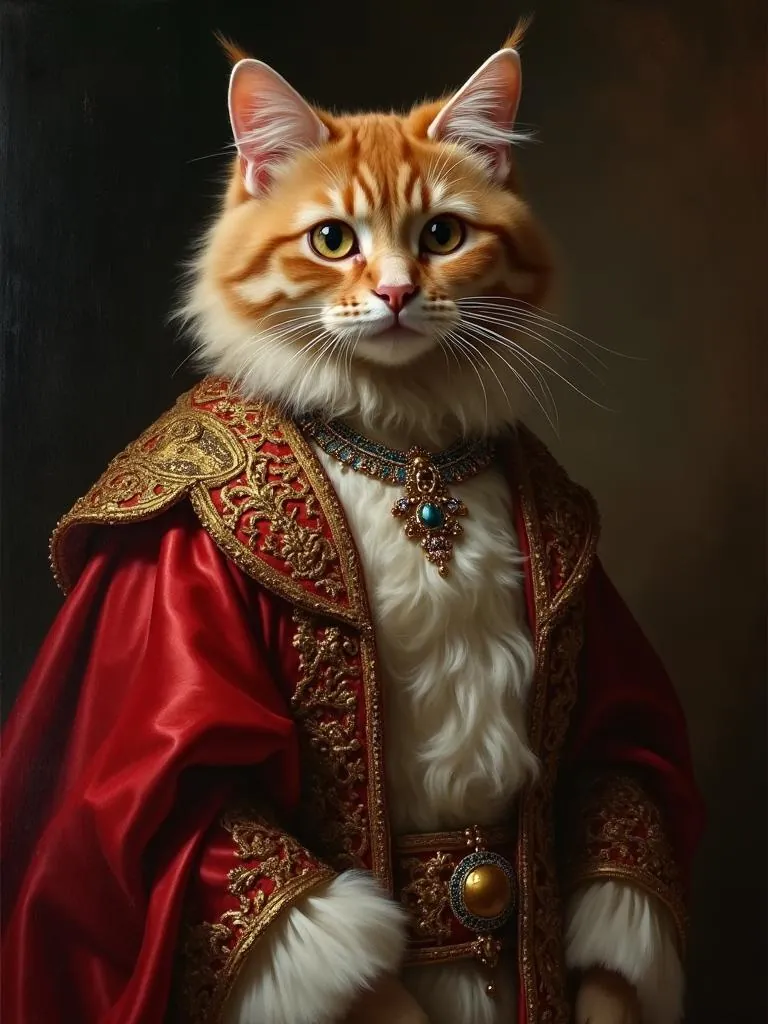
A royal portrait of your dog or cat starts with one photo. The portrait studio takes a single image file of up to 5 MB, which you drag in or choose from your files. The ten tips below come from advice published by the American Kennel Club (AKC) and by two cat charities: Cats Protection in the UK and the Cat Protection Society of NSW in Australia. Every tip works with a phone.
Use soft daylight
1. Take the photo near a window or in shade
A volunteer writing for Cats Protection says natural light through a window can give sharp photos with lots of detail. Outdoors, the AKC suggests shade, or golden hour: the first hour after sunrise and the hour before sunset.
Keep the light in front of your pet. Cats Protection explains that a pet with bright light behind it will look dark, like a silhouette (a dark shape with no detail). Stand with the window or the sun behind you, so the light falls on your pet's face.
2. Turn off the flash
Cats Protection warns that a flash could startle your cat. An AKC article on photographing puppies says never to use a flash with them. When you work near a window in daylight, you can leave the flash off.
Get down to your pet's level
3. Hold the camera at your pet's eye level
A photo taken from standing height looks down on the top of your pet's head. The AKC advises shooting at eye level, which it says often means lying flat on the ground. The Cat Protection Society of NSW gives the same advice for cats. Kneel or lie down so the phone is level with your pet's eyes, and your pet looks straight into the camera.
4. Focus on the eyes
The AKC says to focus on the dog's eye. Cats Protection says the best point to focus on is your cat's eyes, and that on a phone you tap the screen just before you take the shot. After you take the photo, open it and zoom in on the eyes and whiskers. If they look blurred, take the photo again.
5. Move closer instead of zooming
Cats Protection advises against the zoom on a smartphone, because it lowers the photo quality. Walk closer instead, until your pet fills most of the screen. An AKC article on dog photos says the dog should fill the frame, without a lot of empty space around it.
Use the main camera on the back of your phone. The same AKC article says the selfie camera's lens gives a much grainier photo, with more small specks and less fine detail. It also suggests portrait mode when you can use it, with the focus on your dog.
Keep the background plain
6. Clear the space behind your pet
The AKC article on dog photos says to check that the background is clean, with no clutter or distracting things. A plain wall, a sheet or a blanket behind your pet keeps the attention on the face.
Choose a background colour that contrasts with the coat. The Cats Protection volunteer suggests a dark cat against a light background and a white cat against a dark one. The same volunteer says cats with patterned coats, such as tortoiseshells, can be hard to see against a busy scene and look best against clear, pale backgrounds. For a dog, you can use the same rule: a light wall behind a dark coat, and a dark blanket behind a light coat.
Get your pet's attention without stress
7. Bring treats, toys and a sound your pet knows
The AKC suggests bringing your dog's favourite toys and rewards to the photo session. One AKC article describes a photographer who wears a set of calls that make different noises, to get a dog's attention and different expressions. At home, a squeaky toy or a treat held just above the phone gives your pet a reason to look toward the camera.
For a cat, Cats Protection suggests asking someone to help by dangling a toy out of view of the camera.
8. Pick a calm moment and watch for stress
Cats Protection suggests taking a photo just after your cat has eaten or woken up, when it is more likely to be sleepy and relaxed. The Cat Protection Society of NSW says it takes time and patience for a cat to get used to a camera or phone. It suggests linking the camera with something the cat likes, such as play or food treats, for five minutes a day at first, then 10 minutes or longer.
Dogs show stress too. The AKC lists pinned back ears, a droopy tail, lip licking and shaking as signs to stop. A photo session can wait for another day.
Take many photos, then choose one
9. Use burst mode and take more than you need
The Cats Protection volunteer advises taking lots of shots quickly, one after another, so that at least one comes out well. Cats Protection says many cameras have a burst or continuous shooting mode, which takes several shots one after another. Look for it in your camera settings. An AKC article on puppy photos advises getting the same front-facing angle for each puppy, even if it takes 100 shots.
When you choose, look for these points:
- Both eyes sharp: zoom in and check.
- The whole face in the photo: ears, nose and chin inside the edges.
- The head facing you: a front view shows the face and markings more clearly than a side view.
- Nothing covering the face: no hand, collar tag or toy in front of it.
Then check the file size. If it is over 5 MB, the studio will ask for a smaller one. Once you have the photo, the guide on how to choose a royal portrait style helps you match it to one of the 15 styles.
Two coat problems and how to fix them
A very light or a very dark coat causes its own photo problems, and both charities and the AKC give fixes for each.
White or pale fur can wash out. A bright white coat in direct sun can lose all its detail, turning into one flat, overexposed patch with no texture. The AKC's advice to shoot in shade, rather than direct sunlight, matters most for a light-coloured pet, since shade keeps the fur from blowing out to plain white. If your phone has an exposure slider (usually a sun icon you drag after tapping to focus), pull it down slightly before you shoot, so the fur keeps its texture instead of turning flat.
Dark or black fur can lose all detail. The reverse problem shows up on a black cat or a black dog: the coat can turn into a dark shape with no visible texture, especially with a bright background behind it. This is the same problem Cats Protection describes for black cats, and its fix is the same one covered above: a light background behind the dark coat, and enough soft daylight on the face that the eyes and whiskers stay visible instead of disappearing into shadow.
A pet that will not sit still
Not every pet cooperates for a photo. The AKC's advice for puppy photography, cited above, is built around a moving, easily distracted subject, and the same approach works for an adult pet that will not settle.
Work at ground level and let your pet move naturally, rather than trying to pose it. Burst mode, covered above, matters most here: a pet in motion gives you one sharp, well-framed shot out of every twenty or thirty, so take far more photos than you think you need. If a second person is available, have them hold the toy or make the sound that gets your pet's attention while you hold the camera, so you can focus fully on the shot instead of doing both jobs at once. If your pet still will not settle, stop for the day. Cats Protection's advice to pick a calm moment applies to a restless pet just as much as to a nervous one: a five-minute session after a meal or a walk, when your pet is naturally more settled, beats an hour of forcing the issue.
Use an older photo for a pet that has died
10. Choose the clearest photo you have
If your pet has died, you can still use an older photo for a portrait. Look through your phone, your computer and any printed albums, and pick the photo where the face is sharpest and the eyes are easy to see. A front view is better than a side view, because it shows the face and markings more clearly. If you still have the original file on your phone or computer, use that copy.
If you only have a printed photo, you can photograph the print. Lay it flat on a table near a window in daylight. Turn off the flash, hold the phone straight above the print so it fills the screen, and check for any shine from the window across the face. Move the print until the shine is gone, then take the photo. The guide on how to memorialize a pet has more ideas for remembering a pet that has died.
Questions and answers
How to do pet photography?
Pet photography works best with soft natural light and the camera at the animal's eye level. The American Kennel Club advises shooting in shade or in the first hour after sunrise or the hour before sunset, and focusing on the dog's eye. It also says to stop if a dog shows stress, such as pinned back ears, a droopy tail, lip licking or shaking.
How to photograph cats?
To photograph a cat, turn off the flash, get down to its eye level and focus on its eyes. Cats Protection, a UK cat charity, warns that a flash could startle a cat, and says the best point to focus on is the cat's eyes. The Cat Protection Society of NSW advises getting onto the same eye level as your cat.
How to photograph black cats?
Photograph a black cat against a light background, so its outline stands out from what is behind it. A volunteer writing for Cats Protection, a UK cat charity, advises a dark cat against a light background, and a white cat against a dark one, for contrast. The same volunteer says natural light through a window can give sharp photos with lots of detail.
Why do cats hate cameras?
A cat may dislike a camera because a flash can startle it, according to Cats Protection, a UK cat charity, which advises turning the flash off. The Cat Protection Society of NSW says it takes time and patience for a cat to get used to a camera or phone. It suggests linking the camera with play or food treats, five minutes a day at first.
Can dogs see photos?
Dogs can recognize other dogs in images, according to the American Kennel Club. The AKC cites a 2013 study in the journal Animal Cognition, in which dogs still identified images of their own species when the pictures showed different breeds. The AKC also says dogs are dichromatic, which means they see the world in yellow, brown and grey tones.
What lens for pet photography?
The best lens for pet photography on a phone is the main back camera, because an American Kennel Club article says the selfie camera's lens gives a much grainier photo. Cats Protection, a UK cat charity, advises against the smartphone zoom, which it says lowers photo quality, so move closer instead. With a larger camera, Cats Protection says a zoom lens lets you keep out of a cat's personal space.
When is the best time of day to photograph a pet?
The best time of day to photograph a pet outdoors is the first hour after sunrise or the hour before sunset, which the American Kennel Club calls golden hour. The AKC also suggests shade. For a cat indoors, Cats Protection, a UK cat charity, suggests taking photos just after the cat has eaten or woken up, when it is more likely to be sleepy and relaxed.
What photo file can I upload for a Purrealism portrait?
The Purrealism portrait studio accepts one image file of up to 5 MB for each portrait. You can drag the photo into the studio or choose it from your files. If the studio says the file is too large, pick a different copy of the photo that is under 5 MB. Choose the photo where your pet's face is sharpest and both eyes are easy to see.
Can I use an old photo of a pet that has died for a portrait?
An older photo of a pet that has died can be used for a Purrealism portrait if it is an image file of up to 5 MB. Choose the photo where the face is sharpest and the eyes are clear. If you only have a printed photo, lay it flat near a window in daylight, turn off the flash, and photograph it from straight above so the print fills the screen.
Sources
- Tips for Taking Great Photos of Your Dog, American Kennel Club
- Say Cheese! Take the Best Photos of Your Dogs, American Kennel Club
- Why Does My Dog Watch TV?, American Kennel Club
- Pet photography: How to take amazing photos of your cat, Cats Protection
- 9 tips for better cat photos from a Cats Protection volunteer, Cats Protection
- Cat photography: four simple steps to take your skills to the next level, Cat Protection Society of NSW
Go deeper
The full guides on this topic, each a set of pages with sources: