What was the Regency era? Dates, fashion and portraits of 1811 to 1820
The Regency era ran from 1811 to 1820, when the future George IV ruled for his ill father, George III. Where the name comes from, and its clothes and portraits.
By Purrealism
The Regency era is the name for the years 1811 to 1820 in British history. In those years King George III was too ill to rule, and his eldest son ruled for him as Prince Regent. The same name is used for a longer stretch of time around those years, and for the clothes, rooms and paintings made in it.
Why it is called the Regency
A regent is a person who carries out the duties of a king or queen who cannot do so. The Regency era is named after one regent: George, Prince of Wales, the eldest son of King George III and Queen Charlotte.
According to Encyclopaedia Britannica, George III was king of Great Britain and Ireland from 1760 until his death at Windsor Castle on 29 January 1820. In November 1810 he became unfit to rule, and Britannica says that from 1811 until his death he suffered periods of mental illness. Shortly afterward, under a law called the Regency Act of 1811, his son became regent. Britannica gives the date as 5 February 1811, and says the prince was the ruler in practice from that day, while his father kept the title of king.
The act limited the prince's powers at first. Britannica says those limits ended in February 1812, and that the prince then chose to keep his father's government ministers in office.
The Regency ended when George III died. His son became King George IV on 29 January 1820 and reigned until his death on 26 June 1830.
The strict dates and the wider period
The strict Regency lasted nine years, from 1811 to 1820. The name is also used for a longer time. Britannica's article on Regency dress says many historians define the Regency era as the years from the mid-1790s to the mid-1830s, and describes it as a period of change between the Georgian and Victorian periods. The same article says the French Revolution, the Napoleonic Wars (1800 to 1815) and the first Industrial Revolution changed British society, culture and taste in these years.
Britannica also uses the name Regency style for the furniture and decoration made from the start of the Regency to the end of George IV's reign in 1830. Designers borrowed shapes and ornament from ancient Greece and Rome. Egyptian patterns became popular after Napoleon's expeditions to Egypt in 1798, and Chinese patterns came back into use.
Britannica says George IV had sound judgement in the arts. He supported the architect John Nash, who developed Regent Street and Regent's Park in London. His best-known project was the Royal Pavilion at Brighton, designed by Nash with Mughal Indian and Chinese decorations. The Mughal emperors and their court painters have their own guide.
The Victorian era came after. Britannica dates Queen Victoria's reign from 1837 to 1901, so the Regency ended 17 years before it began. For the dogs of that next reign, read Queen Victoria and her dogs.
What women wore
The main mark of a Regency gown is its high waist. Encyclopaedia Britannica says the bodice, the top part of the dress, ended just under the bust or at it. This line was later called an empire waist. Britannica says the high waist stayed in fashion from the 1800s to the 1830s.
The style copied the clothing of ancient Greece and Rome. Britannica says white and pale colours were the most popular because they looked like the white marble of ancient statues. Gowns were often made of light muslin or cotton. Necklines were low, either square or V-shaped.
For warmth, a woman added a shawl or a jacket. Britannica names two jackets: the spencer, a long-sleeved jacket that ends at the bust, and the pelisse, a long coat with a high waist and a high neck. Shawls from Kashmir in India, woven with a teardrop-shaped pattern called boteh, were fashionable and expensive. Copies were woven in Paisley, Scotland, and the town's name became the name of the pattern. In the day women wore bonnets with wide brims, and in the evening many wore silk turbans.
The Victoria and Albert Museum in London holds a real dress from these years: a silk gauze evening dress made in Great Britain between 1810 and 1820. It has a square neckline, puffed sleeves, a high waist and a long skirt. A heavy cord is sewn into the hem so that the skirt falls in folds to the floor. The museum says it was probably worn over a white silk slip, and that white was still the most popular colour for evening wear.
What men wore
Britannica says women's fashion followed Paris in the 19th century, and men's followed London. In the Regency era the English gentleman came to be seen as the best-dressed man in Europe, and Beau Brummell set the example. Brummell cared most about a good fit, simple clothes and cleanliness.
A man wore three pieces: a coat, a waistcoat (a vest) and breeches or trousers. The three pieces were seldom the same colour. Coats were made of dark wool. Britannica describes two main types, both based on the tailcoat, a coat with long tails at the back:
- The dress coat was cut away at the front to show the waistcoat underneath.
- The riding coat had a front that sloped back to shorter tails, and was the less formal choice for daytime.
A white shirt with a high collar came next, then a cravat, a length of cotton or silk tied around the neck. Britannica says the top hat was the most stylish hat, and that tasselled Hessian boots were the most popular boots.
Hunting clothes could be bright. The V&A holds a red tailcoat for hunting, made in Great Britain between 1810 and 1820. It is double-breasted, with nine gold buttons cast with a crest, and it belongs to a group of hunting clothes from Castle Howard in Yorkshire.
Portrait painting in the Regency
The best-known portrait painter of the Regency was Sir Thomas Lawrence. The National Gallery in London calls him the leading British portrait painter of the early 19th century, and says he painted most of the important people of his day.
Lawrence was born in Bristol in 1769 and died in 1830. The National Gallery says he was making skilled portraits in crayon by the age of 10, and showed his first portrait in an exhibition at 19. His first royal work was a portrait of Queen Charlotte, George III's wife, in 1789. He was knighted in 1815 and became President of the Royal Academy in 1820.
From 1818 to 1820, the National Gallery says, Lawrence travelled to Aachen, Vienna and Rome for the Prince Regent. There he painted full-length portraits, showing each figure from head to feet, of the rulers of the allied countries that had helped defeat Napoleon. The paintings were for the prince's Waterloo Gallery at Windsor. Britannica's page on George IV shows Lawrence's own portrait of George as Prince Regent: an unfinished painting from 1814, now in the National Portrait Gallery, London.
A dog in a Lawrence portrait
The Metropolitan Museum of Art in New York holds Lawrence's portrait of Lady Maria Conyngham. The museum dates it to 1824 to 1825, a few years after the strict Regency but inside the wider period that Britannica describes.
In the painting, Lady Maria sits outdoors in a white dress with short puffed sleeves and a gold necklace. A brown and white dog with a blue ribbon at its neck lies beside her and looks up. The Met says George IV was fond of Maria Conyngham and that the portrait hung for a time in his bedroom at St James's Palace. The museum also points out a weakness: Lawrence cared less about drawing, and the girl's fingers are too long and oddly jointed.
The canvas is 92.1 cm tall and 71.8 cm wide. The long side of a 24 × 36 inch print is 91.4 cm, so a print of that size is 0.7 cm shorter than the painting.
The guide to what pet portraits are covers the British painters who made animals the main subject of their pictures, before and after Lawrence.
The Regency Era portrait style
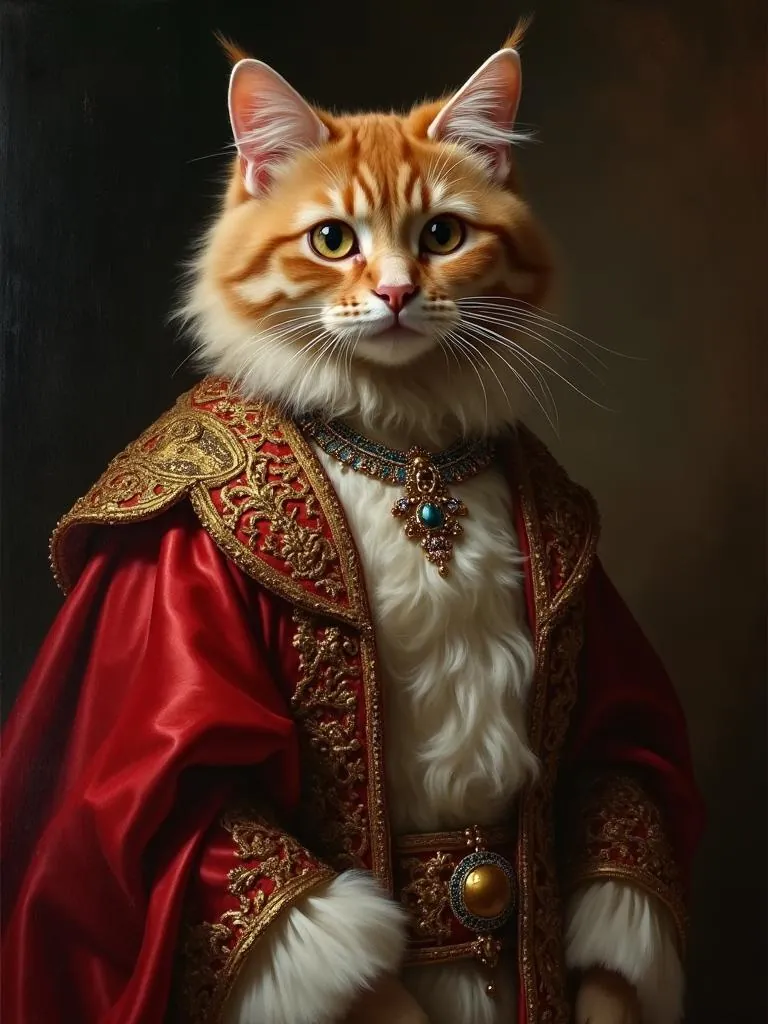
Purrealism has a Regency Era portrait style for dogs and cats. It is one of six European period styles, with Renaissance Royal, Victorian Noble, Military General, Medieval Knight and Baroque Aristocrat. The gallery has no finished Regency Era portrait yet. Its eight portraits are all in Indian court styles.
The Regency Era style sits in the style list of the portrait studio with the other 14 styles. The studio takes one photo of up to 5 MB for every style. If you are comparing it with the other European styles, the guide on how to choose a royal portrait style goes through all 15 by coat colour and character, and the guide to Baroque art covers the century of painting behind the Baroque Aristocrat style.
Questions and answers
When did the Regency era start?
The Regency era started on 5 February 1811, when George, Prince of Wales, became regent for his father, King George III, according to Encyclopaedia Britannica. It ended on 29 January 1820, when George III died and the prince became King George IV. Britannica adds that many historians use the name for a longer period, from the mid-1790s to the mid-1830s.
Why did the Regency era start?
The Regency era started because King George III became too ill to rule. Encyclopaedia Britannica says he became unfit to rule in November 1810, and that his eldest son, George, Prince of Wales, became regent shortly afterward under the Regency Act of 1811. A regent carries out the duties of a king or queen who cannot do so, and the period takes its name from that role.
Which George was Prince Regent?
The Prince Regent was George, Prince of Wales, the eldest son of King George III, who later ruled as King George IV. According to Encyclopaedia Britannica, he was born in London on 12 August 1762 and became regent on 5 February 1811. He became king on 29 January 1820 and reigned until his death on 26 June 1830.
What is a prince regent?
A prince regent is a prince who rules on behalf of a king or queen who is unable to rule. In British history the title belongs to George, Prince of Wales, who ruled for his ill father, George III, from 1811 to 1820. Encyclopaedia Britannica says he served as the ruler in practice from 5 February 1811, while his father kept the title of king until 1820.
Is Regency era before Victorian?
Yes, the Regency era comes before the Victorian era. The strict Regency ran from 1811 to 1820, and Encyclopaedia Britannica dates Queen Victoria's reign from 1837 to 1901. Britannica describes the Regency as a period of change between the Georgian and Victorian periods. It says Regency dresses had a straight shape and a high waist, and Victorian dresses had tight corsets and full skirts.
What is Regency fashion?
Regency fashion is the style of clothing worn in Great Britain during the Regency, from 1811 to 1820. According to Encyclopaedia Britannica, women wore gowns with a high waistline just under the bust, often in light muslin or cotton, in white or pale colours. Men wore a coat, a waistcoat and breeches or trousers in plain, dark fabrics, with a tied cravat at the neck.
What inspired Regency fashion?
Regency fashion was inspired by the clothing of ancient Greece and Rome. Encyclopaedia Britannica says women chose white or pale gowns to look like the clothes on white marble statues, and men wore their hair short and loose like Roman sculptures. The Victoria and Albert Museum says Greek and Roman fashions were still a strong influence on dress in the first decades of the 1800s.
What happened in the Regency era?
The Regency era, from 1811 to 1820, overlapped with the last years of the Napoleonic Wars, which Encyclopaedia Britannica dates from 1800 to 1815. Britannica says those wars and the first Industrial Revolution changed British society, culture and taste. According to the National Gallery in London, the Prince Regent also sent the painter Thomas Lawrence to Aachen, Vienna and Rome from 1818 to 1820 to paint the rulers who had helped defeat Napoleon.
Who painted portraits in the Regency era?
Sir Thomas Lawrence was the best-known portrait painter of the Regency era. The National Gallery in London calls him the leading British portrait painter of the early 19th century and says he painted most of the important people of his day. He was knighted in 1815 and became President of the Royal Academy in 1820. Encyclopaedia Britannica shows his unfinished 1814 portrait of the Prince Regent.
Are there dogs in Regency era portraits?
Dogs appear in portraits from the wider Regency period. The Metropolitan Museum of Art holds Sir Thomas Lawrence's portrait of Lady Maria Conyngham, which the museum dates to 1824 to 1825. She sits in a white dress with short puffed sleeves, and a brown and white dog with a blue ribbon at its neck lies beside her. The Met says the portrait hung for a time in George IV's bedroom.
Sources
- George IV, Encyclopaedia Britannica
- George III, Encyclopaedia Britannica
- Regency dress, Encyclopaedia Britannica
- Regency style, Encyclopaedia Britannica
- Evening dress, 1810 to 1820 (O129127), Victoria and Albert Museum
- Hunting coat, 1810 to 1820 (O96568), Victoria and Albert Museum
- Sir Thomas Lawrence (1769 to 1830), National Gallery, London
- Lady Maria Conyngham (died 1843), Sir Thomas Lawrence, The Metropolitan Museum of Art
Go deeper
The full guides on this topic, each a set of pages with sources: