Military dog portraits: the real dogs who served, and your dog as a general
Real war dogs such as Stubby and Gander earned medals and a rank. Here is their story, and how to make a dog general portrait of your own dog.
By Purrealism
A dog general portrait dresses your own dog as a commander. Real dogs have served with armies too. They carried messages, found wounded soldiers and comforted the troops, and some of them died doing it. This guide tells the stories of several of those dogs, each from the museum, charity or government office that keeps their memory. It ends with the Military General portrait style on Purrealism and ideas for a portrait of your own dog as a general.
How dogs served in war
The Imperial War Museums in Britain says more than 16 million animals served in the First World War. Dogs and pigeons carried messages, and cats and dogs were trained to hunt rats in the trenches. In 1914, French Red Cross dogs wore harnesses that held medical equipment, and they took it to injured soldiers on the battlefield. Other dogs had no task except to be there: the museum says animals were kept as pets and mascots to make the soldiers feel better. The Canadian War Museum says most animals in Canadian regiments were pets the soldiers took in for company, and some dogs searched for wounded men.
A 2017 US Army article says the Second World War saw the biggest rise in American military dogs, which worked as guards, scouts, messengers and mine detectors. The K-9 Corps was set up in 1942.
Sergeant Stubby at the Smithsonian
In 1917, while soldiers trained on the fields of Yale University, Private J. Robert Conroy made friends with a brindle puppy with a short tail. The soldiers called him Stubby, and he became the mascot of the 102nd Infantry, 26th Yankee Division. The Smithsonian's National Museum of American History says he learned the bugle calls, the drills and a dog's salute: he put his right paw on his right eyebrow when the soldiers saluted. Conroy hid him on the ship SS Minnesota to take him to France.
The 102nd Infantry reached the front lines on 5 February 1918. Stubby was hurt by gas, and after that he could sense the smallest trace of it. One early morning, when gas came in while most of the troops were asleep, he ran through the trench barking and biting at soldiers until they woke and sounded the alarm. On 20 April 1918, a grenade attack left pieces of metal in his chest and leg. Later he found wounded men between the trenches and barked until help came. By the end of the war, the museum says, he had served in 17 battles.
Stubby was awarded many medals, including one from the Humane Society presented by General John J. Pershing, the commanding general of the United States Armies. The US National Park Service dates that presentation to 1921 and says Stubby was promoted to sergeant for his heroism. He died in Washington on 16 March 1926. Conroy gave Stubby's preserved body to the Smithsonian on 22 May 1956, and the museum's record describes a stuffed dog with a blanket decorated with medals, shown in the exhibition The Price of Freedom.
The PDSA Dickin Medal and its dogs
Maria Dickin, the founder of the animal charity PDSA, started the PDSA Dickin Medal in 1943, during the Second World War. PDSA calls it the highest award any animal can receive while serving in military conflict, known around the world as "the animals' Victoria Cross". The bronze medal carries the words "For Gallantry" and "We Also Serve" inside a laurel wreath. PDSA says it has been awarded 75 times since 1943, plus one honorary medal in 2014, to 38 dogs, 32 pigeons, 4 horses and 1 cat. Some of the dogs on its roll of honour:
- Jet, an Alsatian with the Civil Defence in London, for rescuing people trapped under bombed buildings. Awarded 12 January 1945. The Imperial War Museums says Jet and his handler recovered 150 people, and that Jet once refused to move for 12 hours while rescuers tried to reach a woman buried in a bombed hotel.
- Rob, a collie who served with the Special Air Service in Italy and made more than 20 parachute jumps. Awarded 22 January 1945.
- Judy, a pointer, for her courage in Japanese prison camps, where she helped her fellow prisoners stay hopeful. Awarded May 1946.
- Chips, a husky crossbreed with the US Army, for the invasion of Sicily on 10 July 1943. Awarded 15 January 2018.
- Kuno, a Belgian Shepherd Malinois with the British military, for an operation in Afghanistan in 2019. Awarded 24 November 2020.
Sergeant Gander and the Canadian War Museum
Gander was a Newfoundland dog raised by the Hayden family on the airport base at Gander, Newfoundland. Veterans Affairs Canada says he grew so large that the family gave him to the Royal Rifles of Canada, the regiment stationed at the airport. In 1941 the regiment was sent to Hong Kong. The men did not want to leave him behind, so they gave him the rank of sergeant, and he boarded the troopship with them.
The fighting came in December 1941, in the Battle of Lye Mun on Hong Kong Island. PDSA says Gander attacked the enemy on at least three occasions. Then a grenade landed near seven wounded Canadian soldiers. Gander picked it up in his mouth and ran toward the enemy. The grenade exploded and killed him, and the seven men lived.
After requests from Hong Kong veterans' associations and the Canadian War Museum, PDSA awarded Gander the Dickin Medal on 27 October 2000. The Canadian War Museum says he was the first Canadian dog to receive it, and Veterans Affairs Canada says his medal is displayed at the museum in Ottawa. On 23 July 2015, statues of Gander and his handler were unveiled in the town of Gander.
Military working dogs today
Dogs still serve. On 24 January 2023, PDSA gave the Dickin Medal to Bass, a Belgian Malinois with the US Marine Special Operation Command, for saving lives in Afghanistan in 2019.
In the United States these dogs are called military working dogs. The 2017 Army article says more than 30,000 dogs have served since the military began to use them, names German shepherds, Belgian Malinois and Dutch shepherds as common breeds, and says the teams help find drugs and explosives. When the dogs retire, their handlers get the first chance to adopt them, and the public comes next. A second Army article says the adoption program began in 2000; before that, dogs that could no longer serve were euthanized.
Your dog as a general: the Military General style
Purrealism offers 15 royal portrait styles, and Military General is one of the six that come from European history. All eight finished portraits in the gallery come from the Indian court styles, so there is no Military General example to look at yet. To see your own dog as a general, choose Military General in the portrait studio and add a photo of up to 5 MB.
Some ideas for a dog general portrait:
- Choose a photo with a steady look. A photo of your dog sitting up and looking at the camera, taken at eye level in daylight, shows the face clearly. The guide on how to photograph your pet for a portrait has more tips.
- Give your general a title. Write a rank and a name, such as "General Biscuit", on the card that goes with a gift.
- Think about the breed. German shepherds and Belgian Malinois serve with the military today, so a general's portrait suits these breeds well. The guide to German shepherd portraits covers that breed.
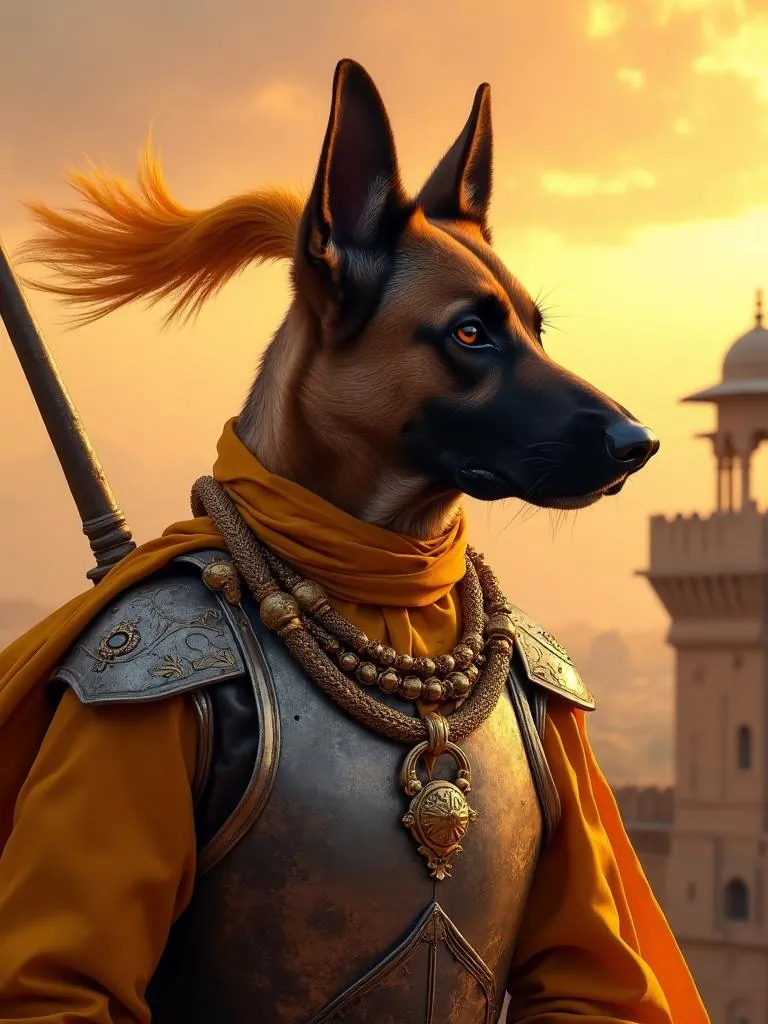
- Compare the other warrior styles. The Medieval Knight style goes with our guide to what a medieval knight wore. The Rajput Warrior on the cover of this guide shows a dog in armour with a fort at sunset behind, and the guide to Rajput painting tells its history. Dogs also lie at the feet of knights on medieval tomb brasses, shown in the guide to dogs in medieval paintings.
- Keep the real history separate. A portrait of your pet in costume is for fun at home. The medals of Stubby, Gander and the Dickin Medal dogs belong to the animals who earned them.
If you plan to hang the portrait, art prints come in 8 × 10, 12 × 16, 18 × 24 and 24 × 36 inches, on matte or glossy paper. Matte paper shows less glare opposite a window. Glossy paper makes dark colours look deeper, which suits a black or dark brown coat.
Questions and answers
Can military dogs get medals?
Military dogs can get medals, such as the PDSA Dickin Medal, which the charity PDSA says is recognised around the world as the animals' Victoria Cross. According to PDSA, its founder Maria Dickin started the medal in 1943 for animals serving in war. PDSA says the medal has been awarded 75 times, plus one honorary medal in 2014, and 38 of the animals honoured were dogs.
How were war dogs used?
War dogs were used to carry messages, hunt rats, find wounded soldiers and comfort the troops as pets and mascots. The Imperial War Museums says dogs and pigeons carried messages in the First World War, and French Red Cross dogs wore harnesses with medical supplies for injured men. A 2017 US Army article adds that in the Second World War, dogs worked as guards, scouts, messengers and mine detectors.
What dog did General Patton have?
General George S. Patton had a bull terrier named Willie. The National WWII Museum in New Orleans shows a photograph, courtesy of the National Archives, of Willie mourning his owner in Bad Nauheim, Germany. According to the museum, Patton was hurt in a car accident on December 9, 1945, and died twelve days later at the US Army hospital in Heidelberg.
What are military dogs called?
Dogs that serve in the United States armed forces are called military working dogs. A 2017 US Army article shortens the name to MWD and calls the soldiers who work with the dogs handlers. The same article says the K-9 Corps was set up in 1942, and a second Army article says First World War dogs that found wounded soldiers were known as mercy dogs.
What dogs are used in war?
German shepherds, Belgian Malinois and Dutch shepherds are common breeds for United States military dogs today, according to a 2017 US Army article. The Department of Defense adoption program adds that Labrador retrievers and German shorthaired pointers appear from time to time. In earlier wars, the PDSA Dickin Medal list shows collies, a terrier, a pointer and dogs of mixed breed.
Can military dogs be adopted?
Military dogs can be adopted through the Department of Defense Military Working Dog Adoption Program at Joint Base San Antonio-Lackland in Texas. According to the program, adopters must have a fence at least six feet high, everyone in the home must be at least 5 years old, and adopters may not already own more than three dogs. The program says the adoption itself costs nothing, and the usual wait is 12 to 24 months.
What happens to war dogs when they retire?
Most United States military dogs go to a family home when they retire. A 2017 US Army article says everything possible is done to place them, first with their handlers and then with the public, and a dog is euthanized only for a terminal illness that cannot be treated. Another Army article says the adoption program began in 2000, after Congress introduced the Robby Law; before that, dogs that could no longer serve were euthanized.
Do military dogs have ranks?
Some famous military dogs were given a rank by the soldiers they served with. The Canadian War Museum says the men of the Royal Rifles of Canada promoted Gander, their Newfoundland dog, to sergeant before they left for Hong Kong. The US National Park Service says Stubby, the mascot of the 102nd Infantry in the First World War, was promoted to sergeant for his heroism in the trenches.
Who was Sergeant Stubby?
Sergeant Stubby was a stray dog who became the mascot of the 102nd Infantry, 26th Yankee Division, in the First World War. According to the Smithsonian's National Museum of American History, he served in 17 battles, was hurt by gas and by a grenade, warned soldiers of a gas attack and found wounded men. He died in 1926, and the museum shows his preserved body in its exhibition The Price of Freedom.
What is the Military General portrait style?
The Military General portrait style is one of the 15 royal portrait styles that Purrealism offers for dogs and cats, and one of six that come from European history. The other five European styles are Renaissance Royal, Victorian Noble, Medieval Knight, Baroque Aristocrat and Regency Era. The gallery has no finished Military General portrait yet, so to see your dog as a general, choose the style in the portrait studio and add a photo of up to 5 MB.
Sources
- Stubby (taxidermic dog, ID AF.58280M), Smithsonian Institution, National Museum of American History
- Stubby: Dog, Hoya mascot, and war hero, Smithsonian National Museum of American History
- Military Dogs, US National Park Service
- PDSA Dickin Medal, PDSA
- Gander: PDSA Dickin Medal, PDSA
- Animals and the First World War, Imperial War Museums
- Man and Beast, Canadian War Museum
- Mascot dog saves his human comrades, Veterans Affairs Canada
- Sergeant Gander and his Handler Memorial, Veterans Affairs Canada
- General George S. Patton, The National WWII Museum
- Military working dogs retire to handlers' homes, The United States Army
- Military Working Dogs: Guardians of the Night, The United States Army
- Military Working Dog Adoption Program, US Air Force, 37th Training Wing
Go deeper
The full guides on this topic, each a set of pages with sources: