What was the Victorian era? Dates, fashion and portraits of 1837 to 1901
The Victorian era is Queen Victoria's reign, 1837 to 1901. Her life, what Victorians wore, and how they had portraits painted and photographed.
By Purrealism
The Victorian era is the name for the years 1837 to 1901 in British history, when Queen Victoria was on the throne. It covers one reign of almost 64 years. In those years the Queen took her first train journey, London held the Great Exhibition, and photography was invented. This guide gives the dates, the main events of the Queen's life, what men and women wore, and how Victorians had their portraits made.
When was the Victorian era?
The Victorian era starts in 1837 and ends on 22 January 1901. Both dates come from the Queen's own life. According to the official website of the Royal Family, Victoria became queen at the age of 18, when her uncle King William IV died in 1837. She died at Osborne House on the Isle of Wight on 22 January 1901. Her reign lasted almost 64 years, which was then the longest in British history. Her son succeeded her as King Edward VII.
So the Victorian era sits almost entirely inside the 19th century. Only its last 22 days, in January 1901, fall in the 20th.
The Regency era came before it. The strict Regency ended in 1820, when George IV became king. George IV and then William IV reigned in the 17 years between the two periods.
Queen Victoria's reign
Victoria was born at Kensington Palace in London on 24 May 1819. The Royal Family's website says she married Prince Albert in 1840, and that they had nine children between 1840 and 1857. Many of those children later married into other royal families of Europe.
The couple wanted homes away from London. Victoria bought Osborne House on the Isle of Wight in 1845 as a family home, and Albert bought Balmoral in Scotland in 1852.
Some dates from her reign:
- 1842: Victoria became the first reigning monarch to travel by train.
- 1851: the Great Exhibition was held in London. Its profits helped to set up the group of museums in South Kensington.
- 1861: Prince Albert died at the age of 42. For the rest of her reign, the Queen wore black.
- 1867, 1872 and 1884: Parliament passed the Second Reform Act in 1867, brought in the secret ballot in 1872 and passed the Representation of the People Act in 1884.
- 1877: Victoria became Empress of India under the Royal Titles Act.
- 1887 and 1897: her Golden and Diamond Jubilees marked 50 and 60 years on the throne.
The Royal Family's website also says Victoria kept a journal through her whole life. She kept many animals as well, and her dogs have their own guide.
What women wore
Victorian women's clothes were built on what was worn underneath. The Victoria and Albert Museum (V&A) in London explains that the corset shaped the waist, and that something under the skirt gave the skirt its outline. That outline changed over the 64 years:
- 1837 to 1849: low necklines that sat almost off the shoulder, a tight waist and a wide skirt. Long corsets shaped the bust, waist and hips.
- 1856: the steel cage crinoline appeared. It was a frame of steel hoops, each wider than the one above, and it replaced the many layers of petticoats that had held skirts out before. The V&A says those petticoats were heavy, hot and unhygienic.
- Mid-1860s: the crinolette, with a flat front and half-hoops at the back, began to take over. The full crinoline went out of fashion around 1868.
- 1870s: the first bustle, a pad or frame that pushed the skirt out at the back.
- Around 1883: the bustle came back, now held by steel strips inside the dress, and it stood out at a right angle from the back.
- 1890s: a simpler A-line skirt that fell from the waist.
New technology changed dress too. The V&A says the first synthetic dye, aniline purple, later called mauve, was patented by William Henry Perkin in 1856. Sewing machines allowed clothes, including corsets and crinolines, to be made in large numbers, so these garments reached people with less money.
What men wore
Men's dress changed more slowly. The V&A says the waisted frock coat came into fashion around 1816 and stayed in use for decades. It had a narrow waist and full skirts that hung straight down at the front, and a man wore it with trousers, a top hat and a cane. By the 1830s, frock coats came in many designs for different tastes and activities.
The top hat was the main hat for a gentleman in the early 19th century. According to the V&A, it was most popular in the 1840s and 1850s, when factories made fashionable clothes cheaper and more people could buy them. Top hats were usually black. By the 1880s men wore them mostly on formal occasions, with a frock coat or a tailcoat.
How Victorians had their portraits made
At the start of Victoria's reign, a portrait meant a painting or a drawing. Two years later that began to change. The Tate says the word "photograph" was coined in 1839 by Sir John Herschel, from Greek words that mean "drawing with light".
The V&A lists the first processes and their dates:
- The daguerreotype, announced by the Frenchman Louis Daguerre in 1839. Each picture was made on a sheet of silver-plated metal, and could not be copied. The V&A says it was used widely for portraits until the mid-1850s.
- The calotype, patented by William Henry Fox Talbot in 1841. It used a paper negative, so one photograph could be printed many times.
- The albumen print, invented in 1850, made on paper coated with egg white and salt. It was the most common kind of photographic print for the next 40 years.
- The collodion negative on glass, introduced by Frederick Scott Archer in 1851. The glass had to be exposed while still wet and developed at once.
The biggest change for ordinary families was the carte de visite, a small photograph mounted on a card. According to the National Portrait Gallery of Australia, the French photographer André Adolphe Eugène Disdéri patented it in 1854, and a card was nine or ten centimetres high and five or six wide. The same article gives two prices from Sydney: in 1842 a single daguerreotype portrait cost a guinea (one pound and one shilling), and in May 1859 a studio sold cartes de visite at twelve shillings a dozen.
The royal family helped the cards spread. The V&A says the photographer John Jabez Edwin Mayall photographed the royal family in May 1860 and had permission to publish the pictures as cartes de visite. The V&A holds one card by Mayall with nine small portraits: Victoria and Albert in the centre, surrounded by their nine children. The image is 86 mm tall and 57 mm wide. After Albert died in December 1861, the National Portrait Gallery of Australia says, 70,000 cartes de visite of him were ordered from one London firm, Marion and Co., within a week.
Studios made their portraits look grand. The V&A describes painted backdrops that showed snowy slopes, deserts or forests, and props chosen to show who the sitter was or wanted to be. People collected the cards in albums and traded them with friends and family.
The court still hired painters for large royal portraits, and those are covered in the guide to Victorian royal portraits. By the end of the reign, a family could own both: a painting for the wall and a small photograph for the album.
The Victorian Noble portrait style
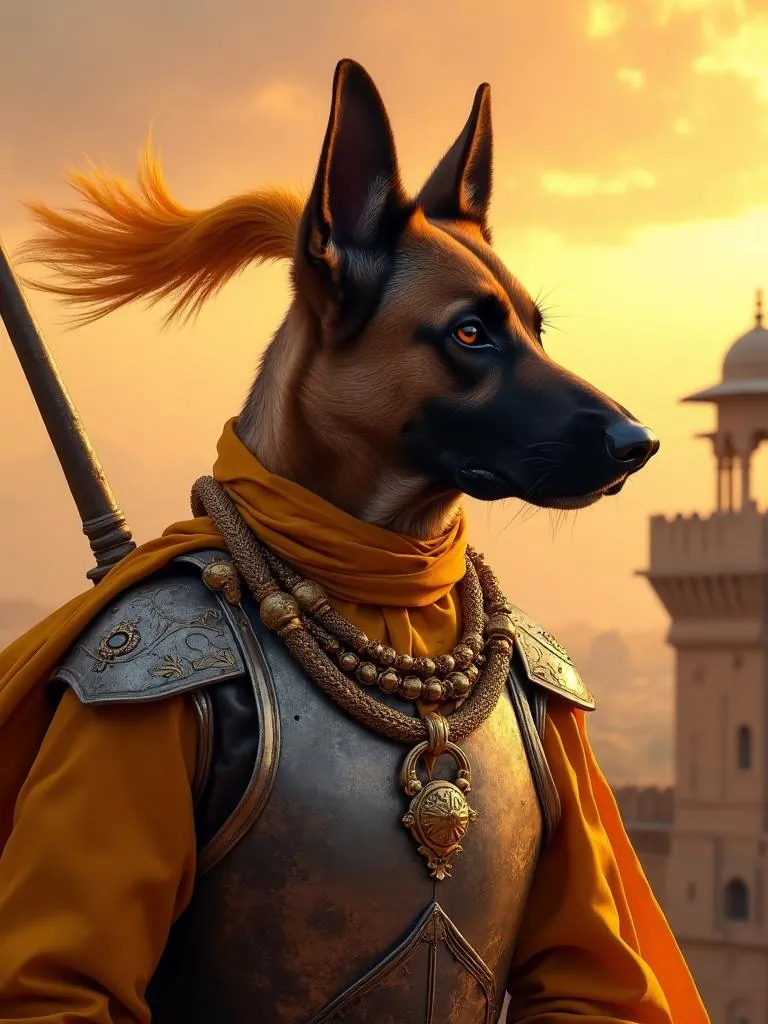
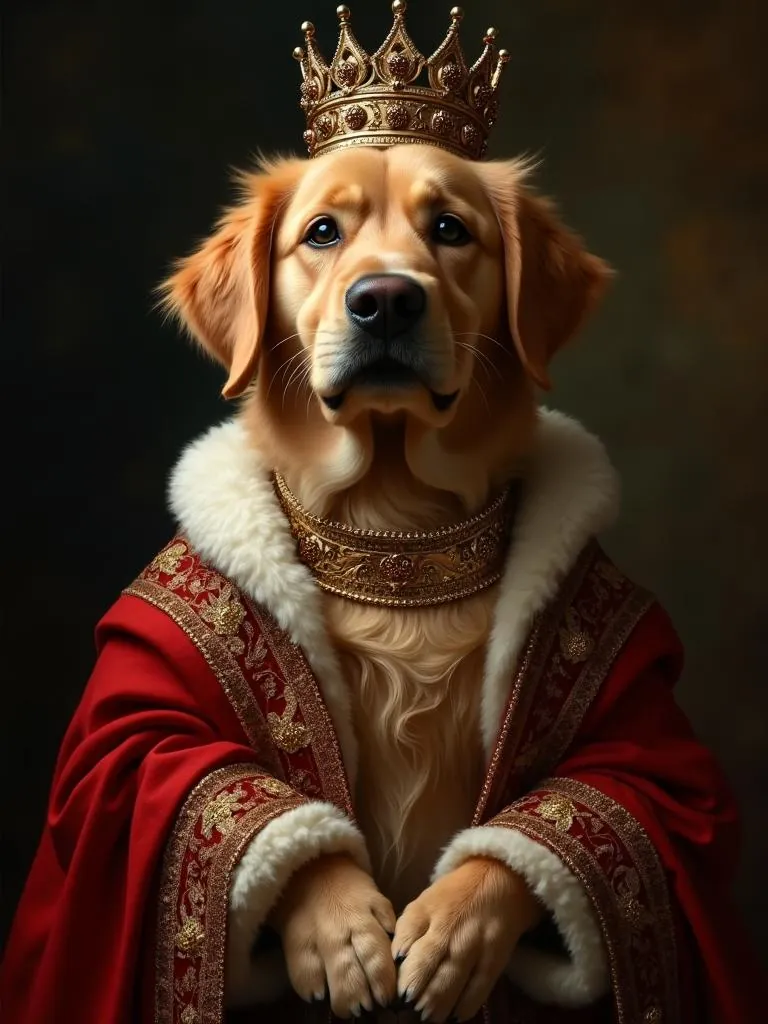
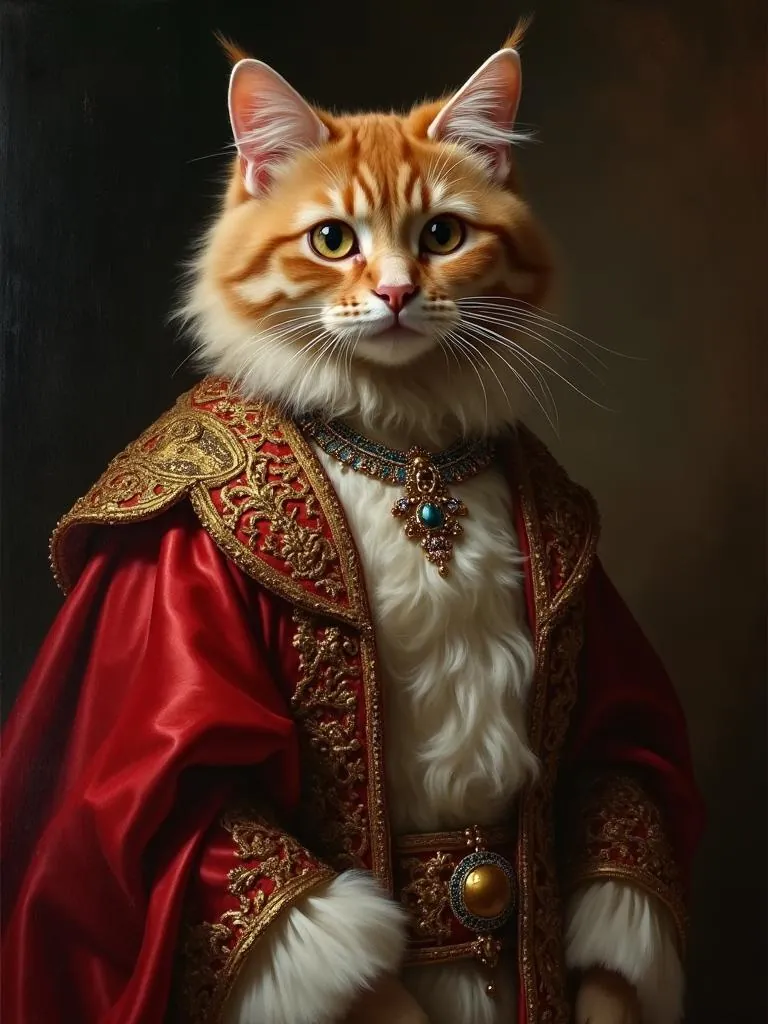
Purrealism has a Victorian Noble portrait style for dogs and cats. It is one of six European period styles, with Renaissance Royal, Regency Era, Military General, Medieval Knight and Baroque Aristocrat.
The gallery shows seven studio examples in the Victorian Noble style: a calico cat, a Norwegian Forest cat, a Siamese, a beagle-harrier, a German shepherd, a French bulldog and a Weimaraner. Each sits next to the original pet photo. In the Norwegian Forest cat portrait, the cat wears a dark green velvet jacket with gold embroidery on the lapels and cuffs, and a white cravat tied at the neck. It sits in a red armchair beside a fireplace, with one paw resting on a pile of books, and the picture is shown inside a carved gold frame.
A Victorian Noble portrait starts from one good photo of your pet. Take it in daylight, at your pet's eye level, with the face sharp and both eyes visible. The guide on how to photograph your pet for a portrait goes through each step. Then choose Victorian Noble from the style list in the portrait studio, which takes one photo of up to 5 MB.
Questions and answers
Who was queen in Victorian era?
Queen Victoria was the queen of the Victorian era, which takes its name from her. According to the official website of the Royal Family, she was born at Kensington Palace in London on 24 May 1819 and became queen at 18, when King William IV died in 1837. She reigned until her death on 22 January 1901, almost 64 years, then the longest reign in British history.
Why was it called Victorian era?
The Victorian era is called Victorian because it covers the reign of Queen Victoria, from 1837 to 1901. The official website of the Royal Family says she became queen in 1837 at the age of 18 and died on 22 January 1901. People use the name for the events of those years in Britain, and for the clothes, houses, furniture and pictures made while she was on the throne.
How did Victorian era end?
The Victorian era ended when Queen Victoria died at Osborne House on the Isle of Wight on 22 January 1901, according to the official website of the Royal Family. Her son succeeded her as King Edward VII. Her reign had lasted almost 64 years, which the same source says was then the longest in British history. For the rest of her life after Prince Albert died in 1861, she wore black.
Is Victorian era 19th century?
Yes, the Victorian era falls almost entirely in the 19th century. Queen Victoria became queen in 1837 and died on 22 January 1901, according to the official website of the Royal Family, so only the first 22 days of 1901 fall in the 20th century. The 19th century covers the years 1801 to 1900, which include 64 of the 65 calendar years of her reign.
Is Victorian era after Regency?
Yes, the Victorian era comes after the Regency. The strict Regency ran from 1811 to 1820, when the future King George IV ruled for his ill father, George III. Two kings then reigned before Victoria: George IV and William IV. The official website of the Royal Family says Victoria became queen in 1837, when William IV died, so 17 years separate the end of the Regency and the start of her reign.
What is Victorian era known for?
The Victorian era is known for a long reign, a growing empire and new inventions. According to the official website of the Royal Family, Victoria took her first train journey in 1842, the Great Exhibition was held in 1851, and she became Empress of India in 1877. The Royal Family's website also says the invention of photography let her family be seen by far more people than any royal family before them.
What did Victorian ladies wear?
Victorian ladies wore a corset to shape the waist and a long, full skirt, whose shape changed by decade. According to the Victoria and Albert Museum, skirts were held out by layers of petticoats until the steel cage crinoline appeared in 1856. The crinoline went out of fashion around 1868. Bustles, which pushed the skirt out at the back, were worn in the 1870s and again from around 1883.
What did Victorians wear?
Victorian men wore a frock coat, trousers and a top hat for everyday dress. The Victoria and Albert Museum says the waisted frock coat came into fashion around 1816, had full skirts hanging to the front, and was worn with a top hat, cane and trousers. The V&A says the top hat was most popular in the 1840s and 1850s. Victorian women wore corsets and long skirts over crinolines or bustles.
How did Victorians have their portraits taken?
Victorians had their portraits taken in a photographer's studio, in front of a painted backdrop and among props. The Victoria and Albert Museum says Louis Daguerre announced the daguerreotype in 1839, and that it was used widely for portraits until the mid-1850s. From 1854 the carte de visite, a small photograph on a card, made portraits cheap enough to trade with friends and collect in albums.
What is a Victorian Noble pet portrait?
A Victorian Noble pet portrait paints a dog or cat as a gentleman or lady of Queen Victoria's time. On Purrealism, the studio example of a Norwegian Forest cat in this style wears a green velvet jacket with gold embroidery and a white cravat, and sits in a red armchair near a fireplace and a pile of books. The painting is shown inside a carved gold frame.
Sources
- Queen Victoria (r. 1837 to 1901), The Royal Family (official website)
- Corsets, crinolines and bustles: fashionable Victorian underwear, Victoria and Albert Museum
- Frock coat, 1830s (O138652), Victoria and Albert Museum
- Top hat, James Lock and Co. (O78788), Victoria and Albert Museum
- An A to Z of photographic processes, Victoria and Albert Museum
- Photography, Tate
- Miniature portraits of Queen Victoria and her family, John Jabez Edwin Mayall (O1407617), Victoria and Albert Museum
- Queen of cartes, National Portrait Gallery of Australia
- Bringing the outside inside: studio photography, Victoria and Albert Museum
Share this guide
The button copies a ready-written post, then opens LinkedIn. Paste the text into the post box.
Go deeper
The full guides on this topic, each a set of pages with sources: