What makes a Renaissance painting, and why some of them include dogs
Renaissance painting used linear perspective, oil paint in thin layers, strong light and shadow, and real-looking faces. Its dogs often meant faithfulness.
By Purrealism
A Renaissance painting is a European painting from the years the National Gallery in London gives for the Renaissance: the 15th century to the end of the 16th century. You can spot one by four features. The room or landscape seems to go back into the picture. The paint was laid on in thin layers of oil. A strong contrast between light and shadow makes figures look solid. Faces, fur and cloth are painted in close detail. Dogs appear in several Renaissance paintings, and this guide looks at five of them.
What makes a Renaissance painting
Depth on a flat surface
Linear perspective makes a flat picture look like a real space. In this system, things further back are painted smaller, and lines that run away from the viewer (the edges of a floor, a row of columns, a road) all meet at one point, called the vanishing point.
The National Gallery credits the architect Brunelleschi with inventing it in Florence. Artists in Florence used it from the early 15th century, and the writer Alberti set out its rules in his book De Pictura. At the same time, painters in the Netherlands made their rooms look deep by working from what they saw, without the Italian system.
Oil paint in thin layers
All paint is a coloured powder, called pigment, mixed with something that holds the powder together. Most early Italian paintings used egg tempera, a paint held together with egg yolk. Oil paint uses an oil instead, such as linseed, walnut or poppy oil.
The National Gallery says oil paint was already used in Northern Europe in the 13th and 14th centuries. Jan van Eyck and the painter Campin found new uses for it, and their methods reached Italy in the early 15th century. Oil paint dries slowly, and the National Gallery says it allowed a wider range of effects and more detailed painting than before. In late 15th-century Italy, painters often combined egg tempera with oil. After 1500, egg tempera became less common.
Oil paint is also used for glazing. A glaze is a thin, see-through layer of paint laid over a lighter colour. It changes that colour without hiding it. By making a glaze thicker in some places and thinner in others, a painter can make a shape look raised.
Light and shadow
Chiaroscuro is an Italian word meaning "light-dark". It describes a clear contrast between lit parts and shaded parts, used to make a figure look solid and round. The National Gallery names Leonardo da Vinci as a famous user of it.
Leonardo also used sfumato, from an Italian word meaning "to turn to smoke". Outlines are blurred, and figures come out of a dark background through slow changes from light to dark, with no hard edges. In The Virgin of the Rocks, Leonardo built up his figures with layers of black and white paint under the colour, to show how light and shadow shape a body.
Faces and things that look real
The fourth feature is careful looking. In Jan van Eyck's Arnolfini Portrait of 1434, the National Gallery points out oranges reflected in polished wood, and beads that cast both shadows and reflections on the wall. The Uffizi Galleries in Florence praise Titian for the softness of the skin he painted, the look of the cloth, and the character he gave his subject.
When and where the Renaissance happened
"Renaissance" is a French word that means "rebirth". It names a new interest in the art, buildings and writing of the ancient world. The National Gallery says this began in Italy in the 14th century and reached Northern Europe later.
The gallery splits the Italian Renaissance into two phases, the Early Renaissance and the High Renaissance. It places the High Renaissance in painting in the first decades of the 16th century, the years of Leonardo, Michelangelo, Raphael and Titian.
Florence was where linear perspective began. Titian painted the Duchess of Urbino in Venice, and he died there in 1576. In the north, Jan van Eyck painted the Arnolfini couple in the reception room of their house in Bruges. The man is believed to be the wealthy Italian merchant Giovanni Arnolfini.
How long a Renaissance painting took
There is no single answer, and two paintings in the National Gallery show the range.
The Virgin of the Rocks took years. Leonardo and two Milanese painters signed the contract in April 1483. Leonardo probably began the London version in the early 1490s and painted it in three phases. When the French captured Milan in 1499, he left for Florence with the picture unfinished. In 1506 the religious group that ordered it called him back, and he was finally paid in 1508.
The Arnolfini Portrait looks precise, but the National Gallery says it was painted quickly and freely. Van Eyck used his fingers and the handles of his brushes as well as the tips, and his thumbprint is still visible beside the shadow of the dog's leg.
Titian's portrait of Eleonora Gonzaga, Duchess of Urbino, was probably painted during one winter, 1536 to 1537, while the duchess was staying in Venice.
Dogs in Renaissance paintings
Dogs appear in Renaissance paintings for a few reasons: as family pets, as hunting animals, and as a sign of faithfulness.
The Arnolfini Portrait, Jan van Eyck, 1434 (National Gallery, London). A small brown dog is between the couple, close to the floor, looking straight out at the viewer. The National Gallery says every hair of its fur is painted in oil, and that a dog was a common sign of faithfulness in marriage.
Portrait of Eleonora Gonzaga, Titian, 1536 to 1537 (Uffizi Galleries, Florence). Titian painted the duchess as a pair with a portrait of her husband, Francesco Maria I della Rovere, Duke of Urbino. The Uffizi says the dog in the portrait is a symbol of faithfulness in marriage. It is a portrait of a real duchess with her dog.
Venus of Urbino, Titian, 1538 (Uffizi Galleries, Florence). The same dog appears again, asleep at the foot of the bed. The Uffizi reads it the same way, as a reference to faithfulness in marriage.
A Satyr mourning over a Nymph, Piero di Cosimo, 1490s (National Gallery, London). A dog sits at the feet of a dead nymph, a nature spirit in the form of a young woman, and seems to mourn her. The gallery says drawings found under the paint show that Piero changed the dog's position with care.
The Vision of Saint Eustace, Pisanello, 1438 to 1442 (National Gallery, London). Saint Eustace was a hunter, and this painting is full of dogs. The gallery says some seem to be copied from illustrated books about hunting that were popular in the 15th century. It is painted in egg tempera.
Dogs also appear in old myths. The National Gallery says a dog is one of the signs of Diana, the goddess of hunting, and in Titian's The Death of Actaeon she sends dogs after the hunter Actaeon.
How a modern pet portrait borrows these ideas
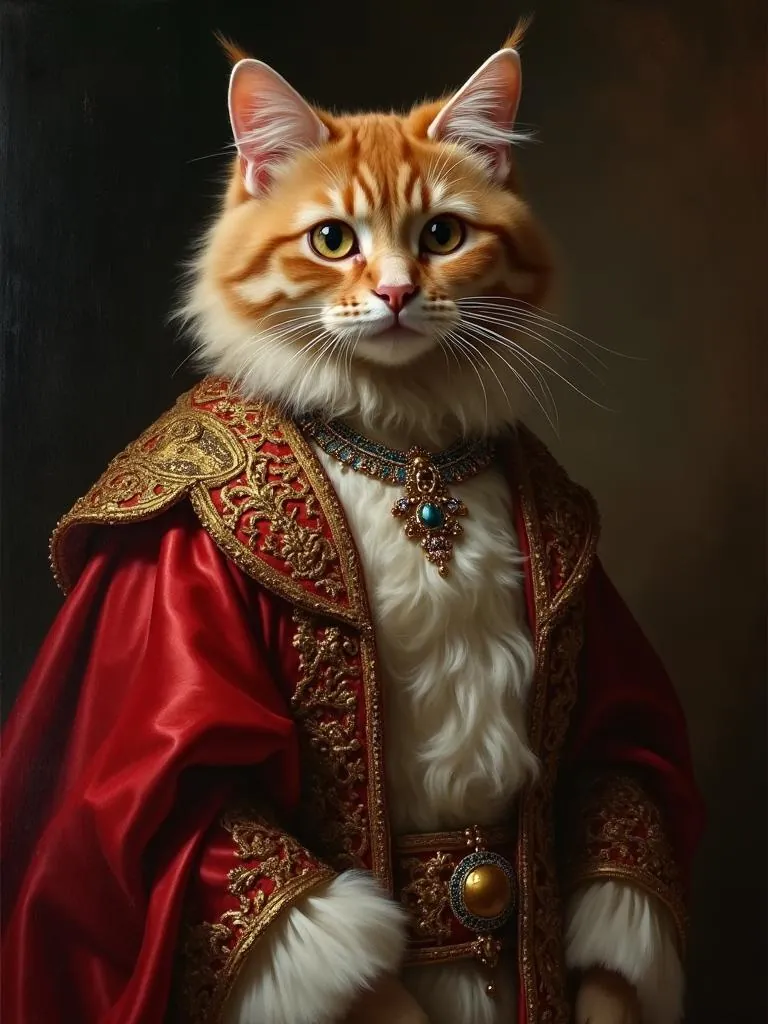
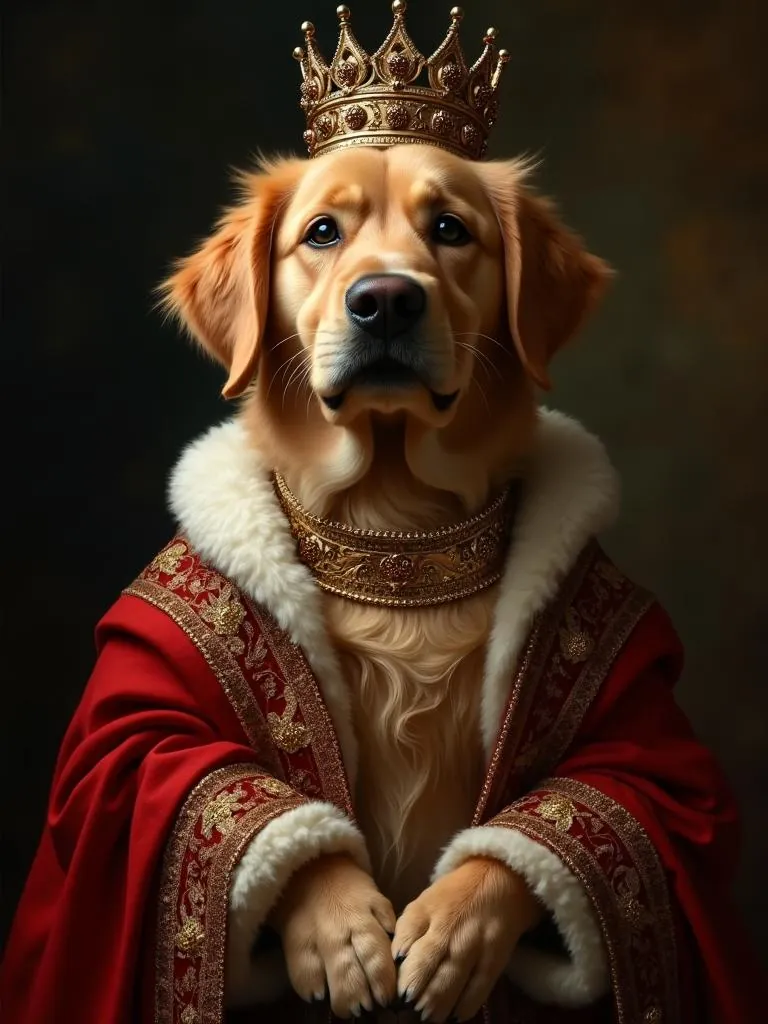
In each of these paintings the dog is one part of a larger scene. A royal pet portrait makes the dog or cat the main subject, dressed as a royal or noble figure.
Purrealism offers a Renaissance Royal style among its six European period styles. The gallery does not yet show a finished Renaissance Royal portrait, so if you want to compare it with other styles first, our guide on how to choose a royal portrait style goes through all 15. You can pick the style in the portrait studio.
Your photo gives the portrait your pet's face and markings. Three ideas from these paintings help when you take it:
- Light from one side. Chiaroscuro is a contrast between lit and shaded parts. A window beside your pet gives one lit side and one shaded side.
- Eyes toward the viewer. The Arnolfini dog looks straight out of the picture. A photo taken at your pet's eye level, with your pet looking at the camera, does the same.
- Detail you can see. Van Eyck painted every hair of the Arnolfini dog. Use a sharp photo where the fur and markings are clear, saved as an image file of up to 5 MB.
Our guide on how to photograph your pet for a portrait covers the photo step by step.
Questions and answers
What makes a Renaissance painting?
A Renaissance painting is marked by four features: depth made with linear perspective, oil paint laid on in thin layers, strong contrast between light and shadow, and faces and objects painted to look real. According to the National Gallery in London, the architect Brunelleschi invented linear perspective in Florence, and artists there used it from the early 15th century. Oil paint dries slowly, and it allowed more detailed painting than egg tempera.
What is Renaissance painting style?
Renaissance painting style is the way European artists painted from the 15th century to the end of the 16th century, the dates the National Gallery in London gives for the Renaissance period. The style shows deep space, soft changes from light to dark, and people who look solid and real. The gallery names Leonardo, Michelangelo, Raphael and Titian as the leading painters of its later phase, the High Renaissance.
Why do Renaissance paintings look like that?
Renaissance paintings look the way they do because painters used methods that make a flat picture seem deep and solid. Linear perspective makes lines that run away from the viewer meet at one point, so a room seems to go back into the picture. Chiaroscuro, Italian for light-dark, uses strong contrast to make figures look solid. The National Gallery in London says Leonardo da Vinci used it to make his figures look three-dimensional.
What are the Renaissance painting techniques?
The main Renaissance painting techniques are linear perspective, glazing, chiaroscuro and sfumato. Glazing means painting a thin, see-through layer over a lighter colour to change that colour without hiding it. According to the National Gallery in London, sfumato is a smoky quality that blurs outlines, so figures come out of a dark background with no harsh edges. Leonardo da Vinci used sfumato in The Virgin of the Rocks.
How long did Renaissance paintings take?
Renaissance paintings could take years or be painted fast. According to the National Gallery in London, Leonardo da Vinci signed the contract for The Virgin of the Rocks in April 1483, left it unfinished when the French captured Milan in 1499, and was paid in 1508. The same museum says Jan van Eyck painted The Arnolfini Portrait of 1434 quickly and freely, using his fingers and brush handles as well as brushes.
Are Renaissance paintings oil?
Renaissance paintings are in oil paint, egg tempera, or both together. According to the National Gallery in London, most early Italian paintings used egg tempera, a paint bound with egg yolk. Painters in late 15th-century Italy often combined egg tempera with oil, and egg tempera became less common after 1500. Jan van Eyck's Arnolfini Portrait of 1434 and Titian's portraits of the 1530s are oil paintings.
When was the Renaissance painting era?
The Renaissance painting era ran from the 15th century to the end of the 16th century, according to the National Gallery in London. The revival of interest in the art and writing of the ancient world began in Italy in the 14th century and reached Northern Europe later. The gallery divides the Italian Renaissance into an Early and a High Renaissance, and places the High Renaissance in the first decades of the 16th century.
Who invented oil painting in the Renaissance?
Oil painting was already in use before the Renaissance began. According to the National Gallery in London, painters in Northern Europe used oil paint in the 13th and 14th centuries, on wooden panels and on walls. Jan van Eyck and the painter Campin then found new uses for it, and their methods reached Italy in the early 15th century. Oil paint dries slowly and allows fine detail.
Why are there dogs in Renaissance paintings?
Dogs appear in Renaissance paintings as pets, as hunting animals and as a sign of faithfulness. According to the National Gallery in London, the small dog in Jan van Eyck's Arnolfini Portrait of 1434 may stand for the couple's faithfulness to each other. The Uffizi Galleries in Florence say the dog in Titian's portrait of Eleonora Gonzaga, Duchess of Urbino, is a symbol of faithfulness in marriage.
How to make a Renaissance pet portrait?
A Renaissance pet portrait at Purrealism starts with the Renaissance Royal style, one of 15 royal portrait styles in the Purrealism portrait studio. You choose that style, then add one clear, well-lit photo of your dog or cat, saved as an image file of up to 5 MB. A photo taken at your pet's eye level, with the face in sharp focus, gives the portrait a true likeness of your pet.
Sources
- Renaissance, The National Gallery, London
- High Renaissance, The National Gallery, London
- Perspective, The National Gallery, London
- Oil, The National Gallery, London
- Tempera, The National Gallery, London
- Glaze, The National Gallery, London
- Chiaroscuro, The National Gallery, London
- Sfumato, The National Gallery, London
- The Virgin of the Rocks, Leonardo da Vinci, The National Gallery, London
- The Arnolfini Portrait, Jan van Eyck, The National Gallery, London
- Dogs, The National Gallery, London
- A Satyr mourning over a Nymph, Piero di Cosimo, The National Gallery, London
- The Vision of Saint Eustace, Pisanello, The National Gallery, London
- Portrait of Eleonora Gonzaga, Duchess of Urbino, Titian, Uffizi Galleries
- Venus of Urbino, Titian, Uffizi Galleries
Go deeper
The full guides on this topic, each a set of pages with sources: