Updated
Hogarth and Trump: the painter, his pug and the dogs in his satires
William Hogarth painted himself with his pug, Trump, in 1745. The portrait, the porcelain Trumps that followed, and the dogs that comment in his satires.
By Purrealism. Part of Dogs in art: the painters and paintings behind a royal dog portrait.
William Hogarth (1697 to 1764) was a London painter and printmaker, known for satires: pictures that make fun of the bad behaviour of his time. He also kept a pug, Trump, and put the dog in a self-portrait. This page looks at that portrait, the porcelain figures of Trump that were sold to his admirers, and the dogs that appear in his satires, where a dog often reveals the truth about the people around it. It draws on the National Gallery in London and the Victoria and Albert Museum (V&A). For the long history of dogs in art, start with the dogs in art guide.
The Painter and his Pug, 1745
In 1745 Hogarth painted a self-portrait with a difference. He shows himself as a painting within the painting, an oval canvas propped up on a stack of books. The National Gallery says the books are by famous British authors. His palette shows a curved line that Hogarth called the "Line of Beauty and Grace", the shape he believed lay behind all harmony in art and nature. He wears casual clothes, which give him a down-to-earth look.
Beside the portrait sits Trump, his pet pug. The National Gallery says the dog "alludes to the artist's own pugnacious character". Pugnacious means ready to argue and fight. The V&A also describes Hogarth as a combative personality.
The canvas is 90 by 69.9 cm. The National Gallery bought it in 1824, from the collection of Sir John Julius Angerstein, as one of the first paintings of the new national collection. It was later transferred to the Tate Gallery. When this page was written it was hanging in Room 34 of the National Gallery, on loan from Tate.
Trump in porcelain
Trump became famous beyond the painting. The V&A owns a small figure of the pug in soft-paste porcelain, a fine white ceramic, 13.2 cm high and 26.5 cm wide. It was made at the Chelsea porcelain factory in London between 1747 and 1750.
The V&A explains how it came about:
- The model. The sculptor Louis-François Roubiliac made the original model of Trump in terracotta, a baked clay. It stayed with Hogarth's widow until her death in 1790.
- The copies. Plaster casts of the pug were sold with Roubiliac's belongings after his death in 1762. London plaster shops sold such casts as ornaments for fireplaces and libraries, and china factories often copied them.
- The porcelain. The Chelsea factory probably based its figure on a plaster cast. Its manager, Nicholas Sprimont, was a friend of both Hogarth and Roubiliac.
- Later versions. The potter Josiah Wedgwood made Trumps in black basalt, a hard black stoneware, from a plaster cast he bought in 1774 from Richard Parker's plaster shop in London.
The museum says the porcelain pugs were probably made for admirers of Hogarth's paintings and prints, to stand in libraries and other rooms. It adds a detail that surprises modern dog owners: "Trump has a much longer muzzle than the pugs of today."
Hogarth's close bond with his dog was well known. The V&A says he "identified strongly with his pet", and that in 1753 the watercolour painter Paul Sandby mocked Hogarth by drawing him as Trump in a caricature called Pug's Graces.
Marriage A-la-Mode: dogs that tell the story
Hogarth's best-known series of paintings, Marriage A-la-Mode, was painted around 1743. It has six scenes, each 69.9 by 90.8 cm. The National Gallery, which owns all six, says they mock the upper classes and were painted to be engraved, with the prints sold once the engravings were finished. The V&A holds one of the prints of the second scene, engraved by Bernard Baron and published on 1 April 1745.
The story follows an arranged marriage between the son of a proud, indebted earl and the daughter of a rich London merchant. Dogs appear at three key moments.
Scene 1: The Marriage Settlement
The earl and the merchant agree the terms of the marriage, while the young couple ignore each other. The National Gallery describes a foxhound and a female hound at the bride and groom's feet, chained together round the neck. The chain, it says, anticipates the bonds of marriage that will soon tie the couple together.
Scene 2: The Tête à Tête
A few months after the wedding, husband and wife sit apart in their new house at noon, both exhausted after separate nights out. A small dog tugs a girl's muslin cap out of the husband's pocket. The V&A's record of the print says the cap in his pocket, "at which a dog tugs", shows that he has come home from a night of misbehaviour. The dog reveals the secret the husband wants to keep. The V&A's summary of the print adds that the couple have every material comfort in a London house furnished in the latest style, yet take no pleasure in each other's company. Their steward leaves on the right with a handful of unpaid bills, in despair at how much they spend and how little comes in.
Scene 4: The Toilette
No real dog appears in this scene, but a story about dogs does. A young page boy holds a statue of Actaeon, the hunter whom the goddess Diana turned into a stag to be killed by his own hounds. The National Gallery explains that the boy laughs and points at Actaeon's antlers, a sign that the wife is being unfaithful to her husband. The same myth appears in the paintings described on our page about Titian's dogs.
Scene 6: The Lady's Death
The series ends in the house of the heroine's father, a mean man who spends as little as he can. The table is set for a thin meal: a boiled egg on a plate of rice and a pig's head. The National Gallery says "the starved dog gnaws at the ear of the pig's head". The Gallery's glossary on dogs calls it "the scrawny mongrel included by Hogarth in 'The Lady's Death'". The Gallery also suggests that the food on the table may be a deliberate joke at the expense of the French still-life painter Chardin, whose work Hogarth may have seen in Paris. The Gallery adds that the pig's head, with its upturned nose and gaping mouth, echoes the face of the dying heroine.
Dogs in Hogarth's prints
Hogarth sold his work to a wide public through prints, and dogs appear there too.
Evening, 1738. In this print from The Four Times of the Day, a family walks out in the evening near Sadler's Wells, a place of entertainment on the edge of London. Their dog walks just in front of them. The V&A says the print was unusual for its time because it was printed in three colours. The husband's hands are blue, to show he is a dyer, and the wife's face and neck are red. The V&A says the picture contrasts the couple's unhappiness with the pleasures of the place.
Gin Lane, 1751. This print attacks gin drinking; the verse printed below it calls gin a "cursed Fiend". The V&A describes a drunk woman on a stair who lets her baby fall, and in front of her "an emaciated man holding a glass which has fallen on its side; his dog sits beside him." Behind them are taverns, pawnbrokers and an undertaker's shop. The lettering at the bottom gives the price: one shilling.
Hogarth's dogs at a glance
| Work | Date | The dog | Where to see it |
|---|---|---|---|
| Evening (print) | 1738 | A family pet on an evening walk | V&A, London |
| Marriage A-la-Mode 1: The Marriage Settlement | around 1743 | Two hounds chained at the neck | National Gallery, Room 34 |
| Marriage A-la-Mode 2: The Tête à Tête | around 1743 | A small dog pulls a cap from a pocket | National Gallery, Room 34 |
| Marriage A-la-Mode 6: The Lady's Death | around 1743 | A starving mongrel at the table | National Gallery, Room 34 |
| The Painter and his Pug | 1745 | Trump, the painter's own pug | Tate, shown at the National Gallery in 2026 |
| Hogarth's Dog, Trump (porcelain) | 1747 to 1750 | A small figure of Trump | V&A, London |
| Gin Lane (print) | 1751 | A dog beside a starving man | V&A, London |
What Hogarth's pug means for a portrait of your own dog
Hogarth chose a dog that matched his own character and put it in front of his own face. That is the idea behind many pet portraits today: the animal stands for the person who loves it. Hogarth's Trump is also a reminder that a portrait should show your dog as it is. His pug had a long muzzle, and the painter showed it that way.
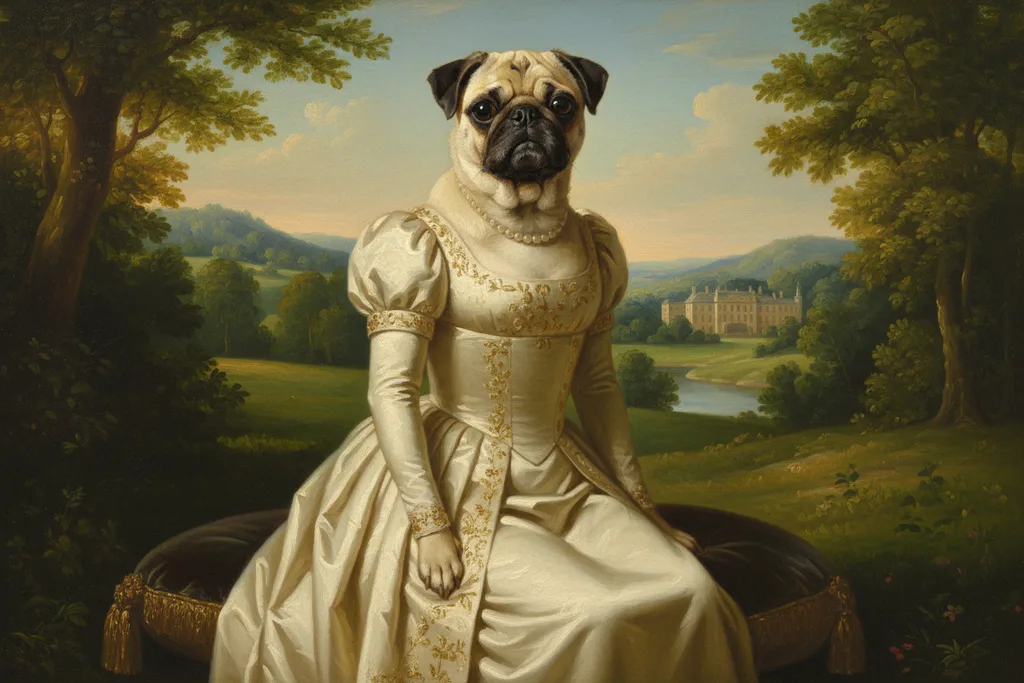
For a portrait of a pug or any short-nosed dog, use a clear photo taken at the dog's eye level. The cover of this page shows a pug from the studio examples in Purrealism's Regency Era style. For a painter of the next generation who put dogs into genteel portraits, read about Thomas Gainsborough's dogs. For how dogs carry meanings such as loyalty in older paintings, see what dogs mean in paintings. To see more finished portraits, visit the gallery.
Questions and answers
What was the name of William Hogarth's pug?
William Hogarth's pug was called Trump. Hogarth painted the dog in the front of his self-portrait The Painter and his Pug, dated 1745, which Tate owns and which hung in Room 34 of the National Gallery in London in September 2026. The National Gallery says Trump alludes to the artist's own pugnacious, or combative, character.
Why did Hogarth paint himself with his dog?
William Hogarth painted himself with his pug, Trump, to say something about his own character. The National Gallery in London says the dog alludes to the artist's pugnacious nature, meaning his readiness to fight. The Victoria and Albert Museum adds that Hogarth identified strongly with his pet, and that in 1753 the painter Paul Sandby drew Hogarth as Trump in a caricature called Pug's Graces.
Why did Hogarth's pug look different from pugs today?
Hogarth's pug, Trump, had a much longer muzzle than the pugs of today, according to the Victoria and Albert Museum. The museum makes this point about a porcelain figure of Trump made at the Chelsea factory in London between 1747 and 1750. Hogarth's self-portrait of 1745, The Painter and his Pug, shows the same dog seated in the front of the picture.
Who made the porcelain figure of Hogarth's pug?
The porcelain figures of Hogarth's pug, Trump, were made at the Chelsea porcelain factory in London between 1747 and 1750. The Victoria and Albert Museum says they were based, through a plaster copy, on a clay model by the sculptor Louis-François Roubiliac. The factory's manager, Nicholas Sprimont, was a friend of both Hogarth and Roubiliac. The V&A's figure is 13.2 cm high.
What happened to Roubiliac's model of Trump?
Louis-François Roubiliac's clay model of Hogarth's pug, Trump, stayed with Hogarth's widow until her death in 1790, according to the Victoria and Albert Museum. Plaster copies were sold with the sculptor's belongings in 1762. The potter Josiah Wedgwood later made figures of Trump in black stoneware, based on a plaster cast he bought in 1774 from a London plaster shop.
What do the chained dogs mean in Hogarth's The Marriage Settlement?
The chained dogs in Hogarth's The Marriage Settlement stand for the bride and groom. The National Gallery in London says a foxhound and a female hound are at the couple's feet, chained together at the neck, to show the bonds of a marriage arranged for money that will soon tie the two young people together. It is the first painting in Marriage A-la-Mode, around 1743.
What is the dog doing in Hogarth's The Tête à Tête?
In Hogarth's The Tête à Tête, a small dog pulls a woman's muslin cap out of the young husband's coat pocket. The National Gallery in London explains that the cap reveals his night of bad behaviour away from home. The painting is the second scene of Hogarth's series Marriage A-la-Mode, painted around 1743 and engraved by Bernard Baron in 1745.
Why is the dog so thin in Hogarth's The Lady's Death?
The dog in Hogarth's The Lady's Death is thin because the house it lives in is mean with food. The National Gallery in London describes the table set for a poor meal in the home of the heroine's penny-pinching father, where the starved dog gnaws the ear of a pig's head. The Gallery's glossary calls it a scrawny mongrel.
Is there a dog in Hogarth's Gin Lane?
Hogarth's print Gin Lane, published on 1 February 1751, includes a dog. The Victoria and Albert Museum describes an emaciated man holding a glass that has fallen on its side, with his dog sitting beside him, in a street of taverns, pawnbrokers and an undertaker. The print sold for one shilling, a price lettered on the sheet.
Is there a dog in Hogarth's Evening from The Four Times of the Day?
Hogarth's Evening, from The Four Times of the Day, shows a family out for a walk with their dog just in front of them. The Victoria and Albert Museum says the print of 1738 was unusual for being printed in three colours: the husband's hands are blue to show he is a dyer, and his wife's face and neck are red.
Sources
- The Painter and his Pug, William Hogarth, The National Gallery, London. Accessed September 29, 2026.
- Hogarth's Dog, Trump, Chelsea porcelain factory after Louis-François Roubiliac, Victoria and Albert Museum. Accessed September 29, 2026.
- Marriage A-la-Mode: 1, The Marriage Settlement, William Hogarth, The National Gallery, London. Accessed September 29, 2026.
- Marriage A-la-Mode: 2, The Tête à Tête, William Hogarth, The National Gallery, London. Accessed September 29, 2026.
- Marriage A-la-Mode: 4, The Toilette, William Hogarth, The National Gallery, London. Accessed September 29, 2026.
- Marriage A-la-Mode: 6, The Lady's Death, William Hogarth, The National Gallery, London. Accessed September 29, 2026.
- Dogs, The National Gallery, London. Accessed September 29, 2026.
- Marriage à la Mode, Plate II, Bernard Baron after William Hogarth, Victoria and Albert Museum. Accessed September 29, 2026.
- Gin Lane, William Hogarth, Victoria and Albert Museum. Accessed September 29, 2026.
- The Four Times of the Day: Evening, Bernard Baron after William Hogarth, Victoria and Albert Museum. Accessed September 29, 2026.
Short reads on this topic
Articles from Purrspectives that answer one question each.
Dog years to human years: the chart by size, and the DNA formula
A 1-year-old dog is closer to 15 or 30 in human years than to 7. The AKC chart by size, the 2020 DNA formula, and a dog's life stages, explained simply.
Pug history: from Chinese emperors to the House of Orange
Pugs began as companions of Chinese emperors, reached Holland on Dutch trading ships and became the dog of the House of Orange. Their history, art and health.
Persian cat history: where the breed came from, its first cat show, coat and care
Persian cat history from a cat brought to Italy in 1626 to the 1871 Crystal Palace show, plus face types, coat colours, grooming and how to photograph one.