The Pekingese and the Chinese emperors: palace dogs, Looty and Empress Cixi
How Pekingese lived at the Chinese imperial court, how dogs taken from Beijing in 1860 reached Queen Victoria, and what Empress Cixi's court wrote of them.
By Purrealism. Part of Royal pets in history: the real dogs and cats of kings, queens and emperors.
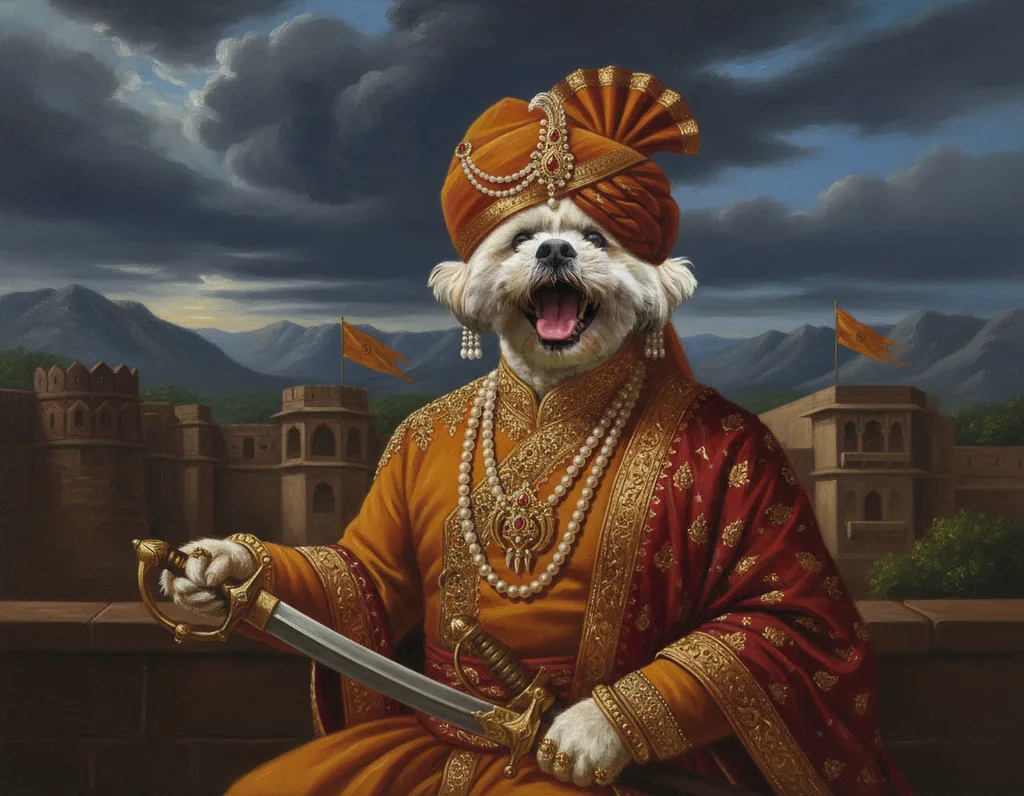
This page follows the small dogs of the Chinese imperial court: the Pekingese above all, and the Shih Tzu and Pug that lived beside it. It covers what kennel clubs say about the breed's early history, the dogs taken from the Yuanmingyuan palace near Beijing in 1860, the Pekingese given to Queen Victoria, the dogs of the Empress Dowager Cixi as two women at her court described them, and how kennel clubs in Britain and America came to recognize the breed. It is one part of our guide to royal pets in history.
Dogs of the imperial palace
The Royal Kennel Club traces the Pekingese back to the Tang dynasty. It says short-legged, short-faced dogs of the "Peke" type have been traced back as far as the 8th century. The club also explains the name. The breed was a favourite in the imperial palace in Peking, the name Europeans used for Beijing. It was a pet for the highest ranks of society, and ordinary people were not allowed to own one.
The American Kennel Club (AKC) goes further back. Its history of the breed says only the imperial family could own these dogs, and that they "were said to date back to the Han dynasty, more than two millennia ago". The AKC gives this as something that was said. It also tells a legend about the breed: a lion fell in love with a marmoset monkey and begged the gods to shrink him.
The smallest palace dogs had their own name. The AKC says miniature Pekingese were called sleeve Pekingese because people carried them in the sleeves of their robes. It adds that the habit of carrying dogs this way probably began in early Italian courts.
The court also kept hunting dogs. The National Palace Museum in Taipei records that in 1747 the painter Giuseppe Castiglione was ordered to paint ten fine hounds. Each painting carries the dog's name and the name of the man who gave it as tribute, in Chinese, Manchu and Mongolian. One hound, Tawny-Yellow Leopard, was a gift from the vice minister Sanhe.
A royal dog could also have fine furniture. The Philadelphia Museum of Art holds a dog cage from the reign of the Qianlong Emperor, who ruled from 1736 to 1795. It stands 115.6 cm tall and is covered in blue and turquoise enamel, with more than 60 five-clawed dragons, the emperor's symbol. The museum says it most likely housed a favourite pet dog of a Chinese nobleman, and that silk curtains once hung from small hooks to make a sleeping place. It was probably made in the enamel workshops on the palace grounds in Beijing.
1860: the Yuanmingyuan and the dogs taken to Britain
The Pekingese reached Europe through war. The AKC says that in 1860, during the Second Opium War, British and French soldiers climbed the 15-foot walls of Yuanmingyuan, the "Gardens of Perfect Brightness" in Beijing, which CNN calls the Old Summer Palace. The emperor and his family had fled. The AKC says the soldiers found five Pekingese in rooms that belonged to the emperor's aunt, who had killed herself as the armies came near.
Sources disagree on parts of this story. CNN calls the aunt and her dogs a legend and says the story may be partly untrue. The AKC, the Pekingese Club of America and JSTOR Daily all count five dogs. The Royal Kennel Club counts four.
One officer wrote down what he took. Captain John Hart Dunne published his journal of the campaign in 1861 as From Calcutta to Pekin. His entry for 8 October 1860 calls it "a memorable day in the history of plunder and destruction". On 9 October the army ordered every officer to hand in what he had taken from the palace, so it could be sold for the army. Things bought in the French camp were allowed to stay with their owners. Dunne wrote that he kept "a pretty little dog, smaller than any King Charles, a real Chinese sleeve-dog. It has silver bells round its neck, and people say it is the most perfect little beauty they ever saw." On 19 October he wrote that the sky over the Summer Palace was black with smoke.
JSTOR Daily, drawing on the historian Sarah Cheang, says one of the dogs was given to Queen Victoria. The others went to the Duchesses of Richmond and Wellington, whose plans to breed them started a market for more Pekingese from China.
Looty at the British court
The dog given to the Queen was the smallest of the group. The AKC describes her as a fawn and white female with silver bells around her neck. Queen Victoria named her Looty. CNN says Dunne, of the 99th Regiment, gave her to the Queen. The AKC adds that she at first refused most of her food.
A painting records her. CNN says Queen Victoria commissioned the German artist Frederick William Keyl to paint Looty in 1861, and that the picture shows her on a cushion in front of a Japanese vase. CNN also reports a 1912 newspaper story that claimed Looty was lonely at Buckingham Palace because the Queen's other dogs would not accept her. That story appeared 40 years after her death.
Looty died in 1872. The AKC and CNN both say she was buried in an unmarked grave at Windsor Castle, and CNN adds that nobody now knows where it is. Queen Victoria's other dogs have their own article: Queen Victoria and her dogs.
The Empress Dowager Cixi and her dogs
Cixi lived from 1835 to 1908, in the Qing dynasty, and CNN says she ruled China for nearly 50 years. Two women who lived at her court from 1903 wrote about her dogs, and a set of photographs shows one of them.
What Katharine Carl saw
Katharine Carl, an American painter, arrived at the Summer Palace in August 1903 to paint Cixi's portrait for the St. Louis Exposition. She lived at the court while she painted, and published her account in 1905. On one walk, she wrote, the dogs were brought out by the eunuchs who looked after them. Cixi had dozens of them, which Carl called "Pekingese pugs", along with a type of Skye terrier, and she named every one herself.
Two dogs were favourites. The Skye terrier type could do tricks, and would lie as if dead until Cixi told him to move. The other was a fawn Pekingese with large, pale brown eyes. He was slow to learn, so Cixi called him Shadza, which Carl translates as "fool".
Carl describes the dogs' quarters in detail. The dogs lived in a pavilion with marble floors, slept on silk cushions, had their own eunuch attendants, went out for exercise every day and were bathed on a schedule. She counted "hundreds of dogs in the Palace", because the young Empress, the princesses, the court ladies and the eunuchs had dogs of their own. The Palace Museum in Beijing repeats this account, saying an American painter described the kennel as a large pavilion with white stone floors and satin quilts.
Cixi disliked sleeve dogs. Carl says she hated the idea of dogs kept small on a diet of sweets and wine, and said she could not understand animals being deformed for people's pleasure. Carl believed this was why fewer sleeve dogs were being bred. One eunuch still bred them.
Cixi also gave a dog away. Carl had been visiting the dogs every day while the court took its afternoon rest. One night after dinner, a eunuch put a white and amber Pekingese in her arms, a gift from Cixi's own kennel. Cixi told her to call him Me-lah, "Golden Amber", after the colour of his spots.
Sea Otter
Princess Der Ling served as Cixi's First Lady-in-Waiting and published Two Years in the Forbidden City in 1911. She wrote that one dog "was with Her Majesty always and followed her wherever she went". She found it the plainest dog she had ever seen, but Cixi thought it beautiful and called it Shui Ta, Sea Otter.
The Smithsonian's Freer Gallery of Art and Arthur M. Sackler Gallery Archives hold 44 glass plate negatives of Cixi taken by the photographer Xunling, mostly between 1903 and 1905. A Smithsonian archivist wrote in 2010 that one of them, showing Cixi with attendants in front of the Renshoudian hall at the Summer Palace, includes her favourite dog, Sea Otter, whom the archivist calls a black Shih Tzu.
Larger claims
CNN reports that a book published by the Palace Museum says Cixi kept more than 1,000 dogs in the Forbidden City, served by four eunuchs, and that she took Pekingese with her on sedan chairs when she fled Beijing during the Boxer uprising. The same report says she allegedly ordered the other dogs killed so foreigners could not take them. Carl, who saw the kennels in 1903, wrote of hundreds of dogs. The AKC says a poem often credited to Cixi, "Pearls Dropped from the Lips of Her Imperial Majesty Tzu-Hsi Dowager Empress", may be the work of a later dog fancier.
The Shih Tzu, the Pug and other palace breeds
The Pekingese shared the palace with other small dogs. The American Shih Tzu Club says that when Cixi died in 1908, three toy breeds were being bred in the imperial palace: the Pug, the Pekingese and the Shih Tzu. It says the Shih Tzu then nearly died out in China, and only a few reached the West.
| Breed | What the kennel clubs say about its court history | How and when it reached the West |
|---|---|---|
| Pekingese | A favourite in the imperial palace in Peking; ordinary people could not own one (Royal Kennel Club) | Taken to Britain in 1860; first classified in England in 1898 |
| Shih Tzu | Bred in the palace; the Dalai Lama gave Cixi dogs similar to it (AKC) | First shown in England in 1933 (Royal Kennel Club); approved for AKC shows on 1 September 1969 (American Shih Tzu Club) |
| Pug | Once the companion of Chinese emperors (AKC) | Taken to the Netherlands by Dutch East India Company traders in the 16th century, then to England by William of Orange (Royal Kennel Club) |
| Japanese Chin | Origins in China; the Royal Kennel Club says a dog given by the Empress of China to her counterpart in Japan began the breed there | Classified in England together with the Pekingese in 1898 (Pekingese Club of America) |
The AKC says Cixi's Shih Tzu breeding was carried out by court eunuchs, who competed to produce dogs the emperor would like. The Royal Kennel Club says the Shih Tzu came from Tibetan ancestors, was once called the Lhasa Lion dog, and may have Pekingese in its background. The Shih Tzu Club in England was formed in 1934.
The Pug reached Europe much earlier, in the 16th century, as the table shows. Carl also repeats a claim that King Charles spaniels were bred from the first of these dogs carried to Europe. She gives it as hearsay, and our page on Charles II and his spaniels follows the spaniel's own records.
Carl adds that Cixi disliked cats, and that the eunuchs who kept fine cats had to keep them out of her sight. The cats kept at other Asian courts are on our page on royal cats of Japan, Korea and Siam.
How kennel clubs recognized the Pekingese
Kennel clubs in England and America recognized the breed between 1898 and 1910. JSTOR Daily says formal recognition came around 1900, at the same time as Western armies entered the Forbidden City.
| Year | Event | Source |
|---|---|---|
| 1898 | Pekingese first classified in England, together with the Japanese Chin | Pekingese Club of America |
| 1905 | The Ladies' Kennel Association invites a visitor from the Chinese embassy to judge Pekingese at a show in April | JSTOR Daily |
| 1907 | The American Kennel Club recognizes the Pekingese | Pekingese Club of America |
| 1909 | The Pekingese Club of America is formed on 1 May in a Manhattan law office, with 16 founders | Pekingese Club of America |
| 1910 | The breed is accepted for Kennel Club registration in Britain | Royal Kennel Club |
| 1911 | The Pekingese Club of America holds its first specialty show, at the Plaza Hotel, on 18 January | Pekingese Club of America |
In Britain, upper-class women bred many of the early Pekingese. JSTOR Daily says these women who bred Pekingese were barred from the Kennel Club, which then admitted only men, so they held their own events, such as the Ladies' Kennel Association show of 1905. The Pekingese Club of America records a dog whose pedigree listed its breeder as "the late Dowager Empress of China".
The breed stayed popular for decades. CNN reports that the Pekingese was the most popular toy breed in Britain from 1914 to 1962, with 5,809 dogs registered with the Kennel Club in 1950.
A palace dog in a royal portrait
The court dogs in this story were small, short-faced dogs with long, silky coats, and they slept on silk cushions. The cover of this page shows a Shih Tzu from our studio examples in the Maratha King style, in an orange turban with strings of pearls, holding a sword in front of a fort. You can choose any of the 15 styles for a Pekingese, Pug or Shih Tzu, from the Indian courts traced in our Indian court painting guide to the European courts in our European royal portraits guide. The gallery shows finished portraits, and the portrait studio takes one clear photo of up to 5 MB. Our pet photo guide explains how to take that photo.
Questions and answers
What does Pekingese mean?
The name Pekingese means a dog from Peking, the name Europeans used for the Chinese city of Beijing. According to the Royal Kennel Club, the breed was a favourite in the imperial palace in Peking, which is how it got its name. The club adds that it was a pet for the highest ranks of society, and that ordinary people were not allowed to own one.
When did Pekingese originate?
The Pekingese originated in China, and kennel clubs give different starting dates. The Royal Kennel Club traces short-legged, short-faced dogs of the Peke type back to the 8th century, in the Tang dynasty. The American Kennel Club says the palace dogs were said to date back to the Han dynasty, more than two thousand years ago, and reports that date as a claim.
What were Pekingese bred for?
Pekingese were bred as companion dogs for the Chinese imperial family. The American Kennel Club says only the imperial family could own them, and that the smallest ones, called sleeve Pekingese, were carried in the sleeves of robes. In 1903 the American painter Katharine Carl saw the dogs of Empress Dowager Cixi's palace looked after by their own eunuch attendants, bathed and taken out for daily exercise.
What happened to the Pekingese at the Summer Palace in 1860?
In October 1860, during the Second Opium War, British and French soldiers looted the Yuanmingyuan palace near Beijing and took several Pekingese. The American Kennel Club and the Pekingese Club of America say five dogs reached England, while the Royal Kennel Club says four. Captain John Hart Dunne wrote in his journal that he kept a small sleeve dog with silver bells round its neck.
What was Looty the dog?
Looty was a small Pekingese taken from the Yuanmingyuan palace near Beijing in 1860 and given to Queen Victoria. According to the American Kennel Club, she was a fawn and white female with silver bells round her neck, and the Queen named her Looty. CNN reports that Captain John Hart Dunne of the 99th Regiment brought her to Britain. She died in 1872 and lies in an unmarked grave at Windsor Castle.
Did Empress Cixi have a Pekingese?
Empress Dowager Cixi kept Pekingese among her many dogs. The American painter Katharine Carl, who lived at her court in 1903, wrote that Cixi had dozens of dogs, Pekingese and a type of Skye terrier, and named each one herself. One favourite, a fawn Pekingese, was called Shadza, meaning fool, because he was slow to learn tricks. The American Kennel Club says Cixi bred Pekingese in her royal kennel.
What was the name of Empress Cixi's favourite dog?
Sea Otter was the name of Empress Dowager Cixi's favourite dog. Princess Der Ling, her First Lady-in-Waiting, wrote that the dog, called Shui Ta (Sea Otter), followed Cixi wherever she went. A photograph by Xunling, taken between 1903 and 1905 and kept in the Smithsonian's Freer and Sackler Archives, shows the dog, which a Smithsonian archivist describes as a black Shih Tzu.
What did Empress Cixi think of sleeve dogs?
Empress Dowager Cixi disliked sleeve dogs, the tiny Pekingese small enough to carry in a sleeve, according to the American painter Katharine Carl. Carl wrote in 1905 that Cixi hated the thought of the dogs being kept small on a diet of sweets and wine, and could not understand people deforming animals for pleasure. Carl believed this dislike was why fewer sleeve dogs were bred at the palace.
Are Shih Tzus from China?
Shih Tzus are from China, where they were bred at the imperial palace. According to the American Shih Tzu Club, three toy breeds were being bred in the palace when Empress Dowager Cixi died in 1908: the Pug, the Pekingese and the Shih Tzu. The American Kennel Club says the Dalai Lama gave Cixi dogs similar to the Shih Tzu, and that court eunuchs carried out the breeding.
Is Pekingese a Shih Tzu?
The Pekingese and the Shih Tzu are two separate breeds with a shared palace history. The Royal Kennel Club says the Shih Tzu developed in China from Tibetan ancestors, was once called the Lhasa Lion dog, and may have Pekingese in its background. The Kennel Club in Britain accepted the Pekingese for registration in 1910, and recognized the Shih Tzu in the 1940s.
Why do Pekingese look like pugs?
Pekingese and Pugs share a Chinese court history, and both are small, short-faced dogs. The Royal Kennel Club says the Pug comes from China, where people favoured short-faced companion breeds, and that Dutch East India Company traders took dogs of this type to the Netherlands in the 16th century. The painter Katharine Carl, writing in 1905, called Cixi's Pekingese 'Pekingese pugs'.
When did the AKC recognize the Pekingese?
The American Kennel Club recognized the Pekingese in 1907, according to the Pekingese Club of America. The breed had first been classified in England in 1898, together with the Japanese Chin. The Pekingese Club of America was formed on 1 May 1909 in a Manhattan law office by 16 founders, and held its first specialty show at the Plaza Hotel on 18 January 1911.
Sources
- Pekingese History: From Imperial Companions to Modern-Day Lapdogs, American Kennel Club. Accessed September 28, 2026.
- Pekingese, The Royal Kennel Club. Accessed September 28, 2026.
- History, Pekingese Club of America. Accessed September 28, 2026.
- The Surprising Imperial History of the Pekingese Dog, JSTOR Daily. Accessed September 28, 2026.
- From Calcutta to Pekin, by John Hart Dunne (1861), Internet Archive (digitized from a Harvard University Library copy). Accessed September 28, 2026.
- 'Looty': How a dog stolen from China sparked a British luxury craze, CNN. Accessed September 28, 2026.
- An Artist, an Empress and Their Dogs (Pets in the Archives Series: 2 of 3), Smithsonian Collections Blog, Smithsonian Institution. Accessed September 28, 2026.
- With the Empress Dowager of China, by Katharine A. Carl (1905), Project Gutenberg. Accessed September 28, 2026.
- Two Years in the Forbidden City, by the Princess Der Ling (1911), Project Gutenberg. Accessed September 28, 2026.
- Empress Dowager Cixi: A Dog Lover, The Palace Museum, Beijing (Palace Museum Youth). Accessed September 28, 2026.
- Portrayals from a Brush Divine: Tributes to Realism for Imperial Review, National Palace Museum, Taipei. Accessed September 28, 2026.
- Dog Cage (Goulong), China, Qianlong period, 1736 to 1795, Philadelphia Museum of Art. Accessed September 28, 2026.
- Early Breed History, American Shih Tzu Club. Accessed September 28, 2026.
- Shih Tzu History: From Royal Dogs to Beloved Companions, American Kennel Club. Accessed September 28, 2026.
- Shih Tzu, The Royal Kennel Club. Accessed September 28, 2026.
- Pug, The Royal Kennel Club. Accessed September 28, 2026.
- Pug Dog Breed Information, American Kennel Club. Accessed September 28, 2026.
- Japanese Chin, The Royal Kennel Club. Accessed September 28, 2026.
Short reads on this topic
Articles from Purrspectives that answer one question each.
Dog years to human years: the chart by size, and the DNA formula
A 1-year-old dog is closer to 15 or 30 in human years than to 7. The AKC chart by size, the 2020 DNA formula, and a dog's life stages, explained simply.
Pug history: from Chinese emperors to the House of Orange
Pugs began as companions of Chinese emperors, reached Holland on Dutch trading ships and became the dog of the House of Orange. Their history, art and health.
Persian cat history: where the breed came from, its first cat show, coat and care
Persian cat history from a cat brought to Italy in 1626 to the 1871 Crystal Palace show, plus face types, coat colours, grooming and how to photograph one.