German shepherd portraits: the breed's history and a royal portrait that suits it
A German shepherd portrait suits a warrior or guardian role. The breed's history since 1899, its kennel club colours, and how to photograph a dark coat.
By Purrealism
A German shepherd portrait works best when the role fits the dog. The breed was made for work, first with sheep and later with the police, the army and people who are blind. This guide covers the breed's history, its look under the kennel club standards, the royal portrait styles that suit it, and how to photograph a dark coat.
Who created the German shepherd?
Until the late 1800s, the herding dogs of Germany looked different from one district to the next, according to the American Kennel Club (AKC). Max von Stephanitz, a captain in the cavalry, set out to make one ideal German herding dog. The AKC says he came to admire the sheepdogs he met in the countryside while he served in the army, and bought a large estate in Bavaria to raise them.
In April 1899, von Stephanitz went with his friend Artur Meyer to one of the largest dog shows in Germany. There he saw a four-year-old dog called Hektor Linksrhein. He bought the dog at the show for 200 German gold marks and renamed him Horand von Grafrath.
The breed club, the Verein für Deutsche Schäferhunde (SV), says it was founded on 22 April 1899, at the time of a dog show in Karlsruhe. Von Stephanitz was its first president. Horand became number one in its stud book, the club's official list of registered dogs.
Horand came from Thuringia, where dogs of his type were common, the AKC says. Thuringian dogs tended to be smaller and stockier, often with wiry coats and sharp temperaments. Von Stephanitz crossed them with dogs from Württemberg, which were larger, with heavier bones, and easier to handle. Three of Horand's grandsons, Heinz von Starkenburg, Beowolf and Pilot, did so well as breeding dogs that the AKC traces nearly every German shepherd alive today back to Horand. Von Stephanitz spent 35 years promoting and shaping the breed, and died in 1936.
From sheepdog to police dog and guide dog
The AKC says the breed was first created to herd sheep, and it places the German shepherd in its Herding Group. The Royal Kennel Club in the UK places it in the Pastoral Group, its group for herding dogs. As fewer farms needed herding dogs, von Stephanitz promoted the German shepherd as a working dog for the police and the army.
The First World War changed the breed's name in two countries. The AKC says it asked the German Shepherd Dog Club of America to remove the word "German" from the club's name and the breed's name. In Britain, the breed became the Alsatian. The SV says thousands of German shepherds died in the war, working as messengers, telephone cable layers and medical service dogs. After the war, two film stars who had both served in it, Rin Tin Tin and Strongheart, made the breed popular around the world, according to the AKC.
Guide work came next. The Seeing Eye, a guide dog school in the United States, says its co-founder Dorothy Harrison Eustis bred and trained German shepherds in Switzerland for the police and the military. Morris Frank, a blind American, trained there and arrived in New York with his guide dog, Buddy, on 11 June 1928. The Royal Kennel Club lists guiding blind people and tracking among the jobs where the breed has done well.
Police work continues today. The Royal Canadian Mounted Police (RCMP) says its general duty and detection dog teams use only purebred German shepherds. It chose them for their versatility, strength and courage, their size, and their ability to work in the many kinds of weather found across Canada.
What a German shepherd looks like
A breed standard is a kennel club's written description of the ideal dog of a breed, and judges use it at dog shows.
The AKC standard asks for a strong, agile dog that is longer than it is tall. The ears stand upright when the dog is alert, the eyes are almond-shaped and as dark as possible, and the nose is black. The coat is double and of medium length, with a dense outer coat of straight, harsh hair lying close to the body. The ideal height at the shoulder is 24 to 26 inches for males and 22 to 24 inches for females.
The two clubs describe colour in different ways:
- The Royal Kennel Club accepts black, black and tan, black and gold, a bi-colour that is mostly black, grey, and four shades of sable: sable, dark sable, gold sable and grey sable. Its standard says colour has no effect on character or fitness for work.
- The AKC says most colours are allowed and strong, rich colours are preferred. Pale, washed-out colours, blue and liver count as serious faults, and a white dog must be disqualified.
The Royal Kennel Club recognises two coats. The standard coat has straight, hard hair lying close to the body. The long coat has longer outer hair, tufts at the ears, feathering on the legs and a bushy tail. For temperament, its standard asks for a dog that is steady, loyal, self-assured and courageous, and never nervous or shy. The AKC standard describes a direct and fearless expression that is "not hostile", and a dog fit to serve as a companion, watchdog, guide for the blind, herding dog or guardian.
Which royal portrait styles suit a German shepherd
Purrealism has 15 royal portrait styles. A breed made for guarding and service suits the warrior and officer styles, so start with those.
- Rajput Warrior. The gallery portrait in this style shows a dog in armour, with a fort at sunset behind it. It is the gallery's one warrior portrait.
- Military General. A formal role for a dog with a serious face. This style has no gallery example yet. The guide to military dog portraits covers it, and you can choose it in the portrait studio.
- Medieval Knight, Chola Warrior and Maratha King. Three more warrior roles with no gallery example yet, each available in the portrait studio. The guides to what a medieval knight wore, the Chola dynasty and Shivaji and the Maratha kings explain the history behind them.
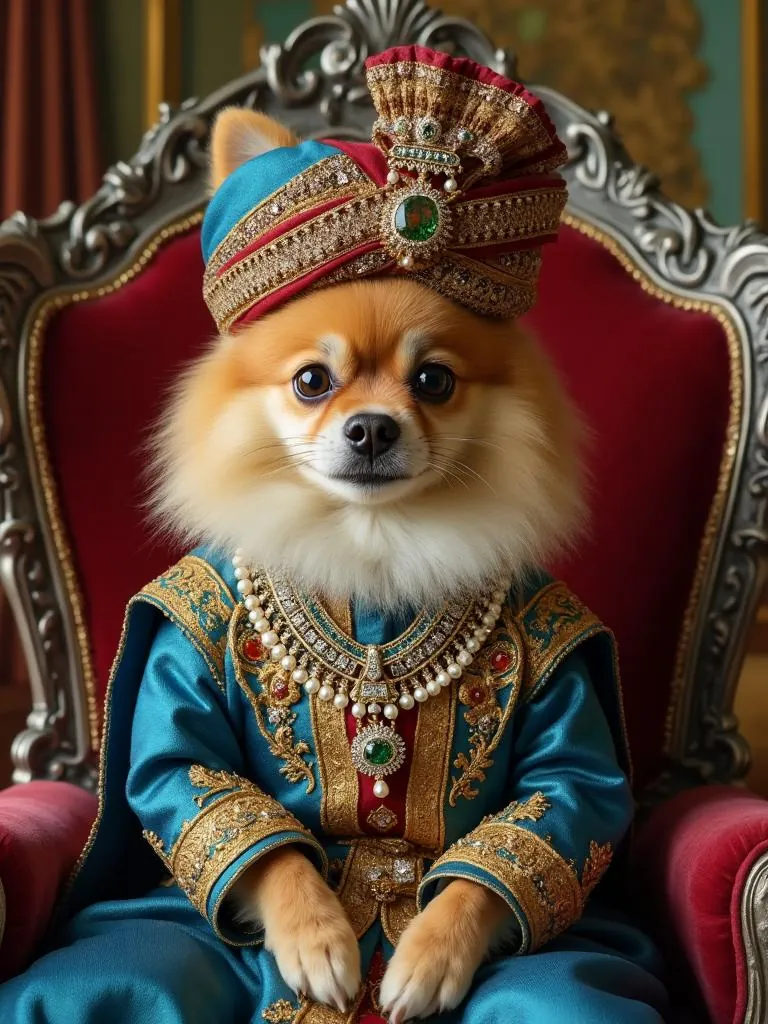
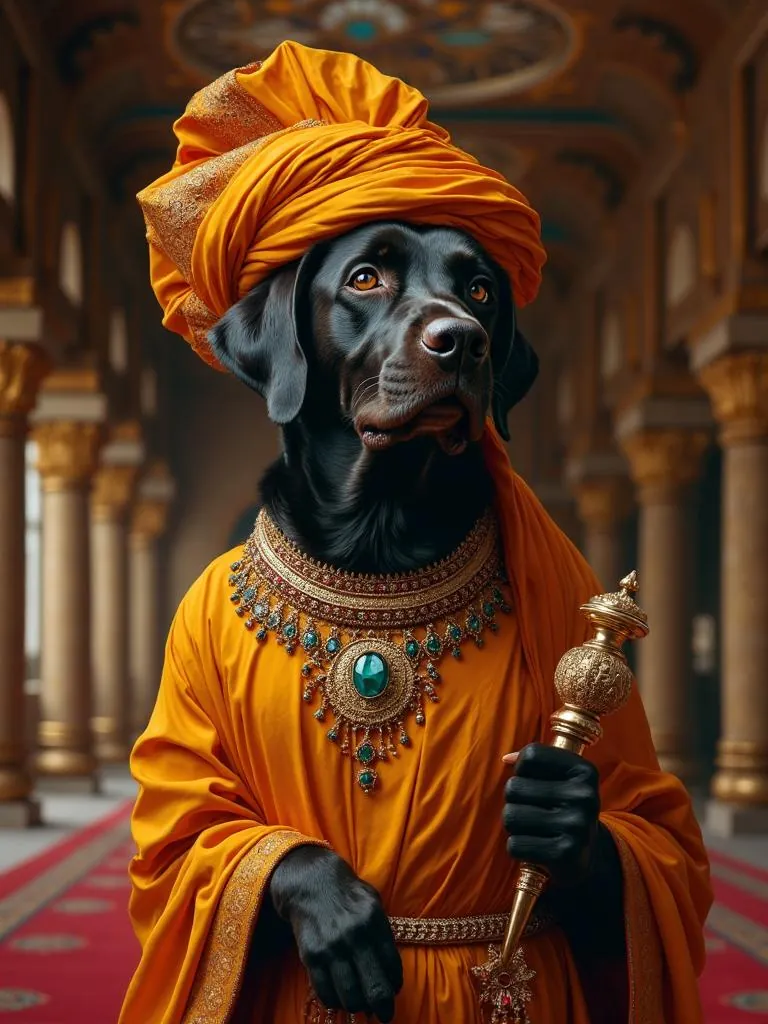
Then think about colour. Most of the colours the kennel clubs accept are black, black with tan or gold, grey or sable. Choose clothes that stand apart from the coat, so your dog is easy to see against the costume. For a black or black and tan dog, saffron and gold stand out: the Mysore Royal portrait in the gallery puts a black labrador in a saffron turban, holding a gold sceptre. For a grey or sable dog, a blue coat, like the one in the Patiala Royal portrait of a Pomeranian, gives a clear edge between the fur and the cloth. The guide on how to choose a royal portrait style has more ways to match a style to a coat.
If you plan to hang the portrait, art prints come in four sizes: 8 × 10, 12 × 16, 18 × 24 and 24 × 36 inches, on matte or glossy paper.
How to photograph a dark coat for a portrait
The portrait studio takes one photo, as an image file of up to 5 MB. With a black or black and tan dog, watch where the light comes from. The AKC's photo advice explains why: when strong light is behind a dog, the dog comes out shadowed. These steps from two AKC articles help keep the detail:
- Keep the light in front of the dog. Indoors, the AKC suggests placing the dog by a window that gets good light.
- Avoid a bright wall or sky behind the dog. One AKC article describes how to make a silhouette on purpose: put the dog in front of a much brighter background, and the dog comes out completely black. For a portrait photo, do the opposite.
- Set the brightness on the dog. The AKC suggests tapping your phone screen on the spot where you want the focus and brightness to be. Tap the dog's face, so the phone brightens the dark fur.
- Add light to the eyes. The AKC suggests a reflector to bring more light to the dog's eyes, and says a plain white foam board works as one.
- Get down to eye level and move close. The AKC advises shooting at the dog's eye level and filling the frame with the dog. Use the main camera on the back of your phone, because the AKC says the selfie lens gives a grainier photo.
The guide on how to photograph your pet for a portrait has ten more tips for dogs and cats. When the photo is ready, check that both eyes are sharp before you upload it.
Questions and answers
Who bred German shepherds?
Captain Max von Stephanitz, a German cavalry officer, bred the first German shepherds from the herding dogs of Germany in the late 1800s, according to the American Kennel Club. In April 1899 he bought a dog named Hektor Linksrhein and renamed him Horand von Grafrath. The breed club, the Verein für Deutsche Schäferhunde, says Horand became number one in its stud book, the club's official list of registered dogs.
Are German shepherds from Germany?
German shepherds are from Germany, and the American Kennel Club lists Germany as the breed's country of origin. The breed club, the Verein für Deutsche Schäferhunde, says it was founded on 22 April 1899 at the time of a dog show in Karlsruhe. According to the AKC, British owners called the breed the Alsatian during the First World War era, and many in Britain still prefer that name.
Are German shepherds herding dogs?
German shepherds are herding dogs by origin, and the American Kennel Club places them in its Herding Group. The AKC says the breed was first created to herd sheep, and that Max von Stephanitz later promoted it for police work as herding jobs declined. The Royal Kennel Club in the UK puts the breed in its Pastoral Group, which it describes as herding dogs that work cattle, sheep and reindeer.
Why German shepherds are used as police dogs?
German shepherds are used as police dogs for their versatility, strength and courage, according to the Royal Canadian Mounted Police (RCMP). The RCMP uses only purebred German shepherds in its general duty and detection dog teams. It says their size and their ability to work in many kinds of weather suit policing across Canada. The RCMP has bred its own police dogs since 1999, and they usually retire at 7 or 8 years old.
Do German shepherds have a double coat?
German shepherds have a double coat, according to the American Kennel Club breed standard. The outer coat is dense, with straight, harsh hair lying close to the body, and the AKC says a softer undercoat grows beneath it. The breed sheds more heavily once or twice a year, the AKC adds. The Royal Kennel Club recognises two coat types, a standard coat and a long coat, and both have a thick undercoat.
Can German shepherds be all black?
German shepherds can be all black, and the Royal Kennel Club lists black as a breed standard colour. Its standard also accepts black with tan or gold markings, grey, a bi-colour that is mostly black, and four shades of sable: sable, dark sable, gold sable and grey sable. The American Kennel Club standard says most colours are allowed, and that strong, rich colours are preferred.
Can German shepherds be white?
Some German shepherds are white, and both major kennel clubs count white against the breed standard. The Royal Kennel Club lists white as a non-breed-standard colour that some dogs in the breed may have, and advises buyers to choose a dog that fits the standard. The American Kennel Club standard, used by judges at its dog shows, says a white dog must be disqualified.
What German shepherd has long hair?
The long coat German shepherd has long hair, and the Royal Kennel Club recognises it as one of the breed's two coat varieties. Its standard describes a longer outer coat that is not always straight, tufts of hair at the ears, feathering on the legs and a bushy tail. The Royal Kennel Club says the long haired variety was officially recognised in the breed standard in recent years.
Which royal portrait style suits a German shepherd?
A German shepherd suits a royal portrait style with a guardian or warrior role, such as the Rajput Warrior, Military General or Medieval Knight styles in the Purrealism portrait studio. The Rajput Warrior portrait in the Purrealism gallery shows a dog in armour, with a fort at sunset behind it. For a black and tan coat, saffron or gold clothes stand apart from the dark fur, as the saffron turban does in the gallery's Mysore Royal portrait of a black labrador.
How do I photograph a dark German shepherd for a portrait?
To photograph a dark German shepherd, place the dog near a window with good light and keep that light in front of the dog. The American Kennel Club warns that a dog lit from behind will come out shadowed. The AKC also suggests tapping your phone screen on the dog to set the focus and brightness there, and holding a white foam board near the dog to add light to its eyes.
Sources
- German Shepherd Dog: Dog Breed Information, American Kennel Club
- German Shepherd Dog History: From Sheep Herding Dog to Popular Companion, American Kennel Club
- Official Standard of the German Shepherd Dog, American Kennel Club
- History, Verein für Deutsche Schäferhunde (SV)
- German Shepherd Dog: Breeds A to Z, The Royal Kennel Club
- German Shepherd Dog: Breed Standard, The Royal Kennel Club
- Our Police Service Dogs, Royal Canadian Mounted Police
- Our History, The Seeing Eye
- Say Cheese! Take the Best Photos of Your Dogs, American Kennel Club
- Tips for Taking Great Photos of Your Dog, American Kennel Club
Go deeper
The full guides on this topic, each a set of pages with sources: