Labrador Retriever portraits: the breed's Newfoundland history and a royal style that suits it
How the Labrador Retriever went from a Newfoundland fishing dog to America's most popular breed, its three coat colours, and which royal portrait style fits one.
By Purrealism
A Labrador Retriever did not start life posing for portraits. It started life hauling fishing nets out of cold water off the coast of Newfoundland, and the breed's shape, coat and temperament all trace back to that job. This guide covers where the breed comes from, what its official standard actually says about coat colour and character, and which Purrealism style suits its look.
From Newfoundland fishing boats to an English estate
The Labrador Retriever descends from the St. John's Dog, a working breed that formed on the island of Newfoundland as fishermen from Spain, France, Portugal and England brought their own dogs to the coast, the American Kennel Club says. Those different breeds mixed on the isolated island into a dog known for its skill in water and its usefulness hauling nets and retrieving fish that slipped free of the lines.
Canadian sailors later exported St. John's Dogs to England, where they docked at Poole on the southern coast. Fishermen there had the dogs retrieve objects thrown into the water in front of gathered crowds, a kind of public demonstration of the breed's skill. The Earl of Malmesbury, an English nobleman, watched one of these displays and decided the dogs would suit duck hunting at his own estate, Heron Court. His breeding program is where the modern name comes from, and where the breed's coat first got written down as a distinguishing feature: the Earl noted it turned water off like oil.
What the breed standard actually says
The American Kennel Club's official standard for the Labrador Retriever describes a dog "bred primarily as a working gun dog," with a build meant for long hours in difficult conditions rather than a show ring alone. Its most distinguishing features, in the standard's own words, are a short, dense, weather-resistant coat, an otter tail, a clean-cut head, and kind, friendly eyes that express character, intelligence and good temperament.
On colour, both major breed standards agree on the same three options. The American Kennel Club and the UK Kennel Club both list black, yellow and chocolate (the UK standard calls the third one liver or chocolate) as the only correct colours, with any other colour, or a mixed colour, treated as a fault. Yellow ranges from a light cream to a deep fox red, and chocolate ranges from light to dark, so within each of the three colours there is still real variation.
On temperament, the American Kennel Club's standard calls for "a kindly, outgoing, tractable nature; eager to please and non-aggressive towards man or animal." The UK Kennel Club's standard uses almost the same language: intelligent, keen and biddable, with a strong will to please, and a kindly nature with no trace of aggression. Two national breed clubs, writing standards independently, landed on the same description, which is part of why the temperament reads as a genuine hallmark of the breed rather than marketing language.
Why it became the most popular breed in America
The American Kennel Club has named the Labrador Retriever its most registered breed for roughly three decades running, a longer streak than any other breed on its list. The breed's working history explains the shape and the coat; the standard's kindly, eager-to-please temperament explains why a dog built for hard hunting work in cold water also does well as a family companion. Both facts come from the same source: a dog bred to retrieve game reliably, without aggression toward the hunter or other dogs nearby, ends up suited to a house full of people for the same reason.
The Mysore Royal style for a Labrador
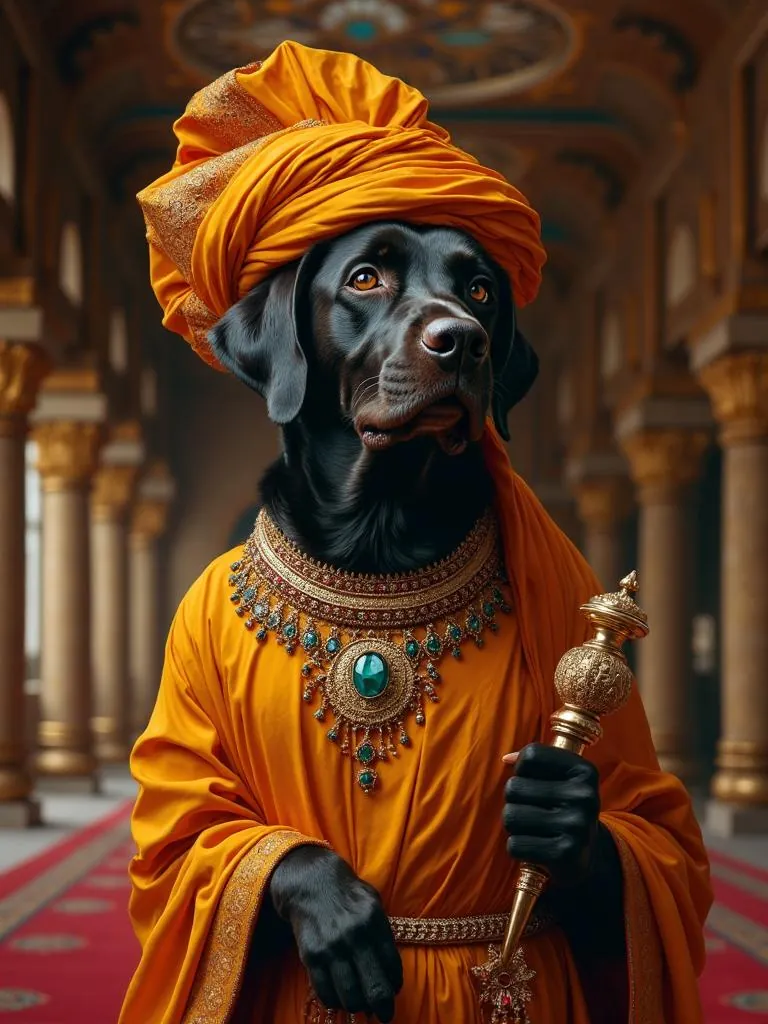
Purrealism's gallery shows the Mysore Royal style on a black labrador: a saffron turban and a gold sceptre, the same object that marked a ruler in courts across Indian history. The colour choice is deliberate. Saffron and gold read clearly against a black coat, the same way the Earl of Malmesbury's "otter" description still applies to any of the breed's three coat colours today. A yellow or chocolate Labrador wears the same turban and sceptre just as well, since the style's contrast comes from the clothing and regalia rather than from matching a specific coat shade.
The full history of the Mysore court and the other Indian royal courts behind Purrealism's styles is in the guide to Indian court painting. For a Labrador with a calmer, more composed look, the Rajput Warrior or Maratha King styles, covered in the same guide, use a similar turban and formal pose with a different colour palette.
Starting your Labrador's portrait
Every style in the portrait studio starts from one photo of your dog, up to 5 MB. Upload a clear, well-lit photo of your Labrador and the Mysore Royal style paints the saffron turban and gold sceptre around it in under half a minute. If the result does not suit your dog's particular coat, any of the other 14 styles is one click away.
Questions and answers
Where does the Labrador Retriever come from?
The Labrador Retriever descends from the St. John's Dog, a working breed that formed on the island of Newfoundland as fishermen from Spain, France, Portugal and England brought their own dogs to the coast, according to the American Kennel Club. Those breeds mixed on the isolated island into a dog known for its skill in water, hauling nets and retrieving fish for the fishing boats that worked the coast.
How did the Labrador Retriever get to England?
Canadian sailors exported St. John's Dogs to England, where they docked at Poole on the southern coast, the American Kennel Club says. Fishermen there had the dogs retrieve objects thrown into the water in front of gathered crowds. An English nobleman, the Earl of Malmesbury, saw one of these displays and decided the dogs would suit duck hunting at his Heron Court estate, so he started a breeding program that gave the breed its name.
What did the Earl of Malmesbury notice about the breed's coat?
The Earl of Malmesbury noted that the breed's coat turned water off like oil, the American Kennel Club says, a description that still matches the breed standard today. The Kennel Club's own standard calls for a short, dense coat with a weather-resistant undercoat, built to shed water rather than soak it up, which is exactly what a dog bred to retrieve from cold water needed.
What colours can a Labrador Retriever be?
A Labrador Retriever's coat comes in three colours under both major breed standards: black, yellow and chocolate. The Kennel Club's UK standard calls these black, yellow and liver or chocolate, and says yellow ranges from light cream to fox red while chocolate ranges from light to dark. Any other colour, or a mixed colour, is a fault under both standards.
What is a Labrador Retriever's temperament like?
The American Kennel Club's official breed standard describes the ideal Labrador temperament as a kindly, outgoing, tractable nature, eager to please and non-aggressive toward people or other animals. The UK Kennel Club standard uses similar language: intelligent, keen and biddable, with a strong will to please, and a kindly nature with no trace of aggression.
Is the Labrador Retriever a popular breed?
Yes. The American Kennel Club has named the Labrador Retriever its most registered breed for roughly three decades, a run longer than any other breed on the AKC's list. The breed's working history as a hunting and retrieving dog, paired with the calm temperament its own standard describes, is part of why it suits households far beyond the hunting field it was bred for.
What is the Labrador's distinctive tail called?
The Labrador's tail is often called an otter tail. The American Kennel Club's breed standard describes it as thick at the base, tapering toward the tip, and covered thickly with the same short, dense coat as the rest of the body, giving it a rounded shape. The standard treats the tail as one of the breed's most distinguishing features, alongside its coat and head shape.
Which Purrealism style suits a black Labrador?
The Mysore Royal style, shown in the gallery on a black labrador in a saffron turban holding a gold sceptre, was painted with a dark coat in mind: the saffron and gold read clearly against black fur the way they would fade against a lighter coat. A yellow or chocolate Labrador can wear the same style, since the turban and sceptre work as well against any of the breed's three coat colours.
Sources
- Labrador Retriever History: From Water Dogs to Beloved Companions, American Kennel Club
- Official Standard for the Labrador Retriever, American Kennel Club
- Retriever (Labrador) breed standard, The Kennel Club
Share this guide
The button copies a ready-written post, then opens LinkedIn. Paste the text into the post box.
Go deeper
The full guides on this topic, each a set of pages with sources: