Royal cats in history: from ancient Egypt to the palaces of Europe
Egyptians linked cats with kings and the goddess Bastet. Later, cats appear in Indian court paintings and in royal portraits, including Queen Victoria's kitten.
By Purrealism
In ancient Egypt, cats stood for rulers and for the goddess Bastet. Much later, cats appear in Indian palace paintings, in a painting made for Queen Victoria, and beside the son of a count. This guide follows the royal cats that museums hold today, and ends with how a royal cat portrait of your own cat works on Purrealism.
Why were cats sacred in ancient Egypt?
The Metropolitan Museum of Art says the Egyptians first domesticated cats in the Middle Kingdom for their skill at hunting mice. By the New Kingdom, cats had also become companions in the home. In tomb paintings they often sit under their owners' chairs.
From October 2017 to January 2018, the Smithsonian's National Museum of Asian Art showed 80 objects in "Divine Felines: Cats of Ancient Egypt", an exhibition organized by the Brooklyn Museum. The museum explained that Egyptians kept cats to keep mice and snakes away, and that cats also came to stand for powerful kings and gods. It pointed to the cat's two sides. A cat can be gentle and caring, and it can also be fierce. Egyptians linked these qualities, together with the cat's loyalty and independence, to their rulers and their gods. One section of the exhibition had the title "Cats and Kings".
The museum's chief curator, Massumeh Farhad, said that Miit, the Egyptian word for cat, was a popular name for girls.
Campbell Price, Curator of Egypt and Sudan at Manchester Museum, describes cats in ancient Egypt above all as religious symbols and as gifts to the gods. In his words, the pampered house cat is "essentially a modern, western concept".
Bastet, the Egyptian cat goddess
The Egyptian goddess most closely tied to cats is Bastet, and The Met calls the cat her sacred animal. The Penn Museum in Philadelphia describes her as the goddess of fertility and the home. Egyptians showed her either as a cat or as a woman with a cat's head. She was linked with the daughter of the sun god Re, and an Egyptian myth says that Re's daughter was a lioness when she was angry and a cat when she was calm.
The Met says Bastet and Sakhmet (also spelled Sekhmet) were two sides of divine power. Sakhmet, the lioness, stood for dangerous forces that could destroy. Bastet, "the feline of the house", stood for the kind side of a god, which rituals could calm. Manchester Museum names a third cat goddess as well: Mafdet, the earliest of them, linked with justice and with protection from poisonous animals.
Kings took part in this worship. According to the Smithsonian, Amunhotep III, a pharaoh of the 18th dynasty who ruled from 1390 to 1352 BCE, ordered two or more statues of Sakhmet for each day of the week. The Met names Bastet's temples at Bubastis and Saqqara as the most important places where people gave cats to her.
Cat mummies and jewelled cat statues in museums
Cat mummies survive in large numbers because Egyptians made them as religious gifts. The Met says people gave mummified cats at Bastet's temples, sometimes inside fine bronze or wooden cases, and the mummies were then buried inside the temple grounds. The Penn Museum adds that large cat cemeteries have been found at Saqqara, Bubastis and Thebes. Young cats were mummified, wrapped in cloth or placed in cat-shaped boxes, and sold to pilgrims, who gave them to the goddess.
Manchester Museum counts the cat mummies given to Bastet and the goddesses linked to her in the hundreds of thousands. It says that many of the cats were killed on purpose, as part of a ritual. A cat mummy from the Smithsonian's National Museum of Natural History shows the care that went into the work: the cat was wrapped tightly in linen, and its features were painted on in black ink.
Several Egyptian bronze cats in museums look royal, with gold and jewels:
- The Met's cat statuette (332 to 30 BCE). This leaded bronze cat was made to hold a mummified cat. Its pierced right ear once held a gold ring, now lost, and it wears a necklace with a wedjat eye, an eye-shaped symbol, as a pendant. The Met writes that the cat's upright pose creates "an impression of majesty".
- The Gayer-Anderson Cat at the British Museum. This hollow bronze cat from Egypt's Late Period wears gold earrings and nose-rings, with a silver sun disc and a wedjat eye on its chest. It stands 42 centimetres tall on its base. Major Robert Grenville Gayer-Anderson gave it to the museum in 1939.
- The Penn Museum's bronze cat (945 to 712 BCE). This seated cat is 55.9 centimetres (22 inches) tall, with gold leaf on its eyes and jewellery cut into the bronze of its chest. The museum thinks it may once have held a cat mummy.
Cats at the Indian and Mughal courts
Cats also appear in paintings made for Indian courts. The Met holds "A Gathering of Court Women", a page from the Davis Album dated to the late 17th or early 18th century. It shows women resting on an open terrace in front of an imperial pavilion, in the zenaneh, which The Met explains was the name for the women's quarters. A prince appears in the background, a baby is in the front, and a black cat is in the middle of the scene. The Met's catalogue entry explains that artists were not allowed into the women's quarters, so they sometimes painted court ladies as ideal beauties. It argues that some of the women in this picture must be portraits of real people.
The Victoria and Albert Museum in London holds a painting with a cat at the centre of the story. The painting, which it describes as probably Mughal and dates to between 1735 and 1744, shows a princess chasing a cat that has run off with her pet parrot. She wears a pink, pleated skirt with gold brocade and a red and green top.
For the wider story of painting at the Mughal court, including a tale about a cat and a falcon at Emperor Jahangir's court, read the guide to Mughal painting.
Cats in European royal and noble portraits
This guide includes only European royal and noble cats that a museum or palace record confirms. Two paintings meet that test.
The Royal Collection Trust holds "Cat and Dogs belonging to Queen Victoria" by Charles Burton Barber, an oil painting signed and dated 1885. Three dogs, a dachshund, a smooth fox terrier and a pug, are in an orchard, gazing at a kitten sitting on a kitchen chair. The Trust says the picture was presumably painted for the Queen, and that it is probably the painting recorded at Osborne in 1886 as a cat with Paul, Vic and Princess. Vic was the fox terrier. The dogs in her life have their own guide: Queen Victoria and her dogs.
The second painting is at The Met in New York. Francisco de Goya's portrait of Manuel Osorio Manrique de Zuñiga is dated 1787 to 1788. The boy was the son of the Count and Countess of Altamira, and he wears a red costume. He is shown between a cage of finches and three wide-eyed cats, who watch his pet magpie. The Met suggests that Goya may have meant the animals as a reminder of how weak the barrier is between a child's world and the forces of evil, or as a comment on how short childhood is. Manuel died at the age of eight, a few years after the portrait was painted.
More cat paintings from European collections are gathered in famous paintings of cats.
How to get a royal portrait of your own cat
A royal cat portrait today uses the same idea as these paintings: one real animal, shown in the clothes and setting of a court. The Purrealism gallery shows three cats:
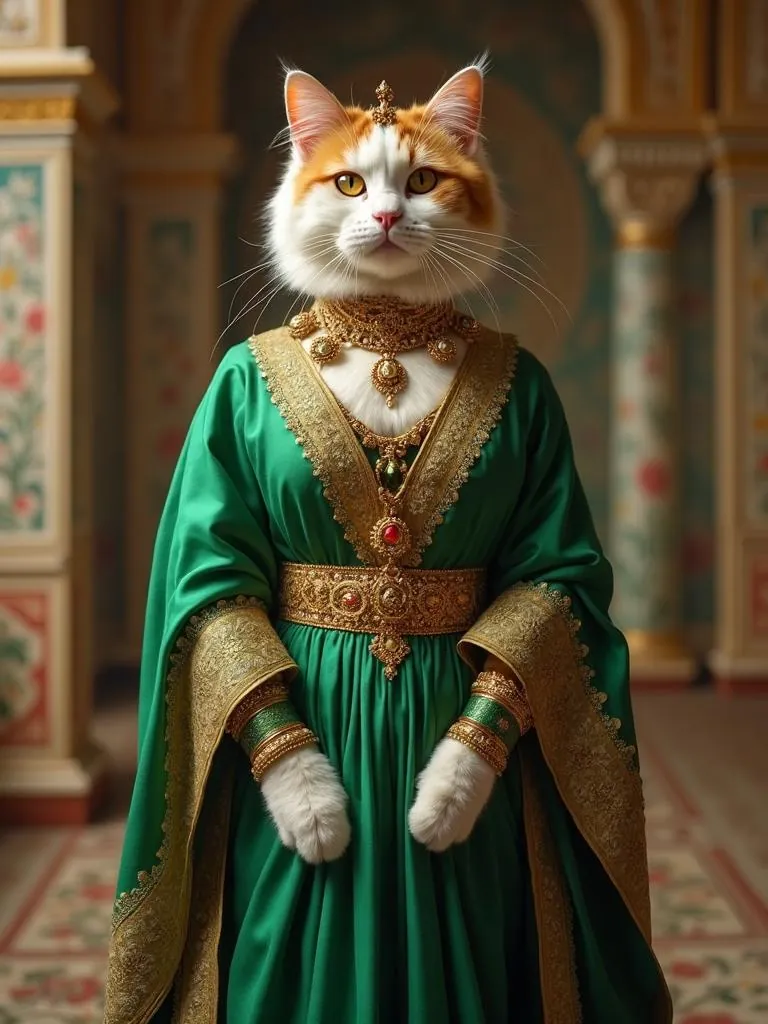
- a white and ginger cat as a Maharani, in a green and gold gown
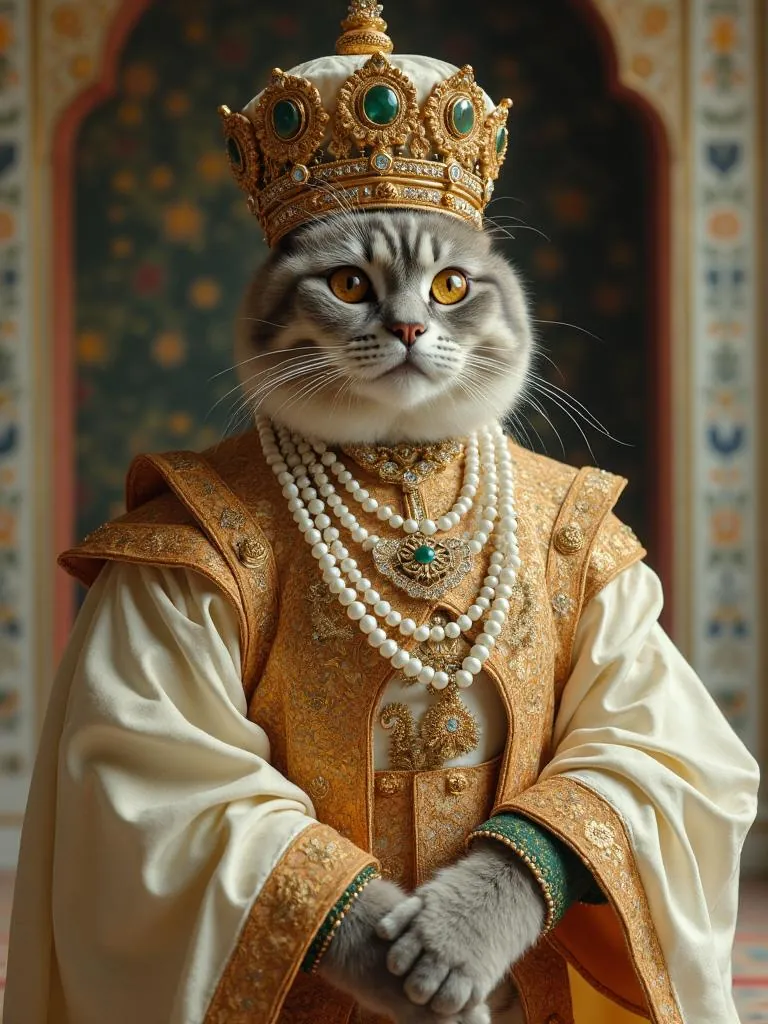
- a grey cat as a Mughal emperor, wearing a jewelled crown and pearls
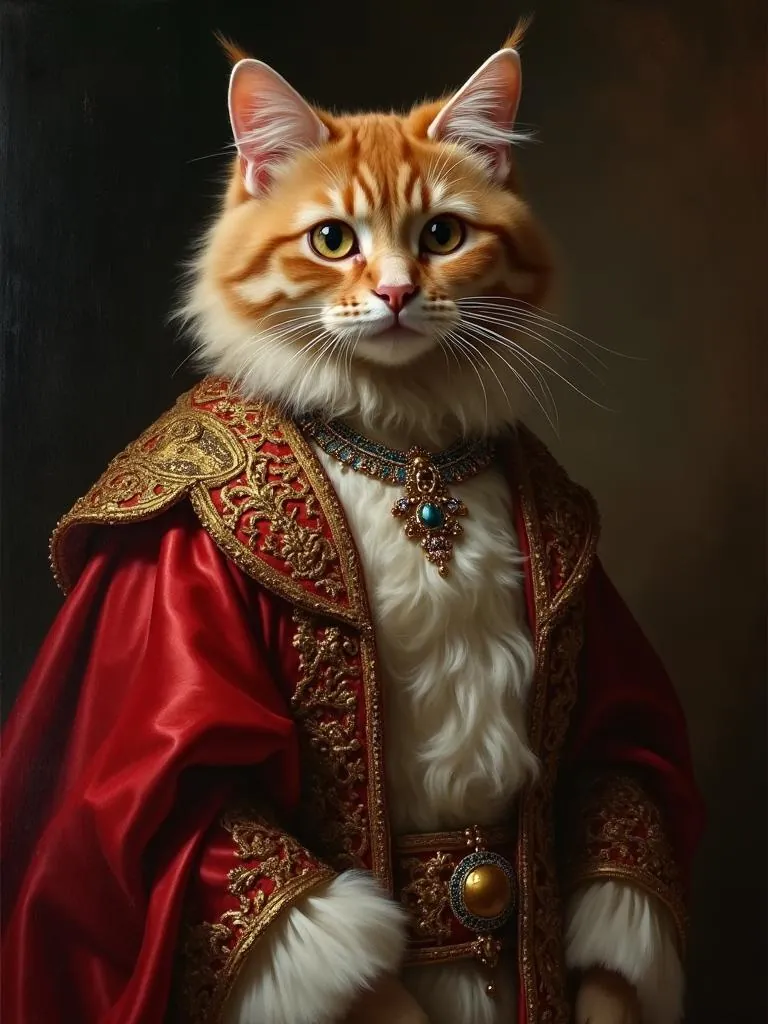
- a ginger cat in a red and gold royal robe, in the Indian Royalty style
In the portrait studio you can choose any of the 15 royal portrait styles for your cat. Nine come from Indian royal courts and six from European periods.
Start with one clear photo of your cat's face, taken in good light at your cat's eye level and saved as an image file of up to 5 MB. The guide on how to photograph your pet for a portrait covers the details.
Last, match the style to your cat's coat. A ginger coat stands out against green, as the Maharani portrait shows. A grey or white coat works with most colours, so you can choose by mood. The guide on how to choose a royal portrait style goes through each coat colour.
Questions and answers
Why were cats sacred in Egypt?
Cats were sacred in ancient Egypt because Egyptians linked them with their gods and their kings. According to the Smithsonian's National Museum of Asian Art, the cat's gentle and fierce sides, together with its loyalty and independence, became associated with Egyptian rulers and gods. The Metropolitan Museum of Art says the cat was the sacred animal of the goddess Bastet, and that people gave mummified cats at her temples, above all at Bubastis and Saqqara.
Who is the Egyptian cat goddess?
The Egyptian cat goddess is Bastet. According to the Penn Museum, she was the goddess of fertility and the home, shown either as a cat or as a woman with a cat's head. She was linked with the daughter of the sun god Re, who in Egyptian myth was a lioness when angry and a cat when calm. Manchester Museum also names Sekhmet, a lioness goddess, and Mafdet, the earliest cat goddess.
How is Bastet depicted?
Bastet is depicted as a cat or as a woman with a cat's head, according to the Penn Museum in Philadelphia. Egyptian cat statues in museums can wear jewellery. The Metropolitan Museum of Art has a bronze cat whose pierced ear once held a gold ring, and the Gayer-Anderson Cat at the British Museum wears gold earrings, gold nose-rings and a wedjat eye, an eye-shaped symbol, on its chest.
Are Bastet and Sekhmet the same?
Bastet and Sekhmet are two separate goddesses who show two sides of divine power. According to The Metropolitan Museum of Art, Sekhmet (spelled Sakhmet by The Met) was a lioness who stood for dangerous, destructive forces, while Bastet, the feline of the house, stood for the kind side of a god that rituals could calm. Manchester Museum says the two goddesses existed side by side in Egyptian religion.
Why were cats mummified?
Cats were mummified in ancient Egypt mainly as gifts to the gods. According to the Penn Museum, young cats were mummified, wrapped in cloth or placed in cat-shaped boxes, and sold to pilgrims who gave them to the goddess Bastet. Manchester Museum says these cat mummies number in the hundreds of thousands, and that many of the cats were killed as part of a ritual.
What are Egyptian cat statues called?
Egyptian cat statues are called cat statuettes or cat figures in the records of The Metropolitan Museum of Art and the British Museum. The Met lists one as a Cat Statuette intended to contain a mummified cat, a leaded bronze cat made between 332 and 30 BCE. The best-known example has its own name: the Gayer-Anderson Cat, which Major Robert Grenville Gayer-Anderson gave to the British Museum in 1939.
Are cats royal?
Cats have been linked with royalty since ancient Egypt. According to the Smithsonian's National Museum of Asian Art, Egyptian cats became symbols of powerful kings and gods, and its exhibition Divine Felines, which opened in 2017, had a whole section called Cats and Kings. Later, cats appear in court paintings, such as a black cat among the women of an Indian imperial palace in a painting held by The Met.
Do any of the royals have cats?
Queen Victoria is one British royal whose cat is on record. The Royal Collection Trust holds Cat and Dogs belonging to Queen Victoria, an oil painting by Charles Burton Barber dated 1885. It shows her dachshund, fox terrier and pug gazing at a kitten on a kitchen chair. The Trust says it was presumably painted for the Queen and is probably the picture recorded at Osborne in 1886.
Do cats appear in Indian court paintings?
Cats appear in several Indian court paintings held by major museums. The Metropolitan Museum of Art holds A Gathering of Court Women, a page from the Davis Album dated to the late 17th or early 18th century, which shows a black cat among women resting before an imperial pavilion. The Victoria and Albert Museum holds a painting, probably Mughal, of a princess chasing a cat that has run off with her pet parrot.
Which cats appear in the Purrealism gallery?
Three cats appear in the Purrealism gallery. A white and ginger cat is shown as a Maharani in a green and gold gown, a grey cat as a Mughal emperor wearing a jewelled crown and pearls, and a ginger cat in a red and gold royal robe in the Indian Royalty style. Each of these styles is one of the 15 royal portrait styles you can choose for your own cat.
Sources
- 'Divine Felines' Highlights the Importance of Cats in Ancient Egypt, Smithsonian's National Museum of Asian Art
- Cat Statuette intended to contain a mummified cat, The Metropolitan Museum of Art
- Statue of a Cat, Penn Museum, University of Pennsylvania
- The enigma of the Egyptian cat: Myth, mystery and meaning, Manchester Museum, The University of Manchester
- The Gayer-Anderson Cat (EA64391), The British Museum
- A Gathering of Court Women, Folio from the Davis Album, The Metropolitan Museum of Art
- Painting of a princess chasing a cat to save her parrot (IS.171-1955), Victoria and Albert Museum
- Charles Burton Barber, Cat and Dogs belonging to Queen Victoria, Royal Collection Trust
- Goya, Manuel Osorio Manrique de Zuñiga (1784 to 1792), The Metropolitan Museum of Art
Go deeper
The full guides on this topic, each a set of pages with sources: