Pahari court portraits: how the rajas of the Punjab Hills were painted
The small hill kingdoms of the Punjab Hills painted their rajas smoking, praying, hunting and at court. How Guler, Jasrota, Kangra and Mandi portrayed rulers.
By Purrealism. Part of Indian court painting: how India's royal courts portrayed their rulers.
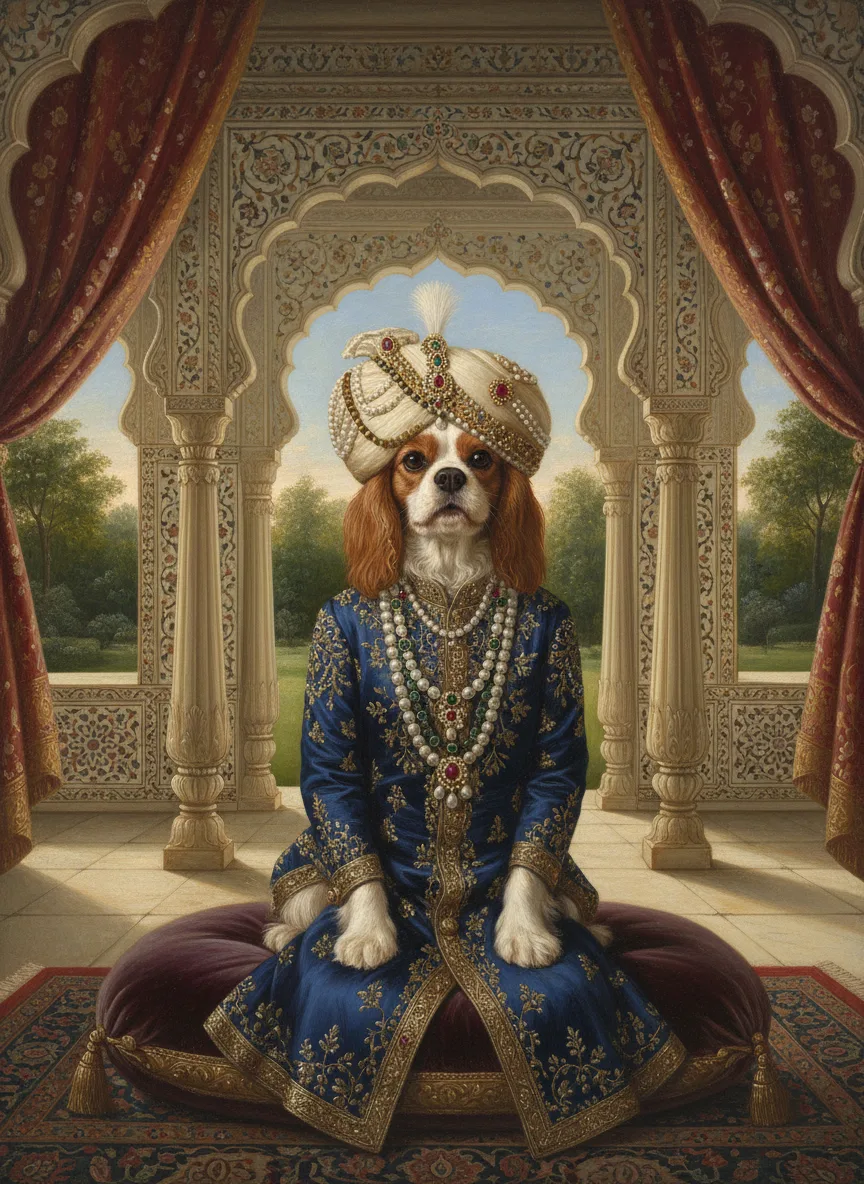
This page looks at how the rulers of the small kingdoms in the Punjab Hills were painted between the late 1600s and the early 1800s. It follows the portraits court by court: the early seated rajas of Chamba, Mankot and Guler, the painter Nainsukh's record of Raja Balwant Singh of Jasrota, the court of Sansar Chand at Kangra, and the odd, frank portraits made at Mandi. For the wider story of Rajput painting in the plains and the hills, read what is Rajput painting. For how the hill courts compare with India's other royal courts, start at the Indian court painting guide.
The hill kingdoms and their painters
Pahari means "hilly or mountainous". India's National Council of Educational Research and Training (NCERT) lists the towns that became centres of painting in the hills of the western Himalayas from the 1600s to the 1800s: Basohli, Guler, Kangra, Kullu, Chamba, Mankot, Nurpur, Mandi, Bilaspur, Jammu and others. Each was the seat of a raja.
NCERT explains that the hill rajas had family ties with the royal courts of Rajasthan, and that Mughal and Rajasthani paintings were known in the hills. It also says the hill schools are hard to sort by place. Few paintings carry dates or the names of their makers, and the borders between the states kept changing. The scholar B. N. Goswamy, whom NCERT calls one of the most important writers on Pahari painting, argued that families of artists carried the style from court to court. His central argument is that the family of Pandit Seu of Guler was chiefly responsible for the course of Pahari painting. Seu's sons Manaku and Nainsukh, and their own sons and grandsons, worked at many hill courts.
The early hill portrait: one raja on a flat colour
The oldest hill portraits follow a simple plan. One raja sits on a terrace or a rug, leans against a large cushion called a bolster, and smokes a huqqa, a water pipe. The background is a flat field of colour.
The Cleveland Museum of Art owns what it calls the earliest known portrait of a Guler chief, Raja Bikram Singh of Guler. The museum dates it between 1678 and 1690 and says it was painted in Chamba, a neighbouring kingdom, possibly for Raja Chattar Singh. It lists the features of early Chamba portraits that it shows: a straight pipe on the huqqa, striped trousers, large bolsters and the raja's seated pose.
Mankot, which NCERT says had marriage ties with Basohli, used the same plan. A Victoria and Albert Museum (V&A) portrait of Raja Ajmat Dev of Mankot, painted close to 1730, shows him in dark green, smoking a huqqa and leaning on a bolster against a bright yellow background. His sword and a spittoon sit within reach. The V&A says the design comes from the same model as a painting in the Chandigarh Museum, but the Chandigarh version also has a servant with a fan, whom the V&A painter left out. One design served for more than one picture.
At Basohli, the court that NCERT says produced the first dramatic hill style, painters liked strong primary colours and warm yellow backgrounds. They painted pearls with raised dots of white paint. To show emeralds in jewellery, they used tiny, shiny green pieces of beetle wings. NCERT dates this style to the reign of Raja Kirpal Pal, from 1678 to 1695, and says Basohli artists painted local kings with their wives, courtiers, astrologers and wandering holy men. NCERT adds that the rulers of Chamba were also painted in the Basohli style in the 1600s and early 1700s.
Guler: a softer look
NCERT calls Guler a high-ranking branch of the Kangra royal family. The Cleveland Museum of Art says Raja Dilip Singh, who came to the throne in 1695, began the practice of ordering paintings and manuscripts for the royal collection at Guler. Its portrait of him, painted early in the 1700s, shows him on a raised seat holding a page of red and black writing, with the mark of the god Vishnu on his forehead. The museum says some members of a Guler family of artists had worked in the Mughal imperial workshop in Lahore. It sees the natural, delicate style they brought in the trees, the raja's face, his belted Mughal-style coat and the flowered carpet.
NCERT describes the change that followed. It says Pandit Seu and his sons Manaku and Nainsukh moved hill painting toward a more refined, quieter style between 1730 and 1740, and that this new phase first appeared at Guler under Raja Govardhan Chand, who ruled from 1744 to 1773. Manaku painted many portraits of Govardhan Chand and his family. The next raja, Prakash Chand, kept Khushala, Fattu and Gaudhu, sons of Manaku and Nainsukh, as his court artists.
A V&A painting from close to 1780 shows Prakash Chand of Guler, who ruled from 1773 to 1790, smoking a huqqa on a terrace with the young Sansar Chand of Kangra. Both men wear plain white robes and white turbans, and a servant with a fan stands behind each one.
Nainsukh and Raja Balwant Singh of Jasrota
NCERT calls Nainsukh's pictures of Raja Balwant Singh of Jasrota, a small state linked to Jammu, unique in the kind of record they give of a patron's life. According to NCERT, Nainsukh appears to have left Guler for Jasrota, where he is believed to have worked first for Mian Zoravar Singh, whose son Balwant Singh became his greatest patron. The V&A gives Balwant Singh's dates as 1724 to 1763 and says Nainsukh worked for him from the 1740s until his death.
NCERT says Nainsukh painted his patron "on every possible occasion". The V&A holds several of these pictures:
| Painting at the V&A | What Balwant Singh is doing |
|---|---|
| Raja Balwant Singh at worship | Seated bare-chested in a white dhoti before a shrine to Vishnu, attended by servants |
| Balwant Singh watching mimics and musicians | Smoking a huqqa on a gold throne under a canopy while a boy dancer, musicians and singers perform |
| Raja Balwant Singh hunting partridges | Out hawking for partridges with his retainers, in a painting 44 cm wide |
The V&A calls the worship scene intimate. It says the raja's head is shaved except for a small tuft of hair that signals his devotion, and calls the picture a rare view of a ruler's daily ritual. In the performance scene, one musician holds up a rolled paper in fun, copying the raja as he smokes his huqqa. The V&A says two sheets of paper were joined to make that wide picture.
NCERT describes other scenes of Balwant Singh: surveying a building site, and sitting in a camp wrapped in a quilt because of the cold. It also describes a painting in which the raja studies a picture of Krishna, while a man bows politely behind him. NCERT says this man is probably Nainsukh himself, one of the rare cases of the artist painting himself with his patron.
Rank written in the border
Nainsukh also painted Balwant Singh's friends. His picture of Mukund Dev of Jasrota, painted between 1740 and 1745, shows him riding through a yellow mustard field in a yellow robe for the spring festival of Vasant, with musicians and a singer named Amal. The V&A says Mukund Dev's pose, dress, horse and servant are almost the same as those of Balwant Singh in another painting in its collection. The words written in the top border mark the difference in rank. They call Mukund Dev "Mian", a lower title, where paintings of Balwant Singh always use Raja or Maharaja.
The V&A records that Nainsukh's sons, Ranjha and Nikka, later worked for Raja Raj Singh of Chamba for twenty years.
Kangra: Sansar Chand's court on record
According to NCERT, painting in the Kangra region grew under Raja Sansar Chand, who ruled from 1775 to 1823 and belonged to the Katoch family. He came to the throne at the age of 10. When Prakash Chand of Guler could no longer pay his artists, NCERT says, the master Manaku and his sons went to work for Sansar Chand.
The V&A shows the family before he became raja. A painting from close to 1770 shows Raja Ghamand Chand of Kangra, who ruled from 1761 to 1774, seated with his son Tegh Chand and three grandsons, Sansar Chand, Fateh Chand and Man Chand, before him.
The Cleveland Museum of Art owns two early pictures of Sansar Chand as a young ruler. One, from the early 1780s, shows him on a red seat at an age the museum puts near 18, still without a beard, with his curly, bushy hair showing under a pink turban. The museum thinks it may mark the Mughals giving up control of Kangra in 1783. The other is a painting on cotton cloth, 256.5 cm wide, of his 1782 attack on Kangra fort, with Persian and Takri writing that gives the date. The museum says the 17-year-old raja rides a dark brown horse in front of a camel, where he blends in among his army and allies.
NCERT lists what Sansar Chand's painters recorded: the raja sitting by the riverside, listening to music, watching dancers, leading festivals, practising archery and tent pegging (a riding game in which a rider spears a peg in the ground), and drilling his troops. A V&A brush drawing shows him walking with his son Anirudh Chand. An inscription signed by William Moorcroft and dated 18 July 1820 says these portraits were "taken 24 years ago". NCERT says Anirudh Chand, who ruled from 1823 to 1831, is often painted with his courtiers too.
Mandi: frank faces
Some Mandi portraits show a ruler's odd character openly. The V&A holds a portrait of Raja Sidh Sen of Mandi, who ruled from 1684 to 1727, seated cross-legged on a striped rug in a red dress and turban, with a white moustache and beard and a curved sword. The museum dates the painting between 1765 and 1780, decades after his reign ended, so the painter was showing a ruler from the past.
His successor, Shamsher Sen, ruled Mandi from 1727 to 1781. The V&A calls him eccentric and says he was often painted as if distracted or even drugged. In one painting he walks with a long stick and holds his half-brother's hand, as if he needs help to stay upright, while a servant waves a fan behind them. The museum adds that slate blue and olive green are typical colours of Mandi painting.
Some inscriptions name the wrong person. A V&A portrait of Raja Ishwari Sen of Mandi, who lived from 1784 to 1826, was painted in Delhi close to 1825. The V&A calls it a Company painting, a type that Indian artists made for Europeans in India. An inscription on the front calls the sitter Ranjit Singh of Lahore. A Persian line on the back gives the correct name: Ishwari Sen, ruler of Mandi in the hills. Painters from the hills later worked for Ranjit Singh's court too, and our page on Sikh court portraits follows them to Lahore.
How to read a hill raja's portrait
| What to look for | What it tells you | Example |
|---|---|---|
| Huqqa and bolster | A ruler at ease at his own court | Ajmat Dev of Mankot; Bikram Singh of Guler |
| Flat yellow, green or plain ground | An early hill portrait, focused on the one figure | Ajmat Dev of Mankot |
| Raja or Mian written in the border | The sitter's rank | Mukund Dev of Jasrota |
| A daily task: prayer, a hunt, a building site | A painter who lived close to his patron | Nainsukh's Balwant Singh |
| Battle, festival or army drill | A ruler who wanted his reign recorded | Sansar Chand of Kangra |
None of the hill portraits on this page shows the halo or the parasol that mark many Mughal and Rajput kings. Compare them with Mughal royal portraits and Rajput court portraits to see the difference. For how the thin paper, the colours and the gold of these small paintings were prepared, read our page on how Indian miniature paintings were made.
From a hill raja to your pet
Hill portraits suit a quiet, close portrait of one animal, and Purrealism's Indian Royalty style fits that mood. In the gallery, the Indian Royalty portraits show a golden retriever wearing a royal crown and red robe, and a ginger cat in a red and gold royal robe. The studio examples also include a Cavalier King Charles Spaniel, a German Shepherd and a Siberian Husky in the same style.
Nainsukh painted Balwant Singh doing ordinary things, and a pet photo can work the same way. Choose a picture of your dog or cat in a pose you know well, with the face in clear focus. The portrait studio takes one photo of up to 5 MB, and you can choose a digital download or an art print on matte or glossy paper.
Questions and answers
Who did the Pahari painter Nainsukh paint most often?
The Pahari painter Nainsukh painted Raja Balwant Singh of Jasrota more often than anyone else. The Victoria and Albert Museum says Balwant Singh, who lived from 1724 to 1763, was Nainsukh's patron from the 1740s until his death. According to NCERT, Nainsukh painted him on every possible occasion: at prayer, checking a building site, and sitting in a camp wrapped in a quilt because of the cold.
Did Nainsukh paint himself next to Raja Balwant Singh?
Nainsukh probably did paint himself next to Raja Balwant Singh. India's National Council of Educational Research and Training (NCERT) describes a painting in which Balwant Singh sits in his palace studying a painting of Krishna, while a man bows politely behind him. NCERT says this man is probably Nainsukh, the artist, and calls the picture a rare case of the painter showing himself with his patron.
How does Nainsukh's painting of Balwant Singh at worship show the raja?
Nainsukh's painting of Balwant Singh at worship shows the raja bare-chested in a plain white dhoti, seated before a shrine to the god Vishnu. The Victoria and Albert Museum says his head is shaved except for a small tuft of hair, which signals his devotion. Two servants wave fans beside him, and a third prepares a small fire outside. The museum dates the painting to the middle of the 1700s.
How did a Pahari portrait show that one man ranked below another?
A Pahari portrait could show rank through the title written above the figure. The Victoria and Albert Museum holds a Nainsukh painting of Mukund Dev of Jasrota riding with musicians. The words in the top border call him Mian, a lower title, while paintings of Balwant Singh always call him Raja or Maharaja. The museum says Mukund Dev's pose, horse and servant match a painting of Balwant Singh.
What does the earliest known portrait of a Guler raja show?
The earliest known portrait of a Guler raja shows Raja Bikram Singh of Guler smoking a huqqa. The Cleveland Museum of Art, which owns it, dates it between 1678 and 1690 and says it was made in Chamba, a neighbouring hill kingdom. The museum lists the marks of early Chamba portraits in it: a straight pipe, striped trousers, large cushions and the raja's seated pose.
Who began the royal painting collection at Guler?
Raja Dilip Singh of Guler, who came to the throne in 1695, began the practice of ordering paintings and manuscripts for the Guler royal collection. That is the view of the Cleveland Museum of Art. Its portrait of him, from early in the 1700s, shows him on a raised seat holding a page of red and black writing, with the mark of the god Vishnu on his forehead.
How old was Raja Sansar Chand of Kangra in his early portraits?
Raja Sansar Chand of Kangra was a teenager in his early portraits. The Cleveland Museum of Art holds one from the early 1780s that shows him at an age the museum puts near 18, before his beard had grown, with curly hair under a pink turban. Its large cloth painting of his 1782 attack on Kangra fort shows him at 17. According to NCERT, he came to the throne at the age of 10.
What did Sansar Chand's painters record about his court?
Sansar Chand's painters recorded almost every part of his life at court in Kangra. According to NCERT, the paintings show him sitting by the riverside, listening to music, watching dancers, leading festivals, practising archery and tent pegging, a riding game with a lance, and drilling his troops. NCERT names Fattu, Purkhu and Khushala as important painters of the Kangra style.
Why was Raja Shamsher Sen of Mandi painted looking distracted?
Raja Shamsher Sen of Mandi was painted looking distracted because that is how people saw him. The Victoria and Albert Museum calls him the eccentric ruler of Mandi from 1727 to 1781 and says he was often shown as if distracted or even drugged. In one V&A painting he walks with a stick and holds his half-brother's hand, as if he needs help to stay on his feet.
Which Mandi portrait was labelled with the wrong ruler's name?
A portrait of Raja Ishwari Sen of Mandi was labelled with the wrong ruler's name. The Victoria and Albert Museum says the front calls him Ranjit Singh, the Sikh ruler of Lahore. A Persian line on the back names the real sitter, Ishwari Sen, ruler of Mandi in the hills. The museum dates it close to 1825 and thinks Lord Amherst acquired it in Delhi in 1827.
How did Basohli painters make the jewels in their portraits shine?
Basohli painters made jewels shine with real materials. According to NCERT, they used small, shiny green pieces of beetle wings to show emeralds, and raised dots of white paint to look like pearls. NCERT dates the Basohli style to the reign of Kirpal Pal, from 1678 to 1695, and says Basohli artists painted portraits of local kings with their wives, courtiers and astrologers.
Sources
- The Pahari Schools of Painting (An Introduction to Indian Art, Part II, chapter 5), National Council of Educational Research and Training (NCERT). Accessed September 28, 2026.
- Raja Balwant Singh at worship, painting by Nainsukh, Victoria and Albert Museum. Accessed September 28, 2026.
- Raja Balwant Singh watching mimics and musicians, painting by Nainsukh, Victoria and Albert Museum. Accessed September 28, 2026.
- Raja Balwant Singh hunting partridges, painting by Nainsukh, Victoria and Albert Museum. Accessed September 28, 2026.
- Mian Mukund Dev riding with musicians, painting by Nainsukh, Victoria and Albert Museum. Accessed September 28, 2026.
- Raja Bikram Singh of Guler smoking a hookah, The Cleveland Museum of Art. Accessed September 28, 2026.
- Raja Dilip Singh of Guler on a dais, The Cleveland Museum of Art. Accessed September 28, 2026.
- Raja Ajmat Dev of Mankot smoking huqqa, painting, Victoria and Albert Museum. Accessed September 28, 2026.
- Raja Prakash Chand smoking with Raja Sansar Chand, painting, Victoria and Albert Museum. Accessed September 28, 2026.
- Raja Sansar Chand of Kangra and courtiers, The Cleveland Museum of Art. Accessed September 28, 2026.
- Raja Sansar Chand attacking Kangra Fort, The Cleveland Museum of Art. Accessed September 28, 2026.
- Raja Ghamand Chand of Kangra, son and grandsons, painting, Victoria and Albert Museum. Accessed September 28, 2026.
- Raja Sansar Chand and Anirudh Chand, brush drawing, Victoria and Albert Museum. Accessed September 28, 2026.
- Raja Sidh Sen seated, painting, Victoria and Albert Museum. Accessed September 28, 2026.
- Raja Shamsher Sen and brother Dhurchatia walking, painting, Victoria and Albert Museum. Accessed September 28, 2026.
- Portrait of Ishwari Sen of Mandi, Victoria and Albert Museum. Accessed September 28, 2026.
Short reads on this topic
Articles from Purrspectives that answer one question each.
What is Tanjore painting? Gold foil, gesso and the Thanjavur court
Tanjore painting is a South Indian style from Thanjavur, made on a wooden board with raised gesso, gold foil and glass stones. Where it came from and how it is made.
Indian royal pet portraits: the nine Indian court styles explained
An Indian royal pet portrait dresses your dog or cat as a ruler or warrior from an Indian court. Here are the nine styles and the history behind them.
The Maharajas of Patiala: the history behind Patiala royalty
The Phulkian rulers of Patiala founded their capital in 1763. Who built Qila Mubarak, who Bhupinder Singh was, and how Patiala joined India.