Rajput court portraits: kings on horseback, at the hunt and at court
Rajput rulers were painted with halos, on galloping horses and at the hunt. How the courts of Rajasthan made royal portraits and kept records of them.
By Purrealism. Part of Indian court painting: how India's royal courts portrayed their rulers.
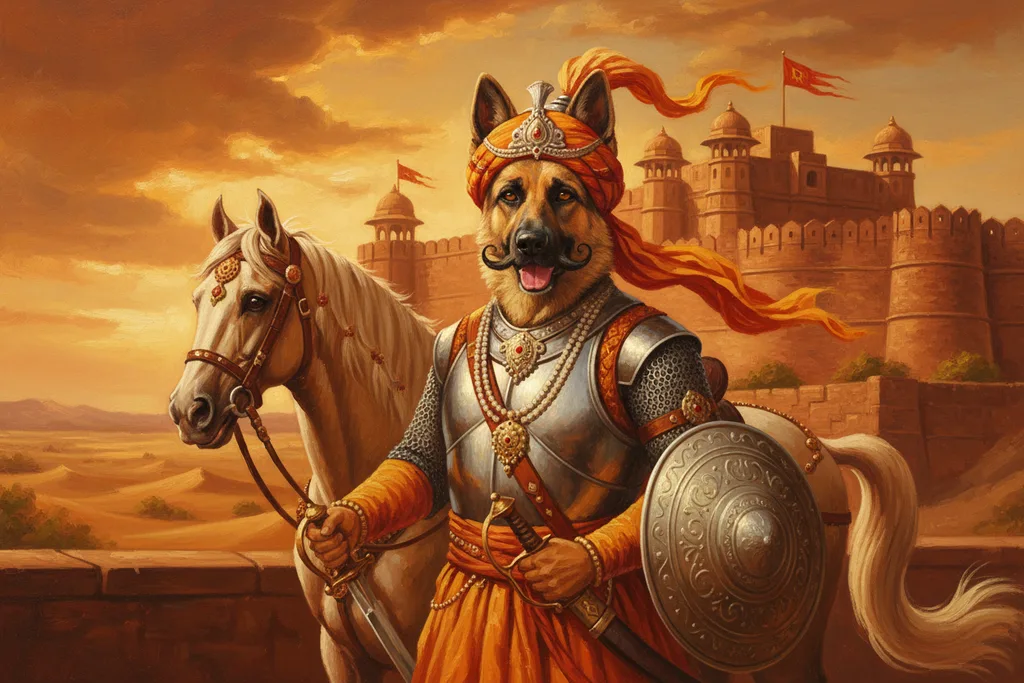
This page is about one part of Rajput painting: the portraits of the rulers themselves. It covers how the kings of Rajasthan were shown, on thrones, on horseback, at the hunt and among musicians, and how some courts kept careful records of who painted what. For an overview of the Rajput schools and how the name came about, read what is Rajput painting. For the place of these courts among all of India's royal painting traditions, see the Indian court painting guide.
From illustrated stories to royal portraits
The early Rajasthani paintings mostly illustrated poems, religious stories and music. India's National Council of Educational Research and Training (NCERT) says that during the 1700s, painting moved away from texts and toward the activities and pastimes of the royal court. At Mewar, NCERT describes a growing interest in portraits in that century, along with large court scenes, hunts, festivals and sports.
Jodhpur started even earlier. NCERT says that in the 1640s, under Maharaja Jaswant Singh, who ruled from 1638 to 1678, Jodhpur painters began to record the court in portraits and scenes of court life. This habit lasted until the 1800s, when photography took over the task of recording events. Many portraits of Jaswant Singh survive.
Some rulers clearly enjoyed being painted. NCERT calls Rao Bhao Singh of Bundi, who ruled from 1659 to 1682, an enthusiastic patron who commissioned numerous portraits of himself.
Where the Rajput halo came from
A Rajput king in a painting often has a circle of light around his head. The Victoria and Albert Museum (V&A) in London explains its origin in the record for a fine brush drawing of Raja Jaswant Singh of Jodhpur with his relatives, made between 1640 and 1650. The museum says the halo of rays was borrowed from Mughal artists, who had taken it from Western art, and that the same sign had appeared much earlier in Buddhist paintings in India. The V&A adds that the quality of the drawing suggests an artist trained in the Mughal court style. Our page on Mughal royal portraits explains how the halo was used at the Mughal court.
By the 1700s the halo was normal at the Rajput courts. A V&A painting from Mewar, made in the 1750s, shows the boy ruler Raj Singh II with a halo while he and his nobles watch dancers at night in the City Palace in Udaipur. The museum says he came to the throne in 1754 at the age of ten and looks only ten or eleven in the picture. A Bundi painting from the late 1700s gives Rao Umed Singh a halo too, in the middle of a fight with a wild boar.
Kings on horseback
Portraits of rulers on horseback were a speciality of Bundi and Kota. NCERT says the two schools produced a series of fine equestrian portraits, which means portraits of a rider on a horse.
The most famous is a portrait of Aniruddha Singh of Bundi, painted by the artist Tulchi Ram in 1680. NCERT says the artist showed speed by leaving out the ground completely: the horse gallops so high that no ground is visible. The names of Tulchi Ram and of the prince are written on the back. The name on the front is Bharat Singh, the youngest son of Rao Chattarsal, so some scholars think he is the rider. Most scholars think it shows the young Aniruddha Singh before he became king. The painting is in the National Museum in New Delhi.
At Jodhpur, the warrior Durgadas Rathore became a popular subject. NCERT says he fought a 25-year war against the Mughal emperor Aurangzeb to win back Marwar for Ajit Singh, and that his equestrian portraits became popular during Ajit Singh's reign.
The hunt as a portrait
At Kota, the hunt was the main way to show a king. NCERT says Kota excelled at hunting scenes and shows an obsession with the chase. Umed Singh came to the throne at the age of 10, and his regent, Zalim Singh, kept the young king busy with hunting while he governed. The paintings of this period served as flattering records of his exploits, and NCERT says even the women of the court took part.
The V&A holds several of these hunting portraits:
- Maharao Umed Singh of Kota on horseback, spear raised against a wild boar, with three attendants, against a bright yellow background, dated 1771.
- Raja Durjan Sal of Kota hunting a lion in a forest, dated 1778.
- Rao Umed Singh of Bundi, with a halo, slashing at a boar that has attacked his horse, from the late 1700s. The horse is falling, legs in the air, while the king stays in the saddle.
NCERT adds more examples. Bishen Singh of Bundi, who ruled from 1771 to 1821, loved hunting, and paintings of him hunting wild animals are common from his reign. At Mewar, a painting from 1744 shows Maharana Jagat Singh II riding through the countryside on the way to hunt with hawks. NCERT also lists a Kota painting of Maharaja Ram Singh I hunting lions at Mukundgarh in 1695.
NCERT describes Kota paintings as spontaneous, drawn with flowing lines like handwriting, with marked shading, most of all on the double eyelid. It says Kota artists excelled at animals and combat. Our page on animals in Indian court painting looks at the hounds, horses and elephants in these scenes.
Portraits of rulers at leisure
Not every portrait was about war or hunting. Many show a ruler at ease with his family or his musicians.
NCERT says the whiskered face of Rao Budh Singh of Bundi can be seen in many portraits, and that he supported painting even though he lost his kingdom four times. A V&A painting from the 1740s shows him with his two sons and an attendant, smoking a huqqa (a water pipe), in a chequered orange and yellow garment.
Another Bundi portrait, from the 1780s, shows Raja Ajit Singh seated under a canopy watching a young kathak dancer. The V&A describes his lavish turban jewels, rows of pearl necklaces with gem-set pendants, and bracelets on both wrists.
Courts that kept records
Rajput paintings are often hard to date, but some courts kept good records.
Bikaner
NCERT calls Bikaner one of the best documented schools of painting. When a painting was finished, the court archivist wrote the name of the master artist and the date on the back. Because of this, a master's name sometimes appears on work painted by his pupils. The master sometimes added final touches, a step called gudarayi, which literally means "to lift". Artists worked in group studios called Mandi, which also repaired old paintings (marammat) and made copies (nakals). NCERT says Bikaner is the only school with a custom of painting portraits of its artists, and that the court kept daily diaries called Bahis.
Mewar
NCERT quotes the inscription on a Mewar ragamala page (a painting of a musical mood) dated Samvat 1685, which is 1628 CE. It names the ruler Jagat Singh, the city of Udaipur and the painter Sahibdin, who is called a chitara, "someone who paints". The painting is described as "written", because the painter's goal was to match the verse on the page.
Jaipur
NCERT says Sawai Jai Singh of Jaipur, who ruled from 1699 to 1743, had a skilled portrait painter named Sahibram in his workshop, and that the hero in many of his story sets looks like the king. Jaipur preferred large paintings and produced life-size portraits. Copies were made by tracing and pouncing. Pouncing means pricking tiny holes along the lines of a drawing and dusting powder through them onto a fresh sheet. The V&A holds a brush drawing of Raja Jagat Singh of Jaipur made during his reign (1803 to 1818) that is pricked in exactly this way.
Portrait habits, court by court
| Court | What its royal portraits are known for | Source |
|---|---|---|
| Jodhpur | Recording court life in portraits from the 1640s; equestrian portraits of Durgadas | NCERT |
| Bundi | Rulers on horseback; the whiskered Budh Singh; Tulchi Ram's flying horse | NCERT, V&A |
| Kota | Rulers hunting lions, tigers and boar; marked shading | NCERT, V&A |
| Mewar | Large court scenes; the boy ruler Raj Singh II with a halo | NCERT, V&A |
| Bikaner | Artist names and dates on the back; portraits of the artists | NCERT |
| Jaipur | Life-size portraits; copies made with pricked stencils | NCERT, V&A |
From Rajput portraits to a Rajput Warrior portrait of your pet
The Rajput Warrior style on Purrealism takes its name from these rulers. In the gallery, the Rajput Warrior portrait shows a dog in armour with a fort at sunset behind it, and the studio examples include a German Shepherd in the same style. Hunting and riding portraits suit an active dog, and our page on Pahari painting shows the quieter portraits made in the hill courts north of Rajasthan. When you are ready, the portrait studio takes one clear photo of up to 5 MB.
Questions and answers
Why do Rajput kings have halos in paintings?
Rajput kings have halos in paintings to show that they are rulers. The Victoria and Albert Museum says a drawing of Raja Jaswant Singh of Jodhpur, made between 1640 and 1650, gives him a halo of rays borrowed from Mughal artists. The V&A also holds a Mewar painting from the 1750s in which the boy ruler Raj Singh II, who looks only ten or eleven years old, wears a halo while he watches dancers.
Which Bundi painting shows a horse galloping so high that the ground disappears?
The equestrian portrait of Aniruddha Singh of Bundi, painted by the artist Tulchi Ram in 1680, shows a horse galloping so high that the ground cannot be seen. According to India's National Council of Educational Research and Training (NCERT), the artist left out the foreground to show speed. Most scholars think the rider is the young Aniruddha Singh, although the name on the front says Bharat Singh. The painting is in the National Museum, New Delhi.
Why did Kota painters paint so many hunting scenes?
Kota painters painted many hunting scenes because their rulers spent much of their time hunting. NCERT says Umed Singh of Kota came to the throne at the age of 10, and his regent Zalim Singh kept him busy with hunting while he ran the state. The paintings became flattering records of the ruler's exploits, and NCERT says even the women of the court joined the chase.
How did Bikaner record who made its paintings?
Bikaner recorded who made its paintings by having the court archivist write the master artist's name and the date on the back of each finished work. NCERT says this is why the master's name sometimes appears on work by his pupils. Bikaner also kept daily court diaries called Bahis, and NCERT calls it one of the best recorded schools of painting in Rajasthan.
What does gudarayi mean in Bikaner painting?
Gudarayi was the word used at Bikaner for the finishing touches a master artist added to a painting made in his studio. According to NCERT, the word literally means to lift. Bikaner artists worked in group studios called Mandi under a master, and the same studios also repaired old paintings, called marammat, and made copies, called nakals.
How did Jaipur artists copy royal portraits?
Jaipur artists copied royal portraits by tracing and by pouncing, which means pricking tiny holes along the lines of a drawing and dusting colour through them onto a new sheet. The Victoria and Albert Museum holds a brush drawing of Raja Jagat Singh of Jaipur, made during his reign from 1803 to 1818, that is pricked in this way. NCERT says many Jaipur copies were made by tracing and pouncing.
When did Jodhpur painters start recording court life?
Jodhpur painters started recording court life in portraits in the 1640s, under Maharaja Jaswant Singh, who ruled from 1638 to 1678. According to NCERT, this habit of documentary painting lasted until photography took over the job in the 1800s. Many portraits of Jaswant Singh survive, and the Victoria and Albert Museum holds a fine drawing of him seated among his relatives.
How can you recognise Rao Budh Singh of Bundi in paintings?
Rao Budh Singh of Bundi can be recognised in paintings by his whiskered face, which NCERT says is visible in many portraits. NCERT adds that he lost his kingdom four times but still supported painting. A Victoria and Albert Museum portrait from the 1740s shows him with his two sons and an attendant, smoking a huqqa, or water pipe, in a chequered orange and yellow garment.
Who painted the portrait of Rao Umed Singh of Bundi fighting a boar?
The portrait of Rao Umed Singh of Bundi fighting a boar is by an unknown Bundi artist, painted in the late 1700s and now in the Victoria and Albert Museum. The museum says Umed Singh wears a halo to show his kingship. He holds a bow in one hand and slashes with a sword at a wild boar that has attacked his horse, which is falling to the ground as he stays in the saddle.
Did Rajput painters sign their names on paintings?
Some Rajput painters did sign or name themselves on paintings, and court clerks named others. NCERT quotes a Mewar ragamala page dated 1628 that calls the artist Sahibdin a chitara, meaning someone who paints. At Bundi, the painter Tulchi Ram's name is written on the back of his 1680 horse portrait, and at Bikaner the court archivist wrote each master's name behind the work.
Sources
- The Rajasthani Schools of Painting (An Introduction to Indian Art, Part II, chapter 2), National Council of Educational Research and Training (NCERT). Accessed September 28, 2026.
- Raja Jaswant Singh of Jodhpur with nobles, brush drawing, c. 1640 to 1650, Victoria and Albert Museum. Accessed September 28, 2026.
- Night entertainment in the City Palace, Mewar, c. 1755, Victoria and Albert Museum. Accessed September 28, 2026.
- Rao Umed Singh of Bundi, painting, c. 1790, Victoria and Albert Museum. Accessed September 28, 2026.
- Rao Budh Singh of Bundi, painting, c. 1743, Victoria and Albert Museum. Accessed September 28, 2026.
- Raja Ajit Singh of Bundi, painting, c. 1780, Victoria and Albert Museum. Accessed September 28, 2026.
- Maharao Umed Singh of Kota, painting, 1771, Victoria and Albert Museum. Accessed September 28, 2026.
- Raja Durjan Sal of Kota, painting, 1778, Victoria and Albert Museum. Accessed September 28, 2026.
- Raja Jagat Singh of Jaipur, pricked cartoon, c. 1810, Victoria and Albert Museum. Accessed September 28, 2026.
Short reads on this topic
Articles from Purrspectives that answer one question each.
What is Tanjore painting? Gold foil, gesso and the Thanjavur court
Tanjore painting is a South Indian style from Thanjavur, made on a wooden board with raised gesso, gold foil and glass stones. Where it came from and how it is made.
Indian royal pet portraits: the nine Indian court styles explained
An Indian royal pet portrait dresses your dog or cat as a ruler or warrior from an Indian court. Here are the nine styles and the history behind them.

The Maharajas of Patiala: the history behind Patiala royalty
The Phulkian rulers of Patiala founded their capital in 1763. Who built Qila Mubarak, who Bhupinder Singh was, and how Patiala joined India.