Chola royal portraits: how the kings and queens of Thanjavur were shown
Chola kings and queens appear in temple murals, stone panels and bronzes, most often at worship. How museums name them, and where the naming is uncertain.
By Purrealism. Part of Indian court painting: how India's royal courts portrayed their rulers.
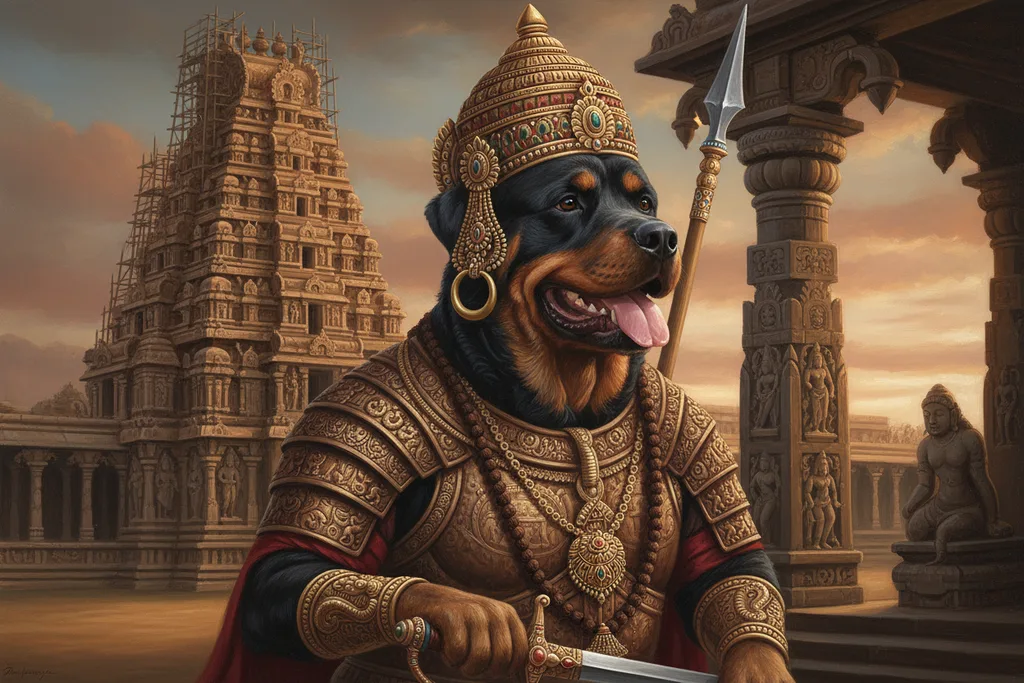
This page is about the few pictures of real Chola kings and queens that survive, and how to read them. It covers the wall painting of Rajaraja I in his own temple at Thanjavur, the bronze that may show Queen Sembiyan Mahadevi, a stone panel of a king and queen at worship, and the ways Chola kings presented themselves as warriors in words and in buildings. For the history of the dynasty, its wars and its bronzes of the gods, read the Chola dynasty. For how the Chola court compares with India's other royal courts, see the Indian court painting guide.
Why Chola royal portraits are rare and hard to name
Most Chola art shows gods. The Cleveland Museum of Art says the serene, smiling faces of Chola bronze gods are completely idealized, so a viewer can tell at once that they show gods. India's National Council of Educational Research and Training (NCERT) says the making of bronze images was the most distinctive craft tied to Chola temples, and that images were sometimes made of devotees as well.
People did appear in Chola art. The Victoria and Albert Museum (V&A) in London says royal portraiture was an established practice in South India from the Chola period, and that the Nayak rulers who came later continued it. The same museum says portraits of donors, the people who paid for a temple gift, are uncommon in Indian temple art.
The harder question is who a figure is. The Freer Gallery of Art in Washington, part of the Smithsonian, explains that portrait statues of this kind were more likely to be identified by their place in a temple, or by their use in a ritual, than by a true resemblance to the person. So the name attached to a Chola royal image usually comes from where it stands, from an inscription or from a festival record. Museums say so openly when the link is uncertain.
The table below lists the images this page describes and how each one is named.
| Image | Material and size | Date | Who it shows | How the name is known |
|---|---|---|---|---|
| Wall painting, Brihadisvara temple, Thanjavur | Paint on the temple wall | Reign of Rajaraja I; temple completed around 1009 | Rajaraja I and his mentor Kuruvar | NCERT names them |
| Queen Sembiyan Mahadevi as the Goddess Parvati, Freer Gallery of Art | Bronze, 107.3 cm high | 10th century | Possibly Queen Sembiyan Mahadevi | The Freer calls the link possible |
| Panel, Uma-Mahesvara temple, Konerirajapuram | Stone | Temple built in or before 974 | A king and a queen worshipping, and the temple's architect | The American Institute of Indian Studies describes them as portraits |
| Standing female devotee, V&A | Copper alloy | 17th century, after the Cholas | The lady Tirunilakanta of Tiruvarur | A Tamil inscription on the base |
| Krishnadevaraya with two queens, Tirupati | Bronze, life size | 16th century, after the Cholas | King Krishnadevaraya, Tirumalamba and Chinnadevi | NCERT names them |
Rajaraja I on the walls of his own temple
Rajaraja I became king in 985, according to both Leiden University Libraries and the American Institute of Indian Studies (AIIS), a body of universities that keeps a photographic archive of Indian temples. The two sources give different end years for his reign: 1012 at Leiden and 1014 at the AIIS. During his reign he built the great Shiva temple at Thanjavur. NCERT says it was completed around 1009. The AIIS says Tamil inscriptions call it Sri Rajarajeswaram, and that it is also known as Dakshina Meru.
The king appears inside the temple. NCERT explains that the paintings were made on the walls of the narrow passage that runs around the central shrine. When they were discovered, two layers of paint were found. The upper layer was painted in the Nayak period, in the 16th century. Cleaning that surface brought the Chola paintings underneath back into view. They show Shiva on Mount Kailash, Shiva as Nataraja the dancer and other forms of Shiva, dancing figures, and what NCERT calls a portrait of the patron Rajaraja and his mentor Kuruvar.
NCERT also describes how these painters drew people. The lines flow in planned curves, the bodies are softly shaped, and the faces and features are drawn longer than in life. NCERT sees in the Brihadisvara paintings the full skill that Chola artists had reached.
The painting fits the Freer's point about naming. The king is painted in the temple he paid for, among pictures of the god he built it for, beside his religious teacher. The setting tells the viewer who he is. The AIIS adds that a later Chola temple was built at the request of the king's spiritual teacher, and that the temples at Thanjavur, Gangaikondacholapuram and Darasuram were built under similar guidance. A king shown with his teacher records that relationship.
Queen Sembiyan Mahadevi in bronze
NCERT names the widowed Chola queen Sembiyan Mahadevi as the distinguished patron of bronze sculpture in the 10th century. The Freer Gallery of Art says she was widowed young and was a respected patron of the arts who spent most of her life paying for temples.
The Freer holds a bronze called Queen Sembiyan Mahadevi as the Goddess Parvati. It is 107.3 cm high and dates from the 10th century. The Freer bought it in 1929 from the dealer Hagop Kevorkian in New York. The museum's label tells its possible story. During the queen's lifetime, her birthday was celebrated in the Shiva temple of a town named after her, and a metal portrait of her was given to the temple in her honour. The Freer says it is possible that this bronze is that portrait.
The label is careful about the likeness too. The pose recalls the goddess Parvati, but the Freer says the figure is unusually individual in the shape of the face, the pursed lips and the long nose. The museum calls the bronze an example of royal and divine portraits mixing in ancient Indian art. Dressed in silks, jewellery and flower garlands, it would have been carried through the town for people to see. The Freer's catalogue keywords list both Parvati and Uma, two names for the same goddess, and the Smithsonian's 2002 to 2003 exhibition of Chola bronzes called it Uma as Queen Sembiyan Mahadevi.
Museums also differ on small facts about her family. The Freer says her husband reigned from 949 to 957. The Cleveland Museum of Art gives 941 to 957. Cleveland holds a bronze Goddess Holding a Lotus from around 950 and says it may have been made in the queen's workshop. Cleveland's wording, like the Freer's, keeps the link open.
A king and queen at worship in stone
One royal portrait group comes from a temple the queen founded. The AIIS says the Uma-Mahesvara temple at Konerirajapuram was founded by Sembiyan Mahadevi in memory of her husband, Gandaraditya, during the reign of her son Uttama Chola, who ruled from 971 to 988. The temple was built in or before 974.
The AIIS describes a panel of portraits there showing a king and a queen worshipping the linga, the rounded stone form in which Shiva is worshipped. The temple also has a portrait of its architect. The AIIS adds that some of the finest Chola bronzes are kept in the temples of Konerirajapuram, and that its bronze of the goddess Bhogesvari may be the earliest of the queen's castings.
In this panel the king and queen appear as worshippers, in the building their gift made possible.
Devotees, saints and donors
Chola temples honoured human worshippers as well as gods. The V&A holds a bronze of Sambandar, a child saint and one of the 63 Shaivite saints of Tamil Nadu, the saints devoted to Shiva, cast in the middle of the 11th century. He is shown as a boy singing a hymn to Shiva, with one finger pointing up. The V&A says sculptures of saints were installed for worship beside the gods and went with them in temple processions, and that the pedestal has holes for fixing it during those processions.
Donor portraits continued after the Cholas. The V&A holds a 17th-century bronze of a woman with her hands raised in worship. A Tamil inscription on the base names her as the lady Tirunilakanta of Tiruvarur. The V&A says such a portrait would only be made to go with a religious gift, and that this one shows the custom of royal portraits spreading to local officials and their families.
NCERT describes a later royal group at Tirupati. In the 16th century, under the Vijayanagara kings, life-size bronzes were cast of King Krishnadevaraya with his two queens, Tirumalamba and Chinnadevi. All three stand with their palms joined in prayer. NCERT says the sculptor combined a likeness of the faces with some idealization. These figures belong to a later dynasty, and they show the same royal pose of prayer at life size. Our page on Maratha court portraits follows Thanjavur's royal portraits into a later age.
Warriors in words and in buildings
The Chola Warrior style takes its name from a dynasty that conquered its neighbours, as NCERT describes, yet the portraits on this page show kings and queens at worship. The warrior image of the Chola kings appears in words and in buildings. NCERT says the praise poems called prashastis, written for kings of this period by learned Brahmanas (members of the priestly class), show how rulers wanted to be seen: as valiant, victorious warriors. NCERT adds that their details may not be literally true.
Chola kings also recorded themselves on copper. Leiden University Libraries describes a charter of King Rajendra I, who ruled from 1012 to 1042. It has 21 copper plates held together by a bronze ring, closed with the king's seal, and weighs no less than 30 kg. Its Sanskrit section gives the Chola family tree, starting with the god Vishnu. Its Tamil section records a gift of village revenue made by his father, Rajaraja I, to a Buddhist shrine in the 21st year of his reign.
Some victories were marked with temples. The AIIS says Kulottunga III, who ruled from 1178 to 1218, fought three wars against the Pandya kings. After the third victory he held a celebration at Madurai, took the title Tribhuvana Vira devar and built the Kampaharesvara temple at Tribhuvanam to mark the win. The AIIS calls it the last of the four great temples built by the Cholas.
What this means for a Chola Warrior portrait of your pet
The Chola Warrior style on Purrealism draws on this dynasty. The gallery has studio examples of a Rottweiler, a Vizsla and Labrador mix, and a Siamese cat in the Chola Warrior style, so you can see how the style handles dogs and cats of different shapes.
The Chola images on this page honour a person by where the image stands and how it is dressed: a king painted in his own temple, a queen's bronze dressed in silks and garlands for her birthday procession. If you choose this style, pick a photo where your pet's head and body are both clear and in focus. The portrait studio takes one photo of up to 5 MB. For a different way of painting a ruler, compare the strict side views on our page about Mughal royal portraits, or see how a later South Indian court painted its kings on our page about Mysore court portraits.
Questions and answers
What did Rajaraja Chola look like?
Rajaraja Chola's best-known image is a wall painting in the Brihadisvara temple at Thanjavur, the temple he built. India's NCERT describes it as a portrait of the patron Rajaraja with his mentor Kuruvar. The Freer Gallery of Art explains that Chola-period portrait statues were identified by their place in a temple more than by a true likeness, so such images show how a ruler was honoured and cannot confirm his exact features.
When did Rajaraja Chola become king?
Rajaraja Chola became king in 985, according to both Leiden University Libraries and the American Institute of Indian Studies. The two sources give different end years for his reign, 1012 at Leiden and 1014 at the American Institute. During his reign he built the Brihadisvara temple at Thanjavur, which India's NCERT says was completed around 1009 and which holds the wall painting described as his portrait.
Where are the Chola paintings in the Brihadisvara temple?
The Chola paintings in the Brihadisvara temple at Thanjavur are on the walls of the narrow passage that runs around the central shrine, according to India's NCERT. Two layers of paint were found there. The upper layer was painted in the Nayak period in the 16th century, and cleaning it revealed the Chola paintings below, which show forms of Shiva, dancers and a portrait of Rajaraja I with his mentor.
Who was Sembiyan Mahadevi?
Sembiyan Mahadevi was a Chola queen of the 10th century who was widowed young and spent most of her life paying for temples, according to the Freer Gallery of Art. India's NCERT calls her the distinguished patron of bronze sculpture in that century. The American Institute of Indian Studies says she founded the Uma-Mahesvara temple at Konerirajapuram in memory of her husband, Gandaraditya, while her son Uttama Chola ruled.
Is the Freer bronze a real portrait of Queen Sembiyan Mahadevi?
The Freer Gallery of Art says its bronze is possibly a portrait of Queen Sembiyan Mahadevi. According to the museum, a metal portrait of the queen was given to a Shiva temple for her birthday, and that its 107.3 cm bronze could be that sculpture. The museum says the face is unusually individual, with pursed lips and a long nose, while the pose follows the goddess Parvati.
Did the Chola kings make statues of themselves?
The Chola kings and queens did have portraits made, and the examples museums describe show them as figures at worship inside temples. The Victoria and Albert Museum says royal portraiture was an established practice in South India from the Chola period, and that the later Nayak rulers continued it. The American Institute of Indian Studies describes a stone panel at Konerirajapuram with portraits of a king and queen worshipping and a portrait of the temple's architect.
What does the stone panel at Konerirajapuram show?
The stone panel at the Uma-Mahesvara temple in Konerirajapuram shows portraits of a king and a queen worshipping the linga, the rounded stone form of Shiva, according to the American Institute of Indian Studies. The same temple has a portrait of its architect. Queen Sembiyan Mahadevi founded the temple in memory of her husband Gandaraditya, and it was built in or before 974.
How were Chola bronzes of queens used in festivals?
Chola bronzes of queens and goddesses were dressed and carried through the streets at festivals. The Freer Gallery of Art says its bronze of Queen Sembiyan Mahadevi as Parvati would have been draped in silks, jewellery and flower garlands and carried through the town for people to see. The Cleveland Museum of Art says its goddess bronze of around 950 was draped with cloth and flowers for processions.
Who was the child saint Sambandar in Chola bronzes?
Sambandar was a child saint, one of the 63 Shaivite saints of Tamil Nadu who were devoted to Shiva, and Chola sculptors cast him in bronze. The Victoria and Albert Museum holds a mid 11th century figure that shows him as a boy singing hymns to Shiva with one finger raised. The V&A says sculptures of saints were installed beside the gods and carried with them in temple processions.
What does Rajendra Chola's copper plate charter say?
Rajendra Chola's copper plate charter, described by Leiden University Libraries, is a set of 21 copper plates on a bronze ring closed with the king's seal, weighing at least 30 kg. According to Leiden, its Sanskrit part gives the Chola family tree starting with the god Vishnu. Its Tamil part records a gift made by his father, Rajaraja I, to a Buddhist shrine.
Which Chola king built the Tribhuvanam temple?
Kulottunga III, who ruled from 1178 to 1218, built the Kampaharesvara temple at Tribhuvanam, according to the American Institute of Indian Studies. After the third of his wars against the Pandya kings, he held a celebration at Madurai, took the title Tribhuvana Vira devar, and built the temple to mark the victory. It was the last of the four great Chola temples.
How did Chola kings want to be seen?
Chola kings wanted to be seen as victorious warriors in words and as devoted worshippers in temple art. India's NCERT says the praise poems called prashastis show how kings of this period wished to be described, as valiant, victorious warriors. In temple art, the Victoria and Albert Museum and the American Institute of Indian Studies describe Chola royal portraits as figures at worship.
Sources
- Later Mural Traditions (An Introduction to Indian Art, Part I, chapter 5), National Council of Educational Research and Training (NCERT). Accessed September 28, 2026.
- Temple Architecture and Sculpture (An Introduction to Indian Art, Part I, chapter 6), National Council of Educational Research and Training (NCERT). Accessed September 28, 2026.
- Indian Bronze Sculpture (An Introduction to Indian Art, Part I, chapter 7), National Council of Educational Research and Training (NCERT). Accessed September 28, 2026.
- Kings and Kingdoms (Our Pasts II, Class 7 history, chapter 2), National Council of Educational Research and Training (NCERT). Accessed September 28, 2026.
- Queen Sembiyan Mahadevi as the Goddess Parvati, Freer Gallery of Art, Smithsonian's National Museum of Asian Art. Accessed September 28, 2026.
- The Sensuous and the Sacred: Chola Bronzes from South India, Smithsonian's National Museum of Asian Art. Accessed September 28, 2026.
- Goddess Holding a Lotus, c. 950, The Cleveland Museum of Art. Accessed September 28, 2026.
- Shiva and Parvati, c. 1020 to 1040, The Cleveland Museum of Art. Accessed September 28, 2026.
- Uma-Mahesvara temple, Konerirajapuram, Tamil Nadu, American Institute of Indian Studies, Virtual Museum of Images and Sounds. Accessed September 28, 2026.
- Brahadisvara Complex, Thanjavur, Tamil Nadu, American Institute of Indian Studies, Virtual Museum of Images and Sounds. Accessed September 28, 2026.
- Kampaharesvara temple complex, Tribhuvanam, Tamil Nadu, American Institute of Indian Studies, Virtual Museum of Images and Sounds. Accessed September 28, 2026.
- Standing female devotee, Tanjavur, 17th century, Victoria and Albert Museum. Accessed September 28, 2026.
- Sambandar, copper alloy figure, mid 11th century, Victoria and Albert Museum. Accessed September 28, 2026.
- A world treasure of great weight: the charter of King Rajendra Chola I, Leiden University Libraries. Accessed September 28, 2026.
Short reads on this topic
Articles from Purrspectives that answer one question each.
What is Tanjore painting? Gold foil, gesso and the Thanjavur court
Tanjore painting is a South Indian style from Thanjavur, made on a wooden board with raised gesso, gold foil and glass stones. Where it came from and how it is made.
Indian royal pet portraits: the nine Indian court styles explained
An Indian royal pet portrait dresses your dog or cat as a ruler or warrior from an Indian court. Here are the nine styles and the history behind them.

The Maharajas of Patiala: the history behind Patiala royalty
The Phulkian rulers of Patiala founded their capital in 1763. Who built Qila Mubarak, who Bhupinder Singh was, and how Patiala joined India.