Symbols of royal power in European portraits: crown, orb, sceptre, ermine and more
What the crown, orb, sceptre, ermine, column, chains of knighthood and other objects meant in European royal portraits, with real paintings as examples.
By Purrealism. Part of European royal portraits: how Europe's courts painted their rulers.
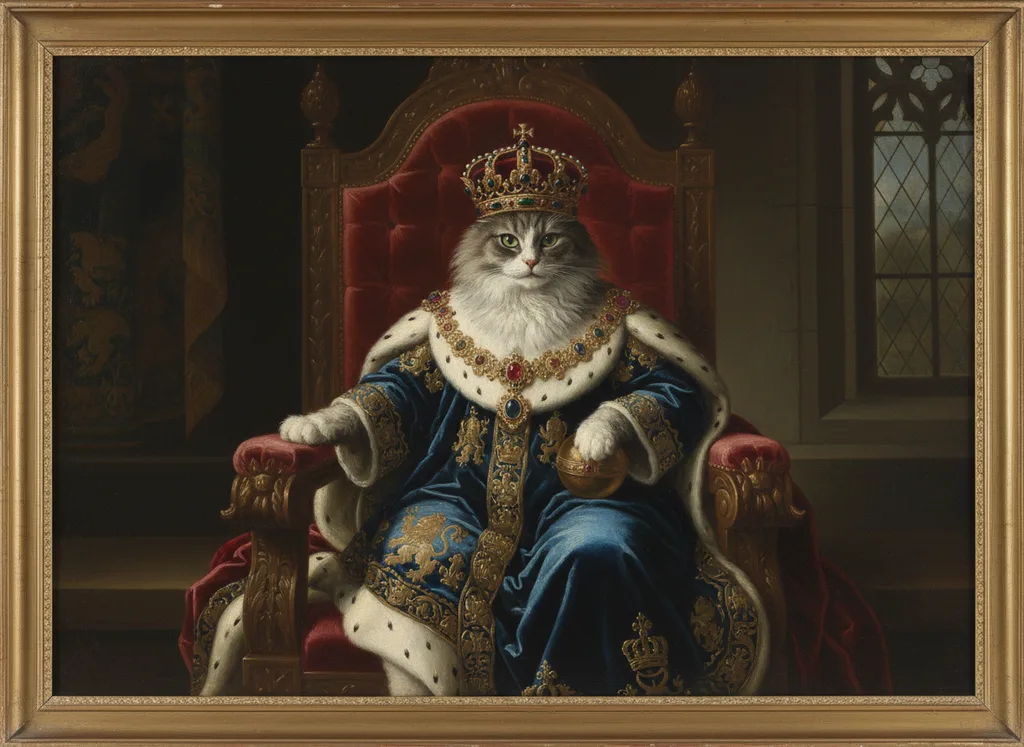
A European royal portrait is full of objects that tell you who the sitter is and what power they hold. A crown, an orb and a sceptre say "monarch". A white fur with black spots says "royal or high noble". A gold chain with a small badge says the wearer belongs to an order of knights. This page explains the most common of these signs, where they came from, and how to find them in real paintings. The companion pages cover the poses in royal portraits and the clothes that showed rank, and the main guide to European royal portraits puts all three together.
Reading objects in a painting
Art historians have a word for an object that identifies a person in a picture: an attribute. Tate in London gives the example of the ancient gods. Doves go with Venus, the goddess of love, and a lyre, a small ancient harp, goes with Apollo. So a figure with a lyre can be named as Apollo.
Royal portraits work the same way. A painter placed objects near the ruler so that any viewer, even one who had never seen the ruler's face, would understand the picture. Some objects belong to every monarch, such as the crown. Others belong to one person or family. Raphael's portrait of Pope Julius II has two golden acorns on the chair, and the National Gallery in London explains that they refer to his family name, della Rovere, since rovere is Italian for oak.
The regalia: crown, orb and sceptre
The objects given to a new monarch at a coronation are called the regalia. Westminster Abbey in London, where English coronations have taken place since 1066, lists them as two crowns, swords, an orb, sceptres, spurs, armills (bracelets) and a ring. The Abbey says crowns have appeared in coronations for over 1,000 years and are shown in manuscripts from the 10th century onwards.
The English set in use today is younger than it looks. Westminster Abbey says almost all the medieval regalia was destroyed or lost after the execution of King Charles I, and had to be made again for the coronation of Charles II in 1661. The Royal Family's own description of the regalia says St Edward's Crown was made for Charles II in 1661 to replace the medieval crown, which had been melted down in 1649, and that the Crown Jeweller Robert Vyner made the Sceptre with Dove the same year.
The crown
The crown is the plainest sign of a monarch. Royal Museums Greenwich says the imperial crown painted beside Elizabeth I in the Armada portrait is often read as a sign of empire, and that it also stood for the Tudor claim to descend from the legendary first king of Britain. It reasserted her right to rule.
A crown does not have to be on the head. In Hyacinthe Rigaud's 1701 portrait of Louis XIV, the Louvre says the crown rests on a cushion beside the king. It is a lighter crown of gilded silver, made for royal funerals, and he holds a short sceptre, which once belonged to Henri IV, upside down.
The orb
The orb is a ball held in the ruler's hand. The Royal Family's account of the regalia says the Sovereign's Orb represents the sovereign's power and symbolises the Christian world. Royal Museums Greenwich sums up the group simply: crowns, orbs and sceptres all signified monarchy.
Orbs appear in the earliest English royal portrait. Westminster Abbey describes a wooden panel of Richard II from the 1390s, which it calls the earliest known portrait of an English monarch. The king sits in the Coronation Chair holding the orb and sceptre. The National Gallery's Wilton Diptych, a small folding altarpiece made for the same king, has a tiny orb on top of a banner. The gallery says it shows an island with green trees and a white tower in a silver sea, and that it stands for England.
The sceptre and the hand of justice
A sceptre is a decorated rod held by the ruler. The Royal Family's account says the British Sceptre with Cross represents the sovereign's power on earth and good government, and the Sceptre with Dove, called the Rod of Equity and Mercy, represents the sovereign's spiritual role. Westminster Abbey says the dove stands for the Holy Spirit.
French kings had a second rod, the main de justice, or hand of justice, topped with a small carved hand. The Wallace Collection in London holds a reduced copy of Louis-Michel van Loo's portrait of Louis XV, a design first shown at the 1761 Salon, the official art exhibition in Paris. The museum says the hand of justice lies beside the crown on a stool, and explains that it is the sceptre for the king as the highest judge. The Louvre says Rigaud's Louis XIV shows it too.
Swords, spurs and batons
Swords appear in the regalia and in portraits. Westminster Abbey says the Sword of Mercy has a blunt tip, after a legend in which an angel stopped a knight from using his sword. The Wallace Collection says Louis XV wears the royal sword called Joyeuse, which was believed to have belonged to the emperor Charlemagne. The Louvre says the same sword hangs at the side of Louis XIV in Rigaud's portrait.
A baton is a short rod of command carried by a military leader. In Van Dyck's Equestrian Portrait of Charles I, the National Gallery says the baton in the king's hand signals his senior military rank. In this picture, the gallery says, the gold chain and the baton show his status, and a Latin inscription on a tablet hanging from a tree names him King of Great Britain. The page on military portraits looks at batons, medals and uniforms in more detail.
Ermine
Ermine is the white fur of a small animal of the weasel family. Each tail has a black tip, so a robe made of many skins sewn together looks white with small black spots.
Royal Museums Greenwich says ermine featured in many portraits of Elizabeth I. According to legend, the animal would rather die than dirty its white coat, so it stood for purity. The museum adds that it was also a status symbol, because wearing ermine was restricted to royalty and the high nobility. In the Westminster Abbey portrait of Richard II, the Abbey says the king wears a crimson robe lined with ermine and an ermine cape. The page on royal portrait costume explains the laws that decided who could wear which fur.
Chains and badges of knighthood
An order of knighthood was a society of knights with its own chain, ribbon and badge, and painters took care to show them. The National Gallery calls the Order of the Garter an elite society and the highest order of chivalry.
| Order | What to look for | Example painting | Source |
|---|---|---|---|
| Order of the Garter (England) | Gold chain, or a badge of Saint George on a blue ribbon | Van Dyck, Charles I on horseback; Rubens, Earl of Arundel | National Gallery |
| Order of the Golden Fleece (Spain and Austria) | A small sheepskin hanging from a gold chain | Velázquez, Philip IV of Spain | National Gallery |
| Order of the Holy Spirit (France) | The order's collar and white robe | Rigaud, Louis XIV; Van Loo, Louis XV | Louvre; Wallace Collection |
| Personal badge | An emblem worn by the ruler's followers | The white hart of Richard II | National Gallery |
The National Gallery says the gold chain in Van Dyck's picture of Charles I is commonly called the "Little George" and marks the king as a member of the Order of the Garter. In Rubens's portrait of the Earl of Arundel, painted in 1629 or 1630, the gallery identifies the medallion on a blue ribbon as the Lesser George, a Garter badge, and calls the Garter the highest order of chivalry. Royal Museums Greenwich says a late portrait of Queen Victoria after Heinrich von Angeli shows her wearing the blue sash of the same order.
For Spain, the National Gallery says Velázquez's late portrait of Philip IV shows the Golden Fleece, a chivalric order whose pendant took the form of a hanging sheepskin, and that viewers of the 1600s would have recognised it at once.
Personal badges worked in a similar way. The National Gallery says Richard II used a white hart, a white stag, as his emblem, probably taken from his mother's white hind and perhaps a pun on Richart, the French form of his name, and that in the Wilton Diptych the angels wear white hart badges to show they are his supporters. Westminster Abbey says he adopted it officially in 1390.
Columns, curtains and papers
The setting also carried a message. Royal Museums Greenwich says the classical columns in two versions of the Armada portrait of Elizabeth I are thought to refer to the pillars of Hercules, the westernmost point of the ancient world. The Louvre says the column in Rigaud's Louis XIV is a symbol of strength, and that its base carries a relief of Justice, so the king appears as royal power resting on strength and justice. The National Gallery says Rigaud gave his portrait of the royal treasurer Antoine Pâris "the base of an immense column" and a sweep of blue velvet drapery. Pompeo Batoni used classical columns and a bust of a Roman emperor, the gallery says, to show that his sitter Richard Milles was a learned gentleman.
A heavy curtain in rich cloth was a common partner to the column. In Velázquez's Philip IV of Spain in Brown and Silver, the National Gallery describes a table covered in red velvet matching the draped curtain behind the king. The king also holds a petition, a written request, signed by the painter as "Painter to Your Majesty".
These props spread far beyond the courts. The National Portrait Gallery in Canberra says photographers of the 1860s gave ordinary customers imitation classical columns, balustrades and heavy drapes, so that anyone could look dignified in a small photographic portrait.
Using the symbols in a pet portrait
The same signs make a dog or cat look royal at a glance. The cover of this page, from the Purrealism gallery, shows a long-haired cat in the Renaissance Royal style wearing a crown and an ermine cape, and holding a gold orb on a red throne. The portrait studio offers six European styles, and the costume and setting come with the style you choose. For the history of animals in portraits more broadly, read what pet portraits are. For the earliest crowns and thrones, continue to medieval royal portraits, or to Renaissance and Tudor portraits for Elizabeth I's many symbols.
Questions and answers
What is royal regalia?
Royal regalia are the objects that stand for a monarch's power and are given to the new ruler at the coronation. Westminster Abbey lists the English regalia as two crowns, swords, an orb, sceptres, spurs, armills (bracelets) and a ring. The Abbey says almost all the medieval set was destroyed or lost after the execution of Charles I, so the regalia were made again in the 17th century.
What does orb and sceptre represent?
The orb and sceptre represent the monarch's power under God. The Royal Family's own account of the coronation regalia says the Sovereign's Orb represents the sovereign's power and symbolises the Christian world. It says the Sceptre with Cross stands for the sovereign's power on earth and good government, and the Sceptre with Dove, known as the Rod of Equity and Mercy, stands for the spiritual role.
What does the orb represent in a royal portrait?
The orb in a royal portrait stands for the ruler's power, and the Royal Family's account of the regalia says it also symbolises the Christian world. In the Wilton Diptych, made for Richard II of England in the late 1390s, the National Gallery in London says a tiny orb on top of a banner shows an island with green trees and a white tower. It stands for England.
How old is the orb and sceptre?
The British Sovereign's Orb and the Sceptre with Dove date from 1661. The Royal Family's own account of the regalia says the Sceptre with Dove was made that year by the Crown Jeweller, Robert Vyner, and that St Edward's Crown was made in 1661 for Charles II to replace the medieval crown melted down in 1649. Westminster Abbey confirms the older set was lost after Charles I's execution.
What does ermine mean in a royal portrait?
Ermine in a royal portrait marks the wearer as royal or high noble. Royal Museums Greenwich says the white fur with a black tip on each tail was restricted to royalty and the high nobility, and that a legend held the ermine would rather die than soil its white coat, so it also stood for purity. Many portraits of Elizabeth I include it.
Why is there a column in royal portraits?
A column in a royal portrait usually stands for strength and a grand, classical setting. The Louvre says the column behind Louis XIV in Hyacinthe Rigaud's 1701 portrait is a symbol of strength, and that its base carries a figure of Justice, so the king appears supported by strength and justice. Royal Museums Greenwich says columns in the Armada portrait may recall the pillars of Hercules.
What is the Lesser George in a portrait?
The Lesser George is a badge of the Order of the Garter, England's highest order of knighthood, showing Saint George on horseback. The National Gallery in London points it out on a blue ribbon in Rubens's portrait of the Earl of Arundel, painted in 1629 or 1630. In Van Dyck's Equestrian Portrait of Charles I, the gallery says a gold chain marks the king as a member of the order.
What does the Golden Fleece mean in a Spanish royal portrait?
The Golden Fleece in a Spanish royal portrait shows that the wearer belongs to a prestigious order of knighthood. The National Gallery in London says the order's pendant took the form of a hanging sheepskin on a gold chain, and that viewers in the 1600s would have recognised it at once. Velázquez painted Philip IV of Spain wearing it in portraits from the 1630s to the 1650s.
What is the hand of justice in French royal portraits?
The hand of justice is a French royal sceptre topped with a small hand, and it stands for the king as the highest judge. The Wallace Collection in London says it lies beside the crown on a stool in Louis-Michel van Loo's portrait of Louis XV, first shown in 1761. The Louvre says Rigaud's 1701 portrait of Louis XIV also shows it on a cushion next to the crown.
How does Van Dyck show Charles I is king without a crown?
Anthony van Dyck shows that Charles I is king through a chain, a baton and an inscription, since the king wears no crown in his portrait on horseback. The National Gallery in London says the gold chain around his neck marks him as a member of the Order of the Garter, and the baton in his hand signals his senior military rank. A Latin inscription on a tablet hanging from a tree names him King of Great Britain.
What was Richard II's white hart badge?
Richard II's white hart badge was a white stag, often shown chained with a crown around its neck, that the king used as his personal emblem. The National Gallery in London says he probably took it from his mother's white hind, and that it may also pun on his name, Richart in French. Westminster Abbey says he adopted it officially in 1390.
Sources
- Royal regalia, Westminster Abbey. Accessed September 29, 2026.
- A guide to coronations, Westminster Abbey. Accessed September 29, 2026.
- The Coronation Regalia, The Royal Family. Accessed September 29, 2026.
- Richard II and Anne of Bohemia, Westminster Abbey. Accessed September 29, 2026.
- The Wilton Diptych, National Gallery, London. Accessed September 29, 2026.
- Symbolism in portraits of Queen Elizabeth I, Royal Museums Greenwich. Accessed September 29, 2026.
- Louis XIV (1638-1715), roi de France, Musée du Louvre. Accessed September 29, 2026.
- Louis XV, The Wallace Collection. Accessed September 29, 2026.
- Anthony van Dyck, Equestrian Portrait of Charles I, National Gallery, London. Accessed September 29, 2026.
- Peter Paul Rubens, Portrait of Thomas Howard, 2nd Earl of Arundel, National Gallery, London. Accessed September 29, 2026.
- Diego Velázquez, Philip IV of Spain, National Gallery, London. Accessed September 29, 2026.
- Diego Velázquez, Philip IV of Spain in Brown and Silver, National Gallery, London. Accessed September 29, 2026.
- Hyacinthe Rigaud, Antoine Pâris, National Gallery, London. Accessed September 29, 2026.
- Pompeo Girolamo Batoni, Portrait of Richard Milles, National Gallery, London. Accessed September 29, 2026.
- Raphael, Pope Julius II, National Gallery, London. Accessed September 29, 2026.
- Queen of cartes, National Portrait Gallery, Canberra. Accessed September 29, 2026.
- What do YOU see in these Royal Portraits? Tudors to Windsors, Royal Museums Greenwich. Accessed September 29, 2026.
- Attribute, Tate. Accessed September 29, 2026.
Short reads on this topic
Articles from Purrspectives that answer one question each.
What was the Victorian era? Dates, fashion and portraits of 1837 to 1901
The Victorian era is Queen Victoria's reign, 1837 to 1901. Her life, what Victorians wore, and how they had portraits painted and photographed.
Military dog portraits: the real dogs who served, and your dog as a general
Real war dogs such as Stubby and Gander earned medals and a rank. Here is their story, and how to make a dog general portrait of your own dog.
Dogs in medieval paintings and manuscripts: hunting hounds, lapdogs and faithful friends
Medieval dog paintings show hunting hounds, lapdogs and loyal dogs in painted books, on church brasses and in the Bayeux Tapestry. Where to find each one.