Costume in European royal portraits: how clothes, fur and wigs showed rank
How European rulers and nobles used robes, fur, ruffs, pearls, black silk and powdered wigs in their portraits to show rank, wealth and loyalty.
By Purrealism. Part of European royal portraits: how Europe's courts painted their rulers.
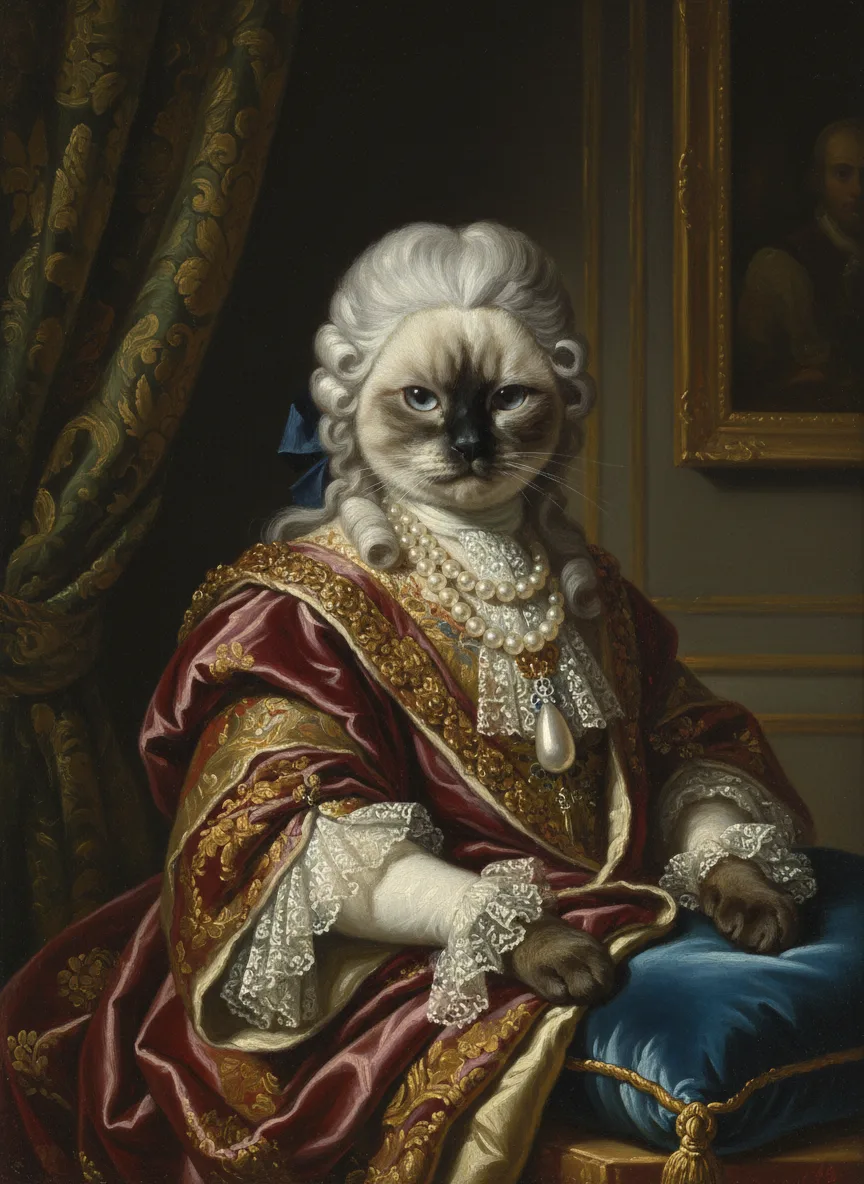
In a European royal portrait, the clothes are part of the message. A robe lined with white fur, a collar of starched lace, a coat of black silk or a powdered wig each told the viewer something about the sitter's rank, wealth, faith or loyalty. Some of these clothes were worn as painted, and some were arranged for the picture. This page follows costume through the centuries, from the fur laws of the Tudors to the wigs and silks of the 1700s, and explains how to read it. The page on symbols of royal power covers the objects a ruler holds, and the main guide to European royal portraits brings the whole subject together.
Clothes as a sign of rank
Royal Museums Greenwich explains that the wide skirts seen in Tudor portraits showed wealth and power, because they made a woman take up more space in a room and forced her to walk slowly. As the museum puts it, only servants hurry.
The ruler set the look for everyone else. Royal Museums Greenwich says Elizabeth I's taste set the "look" of the 1500s. Many of the women around her wore her cast-off clothes, and others copied her style. When her wardrobe became more elaborate, her male courtiers followed. The museum says men wore corsets to pull in the waist and padded "peascod" doublets, close-fitting jackets stuffed to give a pointed belly like a pea in a pod.
Fur and the laws on who could wear it
Fur was a sign of rank, and the law controlled it. A history of the English fur trade, published by the London Record Society and now on British History Online, gives numbers from the royal accounts. Between 1392 and 1394, it says, 1,634 skins of ermine were bought for Richard II, along with large quantities of squirrel and other furs.
Laws decided who could wear which fur. The same history says a statute of 1532 limited sable, a dark and costly fur, to the royal family, and lynx and black genet to dukes, earls and barons. It adds that Elizabeth I tried to make sure the dress laws of her predecessors were obeyed, and issued repeated proclamations on how to enforce them.
Ermine had a special place. Royal Museums Greenwich says wearing ermine was restricted to royalty and the high nobility, which made it a status symbol as well as a sign of purity. So when a painter lined a robe with white fur and black spots, viewers could read the wearer's rank.
Coronation robes
The most formal royal costume is the set of robes worn at a coronation. Westminster Abbey describes the painted panel of Richard II from the 1390s, which it calls the earliest known portrait of an English monarch. The king wears a green tunic decorated with the letter R, a crimson robe lined with ermine, an ermine cape, vermilion socks and gold shoes.
Three centuries later, Hyacinthe Rigaud painted Louis XIV of France in the same kind of dress. The Louvre says the king wears his coronation mantle over the robes of the grand master of the Order of the Holy Spirit, the collar of that order, a large "wig of majesty" and a lace collar.
The robes in a portrait were not always the robes of one real day. The Wallace Collection in London explains that Louis-Michel van Loo's portrait of Louis XV, first shown at the Paris Salon in 1761, mixes two sets of clothes. The white robe of the Order of the Holy Spirit was worn on the second day of the coronation at Reims, and the royal mantle on the first. The museum says the picture combines different aspects of kingship into one ideal image. A royal portrait is a statement about the ruler, and costume could be arranged to make that statement clear.
Coronation robes could also be a burden. Westminster Abbey says George IV sweltered at his coronation in 1821 in thick velvet robes, a long curled wig and a plumed hat, and used 19 handkerchiefs to wipe his face.
Tudor and Elizabethan dress
Royal Museums Greenwich lists the layers of a Tudor woman's court dress:
- A linen smock next to the skin, changed daily and worn at every level of society.
- A "pair of bodies", a corset stiffened with whalebone, which gave the long torso seen in portraits.
- A farthingale, a frame of bent rope, reeds or later whalebone worn around the waist to hold the skirts out wide.
- A forepart, an embroidered triangle of fabric shown at the front opening of the gown.
- A gown of silk or satin, decorated with embroidery, pearls and ribbons, with separate sleeves pinned on.
- A ruff, a starched and pleated collar of linen and lace.
The museum says the Tudors imported pearls from the South China Sea, Borneo and Sri Lanka, and that Elizabeth liked them because they stood for chastity and supported her image as the Virgin Queen. It says Elizabeth I is thought to wear over 800 pearls on her costume in the Armada portrait, not counting her pearl jewellery. She favoured large ruffs, the museum adds, because they made her look like a shining sun at the centre of her kingdom, and many ruffs that look white in portraits may have been tinted pink or yellow.
Make-up belonged to the costume too. Royal Museums Greenwich says a pale complexion signalled wealth and nobility, because it showed that a person did not have to labour in the sun. The most popular white foundation, ceruse, was made from white lead and vinegar. For more on how the Tudor painters built these images, see the page on Renaissance and Tudor portraits.
Black at the Spanish court
At the Spanish court of the 1600s, the king was usually painted in black. The National Gallery in London says Philip IV habitually wore a black costume and was usually painted in it by Diego Velázquez, with a stiff white collar called the golilla. In the gallery's late portrait of the king, his pale face stands out against the black clothes and plain background, with only the gold chain of the Golden Fleece to break the dark.
When Velázquez painted Philip in silver-embroidered brown instead, the National Gallery says the unusual splendour suggests the picture marked a special event. A similar outfit is recorded at a ceremony in Madrid in 1632, when the Cortes of Castile, an assembly of the kingdom, swore loyalty to the king's son.
Mourning dress
Black also meant mourning. The National Gallery says Queen Mariana of Spain, painted by Juan Bautista Martínez del Mazo in 1666, wears a white wimple (a cloth covering the head and neck) and the black habit of a widow, the year after the death of Philip IV. Gerrit van Honthorst's 1642 portrait of Elizabeth Stuart, Queen of Bohemia, shows her in black ten years after her husband's death, with a black ribbon on her right arm to confirm she is in mourning, the gallery says. Her earrings were a gift from him.
Wigs, silk and "drapery" in the 1700s
By the 1700s the powdered wig was part of formal dress. The Wallace Collection describes the bag wig of the fashionable young man in Fragonard's painting The Swing, whose tail of hair was tucked into a black silk bag tied at the neck. It says men often carried their costly beaver hats under the arm to keep them clear of wig powder. The Siamese cat on the cover of this page wears a white curled wig of the kind seen in 18th century portraits.
Joshua Reynolds, who painted many of the wealthiest people in 18th century Britain, distrusted fashion. The Wallace Collection quotes him telling Royal Academy students in 1771 that "it is the inferior style that marks the variety of stuffs". In 1776 he warned against modern dress, whose familiarity alone could destroy all dignity, and advised "the general air of the antique for the sake of dignity, and something of the modern for the sake of likeness". His portrait of Elizabeth Carnac, painted in 1775 and 1776, puts her in a simple white gown meant to belong to no particular year, though the Wallace Collection points out that its bunched hips still follow a fashion of 1775.
Painters also shared out the work. The Wallace Collection says Reynolds sent his sitters' clothes to specialist drapery painters. In the 1750s he charged 48 guineas for a full-length portrait, and the drapery painter Peter Toms received 15 of them. His pupil James Northcote painted the draperies for some of Reynolds's most important portraits.
Formal dress had rules that a portrait could break on purpose. The National Gallery says Madame de Pompadour, in François-Hubert Drouais's portrait of 1763 to 1764, wears a gown over small side hoops, a less formal choice, the gallery points out, than court dress with its wide hoops. Élisabeth Vigée Le Brun, in her 1782 self-portrait, shows her own unpowdered hair, when a wig would have been expected in a formal portrait. The gallery adds that her portrait of Marie-Antoinette in a simple white cotton dress caused a scandal in 1783 because it looked too informal for a queen. The page on Rococo court portraits looks at these French portraits more closely.
Costume in a pet portrait
Every European style on Purrealism comes with its own costume, and it reads the way these historical clothes do. A robe with white fur says royalty, and a powdered wig with pearls says 18th century court, as the gallery's Baroque Aristocrat examples show. For what men and women wore in the Regency years, read what the Regency era was, and see the page on Georgian and Regency portraits for the painters of that time. When you are ready, choose a style in the portrait studio, or look at the gallery to see how the clothes of each style look on real dogs and cats.
Questions and answers
What is an ermine robe?
An ermine robe is a ceremonial robe lined or trimmed with ermine, the white fur of a small animal of the weasel family, whose tail has a black tip. Westminster Abbey describes its 1390s portrait of Richard II, the earliest known portrait of an English monarch, showing the king in a crimson robe lined with ermine, an ermine cape, vermilion socks and gold shoes.
Who was allowed to wear fur in Tudor England?
Who could wear fur in Tudor England was set by law. A history of the English fur trade published by the London Record Society says a statute of 1532 limited sable to the royal family, and lynx and black genet to dukes, earls and barons. The same history says Elizabeth I issued repeated proclamations to enforce the dress laws of her predecessors.
Why did Elizabeth I wear white makeup?
Elizabeth I wore white makeup because a pale complexion signalled wealth and nobility at her court. Royal Museums Greenwich says pale skin showed that a person did not have to work in the sun. The most popular white foundation, called ceruse, was made from white lead and vinegar, and the museum says its toxic ingredients left the skin grey and shrivelled over time.
Why did Elizabeth I wear big ruffs?
Elizabeth I wore big ruffs because they framed her face like the rays of the sun. Royal Museums Greenwich says ruffs were starched, pleated collars of linen and lace that grew larger during the 16th century, and that the queen favoured large ones to suggest she was a shining sun at the centre of her kingdom. The museum adds that many ruffs may have been tinted pink or yellow.
What was a farthingale?
A farthingale was a frame worn around the waist under a Tudor woman's skirts to make them stand out wide. Royal Museums Greenwich says it was made of bent rope, reeds or later whalebone. Wide skirts showed wealth and power because they made the wearer take up more space and forced her to walk slowly, and the museum adds that a drum shape was the fashion after the 1570s.
How many pearls is Elizabeth I wearing in the Armada portrait?
Elizabeth I is thought to wear over 800 pearls on her costume in the Armada portrait, according to Royal Museums Greenwich, and that count does not include her pearl jewellery. The museum says the Tudors imported pearls from the South China Sea, Borneo and Sri Lanka, and that Elizabeth liked them because they stood for chastity and supported her image as the Virgin Queen.
What did Philip IV of Spain wear in his portraits?
Philip IV of Spain usually wore black in his portraits. The National Gallery in London says he habitually wore a black costume with a stiff white collar called the golilla, and was usually painted that way by Velázquez. The gallery's Philip IV in Brown and Silver is an exception: its silver embroidery suggests it marked a special event, probably a ceremony of 1632 for his son and heir.
Did kings wear the exact clothes shown in their state portraits?
Kings did not always wear the exact clothes shown in their state portraits. The Wallace Collection in London says Louis-Michel van Loo's portrait of Louis XV combines the white robe of the Order of the Holy Spirit, worn on the second day of the coronation at Reims, with the royal mantle worn on the first day. The museum says the painting joins different aspects of kingship into one ideal image.
Who painted the clothes in 18th century portraits?
In busy 18th century studios, specialist drapery painters often painted the clothes. The Wallace Collection in London says Joshua Reynolds sent his sitters' clothing to drapery painters such as Peter Toms, and that in the 1750s Reynolds charged 48 guineas for a full-length portrait, of which Toms received 15. Reynolds's pupil James Northcote painted draperies for some of his most important portraits.
Why did Reynolds avoid fashionable clothes in his portraits?
Joshua Reynolds avoided fashionable clothes in many portraits because he believed modern dress took away a portrait's dignity. The Wallace Collection says he warned in 1776 against the modern dress, whose familiarity alone could destroy all dignity, and advised the general air of the antique for dignity with something modern for likeness. He told students that for a great painter, clothing was simply drapery, never wool, linen, silk or velvet.
What is a bag wig?
A bag wig is an 18th century man's wig whose tail of hair is tucked into a black silk bag tied with a bow at the back of the neck. The Wallace Collection in London describes it on the fashionable young man in Fragonard's painting The Swing, and adds that men of the time often carried their costly beaver hats under the arm to keep them clear of wig powder.
Sources
- Richard II and Anne of Bohemia, Westminster Abbey. Accessed September 29, 2026.
- VII. Fashions in Fur, British History Online (London Record Society). Accessed September 29, 2026.
- Symbolism in portraits of Queen Elizabeth I, Royal Museums Greenwich. Accessed September 29, 2026.
- 12 must have items for a Tudor woman's wardrobe, Royal Museums Greenwich. Accessed September 29, 2026.
- Elizabeth I: fashion and beauty, Royal Museums Greenwich. Accessed September 29, 2026.
- Diego Velázquez, Philip IV of Spain, National Gallery, London. Accessed September 29, 2026.
- Diego Velázquez, Philip IV of Spain in Brown and Silver, National Gallery, London. Accessed September 29, 2026.
- Juan Bautista Martínez del Mazo, Queen Mariana of Spain in Mourning, National Gallery, London. Accessed September 29, 2026.
- Gerrit van Honthorst, Elizabeth Stuart, Queen of Bohemia, National Gallery, London. Accessed September 29, 2026.
- Louis XIV (1638-1715), roi de France, Musée du Louvre. Accessed September 29, 2026.
- Louis XV, The Wallace Collection. Accessed September 29, 2026.
- Reynolds's Studio, The Wallace Collection. Accessed September 29, 2026.
- Reynolds and Fashion, The Wallace Collection. Accessed September 29, 2026.
- Fashion in The Swing, The Wallace Collection. Accessed September 29, 2026.
- François-Hubert Drouais, Madame de Pompadour at her Tambour Frame, National Gallery, London. Accessed September 29, 2026.
- Elisabeth Louise Vigée Le Brun, Self Portrait in a Straw Hat, National Gallery, London. Accessed September 29, 2026.
- George IV, Westminster Abbey. Accessed September 29, 2026.
Short reads on this topic
Articles from Purrspectives that answer one question each.
What was the Victorian era? Dates, fashion and portraits of 1837 to 1901
The Victorian era is Queen Victoria's reign, 1837 to 1901. Her life, what Victorians wore, and how they had portraits painted and photographed.
Military dog portraits: the real dogs who served, and your dog as a general
Real war dogs such as Stubby and Gander earned medals and a rank. Here is their story, and how to make a dog general portrait of your own dog.
Dogs in medieval paintings and manuscripts: hunting hounds, lapdogs and faithful friends
Medieval dog paintings show hunting hounds, lapdogs and loyal dogs in painted books, on church brasses and in the Bayeux Tapestry. Where to find each one.